This article originally appeared in Pyramid Magazine on May 12th, 2000.
Unknown Armies, the new title from Atlas Games designed by Greg Stolze and John Tynes, features a unique system of magick. Magick is practiced by adepts, each of which subscribes to a specific school of magick. Based on what school the adept belongs to he builds up “charges” in various ways – members of the school of Pornomancy, for example, build up charges by engaging in ritualized sexual acts; members of the school of Dipsomancy, on the other hand, build up charges by being drunk. These charges (which can be classified as minor, significant, or major based on what the adept did to gain them) can then be expended to create magickal effects.
Magick is, above all, effected by three laws. First, the Law of Symbolic Tension demands that all magick be based on some form an underlying paradox. Hence the adepts of pornomancy gain charges by engaging in sexual acts, but can’t gain pleasure in those acts. Adepts of dipsomancy, in contrast, surrender control over their bodies (by getting drunk) in order to gain control over the universe (in the form of magick).
Second, the Law of Transaction says that you can’t get more out of magick than what you put in. Therefore you get minor effects from minor charges and major effects from major charges.
Third, the Law of Obedience states that adepts can only subscribe to a single school of magick. The schools are mutually exclusive, despite all being based on the same underlying truth, because they each involved interpreting that truth in different ways.
Each school is possessed of standardized rituals which can be cast fairly automatically and also random, improvised magick – which is more difficult and less powerful. All magick cast within a specific school, however, must be based on the principles of the school.
This article details a new school of magick for Unknown Armies: Emotiomancy. It uses the same format as the schools described in the core rulebook.
EMOTIOMANCY
(EMOTION-BASED MAGICK)
Emotions are the primal essence of humanity. Thoughts may define us, but it is emotions which make us what we are. They are a window into the soul and a way by which people may be manipulated and controlled. But emotions are also tools which may be used for good, they are – after all – the source of happiness and love and joy.
This is the domain of the emotiomancer, an expert at the unnatural control of man’s emotions. By creating and harnessing emotions in others the emotiomancer uses those emotions to create and manipulate others.
The advantage to this for many is that the emotiomancer possesses an immense understanding of human thought, emotion, and interaction. This type of emotiomancer is usually extremely popular with others and capable of getting almost anything they want. The drawback, however, is that the emotiomancer slowly ends up distancing themselves from others. Having to manipulate others in order to gain power which allows them to manipulate others, the emotiomancer slowly finds himself valuing others less. They run the risk of either disconnecting so completely with other people that they lose their ability to create charges, or to succumbing to dark impulses.
Other emotiomancers simply begin with dark impulses. They excel at creating fear and hatred; at controlling and creating the darker emotions. They indulge in their alienation from humanity. The emotiomancers who embrace the brighter side of life generally despise these “dark emotiomancers” for the bad reputation they give to their school of magick. Dark emotiomancers do have the advantage of being able to perform some forms of magick which other emotiomancers cannot.
Emotiomancy Blast Style: Only dark emotiomancy charges (see below) can be used to generate a blast effect, taking the form of an intense pain which rips through the victim’s mind. Like the pornomantic blast the damage which it does cannot be explained by medical science, but unlike the pornomantic blast the emotiomantic blast is always possessed of some secondary physical effect – some form of stereotyped emotional reaction taken to the extreme. Examples would be flushes which are strong enough to burst blood vessles or nosebleeds for lust.
STATS
Generate a Minor Charge: Emotiomancers can generate two types of charges – one from generating positive emotions, the other from generating negative emotions. In most cases these emotions can be used interchangeably, but in some cases powers are only available to those who have generated dark charges. To generate a minor charge the adept must create a situation which creates an emotional reaction in someone they do not know. The emotion must be the result of actions specifically planned by the adept in order to create the charge (so you can’t make someone laugh at an impromptu joke and get a charge from it, although planning an elaborate situation in which to tell the joke would do it) and can’t be beneficial to the adept (so you can’t seduce 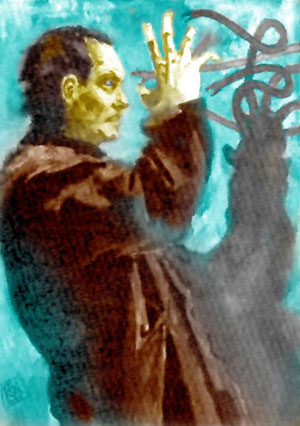 someone and then have sex with them, although you could seduce them and then leave). This isn’t really all that difficult (helping someone across the street or buying them flowers can often generate a positive emotion and a minor charge), but the fact that the emotion must be coldly and manipulatively created makes it difficult from the standpoint of the adept.
Generate a Significant Charge: Significant positive charges are formed by creating extremely positive emotional reactions in people who you do not know, following the same restrictions as those for minor charges. Significant negative charges, on the other hand, are made by creating extremely negative emotional reactions in people who are close to you and in such a way that they know you are responsible for them feeling that way (nor are they allowed to know that it is merely in the interests of generating a charge for you, that “taints” the emotion through selflessness – unless of course that makes them feel even worse about it).
Generate a Major Charge: Generating a major charge requires the character to create an emotional situation of a severity which will be remembered by the person effected for the rest of their lives. The adept himself will be forced to remember the event for the rest of their lives, as well. As with significant charges, positive charges must be generated with strangers while negative charges must be created by effecting those close to the adept.
Taboo: While it is generally easier for emotiomancers to gain charges than other schools, it is also easier for them to lose them: Emotiomancers can lose their existing charges if they do anything to ruin an “emotional moment”. Specifically if they interrupt a positive emotional moment (talking during the end of a romantic film or telling people to “get a room”) they lose their negative charges. If they interrupt a negative emotion (by cheering somebody up or even saving someone from torture) they lose their positive charges. As a result of this dichotomy emotiomancers often find themselves treading a dangerous line – people who are generally nice can create positive charges fairly easily, but will lose them if they stop other people from feeling bad; people who are nasty can generate negative charges easily, but they can never do anything even marginally positive.
Random Magick Domain: Emotiomancers control peoples emotions and, through them, their thoughts. They are the masters of manipulation. Their skills lie entirely within the realm of effecting how others think and feel.
Starting Charges: Newly created emotiomancers start with four minor charges.
EMOTIOMANCY MINOR FORMULA SPELLS
CHARM
Cost: 1 minor charge
Effect: Using this spell allows the emotiomancer to subtly play upon another person’s emotions, binding them to him. If a positive charge is used, whoever they are and whatever their normal reactions towards the emotiomancer would be they will feel as if he were their best friend in the world. If a negative charge is used the spell makes them act in zombie-like obedience to the character (the advantage is that they are willing to do more; the drawback is that they won’t be capable of much intelligent, complicated, or conceptually difficult action). The spell only lasts for a number of minutes equal to the emotiomancer’s skill in magick. Afterwards the victim will remember everything which has transpired, although they may be unsure of the reason why it happened (members of the Occult Underground, of course, will immediately suspect magickal influences of some sort).
MINOR SUGGESTION
Cost: 1 minor charge
Effect: This spell allows the emotiomancer to make a single suggestion to another person. The other person will be extremely receptive to the suggestion made by the emotiomancer and will act on it unless it is completely contrary to their normal behavior (loyal security guards won’t abandon their posts, but might be willing to give someone a security tape even though it was against regulations). The victim cannot leave the presence of the emotiomancer or the spell will be broken. Afterwards the character won’t remember the suggestion or the action taken.
CONFUSE
Cost: 1 or 2 minor charges
Effect: With a single charge cast of Confuse the emotiomancer can target a single person and batter them with conflicting emotions. The character will still be able to take actions, but will do so at a slower rate of speed (in combat conditions this translates to halving successful initiative checks and only allowing characters to take actions on every other turn). Using two charges allows the emotiomancer to target a group of up to five people. The spell lasts until the effected person or persons makes a successful Soul check at -15% (one check can be made every turn of combat or once every minute).
OVERWHELM
Cost: 2 minor positive charges or 1 minor negative charge
Effect: Overwhelm has a similar effect as Confuse, forcing emotions upon its victim. In this case only a single emotion – one of the emotiomancer’s choosing (but consistent with the type of charge used) – is forced, and that one completely overwhelms the person’s ability to take any action which isn’t ordained by that emotion. This reaction will not always be what the emotiomancer may have expected or even wanted, but can be resisted with a successful Soul check at the time of casting. If the check fails the spell’s effects will last about fifteen minutes.
Example: Jeffrey, an emotiomancer, has been confronted in a darkened alley by his arch-nemesis, Chameleon. Jeffrey uses two positive charges and casts Overwhelm on Chameleon, choosing to strike her with lust. She immediately drops the gun and goes off looking for a piece of ass. Jeffrey, on the other hand, is more than a little insulted that she didn’t like his looks.
EMPATHY
Cost: 1 minor charge
Effect: With this spell the emotiomancer can read the emotions of another person at the time of casting. With a successful Soul check the emotiomancer can also get a vague impression of what caused or is causing the emotion.
NUMB
Cost: 1 minor charge
Effect: This spell will numb the emotions and feelings of anyone, including the emotiomancer himself. For the duration of the spell – equal in minutes to the emotiomancer’s skill – the recipient will feel nothing, including physical pain (although the physical damage will still occur).
AFFECT MIND
Cost: 3 minor charges
Effect: This temporarily effects a person’s mental abilities – either raising or lowering it by an amount equal to half of the emotiomancer’s magickal skill. The effect lasts for about ten minutes and isn’t capable of granting knowledge which the recipient didn’t possess before, only of improving the character’s mental aptitude. The emotiomancer cannot use this spell on himself.
EMOTIOMANCY SIGNIFICANT FORMULA SPELLS
CONTROL
Cost: 2 significant charges
Effect: Control allows the emotiomancer to, effectively, completely enslave the target of the spell for a number of minutes equal to his Soul plus his magickal skill (although the victim can make a Soul check at -20% every five minutes). As with Minor Suggestion the person will still resist any commands completely repellent to his nature (so you can’t have him kill his friend), but can follow multiple commands during the duration of the spell and can even leave the emotiomancer’s presence to carry out the orders.
SIGNIFICANT SUGGESTION
Cost: 1 significant charge
Effect: Like Control, Significant Suggestion is a more powerful version of Minor Suggestion (as the name implies). Like Minor Suggestion, Significant Suggestion is only able to give a single suggestion to another person and that person must remain in the presence of the emotiomancer while carrying it out. However, a Significant Suggestion completely overrides a person’s inhibitions – with it the emotiomancer can convince the person to do anything. If the action is contrary to the person’s belief systems (i.e., something which wouldn’t pass as a minor suggestion) the person gets a chance to resist, making a Soul check. If it’s a particularly serious transgression (such as killing their own mother) the GM may modify this check in the victim’s favor as he sees fit.
WARP
Cost: 3 significant charges
Effect: With Warp the emotiomancer temporarily simulates the effects of the House of Renunciation, absolutely switching the most important elements of the victim’s personality to its polar opposite (so that a cruel person becomes kind, a person with a vendetta instead finds ways to help her former target). When the spell is first cast the person gets to make a Soul check to see if they are effected by the spell. If that fails the person can make an additional check every hour at -50% until they throw off the effect of the spell.
PHOBIA
Cost: 1 significant negative charge
Effect: With this spell the emotiomancer instills a great fear of a specific item, animal, individual, or situation in his target – an intense phobia. Whenever the victim encounters the stimulus from that point forward they will suffer a paralyzing fear until the stimulus has passed. Whenever this phobia inflicts itself the victim can make a Soul check at -20% as they attempt to resist what they subconsciously realize is an unnatural impulse. If they are successful, the phobia will no longer effect them.
FIXATION
Cost: 1 significant charge
Effect: In many ways the exact opposite of the emotiomancer’s Phobia spell, Fixation allows him to specify a goal which the victim must attempt to fulfill. If the goal is something which is theoretically achievable (anything from “eat a hot dog” to “steal the Mona Lisa” would be acceptable) then there is no way for the victim to remove the spell’s effects (without other unnatural influences) unless they succeed at achieving their goal. If the goal is something which is impossible (“eat all the hot dogs in the world” or “steal the Eiffel Tower”) then the victim can make a Soul check at -20% once a day to overthrow the effects of the fixation (although they must attempt to fulfill their fixation up until that point). The fixation cannot be something which would be immediately deadly to the character (“throw yourself off a cliff” or “shoot yourself in the head”) or completely alien to their belief system (you couldn’t convince a nun to sleep with someone), but other than that things are wide open. Finally, the degree of intensity for the fixation depends on its complexity. If the fixation was to “eat a hot dog” then the person would probably immediately drop what they were doing and go out to find a hot dog. If, on the other hand, the fixation was to “steal the Mona Lisa” they wouldn’t just walk into the Louvre and try to pick it up – they would be allowed to research and concoct a plan before proceeding. All of this is at the GM’s discretion.
EMPATHIC CONNECTION
Cost: 1 significant charge
Effect: With this spell the emotiomancer can create an empathic connection between any two minds (not necessarily including his own). By expending minor charges he can add additional people to the link (one charge per person, up to a total of six). Anyone who is a member of the link will feel the emotions of the other people through the link, identifying who the emotion actually belongs to). Typically the nature of the link allows the recipient to distance themselves from the emotions of others, but for particularly intense feelings (such as the pain of being tortured or the heartache of seeing a loved one leave you) other members of the link must make a Soul check or be overwhelmed. At no point in time do other members of the link know what caused the emotion – only the emotion itself. The link lasts for twenty-four hours, but can be extended for another twenty-four hours if the emotiomancer expends a minor charge for every member of the link. This can be continued indefinitely.
MIND LINK
Cost: 3 significant charges
Effect: A more powerful version of the Empathic Connection, the Mind Link allows the emotiomancer to connect the minds of up to six individuals (using the same procedures as for Empathic Connection, with each additional person in the link above two costing a single minor charge). In this case, however, the members of the link will be able to see, feel, and hear everything which the other members of the link experience by focusing on that individual. However, a person can only focus one such set of sensory inputs at once – so if you’re focused on someone else, you don’t know what’s happening to you. The emotiomancer, through his magickal training, can attempt to process multiple “feeds” at once – including his own. To do so he makes a Mind check with a -10% penalty for every additional link above two he attempts to process (so he would have a -10% penalty for three links at once (including his own) and a penalty of -40% if he attempted to process all six members of a link at once). If succeeds he successfully processes the multiple feed for a single combat round or for a minute, having to make the check again every minute or combat round after that point. If he fails he is paralyzed for five combat rounds or minutes from mental overload.
EMOTIOMANCY MAJOR EFFECTS
When you create a major emotiomancy effect you are toying with the basic elements of human existence as if they were mere whims. Emotiomancers are capable of driving men beyond the brink of insanity; causing massive, permanent shifts in personality; enslaving entire populations to their will (although the larger the population the less likely it will be a permanent effect); or even fundamentally altering the emotional responses of people (instead of just polarizing their compulsions, for example, you could have people hate those they have always loved and loved those they have always hated). In short the emotions and thoughts of man are your playthings and you are capable of doing anything with them you wish.
Original Art by Robert Nemeth, coloured by Philip Reed.
I feel a great sense of satisfaction with this article. Looking back on my earliest professional work, I realize that it actually represents a significant shift for me: It was the first time I wrote something for publication and found that the words were simply… flowing. I wasn’t agonizing over every turn of phrase and trying to perfect every sentence. I was simply letting the idea express itself simply and cleanly, without ostentation or ornamentation. It probably wasn’t a coincidence that my success rate radically increased after this point.