The Alexandrian

Posts tagged ‘d&d’

The Dreaming Arts

August 26th, 2018

The Dreaming is a realm which lies “beneath” or “alongside” the world as the mortal races know it. It is a wild and dangerous place, an ever-shifting forest whose shadows and glades hold the greatest of wonders. Mortals sometimes reach it, unwittingly, in their hours of deepest dreaming, and it is said to be the place where all dreams are born. In the Dreaming, one may leave a city forged with towering spires of the finest crystal and lose sight of it within three paces, never to see it again. Or one may be tempted by strange, dancing lights, and never wake from their dreams.

This is what the Dreaming is in words. But what it is in truth is not so easily expressed. To understand the Dreaming, one must learn to feel the Dreaming. To trust the Dreamsong.

THE NATURE OF TIME IN THE DREAMING

The elven scholar Falnafeshnae described three orders within the Dreaming: The Dream That Was, the Dreaming Moment, and the Undreamt (or the Dream That Will Be).

THE DREAMING MOMENT: The Dreaming Moment is now. It is the moment of existence. It is the present tense. It is fleeting. It is ever-changing – it is always present, but it is always passing and it is always going.

In life we rarely live within the moment. Our thoughts dwell in the past or wish upon the future. But in the Dreaming, such wandering ways are dangerous. In the Dreaming it is the Moment that is the touchstone of your experience. It is the bedrock upon which you stand.

It requires absolute mental precision to maintain it. But without it you will be lost.

THE DREAM THAT WAS: Within the Dreaming all things that ever were exist… but also many things that never were or merely might have been. It is uncertain to us whether all of thought originates within the Dreaming and passes through our hands to become reality, or if thought comes from us and then passes through the Dreaming and thus into the waking world. But that is how it is.

THE DREAM THAT WILL BE: Just as all that was lies within the Dreaming, so too is there everything that might be. But such realms are dangerous and uncertain. We will return to them later.

But the secret of the Dreaming is that there is no true distinction between past, present, and future. All are as one in the Dreaming, even if we are not capable of understanding it in totality. That is why we must be careful. That is why we must stand upon our bedrock in the Dreaming Moment that is.

Meditate upon these things. Seek the truth of them within yourself.

THE LORDS AND LADIES

MINOR SPIRITS, LORDS, AND LADIES: House spirits are the most common of the “minor spirits” which you can see manifestly in the world, but they are far from the only ones. These minor spirits, also known as rivera, can be found almost anywhere. The world around you is filled with a spiritual life. Those who smile upon the spirits are blessed by good fortune, while those who do not will find their lives cursed by them.

Above the minor spirits of the world there are the Spirit Lords, who each possess dominion over a common family of minor spirits. For example, Pegana, the Lady of the River, rules over the spirits of stream and brook. They were first worshipped by the trading clans. Their ancient representations can also be found on the charm tokens of the northern barbarians.

LORDS OF THE DREAMING: What the common man does not understand is that the Spirit Lords are, in truth, powerful lords of the Dreaming. It is through the Dreaming that these Lords have power, for they are of the Dreaming.

It is overly simplistic, however, to consider them as individuals. They are not gods. They are more fundamental than that – they arise of the Dreaming, and the Dreaming arises from them. The Pegana one meets in the deltas of Duvei is not the same Lady of the Rivers one might meet in the spring thaws of the Great Glacier or the mountain streams of Hyrtan. She might not even be the same Pegana you’d meet in the next river valley to the west. She might not even be the same Pegana you met last night in the very same place. Or, on the other hand, she might be.

SHAPING THE SPIRITS: Few take these beliefs literally any more, but they remain a part of their philosophical outlook. For example, many believe that a person’s outlook on life “shapes the spirits” around them and has an effect on the fate that life brings them.

In this there is truth.

GUIDES: The Spirit Lords serve as guides and signs. We have learned to trust them, although not completely. Some are more trustworthy than others.

When a Spirit Lord seeks out a Dreamwalker, however, it is always a matter of great import – an event which will change the Dreaming and thus the world in ways unforeseen and unknowable.

And for a Spirit Lord to seek out one who is not yet trained in the Dreaming Arts, as the Lady Pegana did with you, is something rarely if ever seen.

DREAMING ARTS

Dreaming Arts is a new Wisdom-based, trained-only skill. Dreaming Arts checks are made in conjunction with the three different paths of the Dreaming Arts.

DREAMSIGHT: The Dreaming is the wellspring from which all of reality is born and the grave to which all of living memory returns. As such, those who can see the Dreaming with unclouded eyes can perceive deep truths of the world around them.

Game Mechanics: Without any training, you’ll be able to use Dreaming Arts checks to duplicate the effects of an augury spell. With a feat you’ll be able to unlock more powerful divination abilities (that you’ll use with your Dreaming Arts check).

DREAM PACTS: The Lords of the Dreaming are powerful and fey. Those skilled enough in the dreaming arts can turn their own souls into conduits through which the Spirit Lords can be made manifest in the world around us. But following such a path requires supreme self-control, for the Lords of the Dreaming will reshape your soul.

Game Mechanics: There is a class dedicated to forming dream pacts. In order to form dream pacts, you would need to multiclass. By channeling different Dreaming Lords, you will gain a variety of powers.

DREAMSPEAKING: Those practiced in the dreaming arts can reshape the Dreaming around them. Those who are masters of the Dreaming, however, can reshape the world around them by reshaping the dreams from which the world is born. These arts have been perfected into the dreaming tongue – a primal language which not only describes the most fundamental aspects of reality, but can be used to transform it.

Game Mechanics: These are a suite of feats you can take, giving you mastery over various parts of dreamspeak. Dreamspeaking essentially allows you to reshape reality or yourself – essentially minor spellcasting.

Dreamsight – Dream Pacts

IN THE SHADOW OF THE SPIRE

Session 14A: Many Unhappy Returns

When Ranthir awoke, he quickly prepared the magical rites he would need to analyze and identify the equipment they had taken from Morbion. Much of this proved to be magical, but perhaps the most valuable were the finely-crafted boots he had worn. These had been enchanted with a levitation charm.

I think managing your gear is an important (possibly essential) part of Dungeons & Dragons. I don’t think it should be a painful or belabored process (and have even gone so far as to create house rules to streamline gear management), but both the balance of the game and its narrative dynamic are driven by PCs managing their equipment.

Some people may think that sounds like a strange idea, but the current session offers a couple good examples of what I’m talking about.

The first, which I already talked about briefly in “Treasure With Context”, is the orrery: A valuable treasure which is difficult to remove from the dungeon due to its bulk. If you were in a campaign that tended to just gloss over matters of encumbrance, it might be simple to simply handwave this away, too. “Once the complex is cleared, you’re able to figure out how to extract the orrery and sell it. Add X amount of gold to your bank account.”

But because there are structures and expectations in place, this campaign defaults to the players needing to figure out exactly how they’re going to solve this problem. The solution they came up with (selling the location of the artifact instead of the artifact itself) was incredibly clever, and thus both entertaining and rewarding in itself. But it also pushed the PCs to enter into an arrangement/alliance with a powerful noble family. That sort of thing has consequences.

Eventually, however, Tee was able to use the boots to reach the high cavern and confirm that there was, indeed, a cindershard outcropping there. Tee threw a rope and grappling hook down to her companions below, allowing Agnarr and Tor to climb up and join her in harvesting the crystals.

The second is the cindershard expedition: Notice that overcoming the challenges preventing them from harvesting the crystals couldn’t be easily overcome until they were properly equipped. Realizing that you aren’t currently carrying the right tools for the job will force a group to disengage and then, importantly, re-engage with the dungeon. Or it will force them to improvise around the lack. Either option will tend to create multi-faceted interest in the form of both challenge and drama as the groups deals with either the immediate jeopardies involved with improvising around missing equipment or dealing with the strategic complexities (and evolving narrative) that comes from leaving and then returning to the dungeon.

Dungeon expeditions are, above all, expeditions: It is a prolonged journey into a dangerous unknown where you are, for the duration of the expedition, cut off and unable to resupply from civilization. The decision to take resource X will unlock certain experiences, but comes at the expense of taking resource Y (which would have unlocked different experiences).

And if you look at Dungeons & Dragons from 1974-2008, the structures of the game are all ultimately focused on (and balanced around) the strategic elements of expeditionary play. While D&D is flexible enough that you can do many different things with it, the further your get from expeditionary play – the further you drift from Arneson’s and Gygax’s expected play – the more mechanical problems you’re going  to find cropping up.

OTHER DYNAMICS

This is often mistaken for one-true-wayism. That’s not the case. Gear management is rewarding for D&D’s dynamic; it often isn’t rewarding for other play dynamics.

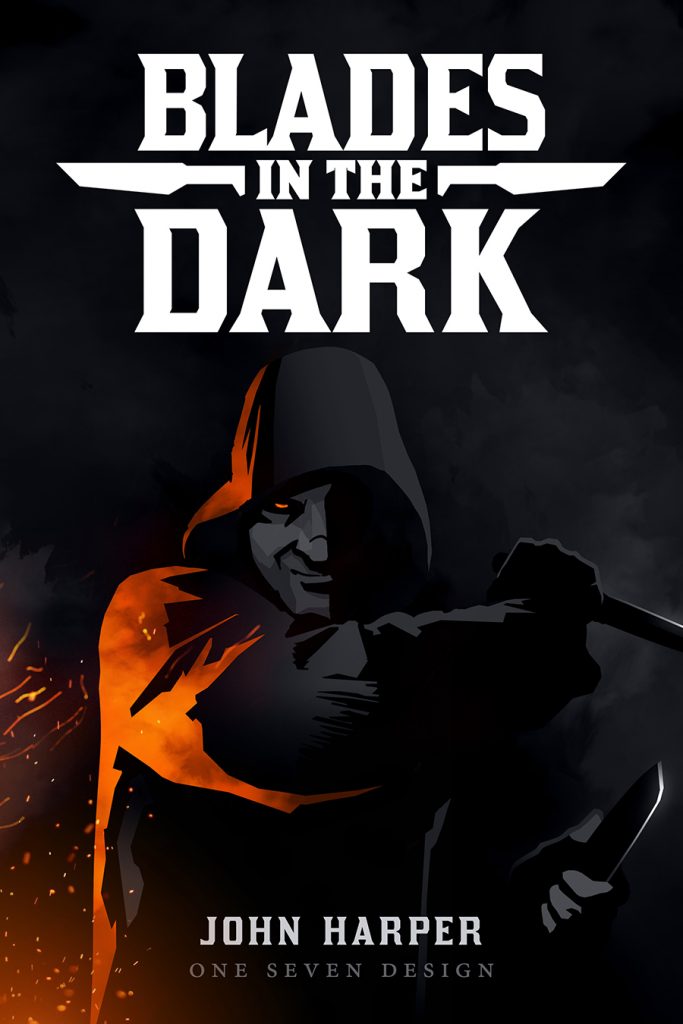
Blades in the Dark, Blades in the Dark - John Harperfor example, focuses on criminal crews performing scores. Such scores are generally intended to be (and usually work when they are) one-shotted. You don’t want to disengage and then reengage with them; you want to run them.

To create challenging and drama-filled runs, Blades’ game play is built around two pillars: First, improvisation and retroactive planning. Second, ticking clocks and resource ablation that pushes the PCs to the wall and makes them hurt. The game, therefore, uses an equipment system in which you select a specific Load before each score. The Load determines how many useful items of gear your character is carrying (3 for a Light Load, 5 for a Normal Load, etc.), but you don’t have to decide exactly what those items are until you use them. (Thus you can improvise freely by simply declaring that you planned for and brought exactly the right item for this circumstance, but are also faced with the possibility of running out of Load slots, leaving you unequipped for the next challenge.)

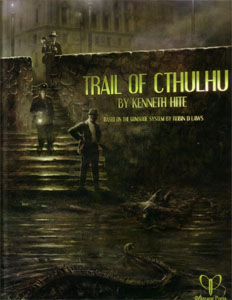
Another example is Trail of Cthulhu, which has a Preparedness skill. As long as an investigator has access to their kit, they can make a Preparedness test to see whether or not they have a particular piece of equipment. This is desirable in Trail because the game’s focus is the investigation; periodically putting the investigation Trail of Cthulhu - Kenneth Hiteon hold in order to prepare an equipment list doesn’t enhance the core game play, it distracts from it. You want to move from getting a clue to seeing the payoff from the clue; you don’t want to pause between those two points for an equipment break.

Why couldn’t you just takes Blades-style Loads or Trail-style Preparedness and graft them onto D&D?

Well, you could. But as I alluded to above, equipment management in D&D is only one of the ways in which the game is designed for an expeditionary dynamic: Wizard spell slots, long-term hit point ablation. The game was built on mounting expeditions into the dungeons below Castle Blackmoor, and virtually all of the core game play that isn’t built around a combat simulator is built around those expeditions. Tearing out one chunk of that game play and replacing it with something else isn’t going to single-handedly change the nature of the game. You’re going to end up with a mechanical chimera. One that may, or may not, work out.

(But, if you don’t give careful thought to the actual effect you’re trying to achieve, is more likely not to.)

Ptolus - In the Shadow of the Spire

IN THE SHADOW OF THE SPIRE

SESSION 14A: MANY UNHAPPY RETURNS

January 5th, 2008
The 3rd Day of Kadal in the 790th Year of the Seyrunian Dynasty

They returned to the surface just as the sun was slipping behind the Spire. They walked home in the Spire’s shadow, arriving as true evening fell and Ptolus’ second dusk began.

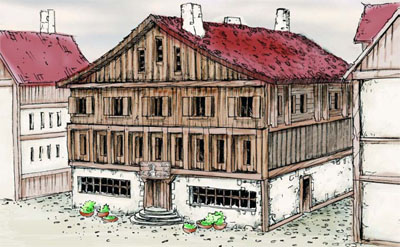
They weren’t sure when they had begun to think of the Ghostly Minstrel as home, but as they washed their bloody clothes and bodies in the stables, that’s how they thought of it. And all of them were looking forward to a long and well-deserved sleep in their own beds.

Ptolus - The Ghostly MinstrelBut before they could get there, Tee voiced a thought that was on many of their minds: “We need to talk.”

“Can it wait until morning?” Elestra asked. “Breakfast?”

Tee shook her head. “No. We need to talk now.”

They retired to Elestra’s room – the room that had once been Agnarr’s. Once the door was shut behind them, Tee turned to face Elestra: “What happened down there… That can’t happen again. You nearly got us all killed.”

“It’s not that simple,” Elestra protested. “My snake—“

“It is that simple. That door had to be closed. Agnarr knew it. And you kept opening it.”

Agnarr nodded, and then Tor joined in: “And this isn’t the first time. This is life and death. You have to be focused. If you ever put us in that situation again, I’ll kill you myself.”

“I don’t know about that,” Tee said.

“Better one of us than all of us,” Tor said bluntly. “Dominic can always heal her wounds if we survive.”

Tee didn’t have a response for that. She turned back to Elestra. “Look, you say you care about your snake, but you keep sending it into dangerous situations. And its gets us all in trouble.”

“I understand that,” Elestra said. “But what am I supposed to do?” (more…)

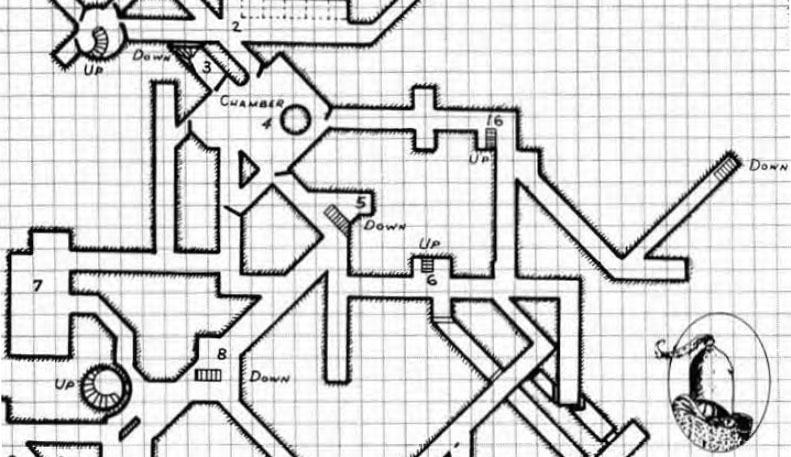
Castle Blackmoor's Dungeons - Dave Arneson

Newer readers may not be familiar with my old Reactions to OD&D series. If you haven’t read them, you may want to check them out first. It’s been more than half a decade since I last visited the series, but a recent discussion prompted me to track down and dust off some old notes.

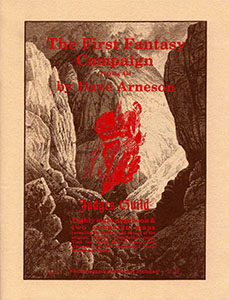
Dave Arneson’s First Fantasy Campaign was published by Judges Guild in 1977. It “attempted to show the development and growth of his campaign as it was originally conceived.” (For those unfamiliar with the early history of D&D, the campaign in question is Blackmoor: The original dungeon, city, and wilderness setting in which Arneson created modern roleplaying games, and which would eventually become Dungeons & Dragons.) In practice, sadly, it is a deeply flawed book. It’s a haphazard concordance of lightly edited campaign notes, and Arneson, unfortunately, is not First Fantasy Campaign - Dave Arnesonparticularly effective in explaining what many of these notes mean or how they were supposed to be used in actual play. The confusing nature of the book is heightened because its contents span both the original Blackmoor material (starting in 1970), revisions made to his home campaign after D&D was published in 1974, and further revisions made to the material in order to run it at conventions from 1975-77… and Arneson is rarely clear about exactly which material is which.

To take one small example, let’s consider the BLACKMOOR DUNGEONS section of the book. The material described here is literally Ground Zero for every single roleplaying game ever published (and, by extension, a huge percentage of pop culture, literature, and gaming over the past 50 years). Being able to get a glimpse into how Arneson actually ran those games would be an incredibly cool insight into a cultural watershed.

It’s frustrating, therefore, to discover that the First Fantasy Campaign makes it basically impossible to puzzle out what Arneson’s actual procedures were. I’ve spent an incredible amount of time pouring over this section of the book, and it remains a tantalizing enigma. I have, however, managed to work out a few details which I think others might find interesting.

Before we begin taking a close look at the text, however, it’s important to note a key point of context:

The Castle itself is still blank since it has been destroyed twice and rebuilt twice and then taken over by non-player Elves when the local adventurers were exiled. Thus, there are no sheets or goodies for it and only a sketch of its appearance. The Cavern sheet of Encounters is also lost (at least the first ones and the new one is in use). For these deletions I apologize.

The first six levels of encounters were prepared in the last two years for convention games, and set up along “Official” D&D lines. The last (7th – 9th and Tunnel Cavern System) are the originals used in our game. Additional crazy characters that got into the game over the years have been the Orcian Way and Sir Fang the Vampire.

(…)

Details on room, Cavern shapes for the Tunnel/Cave system have been lost or misplaced.

The first thing is that, as noted before, sections of Arneson’s notes as presented in the First Fantasy Campaign had been revised for convention play. This has, for better or worse, eradicated some amount of crucial information. The second is that the notes have also been partially (but not wholly) revised through actual play.  And the third is that Arneson has deliberately not included some of his notes because he’s still using them in actual play. So you can already see that there are multiple layers of obfuscation here, made worse by the fact that some material has simply been lost due to the passage of time.

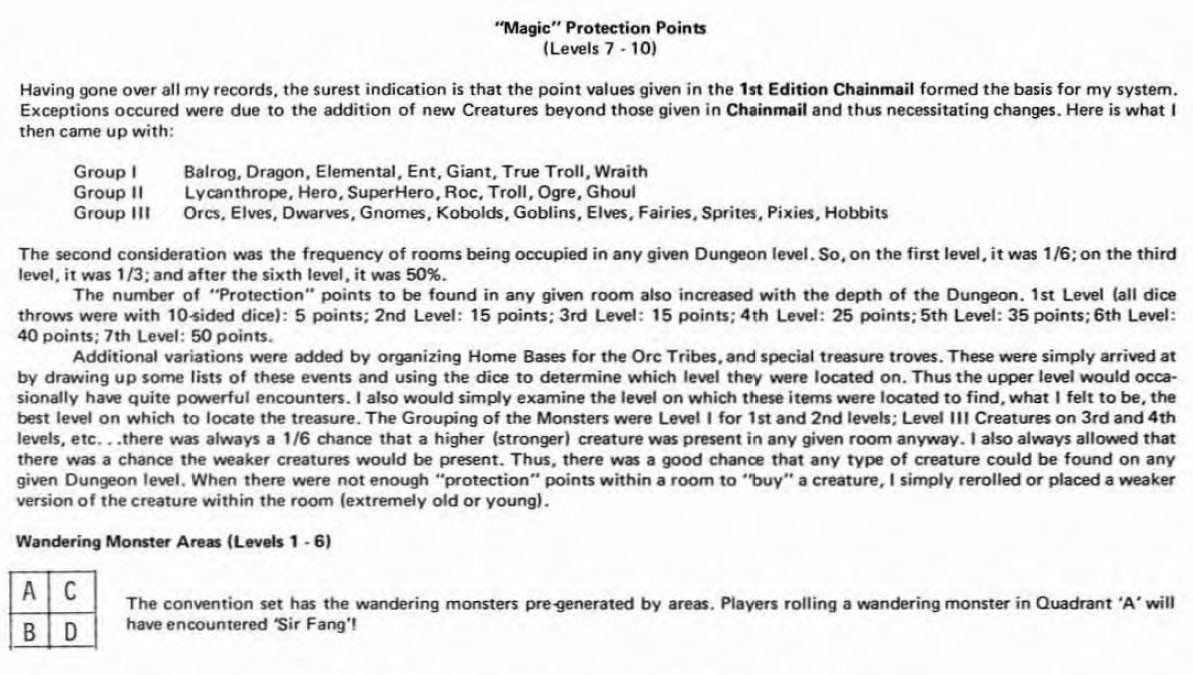
With that being said, let’s take a look at what Arneson is able to give us:

First Fantasy Campaign - Dave Arneson(click for larger version)

The other obstacle we almost immediately encounter here is poor proofreading.

For example, Arneson lists Group I, Group II, and Group III for monsters. Later he says: “The Grouping of the Monsters were Level I for 1st and 2nd levels; Level III Creatures for 3rd and 4th levels, etc . . .” It seems fairly certain that “Level III” here should be read as “Level II”. One might initially conclude, both due to similarity of usage and the use of the capitalized term “Grouping”, that “Group I” and “Level I” are meant to be the same thing, but they are clearly not. (Balrogs on the 1st level of the dungeon would be an unusual design choice.)

Level I most likely refers to something equivalent to OD&D’s Monster Level Tables, so Arneson is saying to use the “Level I” (sic) tables for the 1st and 2nd level maps of Blackmoor. But if “Level I” and “Group I” aren’t the same thing, what are the Group listings used for? Ultimately, after going over the text several times, I’m forced to conclude that there simply isn’t any explanation given for why he created the Groups or what purpose they served. (Perhaps the order of the Groups was inverted and they ARE the same thing as the Levels, with Balrogs being Group III creatures instead of Group I?)

THE ARNESONIAN DUNGEON

Here’s what I think can be worked out with a fair degree of certainty. If you want to run Blackmoor in a style similar to how Arneson originally ran it:

1. You’ll need Level I, Level II, Level III, Level IV, and Level V monster tables.

  • 1st / 2nd level: Level I
  • 3rd / 4th level: Level II
  • 5th / 6th level: Level III
  • 7th / 8th level: Level IV
  • 9th / 10th level: Level V

These tables are not provided in the First Fantasy Campaign, but it’s likely that these were D10-based tables. (He writes “all dice throws were with 10-sided dice.” Although this appears as almost a non sequitur in the text, the only logical use of the D10s here would be on the monster tables.) To stock the tables, I would probably try to pull a full list of monsters appearing on the Blackmoor key and the anomalous “Group” listings and then distribute them appropriately. (You might also consider stocking all of the creatures found in Chainmail.)

2. You’ll need to pull the point values for creatures from Chainmail. (And “due to the addition of new Creatures beyond those given in Chainmail” create point values where necessary. Additional values might also be gleaned from other sections of the First Fantasy Campaign.)

3. There is a “magic protection point” encounter budget that is determined by the dungeon level:

  • 1st level: 5 points
  • 2nd level: 15 points
  • 3rd level: 15 points
  • 4th level: 25 points
  • 5th level: 35 points
  • 6th level: 40 points
  • 7th level: 50 points

(It feels extremely likely that the value listed for either the 2nd or 3rd level is a typo. I’m guessing the values should either be 10 & 15 or 15 & 20.)

4. For each room, roll an encounter chance:

  • 1st level: 1 in 6
  • 2nd level: 2 in 6
  • 3rd+ level: 3 in 6

5. If an encounter is rolled, roll 1d6 for a 1 in 6 chance that the room includes “a higher (stronger) creature”.

(By default, I would assume “stronger” just means “use the next Level monster table,”  but you might have some chance of using encounters from even stronger Level tables. There’s also “a chance that weaker creatures would be present”, but it’s not spelled out. It’s possible Arneson just winged that. You might also consider rolling 1d6 and using a weaker encounter on 1 and a stronger encounter on 6.)

6. Roll on the appropriate Level table, then purchase creatures of that type using the “magic protection point” budget. If you don’t have enough points, then either “reroll or place a weaker version of the creature within the room (extremely old or young).

(Arneson gives no indication for mixed encounter types. You might wish to do so: Perhaps generate No. Appearing using OD&D methods and then, if you have points left over, check for additional encounters in the same room. OTOH, Arneson’s keys and wandering encounters give no indication that he ever used encounters with mixed creature types.)

CONCLUDING THOUGHTS

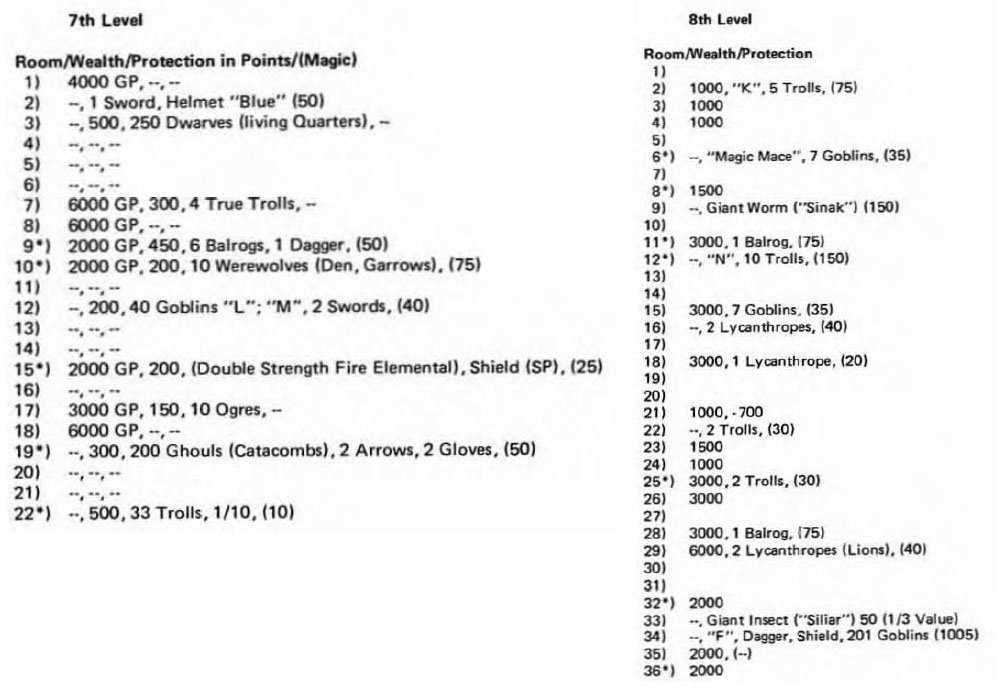
It remains unclear whether this was a “restocking” procedure that Arneson used between sessions or if he randomly determined results during play as rooms were being explored. It has the feel of a during-play system, but look at the key for the 7th to 10th levels (the ones set up according to the original schema and not revised for post-D&D convention play):

Note that the “Protection in Points” entry doesn’t consistently list points; it also lists specific creatures which have been generated with those points. If these are the notes Arneson was running the adventure from, then he was using the Protection Point system to restock. (For more on re-stocking dungeons, see (Re-)Running the Megadungeon.)

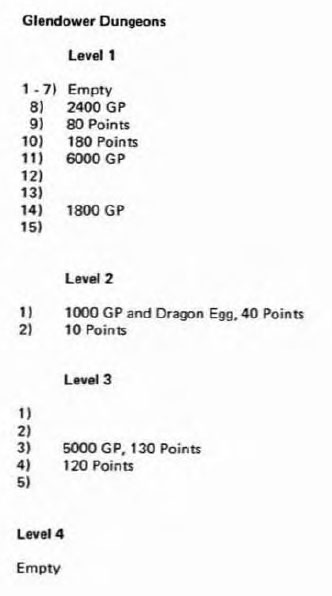
On the other hand, look at the similar key given for the Glendower Dungeons:

First Fantasy Campaign - Glendower Dungeons - Dave ArnesonThose entries would appear to be the “Protection Point” or “Magic Point” values for those rooms, without the nature of that protection being predetermined. In the description of Loch Gloomen, Arneson also writes:

Defense of Area

30 – 180 Magic Points Creatures (two six-sided dice): 2) Giant; 3) True Trolls; 4) Roc; 5) Air Elemental; 6) Ogre; 7) Basilisk; 8) Goblins; 9) Ghouls; 10) Lycanthrope; 11) Balrog; 12) Dragon

The fairly clear intention here is to roll 3d6 x 10 to determine the number of Magic Points, and then roll 2d6 to determine the creature type.

So it seems quite likely that the Protection Point system was a flexible one. Arneson could:

  • Stock the dungeon with specific creatures (using the Protection Point system as a procedural content generator).
  • Quickly note “there should be X amount of protection in this room” (and then either specify it later or generate it during play).
  • Randomly stock the dungeon room by room during play.

However, there are still several points which I find confusing. You might notice the “(Magic)” values given in the key for the 7th level of the Blackmoor dungeons, for example. It’s unclear what this entry is supposed to be: In any single entry it might be interpreted as an empty room’s encounter budget, the total cost of the listed “protectors”, or an unspent number of “magic protection points” that is meant to be spent in addition to the listed protectors. But no explanation seems to satisfactorily explain all instances (and any given explanation I’ve ventured is frequently contradicted by one of the usages). My suspicion is that he actually had a point system for determining how many magic items were located in each room (similar to the point budget for monsters in each room), but if so there’s no surviving evidence of how it would have worked.

Based on the key, it’s also likely that Arneson had some method for generating “Wealth” values independently from the Protection Points, but it’s not detailed here. (I’m guessing it was not dissimilar from that described in OD&D: 1 in 3 chance for treasure in occupied room; 1 in 6 chance in unoccupied room. And then rolls on some associated treasure table based on the dungeon level.)

It’s also unclear whether Arneson used wandering monster checks in addition to these room stocking procedures. It seems likely, but whatever method he may have used isn’t detailed. (Note that the poorly described “Wandering Monster Area” quadrant system described in the First Fantasy Campaign is part of the revision done to the material for convention play.)

Arneson also mentions that he would intermittently create “Home Bases for the Orc Tribes” and “special treasure troves”. These appear to have been completely arbitrary in their creation, but he would randomly roll to determine which level of the dungeon they would be added to. (“Thus the upper levels would occasionally have quite powerful encounters.”) The special distinction of the “Home Bases for the Orc Tribes” (as opposed to lairs for other creatures) seems significant, but I’ve been unable to tease it out. (And it may be entirely illusory.) There were four orc tribes in the campaign: Red Eye Orcs, Orcs of the White Hand, Isengarders, and Orcs of the Mountains, but the only information given relates to outdoor adventures, and it’s unclear what their agenda/function within the Blackmoor dungeon would have been.

I’ll also admit that I stopped trying to make sense of Arneson’s key for Blackmoor when I realized that he had 32 dwarves keyed to a room that’s 20′ x 10′. In the lower levels, there’s a point where he keys “250 Dwarves (living quarters)” into a room 10′ x 40′ long. There’s clearly some method to the madness here, but it’s beyond my ability to figure it out.

Go to Arneson’s Machines

Back to Reactions to OD&D

IN THE SHADOW OF THE SPIRE

Session 13D: A Time of Tragic Rest

Joey

Poor puppy…

In my experience, there are very few immutable rules when it comes to being a Game Master: Something that would completely ruin one game might be the ultimate coup de grace in another, either because the mechanics are different, the setting is different, the players are different, or just because the situation is different.

But there is at least one truism: If you kill their pets, you are guaranteed an emotional response.

That response will almost certainly include anger, but it will also include anguish and guilt and regret. If you want the PCs to be motivated to seek vengeance, you’ll probably get more consistent results from knocking off Fido than you will from slasher-slaughtering their boyfriend.

Now, if the death of that pet is capricious or forced, then a lot of that anger can end up getting channeled at you. This is one of the advantages of cultivating a reputation of fairness and impartiality: If your players trust you not to just screw with them arbitrarily, then when the hammer comes down they’ll turn their emotional reaction into the fiction and it will deepen their immersion into the game. If they don’t trust you, then the emotional response will be channeled out of the game and damage their immersion.

You can see a fairly clean example of this in the current session: Elestra had been cavalierly sending her python viper into dangerous situations for several sessions, and that had now created a situation which (a) nearly got the entire party killed and (b) resulted in the python’s death.

Heated arguments. Recriminations. All of it turned inward. All of it focused on the relationships between the characters, and thus strengthening the reality and the significance of those relationships (fictional though they may be). Great stuff.

A slightly less clean example happened in my original Eternal Lies campaign. (No spoilers for the published campaign here.) One of the characters owned a horse. The bad guys killed the horse. In this case, I think largely because the event happened “off-screen” while the PCs were in a different country, there was more recrimination aimed at me as the GM. But it was a legitimate consequence: The PCs had let the bad guys identify them; the bad guys had sent them a warning. And that emotional burst was quickly turned back into the game and focused on those bad guys, adding fresh resolve to the investigators and what they were trying to accomplish.

(I will say, though, that I’m pretty convinced killing the horse evoked a bigger response than if I had chosen to target one of their other Sources of Stability – i.e., NPCs who are specifically important to them.)

Conversely, these strong emotional reactions around pets can also be inverted. For example, in the first 3rd Edition campaign I ever ran there was a time when the party got unexpectedly cut off inside a dungeon. By the time they’d managed to work their way back to the surface, they were fairly convinced that the pack animals they had left tied off – including their beloved steeds – would be dead. There was a fair amount of emotional dread and pre-guilt. Instead, they found their horses unharmed and surrounded by catastrophic devastation and a dozen or so dead bad guys.

Not only was the emotional relief a much-needed “win” at the end of a scenario which had unexpectedly taxed and stressed them in a number of ways, it also deepened their curiosity regarding the mystery of what exactly had happened while they were in the dungeon.

(This technique doesn’t work, of course, if everyone knows that their pets have plot armor and death immunity.)

You can get similar results by putting beloved pets in jeopardy, thus investing the sequence to rescue them with a heightened emotional tension. Although, once again, it’s important to remember that if the danger is capricious or forced, the reaction to it will be directed out of the game and instead reduce the stakes.

Her pet of long years – her last connection to her home in Seyrun – had been slain. Dominic laid a blessing upon the body that would preserve it for three days and nights, but there was nothing more that he could do for it.

Archives

Recent Posts

Recent Comments

Copyright © The Alexandrian. All rights reserved.