
The Alexandrian

Posts tagged ‘d&d’

Ptolus - In the Shadow of the Spire

IN THE SHADOW OF THE SPIRE

SESSION 14C: THE TEMPLE OF EBONY

January 5th, 2008
The 5th Day of Kadal in the 790th Year of the Seyrunian Dynasty

Intrigued by these discoveries, Ranthir selected one jar from each of the six rooms and slipped them into his bag of holding.

They had now opened all of the doors on the upper level and were prepared to go down to the lower level. This proved slightly troublesome: There was a ladder on the iron catwalk in the middle of the chamber, but it had been rusted into a raised position. So, in lieu of that, they simply pitoned a knotted rope to the floor and climbed down along one of the walls.

Most of the rooms on the lower level appeared to have been kennels of some sort. Those around the base of the pit itself had metal doors, but through a set of double doors in the south wall of the pit there was a long hallway flanked by nearly a dozen more rooms with wooden doors that were almost entirely rotten away from sheer age. Large channels from these rooms led out to a 6-inch wide gap in the middle of the hall’s floor. Beneath this gap there was a 50-foot-pit down which charnel waste was apparently washed.

Another door off the pit led to a room filled with weapons hung from iron racks covering the walls. All of these weapons were designed for beasts: Claw-like tines; serrated harnesses; and the like. All of them seemed to be crafted to appear as vicious and merciless as possible. Many were stained with blood. The vast array was impressive in itself, but a closer inspection revealed that most of them were unusable: Either custom-crafted for unusual creatures; with important bits rotted away; or their metal rusting and fatigued from age.

THE TEMPLE OF EBONY

At the far end of the kennel hall, another set of iron doors led out to a hallway which took a sharp turn off to the west. From there the hallway branched again, and the decision was made – with Ranthir once again studying his partially completed map of the upper level – to return to the upper level and finish exploring there before proceeding to the lower level.
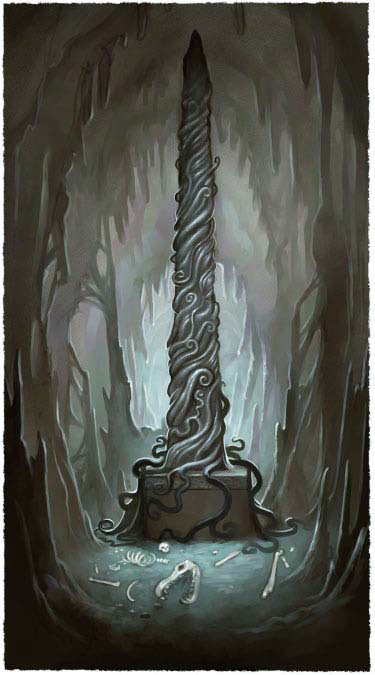
Ptolus - KihomenethothThey climbed back up their rope and returned to the first major chamber they had entered after leaving the laboratories that had been inhabited by the bloodwights: The large room flanked by four massive statues of Ghul.

From here there were four halls: To west lay the bloodwight laboratories and they had explored everything to the north. This left the hall to the east – which they could see ended in a set of large iron doors – and the hall to the south.

They decided to start with the hall to the east: The iron doors opened onto a large room paved in glistening ebony. It rose in three tiers. Two horrific statues stood in the corners of the second tier. To the left a twisting pillar of coiled tendrils and to the right a squat monstrosity.
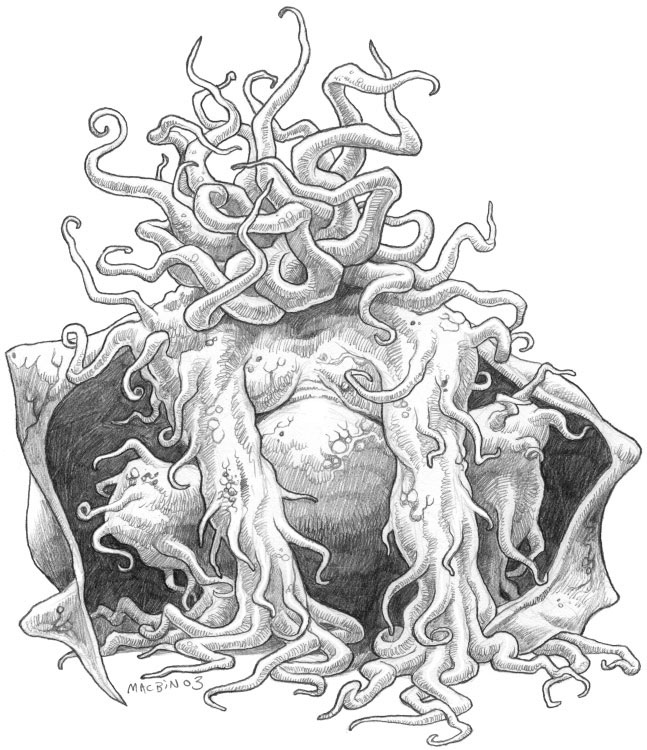
Ptolus - Shallamoth KindredIn the center of the third tier, at the top of the room, there was a slab of black ebony with the appearance of an altar.

The room seemed permeated with a palpable sense of evil, but Tee took a deep breath and slipped through the door. A cursory examination turned up no hidden exits or treasures, but she did discover that inscriptions had been written in a strange and alien tongue upon the base of the two statues on the second tier.

Ranthir, hearing this, entered the room himself and went up to study the statues. He confirmed that the language was completely unknown and, surprisingly, his magical arts gave him no translation, either.

Tee, meanwhile, had been exploring the uppermost tier. The altar or slab in the center of this tier was completely featureless, except – Tee discovered – for a small sigil that had been carved into the rear corner of the altar:

Ranthir finished carefully copying down the inscriptions on the statues into a journal and then joined Tee to inspect the altar sigil. It wasn’t familiar to him, either, but he took the time to copy it as well.

Then they left. As they passed through the doors and shut them behind them, they could feel a palpable sense of dread sluicing off of them like an oil slick.


NEXT CAMPAIGN JOURNAL

IN THE SHADOW OF THE SPIRE

Session 14B: Malkeen Dawning

Before the development of the modern clone spell – a powerful magical rite that would allow a spellcrafter to duplicate his own body – the archaic version of the spell was dangerous to both subject and spellcaster. However, the now largely forgotten blood clone spell was safer, although it was not as useful (the subject would awaken an amnesiac). Most modern practitioners of the craft now considered blood clone to be only one step removed from raising the dead, since one was essentially capturing a soul which would then lose its own identity.

In this journal entry you can see a gimmick that I find appealing: The idea that the magical spells and equipment found in the core rulebook represent the current “state of the art” when it comes to magical understanding in the game world, but that, like any other body of knowledge, it was preceded by long aeons of experimentation and cruder antecedents.

And when you go poking around in the dark and dusty portions of the world (like, say, subterranean vaults) you’re likely to stumble across those antecedents (or their remnants).

Sometimes you can find weird oddities in the way this older stuff works, presenting utility which may have been lost with the more efficient modern versions. (Odd parallel with the Old School Renaissance there.) But this unexpected utility isn’t really the point; the point is to create a sense of antiquity. Or, I suppose more accurately, to give the game world actual antiquity. The sort of real depth that breathes life into a setting and makes the word “ancient” in “ancient ruins” into something that’s meaningful.

Hence the blood clone facility the PCs find here.

If you’re designing antecedent magic for your own campaign, here are a few angles to think about.

LIMITED EFFECT: Like the blood clone spell, look at a magical element and figure out how you could strip out some aspect of its utility. Just stripping out that utility and having a slightly crappier version of the spell is okay, I guess, but it’s better if you can look at that limitation and find a way to evocatively express it.

For example, a mirror image spell which was limited to casting your duplicate images into actual mirrors. Or a teleport artifact based on an older version of the spell that leaves a peephole-sized tear in reality for 1d4 minutes, making it easy for people to see where you’ve gone.

BIGGER: Look at your smartphone. Imagine how many warehouses it would have taken to house that much computing power back in the ‘40s. Now, apply the same logic to magic.

For example:

LEY-LACED MARBLE

Ley-laced marble is a naturally occurring stone. During the metamorphic processes which form the marble, ley-energy permeates the impurities lacing the original sedimentary rocks. The resulting marble (which is usually found on or near ley lines) is possessed of properties similar to a pearl of power. (In fact, it’s hypothesized that pearls of power were created by reverse-engineering ley-laced marble.)

Unlike pearls of power, however, ley-laced marble is not particularly efficient in its retention of magical energy. In addition to being difficult to excavate from the ground, ley-laced marble must be maintained in such large chunks in order to maintain its properties that it is rarely if ever portable in any true sense of the word.

However, rites have been perfected which allow a piece of ley-laced marble to be keyed to a specific object. Anyone carrying the keyed object can access the powers of the ley-laced marble at a distance of 1 mile per caster level.

Later in the campaign, the PCs find the statue of an archer carved from ley-laced marble and the adamantine arrow to which the statue has been keyed in the collection of a lich. Not only does this emphasize that the lich’s legacy stretches back into time immemorial, it also creates treasure with unique interest.

SIDE EFFECTS: You could do the same thing back in Ye Olden Days, but there were consequences we no longer suffer from; kinks that generations of patient work and research have managed to work around.

For example, did you know that the earliest magical potions required you to surgically extract and pulp the brain of a freshly dead arcanist who had memorized the spell? Once established, these could be alchemically maintained sort of like sourdough starters. The problem is that sometimes the drinker of such a potion would be “infected” with the memories of the original arcanist from which the potion stock had been derived. False memories, geas-like obsessions, and other strange affectations could result.

You can also use this to push magical research in the opposite direction: Somebody figures out how to create a magic item that’s more powerful than the common variety, but they haven’t worked out all the kinks yet. For example, I had a potion master in my campaign who had developed potions with unusually powerful effects, but also unusually powerful side effects. For example:

Granite Hide: This grainy, chalk-tasting, orange liquid turns the imbiber’s skin into a pliable yet hard-as-granite substance. (Treat as stoneskin spell.) The potion lasts for 1 hour. After the potion wears off, the victim suffers 1d6 points of Dexterity damage from a calcification of the joints (temporary damage, no save).

Caster Level: 7th; Prerequisites: Brew Potion, stone skin; Market Price 2,350 gp

MISSING LINKS: Once you’ve established one piece of antecedent magic, you can also look at filling in the “missing links” between then and now. For example, later in the campaign the PCs had the opportunity to discover another blood clone facility, but in this case one which showed that the ancient arcanist had figured out how to re-imbue the clone with the original’s memories. It was still an overwrought and complicated process compared to a modern clone spell, but it’s getting closer.

As you can see, this won’t be the last time antecedent magic crops up in this campaign journal. After all, it is, as I said, a gimmick that I like.

Ptolus - In the Shadow of the Spire

IN THE SHADOW OF THE SPIRE

SESSION 14B: MALKEEN DAWNING

January 5th, 2008
The 4th Day of Kadal in the 790th Year of the Seyrunian Dynasty

It was still the dark of night when Tee woke up to find Malkeen Balacazar in her room.

Ptolus - Malkeen BalacazarThe crime lord was sitting on the chair in the corner, the light of the bedside lamp that he must have lit casting shadows that turned the star-tattoo across his eye into a pit of darkness. “Good morning, Tee.”

Tee’s heart was trying to pound its way out of her chest. “What are you doing here?”

“I thought we had an arrangement, Mistress Tee.” Malkeen’s voice was hard and cold. “I would let you and your friends live, and you would never interfere in my business again.”

Tee glared. “And we haven’t.”

“Then explain this.” Malkeen flicked his wrist, throwing a piece of paper onto Tee’s bedcovers. It had been crumpled, burned around the edges, and badly water damaged – but Tee recognized her own handwriting. It was the note that she had written and left for Dullin at the Cloud Theater.

“Dullin was connected to you?”

“My nephew. You didn’t know?”

Tee shook he head.

“Then why were you trying to contact him?”

“We thought his life was in danger.” Tee took a deep breath, and then spilled out the story of finding the note in Helmut’s house. (Although she was deliberately vague on the details of exactly why they were in the house.)

“Do you still have this note?”

“No, but I made a copy.”

“And do you have the copy?”

She did, and was able to produce it from her bag of holding. Malkeen inspected it closely, then folded it and slipped it into a pouch on his belt. “I’ll take this with me and investigate thoroughly. And I’ll be keeping an eye on you. I hope, for your sake, that we will have no more misunderstandings.”

“So do I,” Tee said. And meant it with all her heart.

Malkeen smiled coldly and then disappeared into thin air. (more…)

Franz Marc - In the Rain

Go to Dreamsight (Part 1)

DREAMING TOUCH

DREAM SPYING: With a successful Dreaming Arts check, a dreamer can peer into the dreams of another. The DC of the check is determined by the type of information the dreamer wishes to glean. If the check is successful, the target can make a Will save with a DC equal to 10 + the dreamer’s ranks in the Dreaming Arts skill.

The target must be either sleeping or physically present in the Dreaming at some point during the dreaming night, otherwise the attempt automatically fails.

Altering the Dream: For every two ranks the dreamer has in the Dreaming Arts, they can make one attempt to introduce new elements into the dream or subtly alter it (which may allow them to glean additional information). However, each attempt allows the subject to attempt a new Will save. If they succeed, the dream spying immediately ends.

Target’s Awareness: When the dream spying begins, the target makes an immediate Dreaming Arts check opposed by the dreamer’s Dreaming Arts check. (They can make this check even if they are untrained in the skill.) If the check succeeds, the target is aware that someone is spying on their dreams. Even if the initial check fails, an additional check can be made with a cumulative +2 bonus each time the dreamer alters the dream.

Dream Trace: Targets who are trained in the Dreaming Arts who become aware that someone is observing their dreams can make an opposed Dreaming Arts check as a standard action to identify the person spying on their dreams.

Level of AccessDC
Dream peek10
Surface thoughts15
Associations20
Short-term memory25
Long-term memory30
Subconscious40
FamiliarityCheck Modifier
Familiar (the dreamer knows the target well)+0
Firsthand (the dreamer has met the target)-5
Secondhand (the dreamer has heard about the target)-10
None (the dreamer must still have some sort of connection to the target)-20
ConnectionCheck Modifier
Likeness or picture+5
Possession or garment+8
Body part, lock of hair, nail clippings, etc.+10
Touching the subject+15

Dream Peek: The dreamer literally observes whatever the target happens to be dreaming about. This may be useful or it may be complete nonsense, at the DM’s discretion.

Surface Thoughts: After making contact, the dreamer can use their connection to the Dreaming to read the target’s surface thoughts, as if with the use of a detect thoughts spell.

Associations: The dreamer can pick upon emotional and informational associations with the target’s surface thoughts. For example, if the target is dreaming about someone or something, the dreamer knows how they feel about it and what their relationship is to it.

Short-Term Memory: The dreamer manipulates the target’s dream in order to reveal a specific piece of information or short-term memory from the past week or so (such as a password or what they were doing at a specific time last Tuesday, for example). This information is revealed through the structure of the dream and may be slightly distorted or incomplete as a result of being part of a dream (at the DM’s discretion).

Long-Term Memory: The dreamer can access any of the subject’s conscious memories, although the information is only as accurate as the subject recalls.

Subconscious: The dreamer can access the subject’s subconscious, giving them access to memories and information that the subject may not consciously recall (due to trauma or simple forgetfulness). It can also grant the dreamer insight into the subject’s psyche, such as their deep subconscious desires, fears, traumas, and so forth (one piece of information for each alteration of the dream).

NIGHTMARE: With a successful Dreaming Arts check (DC 20), you twist a victim’s dreams into a hideous and supernatural nightmare. The check is modified and prompts a Will save as per a Dream Spying check. If the check is successful, the nightmare prevents restful sleep and also causes 1d10 points of damage to the victim. The nightmare leaves the victim fatigued and unable to regain arcane spells for the next 24 hours.

The target must be either sleeping or physically present in the Dreaming at some point during the dreaming night, otherwise the attempt automatically fails.

DREAMING VOYANCE

SIGHT OF THE DREAMING EYE: With a successful Dreaming Arts check, you can see and hear the events surrounding a particular character or at a particular location. The time period observed can be at any time during the dreaming night or at any point in the past, but the total time period observed cannot be longer than 1 minute per rank in the dreamer’s Dreaming Arts skill, and the difficulty of the Dreaming Arts check increases based on the distance in both time and space between the dreamer and the events being observed.

The dreamer is not truly observing the world, but rather the echoes that the world creates within the Dreaming.

FamiliarityDC
None (dreamer must have connection to subject/location)30
Secondhand (dreamer has heard of subject/location)25
Firsthand (dreamer has met subject/seen location)20
Familiary (dreamer knows subject/location well)15
DistanceCheck Modifier
Current Location / Subject Present+5
Within 1 mile+0
Per mile of distance from current location-2
Temporal DistanceCheck Modifier
Current Events+0
Per hour in the past-1
ConnectionCheck Modifier
Likeness or picture+5
Possession or garment+8
Body part, lock of hair, nail clippings, etc.+10
Touching the subject+15

VISION OF THE DREAMING SHADOWS: With a successful Dreaming Arts check (DC 25), the dreamer can attune themselves to the Dreaming resonances of the location in which they slumber, allowing them to effectively see and hear the events of the past during their dreaming night.

The dreamer can choose to focus on either a short or long span of time, with the types of details they observe depending on how large of a span they attempt to observe.

Days: The dreamer observes the events of the most recent days, covering a span equal to 1 day per rank in the Dreaming Arts. The dreamer gains detailed visions of the people who have been in the location as well as the actions, conversations, and other events that have happened there.

Weeks: The dreamer observes the events of the most recent weeks, covering a span equal to 1 week per 2 ranks in the Dreaming Arts. Precise details and exact wording cannot be discerned, but the dreamer will still know the people who have been here, the general topics of conversation, and the gist of events.

Years: The dreamer observes the events of the past few years, covering a span equal to 1 year per 3 ranks in the Dreaming Arts. Only the most noteworthy events are recaptured — battles, deaths, emotional revelations, and so forth.

Centuries: The dreamer observes events stretching back over centuries, covering a span equal to 1 century per 4 ranks in the Dreaming Arts. Only events of historic importance – deaths of important people, major battles, coronations, and the like – are learned.

VOICE OF THE DREAM: With a successful Dreaming Arts check (DC 15), a dreamer can briefly make contact with the dreams of another character, delivering a brief message of 25 words of less and receiving a response of equal length.

The recipient of the message must be sleeping at some point during the dreaming night or the attempt automatically fails. However, with a more difficult Dreaming Arts check (DC 25), the dreamer can leave a message “hanging” in the Dreaming. The next time the recipient of the message falls asleep, the message will be delivered (although no response is possible).

This material is covered by the Open Gaming License.

Dreaming Horse - Franz Marc

Go to the Dreaming Arts

Because all of reality is born from the Dreaming it is possible to explore the threads of your own future. Because the shape of the Dream That Will Be is complex and its paths dangerous to explore, however, even those skilled in the Dreaming Arts will not attempt to approach them directly. Instead, they will reach for the “shape” of the Dream That Will Be.

BASIC DREAMSIGHT

Dreamsight is performed while sleeping (or in a similar state, such as an elven trance). With a successful Dreaming Arts check (DC +1 per hour after waking, minimum DC 12), you can tell whether a particular action will bring good or bad results for you in the time period you’re attempting to foresee. If the check succeeds, you get one of four results:

  • Weal (if the action will probably bring good results)
  • Woe (for bad results)
  • Weal and woe (for both)
  • Nothing (for actions that don’t have especially good or bad results)

This basic use of the dreamsight does not take into account anything beyond the time period you attempt to foresee, so the long-term consequences of the contemplated action will not be revealed.

All attempts by the same person to foresee the same topic use the same dice result as the first dreamsight attempt.

You can use dreamsight a number of times per night equal to twice the number of dreamsight feats you possess (minimum once per night if you do not have any dreamsight feats).

DREAMSIGHT FEATS

DREAMING LORE

Prerequisite: Dreaming Arts 1 rank

Benefit: You can perform Dreaming Lore actions using your dreamsight each night, including Query of a Dreaming Lord and Seeking the Hidden Truths.

DREAMING PRESCIENCE

Prerequisite: Dreaming Arts 1 rank

Benefit: Your dreamsight includes powerful Dreaming Prescience, including Dream Echoes and Dreaming Visions.

DREAMING TOUCH

Prerequisite: Dreaming Arts 1 rank

Benefit: When using dreamsight, you can use the Dreaming Touch to perform Dream Spying and Nightmare.

DREAMING VOYANCE

Prerequisite: Dreaming Arts 1 rank

Benefit: You can use Dreaming Voyance actions using your dreamsight each night, including Sight of the Dreaming Eye, Vision of the Dreaming Shadows, and Voice of the Dream.

DREAMING LORE

QUERY OF A DREAMING LORD: During a dreaming night you can seek out a Lord of the Dreaming and ask them a single question by making a successful Dreaming Arts check (DC 25). For every 5 points by which your check result exceeds DC 25, you can ask one additional question. (For example, a Dreaming Arts check result of 35 would allow you to ask 3 questions.)

The questions are usually answered by a simple yes or no, although in cases where a one-word answer would be misleading or contrary to the Lord’s interests, a short phrase (five words or less) or even a brief vision may be given as answer instead. The answers are correct within the limits of the Lord’s knowledge. “Unclear” is a legitimate answer because the Lords are not omniscient.

At best, a Lord of the Dreaming provides information to aid a character’s decisions. The Lord will structure their answers to further their own purposes.

SEEKING THE HIDDEN TRUTHS: Hidden within the layers of the Dreaming are the countless legends of the world – some of them true, many of them not. By exploring the Dreaming, you can learn the legends surrounding an important person, place or thing.

Seeking the hidden truth, however, takes time. If the person or thing is at hand, or if you are in the place in question, it takes only a single night of dreaming. If you only have detailed information on the person, place, or thing, it requires 2d6 dreaming nights (consuming a Dreaming Arts check each night), and the resulting lore is less complete and specific. If you only know rumors about the person, place, or thing, it requires 2d6 weeks of dreaming nights, and the resulting lore is vague and incomplete (although it often directs you to more detailed information, allowing you to seek again with the possibility of better results).

When the required number of dreaming nights have elapsed, make a Dreaming Arts check. The DC is set by the DM. Typical DCs are:

DC 20             Person, object, or place is at hand.

DC 25             Only detailed information is available.

DC 30             Only rumors are known.

But the specific DC may be higher or lower, depending on the rarity of the information being sought. If the person, place, or thing is not of legendary importance, the DC of the check will usually be radically higher.

If the check is successful, you have discovered legends (if any exist) about the person, place, or thing. These may be legends that are still current, legends that have been forgotten, or even information that has never been generally known.

DREAMING PRESCIENCE

DREAM ECHOES: The creation of a dreaming echo is like a deliberately induced sense of déjà vu. With a successful Dreaming Arts check, you can create a dream echo that can be activated at a time of your choosing within 24 hours. Activating a dream echo is a free action that can be taken at any time.

Moment of Recognition (DC 15): You can immediately reroll any die roll that you just made. You must abide by the second roll.

Moment of Awareness (DC 25): For 10 rounds + 1 round for every 5 points by which your check result exceeded DC 25, you gain a moment of awareness which warns you of impending danger or harm. While under the effects of a moment of awareness, you are never surprised or flat-footed. In addition, you gain a +2 insight bonus to AC and Reflex saves (although this bonus is lost whenever you would lose your Dexterity bonus to AC).

Moment of Prescience (DC 30): You gain a bonus on your next die roll equal to your ranks in the Dreaming Arts skill.

Moment of Fate (DC 35): For 5 rounds + 1 round for every 5 points by which your check result exceeded DC 35, you can gain a moment of fate during which the consequences of your choices are laid out before you like a network of silvery light. While under the effects of a moment of fate, any time you make a die roll you may roll twice and then select which die roll you wish to use.

DREAMING VISIONS: Similar to basic dreamsight, with a successful Dreaming Arts check (DC 15 + 5 per day after waking), you gain a useful piece of insight concerning a specific goal, event, or activity that is to occur within the time period you’re attempting to foresee. The advice takes the form of a short and cryptic vision within the Dreaming. If you don’t act on the information, the conditions may change so that the information is no longer useful.

Go to Dreamsight (Part 2)

Archives

Recent Posts

Recent Comments

Copyright © The Alexandrian. All rights reserved.