
The Alexandrian

Archive for the ‘Roleplaying Games’ category

As I’ve discussed in the Art of Rulings and Rules vs. Rulings?, among other places, I think it’s important that a DM not allow any interaction at the table to become purely mechanical. Partly this is just an aesthetic preference on my part (it keeps things interesting), partly it’s ideological (rules are associated for a reason), and partly it’s because specificity and detail usually leads to creative gameplay.

Traps are a key example of this. If all you can do with a trap is make a skill check to Search for it, make a skill check to Disable it, and/or take damage from it, then the trap will be fairly boring. You can try to spice that up mechanically or (and this is easier) you can spice it up by being relatively specific about how the trap works. (For example, you might end up with players scavenging the tension ropes that reset a spike trap in order to tie up their kobold prisoner. Or draining the alchemist’s fire through the nozzles of a flame trap. When they disable the pit trap do they wedge it open or use spikes to let it support their weight one at a time? The difference will matter if they end up getting chased back down that hall by ogres.)

In following this doctrine, I’ve found that it can occasionally be difficult to imagine what disarming a magical trap really looks like. I mean, if it’s just magical potential hanging in the air waiting for an alarm spell to go off, what is the rogue doing, exactly, when they make their Disable Device check? And what are they actually sensing with their Search checks?

To that end, here are a few techniques I use when thinking about magical traps.

Magical Potential: Permanent and semi-permanent magical effects will leave a very subtle “impression” on the physical world. Careful characters with great sensitivity can detect the presence of a magical field. In some cases this may be the first step in identifying how to bypass or disable the magical trap; in other cases, it may turn out that the trap can’t be disabled without something like dispel magic (but at least the rogue can figure out where it’s safe to walk and where it isn’t).

Ethereal Hooks: Ethereal hooks are attached to spell potential stored on the Ethereal Plane. When the ethereal hooks are “tugged”, they yank the spell potential back from the Ethereal Plane and the energy of the planar transition triggers the spell effect. Ethereal hooks are particularly useful for warding physical objects (i.e., traps which are triggered when you pick up an item). They can also be attached to physical tripwires. In either case, the ethereal hooks require some physical substance and can be safely dislodged if sufficient care is taken.

Spellsparks: Tiny spheres or cylinders made from small amounts of mithril and taurum (true gold). Spellsparks impact areas of spell potential and complete the casting. A typical application would be a spellspark attached to the bottom of a trigger plate: Step on the plate, the spellspark depresses and triggers a fireball. But if you can remove the spellspark, the spell potential is as harmless as a block of C4 without a detonator. (A divine variant of the spellspark is to douse a small prayer wheel in holy or unholy water.)

Smudging Sigils: This is almost always the case for things like a symbol of death, but quite a few other spell effects can also be “stored” as arcane or divine sigils using the proper techniques. You generally can’t just reach out and smear the thing (that’ll usually trigger the effect; spellcasters aren’t stupid). But if you’ve got the proper training, then you can usually identify exactly where you need to smudge the sigil to negate its effects.

Counterchanting: Spell effects with verbal components still resonate with those chants even after the casting is complete. By using proper counterchanting techniques, a character can weaken those resonances and eventually dissipate the spell effect. (This isn’t like counterspelling: The counterchanting is too slow a process to use on a spell as its being cast. It only works here because the spell is being held in a stored state.)

Concealed Material Components: In some cases, spell effects built into traps still require the material components of the spell to be present in order for the spell to be triggered. These are usually concealed in the trap somewhere. (For example, a fireball trap might have a bit of sulfur tucked away.) If you can remove the concealed material component without triggering the trap, then the trap is rendered impotent.

Arcane/Divine Focuses: Other spell-storing techniques require the presence of a physical talisman or focus. In some cases, removing the focus will cause the spell energies to dissipate harmlessly. In other cases, it will just defang the spell — which means that it could be triggered again if the focus were restored.

Bypass Passwords: Some spellcasters will intentionally build bypass passwords into their traps. If the builder was cautious, these can be quite difficult to determine. But many spellcasters will simply draw on a common lore of such phrases. In other cases, casters may not be aware of (or simply choose not to bother changing) standard bypasses built into the most common forms of certain rituals. Like Gandalf standing before the doors of Moria, characters with proper training can often run through their stock of common passwords and discover that they’ve managed to disable the trap without any real danger. (Some caution is required, however: Some trap-makers anticipate this sort of thing and will instead have the trap trigger if certain false passwords are given.)

Telepathic Completion: This is a subtle technique. The spell effect actually reaches out telepathically and sends a completion word; the power of the victim’s own thoughts will trigger the trap. (This means that characters immune to mind-affecting effects and/or telepathic communication can’t trigger the trap. This often means that undead can freely cross through the trap.) Rogues holding a proper counter-command in their thoughts while moving through the triggering zone of the trap can disrupt the delicate telepathic effect for a limited amount of time (say, 1d4 minutes), allowing others to pass through safely.

Clockwork Mechanisms: Spells can be stored inside clockwork mechanisms. Physically disabling the clockworks will disable the magical trap. Nice and simple.

Thoughts? What other techniques could we be using here?

As a final utilitarian note: I’ll only rarely include these specific details into my notes. Instead, this is just a conceptual toolkit that I can use to explain the working of any trap as it comes up during play. Similarly, I usually don’t spend time prepping the exact mechanics of how a particular pit trap works (one door or two? where are the hinges? are there hinges? what are the spikes at the bottom made out of? etc.).

Legends & Labyrinths - Art Logo 1

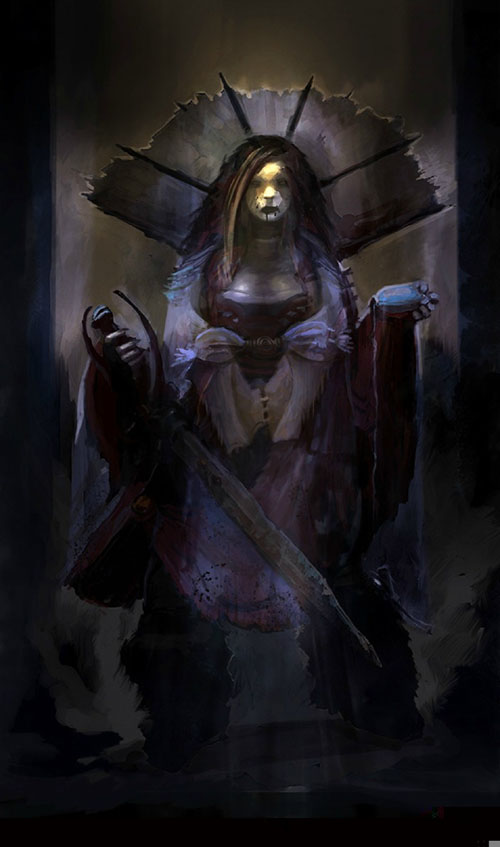
Alchemist Witch – Alex Drummond

The image of the game often seems to be “Conan and Merlin adventuring in Middle Earth”. But in my campaigns the strange vistas, cyclopean mysteries, and byzantine darkness of Clark Ashton Smith, H.P. Lovecraft, and Jack Vance are an important part of the mix. And I wanted them to be part of the mix of artwork in Legends & Labyrinths, too.

This particular illustration seemed to just ooze the arcane; the alien; the weird. I don’t know what she’s casting, but it’s nothing pretty or pyrotechnic.

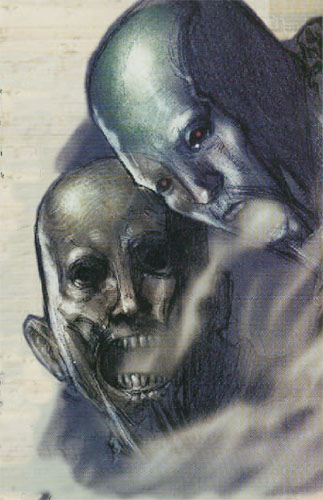
Way back in Dragon #285, James Jacobs presented the Breathdrinker: A creature of evil, elemental air that could silently steal the air from your very body. This is the illustration which accompanied the article–

Breathdrinker - Dragon #285

I was immediately struck by how delightfully creepy they were, and in my first 3E campaign two of them were sent as assassins to ambush the PCs in the night. (This was actually in retaliation for what the PCs had done In the Depths of Khunbaral.) As I wrote in my notes:

  • They come in the night.
  • Glowing red eyes. Silverish-gray skin, taut against bone. Translucent and insubstantial. Glide with utter silence.
  • One attacks the party member farthest from the guard. The other attempts to paralyze the guard one round later.

(If you really want to recreate the experience, I cued the encounter to track 26 on the Final Fantasy IX Plus soundtrack, which you can listen to here.)

A couple years later, the breathdrinker was picked up for inclusion in Monster Manual II. And I was like, “Of course they did. That’s an awesome monster and it gave me an awesome encounter.”

Here’s the illustration which appeared in Monster Manual II:

Breathdrinkers - Monster Manual II

Maybe this is an admission of shallowness on my part, but I don’t think I end up with my creeptacular encounter of eery, silvery forms if that illustration had been my introduction to breathdrinkers. (Actually, I suspect I would have skipped right over breathdrinkers and never given them a second thought.)

If you look at the history of mechanical design for roleplaying games, I think there’s a very clear arc:

(1) You start with games that have very specific game structure that has been placed into a wider “world simulation”. (The influence from wargames is clear here.)

(2) The level of detail in the world simulation begins to grow, but is still largely contained to clear game structures. (Basically, the desire to simulate reality found within the existing wargames community began to expand as the focus of the games expanded beyond the battlefield.)

(3) Generic games appear. In seeking to provide universal rules, however, these games actually end up stripping out the vestigial game structures that still existed in RPGs. (Reading contemporary documents, it seems pretty clear that people at the time weren’t really conscious of the game structures in RPGs. In fact, most gamers still aren’t.)

(4) Between the universal focus and the removal of game structures, the desire for simulation metastasizes. Throughout the late ’70s and early ’80s, every game that came out tried to graft on more and more detail, accuracy, and specificity. (For example, look at the first edition of Paranoia: Hilarious, evocative game universe. But the rule system is completely obsessed with detailed simulation.)

(5) Around the mid-’80s, however, you start to see the backlash. A growing body of games are being designed with deliberately simpler rules because other games have gotten too complex (this is even talked about in the rulebooks themselves). (I generally point to West End Games as an early instigator for this with Ghostbusters and Star Wars, but that may just be a perspective bias on my part.)

(6) The first wave of these “rules lighter” games generally just scaled back the rules while maintaining the same focus on world simulation, but by the early ’90s you start seeing some designers really embrace the rules-light movement by looking at radically alternative approaches. (Amber Diceless Roleplaying and other diceless games are a really noticeable part of this.)

The fallout from this, IMO and IME, was that the entire spectrum of RPG system design was basically open for business: We’d explored rules heavy, bounced back to rules light (now featuring unified mechanics), and now people were basically experimenting all over the place.

If there was a major trendline in the ’90s it was the boom of splatbook-universes (Torg, World of Darkness, Legend of the 5 Rings, Deadlands, Heavy Gear, Jovian Chronicles, Fading Suns, AD&D’s campaign worlds, and a ton of wannabes). As you hit the late ’90s, these product lines all burn out their supplement treadmills. Shortly thereafter you get the D20 boom and the STG revolution.

Tagline: Possibly the funniest gamer-related cartoon of all time, Knights of the Dinner Table has well-deserved its position as a cult classic. All true gamers should be reading this. Hoody hoo!

I would now give the title of “funniest gamer-related cartoon of all time” to the early strips of Order of the Stick. I have long since let my subscription to Knights of the Dinner Table lapse, but these early strips are still hilarious good fun.

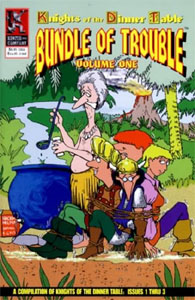
Knights of the Dinner Table - Jolly BlackburnAlthough this review purports to focus primarily on the reprint volume Bundle of Trouble it’s really going to be a general assessment of the Knights of the Dinner Table (KODT) strip as a whole.

KODT debuted in the pages of Shadis several years ago when its creator, Jolly Blackburn, was still serving as the editor of the magazine he had created. Jolly would eventually leave Shadis and KODT would make the transition to the back of Dragon Magazine. More recently KODT has become its own stand-alone comic/magazine and is now well over the twenty issue mark. The first few issues have become scarce and impossible to track down, which brings us to Bundle of Trouble — a reprint volume of the first three issues.

Although gamer-oriented comics have had a place in the hobby for years, KODT was the first strip to truly take the humor of those strips out of the game settings and place it on the gamers themselves. It focuses on the escapades of B.A. Felton, the GM, and his players: Bob Herzog, Dave Bozwell, Brian Van Hoose, and (more recently) Sara Felton (B.A.’s cousin). In addition, a large supporting cast has been established, including Gary Jackson (the creator of the HackMaster(TM) game); Nitro Ferguson (infamous for his LARP involving steam tunnels and college students); and Weird Pete (everyone’s favorite game store owner and Keeper of the Lore).

It has become clear over the years of KODT’s growing popularity and success that Jolly Blackburn has successfully tapped into the gamer’s consciousness. His strips repeatedly strike far too close to home not to elicit peals of laughter while raising the question, “Where has he hidden the camera he’s filming my gaming group with?” Again and again Jolly succeeds at pinioning the classic stereotypes and realities of gamers in a hilarious fashion. His quirky, amateur style – which he constantly pokes fun at himself – only serves to heighten the effect. It has well-deserved its reputation as a cult classic and is quite possibly the funniest gaming-related comic every produced. All true gamers should be reading this strip, and Bundle of Trouble would be an excellent place to start.

Hoody hoo!

Style: 5
Substance: 5

Author: Jolly Blackburn
Company/Publisher: Kenzer & Company
Cost: $9.95
Page count: 96
ISBN: n/a
Originally Posted: 1998/12/14

No offense to my former self, but this is a terrible review: It summarizes content without explaining why the summary is significant, and it spends far too much time saying “it’s really funny!” without explaining why I think it’s funny. It starts to pull itself together in the last paragraph, but then abruptly stops instead.

Ah, well. Can’t win ’em all.

On the other hand, I am going to go pull my collections down off the shelf.

For an explanation of where these reviews came from and why you can no longer find them at RPGNet, click here.

Archives

Recent Posts

Recent Comments

Copyright © The Alexandrian. All rights reserved.