Tagline: Compared to the first installment, Passage Through Shadow works even better as a basic story and premise and has solved many of the problems which flawed the first. However, there are still some significant flaws – particularly in the first of the two scenarios.
Note: This product is a module. In the following review there will quite likely be spoilers of various sorts. Don’t say I didn’t warn you.
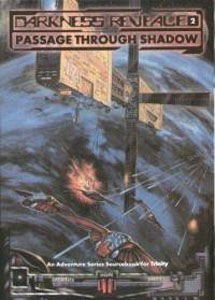 Those of you reading my review of the first installment of this adventure trilogy (Darkness Revealed 1: Descent into Shadow) know that I had two main problems with it: First, although the basic conceptual idea and story were excellent they were adapted into module form in a sub-standard fashion. Second, the design principles behind the color insert sections were extremely flawed and had the potential to ruin the gaming experience if used in the manner intended. The overall product was salvageable simply because the basic conceptual idea and story were excellent – although requiring slightly more work than should be needed, you can transform what is a fairly railroaded set of adventures into an excellent set of first-condition adventures.
Darkness Revealed 2: Passage Through Shadow, happily, is an improvement. The basic conceptual idea and story remain excellent, drawing the PCs into an even higher echelon of the Trinity universe. The color sections, while still possessing some doozies, are much more reliable. And, although the first adventure still possesses some flaws, the second is really excellent.
Like the first, the value for $15.95 compared to the $20 and $30 products emerging from other publishers is fantastic. Highly recommended.
THE COLORED SECTIONS, REDUX
Okay, the weakest part of this product remains the colored sections. Designed to be handouts to the players they still possess the physical flaw of being located in the middle of vast tracts of GM-only information – meaning that only by tearing your book into pieces or by expensively color copying will you really find value here.
Fortunately, however, you’re never going to want to give these handouts to your players, so that basically solves your problem. The first color section is definitely the worse of the two, among its faults:
1. Presented as a mission briefing for the character’s new assignment it contains memos of people discussing the character’s arrival at their new assignment.
2. The entire course of the investigation is telegraphed and revealed: Basically the players know exactly where they’re supposed to be looking and, generally, what they’re supposed to be looking for. Why? Because the colored section gives briefings on all the important areas… and only the important areas. More general information, like floor plans, would be more appropriate than secret communications which should, rightfully, be discovered during gameplay.
3. A central question of the PC’s investigation should be, “Is Basel, the location of our assignment, involved in this conspiracy plot?” This is rendered into a no-brainer, however, because on pg. 13 of the handouts we read a “Huang-Marr Project Briefing” recovered from “Aesculapian databank [Basel]”.
4. Another central question is whether or not high-ranking officials are involved or not. Again, pg. 13 not only gives that away – it gives a list of names!
5. I have serious suspension-of-disbelief problems where a funeral for one of the NPCs in the first adventure is interrupted as dissidents stomp all over his grave… AND NO ACTION IS TAKEN TO STOP THEM.
The second color section errs far less (largely because the GM is instructed in the text of the adventure to reveal certain sections only at certain times during the game). The only serious problems are:
1. At the beginning of the adventure the PCs have no idea they will eventually end up on the orbital station Eyrie. For some reason, however, their briefing file contains an extensive report on the station.
WHAT HAVE THEY FIXED?
The most noticeable problem they fixed is that the adventures no longer seem too brief to consume an evening of gaming. One reason which may be trotted out for this is that this book only contains two adventures, instead of three. More essential in my mind, however, is the fact that they’ve fixed a more pressing problem: The plots are no longer railroaded. Railroaded plots take longer to explain (because you not only need to express initial conditions, but also exactly how the adventure will progress at each step), and tend to have gaping holes in their design (because they require leaps of PC intuition that, in my experience, rarely happen at the scripted moment).
The first adventure still suffers from this slightly (the most telling example being that the adventure assumes that the PCs will make no concerted effort to get in touch with their major lead at the clinic they’re visiting until he comes into work the night after they arrive), but the second avoids it completely.
So they’ve fixed my major beef with the first product, which is that the mysteries don’t operate as mysteries.
CONCLUSION
In addition to solving the problems of Descent into Darkness, Passage through Shadow has all of its strengths: A strong story, great artwork, high production values, an attention to detail, and focus on PC involvement. Not only that, but if you’re the kind of GM who likes to have your PCs operating at the highest levels of the campaign world, then the Darkness Revealed trilogy is definitely an elegant way of going there – the first volume lets the PCs into this rarefied world by a lucky break, and the second expertly develops that break into major sociopolitical importance (a key sign of how effective this volume was, is that when the PCs meet and work with the Orgotek Proxy it seems like a natural result of the events which have transpired – unlike many such cases where PC-involvement with important setting figures seems forced and artificial).
So that’s my conclusion: Although it still needs some minor work and modification, I definitely recommend it, particularly since it only costs $15.95. Excellent product.
Style: 4
Substance: 4
Author: Bruce Baugh and Richard E. Dansky
Company/Publisher: White Wolf
Cost: $15.95
Page count: 120
ISBN: 1-56504-752-4
Originally Posted: 1999/01/24
Read the review of Darkness Revealed 3: Ascent Into Light
For an explanation of where these reviews came from and why you can no longer find them at RPGNet, click here.