The Alexandrian

Archive for the ‘Roleplaying Games’ category

The Names of Legend

March 2nd, 2015

Names of Legend - Wordle

This article originally appeared in Pyramid Magazine on July 23rd, 1999.

When a character is in the process of being created it is a rather magical period of time. The most proficient members of our hobby are able to breathe so much life into their characters that they seem to actually inhabit the bodies of their players while the game is in action.

However, the half-elven archer who is tortured by the fact of his heritage and was torn from his mother and rejected by his father when the truth was first learned — while being an exciting and interesting character to play — is all too easily spoiled by a name such as: “Ron the Archer”. Somehow it just seems to lack an essential ephemeral quality.

An engaging, exciting, entertaining, and original name for characters in a fantasy universe has become essential. “Gregory” dims in comparison to “Fairyleaf” or “Dewdusk”; “Stewart” becomes shallow when held up to names such as “Aldervan” or “Floaic”.

But there are no sources from which to draw these names and I have, more than once, had the character creation process halted by the fact that I cannot find an appropriate name for a character. Even fantasy literature does not aptly serve this purpose, because if you have seen one “Aragorn” you have seen them all.

The task becomes even more daunting for the aspiring Game Master. He must, literally, populate his world with thousands of NPCs and the one bad memory of “Bob the Butcher” will leave a much greater impression upon his players than a hundred characters with interesting and original names will ever do.

This problem is one unique to the gamers of fantasy. If you are playing a campaign on the modern or futuristic scales names such as “Donald” and “Blake” do not appear incongruous with their surroundings, and “Arthur” is a fine name for a historically-based medieval campaign. Fantasy, on the other hand, is a world of primitive wonders that are completely unearthly in their scope and nature. This inspires us to come up with equally unnatural and magical names to the mirror the world in which the individuals who bear these names live their lives. Fantasy worlds are the domains of Fafhrds and Alustriels… somehow it seems the only proper thing to do.

This article strives to alleviate these problems from the backs of fantasy gamers by providing sources you may not have thought to consult, as well as some basic ways to start the creative process when the block occurs.

HISTORICAL TEXTS

Historical texts are an invaluable source for names. Although many are cluttered with more common names such as “John” or “Margaret” you can often caches of treatises which deal in totally foreign names.

J.R.R. Tolkien used historical papers and names extensively. The names of the thirteen dwarves from The Hobbit are lifted verbatim and in order from one of the Icelandic sagas.

Even the common-sounding names from historical papers can often be fancied to one degree or another to produce a usable fantasy name of some sort. For example, while “Thomas” is rather mundane you can easily make it of the female persuasion (“Thomasine”) and end up with a name that is not commonly used.

LEGENDS AND FAIRY TALES

Naturally enough, from this sort of material, you will be able to reap great rewards in terms of names. Although many of these tales employ common names of the time period, it is not hard to find names (usually in the more mystical sections of the story) that will spark your creative skills.

Often you will find good sorts in foreign tales, as names are not typically translated. Therefore you can draw greatly from common names, so long as they are not common to the people with who you are playing.

It is also advised that you avoid well known material. Having the captain of the Lich’s guard named “Neibling” is probably not the best way to come off as witty and an intelligent to your peers; similarly the elven archer who has lost his royal title and is named “Robin” is not going to instill coos of delight at your originality. Therefore avoidance of tales in the ilk of Robin Hood or King Arthur is heartily suggested.

FANTASY FICTION

Although the last names of your peers may seem boring and commonplace, it is more likely because you have become overexposed to them. There are many uncommon last names with a feeling of unearthliness attached to them, and if employed correctly even your local phone book can be applied to naming your NPCs.

If you have a large library of novels and other works it is suggested that you look at the last names of some of the lesser known authors. Names such as “Gillard” and “Amend” strike me as perfect for the use being discussed. Even slightly more earthly names such as “Blish”, or names that seem just slightly unusable, can be changed in various manners (see the Syllables sections below) to suit your purpose.

It is also suggested that you get in the habit of looking at the credit pages of large books. If you look at the front of a TSR book you will get a listing of everyone from the CEO to the artists to the actual writers of the work. A massive collection of names, any one of which may be fascinating for you.

To stress this point again (and I do not believe it can be understressed): Do not use the last names of popular authors. If you add characters such as a fearsome fighter of unparallelled strength known as “Asimov” or a butcher named “Gygax” the popularity of your campaign may be drastically reduced. The author of this article takes no responsibility if this warning is ignored.

COMBINATIONS

If you are in a rush a cut and paste method may best fit your tastes. By this I mean that by a combination of two different sections of text from a work (or two different works) you may be able to come up with something completely original.

For example: Paging through a handy science fiction novel I spot two names I rather like, Bryce and Nicolai. I quickly paste them together and my character becomes known as Nicolai Bryce.

Try to make it compositionally sound; “Richard Andrew” just doesn’t make the cut.

Do not let yourself be limited to just fantasy authors. If you employ this method in combination with the Last Name method above you’ll find great success: modern fictional characters can have exciting last names just as easily as real people. The only thing to remember is our prime directive: No popular works (and thus, in this case, characters). Therefore “Gandalf Bilbo” is probably not the wisest thing to attempt.

GAMING SUPPLEMENTS

Gaming supplements may seem unlikely places from which to draw material from names — especially if you are playing the game in question — but, if done properly, the supplements game companies produce are invaluable assets.

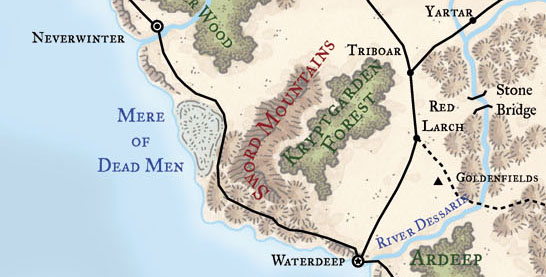
If you are running the campaign on the fly, either because the PCs have taken off in an unexpected direction or you simply had nothing prepared, and you want them to enter a village, but have no name for it my suggestion is to open one of the game worlds produced by game companies. This process works for any locale name, from cities to mountain ranges, so long as you avoid the more popular names which are immediately recognizable.

SUGGESTED

GM: The dust billows up around you as you walk down the dusty road. A rickety old sign off to the side says “Sourlode”; some short figures, probably dwarves, are milling about an old mine entrance about a half mile away.
Player: Wow!

AVOID LIKE THE PLAGUE


GM: Alright, you’re in Waterdeep–
Player: So this campaign is in the Forgotten Realms?
GM: No, I just stole the name.

This method even works effectively for NPCs; so long as you avoid Elminsters and Raistlins you should meet with successful results.

BABY NAME BOOKS

Although the vast majority of the space in these tomes are filled with commonplace names such as “Betsy” and “Frank”; one of my best characters — Darwara — was named from one such book.

It may take a little bit of time to find an appropriate name, but if you are completely out of ideas or simply want to browse for awhile you may uncover simply wonderful and awe-inspiring names that you never would have considered. Render all options fully available to yourself; leave no stones unturned and no doors unopened.

SYLLABLES, METHOD ONE

The modern world as we know it is a mass of written material. Even the radio, a purely sound based invention, will have written characters upon it. At this very instant there is 100% chance that there is written material within your line of sight (since you are reading this I figure this is a pretty safe bet).

Each word in the English language is broken down into syllables — one or more for each word. This also applies to names. If you find a string of syllables and arrange them in an audibly appeasing fashion chances are that you will end up with a name fully usable for a fantasy character.

To exemplify an this procedure: I have an AD&D handbook close at hand. Across the room is a shelf of Star Trek novels. From those five words (Advanced, Dungeons, Dragons, Star, Trek) I can construct the name of “Adarun”. I drew the syllable “ad” from “Advanced”; the syllable “ar” from “Star”; and the syllable “un” from “Dungeon”.

This procedure can be applied to any written material you may have at hand. The name “Procan” is drawn entirely from two words in the previous sentence, considering how many words fill up this magazine there are a nearly infinite number of names you could conceive from the combination of varying syllables throughout.

Considering that there must be some written material at the game table in order for the game to be played, it should not be vastly difficult to come up with names on the fly with this method.

SYLLABLES, METHOD TWO

The first step you must take in applying this method is finding a base word; usually this is the sort of thing you can simply pick out of thin air. From this base word you change syllables incremently to similar sounds, or delete them entirely until you come up with a name which you enjoy. It takes me approximately ten seconds to run through the whole process (on average) in my head.

For example:

Ravenloft
Cavenloft
Cavloft
Covloft
Covlaft

And you have a completely original name that is unlikely (if not impossible) for anyone to trace back to its roots in the word “Ravenloft”.

CONCLUSION

I can only hope that this article finds its way into the hands of at least one Gamemaster who will find some use for it. Who will be able to improve his campaign, reduce the guffaws from his players as NPCs with generic names gain center stage, and add the essential elements to the atmosphere of his campaign that creative and correct naming processes can accomplish.

This article was my first professional sale. In fact, it was almost my first professional sale twice over: I sold it to Shadis Magazine, but it remained unpublished when Shadis went on permanent hiatus in 1998. When it became clear that Shadis wasn’t coming back, I sold it to Pyramid Magazine. (In the interim, however, I had sold a book to Dream Pod 9 that was never published.)

Reading it now, I find myself cringing a lot at how overwritten it is. The core of the advice remains pretty solid, though: The syllabic methods remain my go to solution for cranking out alien/fantastical names. (I will note, however, that I find my younger self’s intolerance of names like “Gregory” and “Thomas” for fantasy characters completely inexplicable.)

Semi-interesting note about the byline here: This article was originally published under the name “Justin Bacon”, which was the same name my RPGNet reviews had been appearing under. (At the time my legal name was “Justin Alexander Bacon”.) Shortly thereafter, however, I decided that I wanted to drop my last name and simply be “Justin Alexander”, so I asked Steven Marsh (the editor of Pyramid) to change it. Thanks to the glorious flexibility of digital publishing, this was easily done. Unfortunately, a few months later Dream Pod 9 screwed up the Jupiter Planet Sourcebook for Jovian Chronicles and published the book (my first book!) under the name “Justin Bacon”. I reluctantly decided to accept the fait accompli and went back to Steven Marsh and asked him to swap my article credit back to “Justin Bacon” with the intention of using it for all my future RPG work. (Later I took a hiatus from the industry and when I came back I decided to reverse course once again and fully embrace the name “Justin Alexander” for all of my work, for better or worse.)


Tagline: A great bargain for a wealth of material, and a wonderful little taste of history.

Dragon Magazine ArchiveAllow me to salivate.

The Dragon Magazine Archive collects, on five CD-ROMs, the first two hundred and fifty issues of Dragon Magazine, as well as all seven issues of The Strategic Review (the house organ which Tactical Studies Rules published prior to Dragon). It thus collects more than twenty years worth of material – thousands and thousands of pages of the finest roleplaying material ever set to paper.

For forty bucks. (Some places are selling it for as much as $70 – don’t let ‘em fool you. Amazon.com is selling it, here, for $28.)

So, like I said: Allow to salivate.

Elsewhere on RPGNet I have written a lengthy “100 Issue Retrospective” which covered the magazine from Issue #162 (the first issue of Dragon I ever owned) through to #262 (the most recent at the time I wrote the retrospective). In it I discussed at quite some length the merits and history of The Dragon, and I heartily encourage you to take a look at that for more background information concerning the magazine.

To summarize my feelings, I consider Dragon Magazine to be one of the most significant icons in the roleplaying industry – and certainly one of the most enduring. I remember well removing the subscription card from my red-boxed Basic Set of D&D (hands up everyone who was introduced to roleplaying through that nostalgia-ridden product), mailed it in, and waited with eager anticipation for my first issue to arrive in the mail. When it did, I felt instantly connected to a larger world of roleplayers.

Because so many roleplayers are introduced into the industry through some form of Dungeons & Dragons, and because it is a natural progression to purchase a subscription to Dragon (particularly in the years when TSR was advertising the magazine in the introductory sets of their games), I imagine this is feeling which I share with many others. To a very real extent, Dragon (like D&D itself) serves as a major portal into the hobby of gaming.

Thus the Dragon Magazine Archive, in addition to providing you with an amazing wealth of material, lets you take a peek into what was passing through this gateway in years past. For years when you were in the hobby (particularly the early years), it’s a nostalgia trip of immense proportions. For the years when you weren’t, it’s a glimpse into an “arcane past” which is fascinating and invigorating.

But, lest we forget and assume there is nothing here but nostalgia, let us remember that within this archive you will find thousands of articles and reviews and columns. You simply cannot find a better bargain, in terms of a dollar-to-content ratio, then you will find in this package.

FAVORITE BITS

Despite owning the Archive since my birthday (about four months now), I’ve been able to do little more than skim through the thinnest layer of material – most of it concentrated in the earliest years of the magazine. As a small sampling, let me point out some of my favorite bits:

Strategic Review #1: After a lengthy discussion of spears in man-to-man combat, Gary Gygax writes: “Coming Next Issue . . . POLE ARMS, and Their Relationship to CHAINMAIL.”

Maybe I’m just warped, but I found this intrinsically amusing. (If you have no idea why it would be, you’re just too young.)

Other notable “before they were famous” moments including one of the earliest discussions of the dual-axis alignment system (complete with the diagrams that would later crop up in first edition). My favorite, though, is the article of random dungeon design (for solo play) which would later serve as the basis for one of the most famous sections of the 1st edition DMG.

One of the first things most people will take a look at when they get their hands on the Archive is the very issue of Dragon — and with good cause. It is a major milestone, and I have met old hands who divide the entire history of roleplaying (at least during the first couple of decades) into “before Dragon” and “after Dragon”.

The very first words of the editorial content of The Dragon are: “This issue marks a major step for TSR Hobbies, Inc. With it, we have bid farewell to the safe, secure world of the house organ, and have entered the arena of competitive magazine publishing.”

I don’t think I’ve ever read anything so unintentionally hilarious in my life.

Perhaps the most valuable resource I found in the Archive were the early Tékumel articles – articles which are otherwise very difficult to obtain. While they wouldn’t fully justify the cost of the Archive, except for the true Tékumel fanatic, they come awfully close. Easily worth $10-15 to anyone with the slightest interest in Tékumel, which doesn’t leave a lot of the purchase price left to make up with everything else. (I have posted a review of Tékumel elsewhere on RPGNet.)

Any summary of the Archive would not be complete without perhaps the most noteworthy inclusion:

Wormy!

SnarfQuest and Yamara, the other two comics of serious note in Dragon’s history, in my opinion, have been published in collections, but Wormy never has (because it’s creator simply disappeared). (I believe the Yamara collection is still in print from Steve Jackson Games; while a new (and more complete) SnarfQuest collection is on its way from Dynasty Publishing – which will also be publishing new(!) SnarfQuest strips in their Games Unplugged magazines. But I digress.)

Wormy is one of the most memorable icons of the gaming industry, and has long been unavailable in any form. Now, at last, it is possible to read the strip in its entirety at an affordable price. If the Tékumel articles almost make the Archive worth the price all by themselves, then Wormy definitely has the cover charge under control.

PROBLEM PARTS

Every single problem with the Archive can be summed up in one word: Interface.

The interface, quite frankly, sucks. It’s not just bad, it’s atrocious. The pages take too long to turn, the general controls are unintuitive to the point of stupidity and are sluggish to respond. The provided Table of Contents for several issues is screwed up (although you can always just look at the magazine’s contents page and work from there).

For a product like this, printing is of the utmost importance – but here the problems seem to multiply. I routinely had the printer simply print blank pages. And, unless you set the printing to grayscale, the program will print the black ink by using your color cartridge to print all the colors in the spectrum (a massive waste of expensive ink). Plus, they don’t have the page numbers of the digital document match up with the page numbers of the actual magazine (because they don’t take the simple step of not counting the cover and inside cover as pages).

Worse yet, though, this monstrous program takes up 40MB of RAM! It slows any attempt to multitask down to a crawl.

Bah.

Fortunately, all of the magazines are presented in Adobe Acrobat format and thus, with their free viewer, you can access them directly and without any problems – bypassing the clunky interface entirely. (Although you may still occasionally use the program for the search engine it employs – which quickly and efficiently searches through the entire collection.) There’s still no way to bypass the faulty page numbering (because that’s embedded in the document format), but at least in the Acrobat Reader the digital page numbers are displayed right on the screen – so that you won’t be reduced to guessing how large the off-set is for this particular issue.

CONCLUSION

The Dragon Magazine Archive is a fantastic bargain. Don’t pass it up.

Style: 3
Substance: 5

Author: Various
Company/Publisher: Wizards of the Coast / TSR, Inc.
Cost: $40.00
Page Count: Unfathomable
ISBN: 0-7869-1448-3

Originally Posted: 2000/03/21

“Worse yet, though, this monstrous program takes up 40MB of RAM!” … speaking of things rendered hilarious through the benefit of hindsight.

The Dragon Magazine Archive remains one of the best bargains in the history of gaming. And that remains true even though it’s currently priced at $155 on Amazon.

For an explanation of where these reviews came from and why you can no longer find them at RPGNet, click here.

Go to Part 1

And at long last, the Hexcrawl essay draws to a close. As a final parting gift, I offer up two cheat sheets for running your own hexcrawls.

The Basic Cheat Sheet offers the stripped down core of the game structure. If you occasionally found your eyes glazing over during the previous 12 installments, this is probably the cheat sheet for you: Just basic navigation, encounter checks, and hex movement.

The Advanced Cheat Sheet is the full package: It includes the full watch checklist, the robust encounter system, the ability for characters to become lost, all the modes of travel, terrain modifiers, foraging rules, and tracking. The whole nine yards. (The tenth yard is the one where you make an awesome campaign out of it.)

Of course, you can also selectively pick-and-choose from the advanced elements, deciding what stuff you want to incorporate into the basic system.

Hexcrawl - Basic Cheat Sheet

(click for PDF)

Hexcrawl - Advanced Cheat Sheet

(click for PDF)

Addendum: Sketchy Hexcrawls
Thinking About Wilderness Travel

FURTHER READING
Thought of the Day: Hexcrawl in the Underdark
Check This Out: Hexcrawl Tracks
Check This Out: Hexcrawl Sighting Distances
Game Structures
Thinking About Urbancrawls

Go to Part 1

This will be the final installment in this essay series. My goal here will be to describe the actual process of what I do at the gaming table while running a session of my Thracian Hexcrawl. I’m not entirely sure how useful it will be, but I”m hoping it will provide some sort of insight.

This post is going to be an attempt to provide an abbreviated, annotated record of actual play from my hexcrawl campaign. The goal is to show what I was thinking, the decisions I made, the procedures I used, the tools I exploited, and so forth.

SETUP

An hour or so before the game is scheduled to start, I’ll set up the table.

I sit at one end of a long dining room table. I place a TV tray to the left of my chair and another TV tray to the right of my chair. Then I pull out the box that I keep all my Thracian hexcrawl material in.

On the TV tray to my right I place the Binder that contains the campaign key and the Folder which contains the documents detailing individual locations.

There’s a second folder which contains a DM screen, the four pages of reference tables that I paperclip to the DM screen, a copy of the campaign map, and several copies of the DM’s worksheet I designed for hexcrawling. I place the worksheet on the table in front of me. I place the DM screen on the TV tray to my left. And I conceal the campaign map behind the DM screen.

Next, the rulebooks: I have several copies of Volume 1: Men & Magic that I place in a stack on the table for the players. I take my copies of all three OD&D booklets and place them in a stack behind the DM screen to my left.

I also have a stack of graph and hex paper, including several “communal maps” that have been drawn by the players. These are placed on the table.

I also have a stack of three folders: One for blank character sheets, one for living characters in the campaign, and one for characters who have died. I place these folders on a counter off to one side of the room. (I rarely need to access them, so it’s easiest just to have them out of the way.)

I print out a copy of the Campaign Status sheet for the current session and also place it on the table in front of me.

I grab my dice bag and pull out the dice I need: 2d4, 6d6, 6d8, 2d10, 2d12, 6d20. 6d6 for fireball and lightning bolt damage. 6d8 because it means I can roll an entire day’s worth of encounter checks in a single go. 6d20 because I can simultaneously roll an entire mob’s attack rolls. (The 6d20’s are selected in three pairs of matching colors because it allows for easy grouping for mixed types.)

BEGINNING OF THE SESSION

As players arrive, I pull their character sheets out of the appropriate folder. Many players need to choose which of their active PCs they’re going to be playing.

Two things happen at this point:

  1. I make a rumor check for each primary PC (not for hirelings). There’s a 1 in 3 chance for each PC that they’ll receive a rumor. (The current rumor table is part of the Campaign Status document. It’s generated based on the activities of PCs in previous sessions and by randomly generating hex numbers and creating rumors based on the contents of the generated hex.)
  2. I make a morale check for each hireling employed by the active PCs. On a success, the hireling continues adventuring with their employer. On a failure I use a system based on the OD&D reaction table to determine the hireling’s action: They might automatically leave their PC’s service or demand an additional bonus of some variable amount. (Usually nothing happens because the players have learned to keep the morale of their hirelings high.)

I keep a master list of every hireling in the campaign — including their current loyalty and morale values — in the Campaign Status sheet.

While I’m doing this, the players are generally getting prepared for the adventure. This includes:

  1. Discussing what their expedition is going to be.
  2. Buying equipment.
  3. Hiring hirelings.
  4. Any other business they might need to attend to while in town.

If they go looking for hirelings, I have a simple system I use to determine how many hirelings are currently available for service in town; what classes they are; and what level they are.

STARTING OUT

While the players are wrapping things up, I’ll grab my 6d8 and roll them: Virtually all of my regions use a 1 in 8 encounter check. Each roll, therefore, represents a full day’s worth of encounter checks (since there are six watches in a day). By reading the dice left-to-right as they fall, I can very rapidly determine which watches in the day have an encounter. Since I don’t yet know where the PCs will be on those days, I can’t generate the specific encounters (which are region-dependent). But on my DM’s worksheet, I can write down the Day/Watch when encounters will be happening. By generating three or four days worth of encounter checks up front, I can simplify my workflow once the PCs hit the road.

(Note, however, that if I know at this point that the PCs are going to be heading in a direction which will almost certainly have them traveling through a given region for a lengthy period of time, I can also go ahead and generate full encounters at this point.)

Maernath - Thracian HexcrawlIn this case, the PCs are in the city of Maernath, located in hex O6. Maernath is an old city-state in this setting. It was here long before the Duchy of Thracia began pushing east in recent years (establishing the Keep on the Borderlands and the logging village of Caerdheim to the south) and the City Fathers occasionally chaff against the “authority” of the newcomers. Although the early adventures of the PCs were based primarily out of Caerdheim (which was near the Caverns of Thracia), an increase of interest in the Palace of Red Death to the north led to an increased number of expeditions being mounted from Maernath. Those expeditions resulted in various PCs gaining a lot of lore about the area surrounding Maernath and that, in turn, spurred even more expeditions here.

The PCs leave town along the road heading south. They’re lightly encumbered (12″ movement) and they’re traveling along a road through open plains, so they can travel 12 miles per watch. Maernath’s position within hex O6 is biased, so it only takes 4 progress to exit the hex. They’re aiming for the river, which is on the road right on the border of the hex (so they obviously have no difficulty finding it).

Their goal is to follow the river into the Old Forest (in hex P7), so now I’m going to look ahead: Their course along the river takes them through the near side of the hex (6 miles away) into hex P6 and from there they will then pass through the near side of hex P7 (another 6 miles). Although they’ve left the road, they’re still traveling through open plains and the river provides enough of a track that they’re still traveling at 12 miles per watch. Total it up:

4 miles (Maernath to river) + 6 miles (O7 to P6) + 6 miles (P6 to P7) = 16 miles

Which means they’ll arrive at the edge of the Old Forest a little over an hour into their second watch. This is notable because, looking at my DM’s worksheet, I can see that the second watch of the day has an encounter. I can determine the time in the watch by rolling 1d8. The result I get is a 3, which basically means the encounter is scheduled to take place just as they’re reaching the edge of the Old Forest.

1. First, there’s a 50% chance that the encounter will be the location keyed to the hex. I roll the dice and it is not. (If it had been and they were traveling through open country, I would flip to the location key and they would have that encounter. In this case, however, they’re following the river: Unless the keyed encounter for this hex was on the river, they would not encounter it. That would either result in no encounter happening despite the check or they might experience an encounter connected to the keyed location. For example, the keyed location for P6 is Orkam’s Hole, which is inhabited by a family of basilisks, so they might spot basilisk footprints in the muddy banks of the river.)

2. If the PCs are in a hex bordering another region (and they are), there’s a 50% chance that they’ll get an encounter from the other region instead.

3. I roll a 13, so that’s exactly what’s going to happen.

4. I flip to the Old Forest encounter table and roll. The result I get is “Slimes”, which has a sub-table which generates Gray Ooze. The slimes don’t have any % chance of being a Lair or Tracks encounter, so I can skip that step.

Given the confluence of all the factors involved, I’m going to have the Gray Oozes appear just as the river passes beneath the boughs of the Old Forest. They’ll be draped down from the tree branches above the river like some kind of horrific spanish moss.

INTO THE OLD FOREST

Forest River

After the PCs have dealt with (or avoided) the Gray Oozes, they’ll be able to continue along the river. It’s a medium forest and their speed is going to drop by 1/2. They had 8 miles of movement left in their second watch, so they’ll be able to gain 4 progress through hex P7.

Three miles along the river, however, they come to a tree on the south bank of the river with the Dwarven letter “mu” carved into its trunk. They’re familiar with it. In fact, one of the PCs left it here as a marker: Gordur, a powerful orc stronghold, lies several miles due south from this spot.

This, however, is not their goal. They continue along the river for another mile and then make camp for the night. The next day, they continue another two miles until they find a similar tree with the Dwarven letter “thod” carved into it. This marker was placed due north of the Crypt of Luan Phien. The crypt is their ultimate goal and so now they turn south, away from the clear navigational marker of the river and into the depths of the Old Forest.

At this point, they need to start making Navigation checks. Epicaste, a hireling rescued by the dwarf Aeng from the Caverns of Thracia, is the group’s best navigator, so she steps forward and takes point.

1. It’s a medium forest, so the Navigation DC is 16.

2. Epicaste blows the check. (Possibly because Delmhurst, another hireling, keeps second-guessing her.) I roll 1d10 to determine the group’s veer. With a roll of 8, I determine that they’re veering to the right. Instead of heading due south into hex P8 (which is where they want to go), they’re going to end up in hex O8.

When does that actually happen? Well, they entered hex P7 from due north. Whether they’re leaving into hex P8 or O8, they’re still exiting through the far side of the hex. So they need to rack up 12 progress to exit the hex. They’d gained 4 progress in the hex during their second watch; they’ll gain another 6 progress in their third watch of travel (the following day), and they’ll enter hex O8 about midway through the second watch of that day.

I’ve also generated an encounter for the second watch of the second day, so once again I generate a random time and determine that the encounter will be taking place after they’ve entered hex O8. This is particularly important because this time the encounter I generate is a location encounter, so I flip to the key for O8:

Me: “Towards the waning hours of the day, you enter a small clearing. Criss-crossing branches grow into what appear to be houses with walls of woven moss.”

Aeng: “I don’t remember this.”

Delmhurst: “I think the thousand-year dummy has gotten us lost again.”

It turns out the strange houses are empty and abandoned. It’s getting late in the day, so the PCs decide to make camp here for the night. They’ll try to backtrack their trail the next day and figure out where they made the wrong turn.

 CONCLUDING THOUGHTS

 And that’s basically all there is to it. With a strong key and a clean procedure, the hexcrawl will flow naturally in response to the explorations of the PCs, drawing them deeper and deeper in to the mysteries of the wilderness.

Although this is the final essay in this series — and the end of my thoughts on hexcrawls (at least for the moment) — there will be one final installment containing system cheat sheets for hexcrawling.

Go to Part 13: Hexcrawl Cheat Sheets

Yesterday I posted a scenario for Numenera called “The Last Precept of the Seventh Mask“. The scenario features multiple religious sects fighting for control of the body of the Seventh Mask (a religious leader denoted by the strange, mask-like biotech growth which extrudes from their face). The basic idea is that the PCs will approach the camp of one of these sects, get hired to protect them on their journey to the aldeia of Embered Peaks, and then be forced to deal with the other factions in an orgy of violence and collusion and zealotry.

But when I ran the scenario? That’s not what happened.

THE STARSCRIPT CAVERN

The Narthex - Numenera

The PCs in this campaign have been traveling around inside the Narthex. You don’t need to know much about the Narthex except that it’s bigger on the inside than the outside and that it teleports semi-randomly around the landscape of the Ninth World. (If you want to basically think of it as a TARDIS that doesn’t travel through time and can’t leave the planet its currently on, you wouldn’t be too far wrong. Except this particular TARDIS is populated by a group of religious zealots that the PCs have inadvertently ended up being in charge of. But I digress.)

For this particular scenario the Narthex was going to appear at a location they couldn’t predict. It was important, therefore, for the local resident expert to look at the starscape above their arrival point to figure out where they had ended up. When they emerged from the Narthex, they found themselves inside a giant cavern with walls covered in ancient runes that glowed with a faint silver light. The starscript writing described the Narthex as a holy relic, but whoever had worshiped the Narthex here was long dead and gone.

As they emerged from the cavern, however, to gaze up at the stars above, they saw the lights of a camp further down the side of the mountain.

RAVAGE BEAR DELIGHT

The camp itself was tucked out of sight behind some tall outcroppings of rock, but they could hear the distant sounds of the people who were resting down there.

The idea here should be pretty obvious: I expected them to go down to the camp. There they would meet the Bensal kokutai and Fassare would ask for their help in guarding the body of the Seventh Mask on its journey to Embered Peaks.

But that’s not what happened.

Instead, they decided to simply keep quiet, take their star readings, and retreat back to the Narthex.

So I checked my notes. What would happen next?

Well, a pack of six ravage bears was supposed to attack the Bensal kokutai encampment that night. So they did. The PCs heard the roar of the ravage bears (and identified them) as they rushed the camp.

Once again, the intention should be obvious: I expected the PCs to rush down to help the unknown campers. They could drive off the ravage bears and–

Nope.

The PCs had suffered a previous encounter with a pair of ravage bears and their bodies still bore the scars to prove it. Six of them? No, thank you. They rolled up their star charts and ran back to the Narthex with the screams of the ravage bears’ victims echoing in their ears.

IN THE MORNING’S LIGHT

The next morning the PCs came back out of the Narthex and went down to investigate the camp. The ravage bears had… well, ravaged it. Tents were shredded. Dismembered limbs and half-devoured bodies were strewn about. It was clear that several more bodies had been dragged away from the site.

The only incongruous element was the bier of the Seventh Mask, which I decided had been left undisturbed by the ravage bears. Two of the PCs — Laevra and Sheera — were incredibly creeped out by this and the biotech, mask-like growth on the corpse’s face didn’t help matters much. While Laevra, the nano, examined the mask, another PC — Phyros, a clever jack who employs magnetism — decided it would be funny to program his morphable mask to look exactly like the biotech extrusion. Laevra and Sheera, for their part, were largely unamused.

Laevra eventually concluded that there was still living activity within the biotech of the mask. The group fell into a debate about whether or not they should cut it off the corpse: Laevra had curiosity on her side. Phyros, for all of his monkeying about with the morphable mask, was legitimately concerned that it might be infectious or dangerous.

While this debate continued, I decided to have a group of Caral kokutai show up on their flying platform. Since the Caral kokutai had been stalking the Bensal kokutai, this made sense. I also thought it might offer me an opportunity to re-hook the scenario: The Caral were just as interested in transporting the Seventh Mask to Embered Peaks. Like the Bensal kokutai, the Caral kokutai would also be concerned by the other factions in the area and could easily ask the PCs for help.

Of course, that’s not what happened.

APOTHEOITES

Remember that Phyros had made his morphable mask look just like the Seventh Mask?

Yeah.

As the energy platform of the Caral kokutai swept down into the grotto, their initial hostility towards finding the PCs standing in the midst of the carnage melted away into confusion as Phyros presented himself as the Eighth Mask. This story wasn’t completely plausible: Generally speaking, the Eighth Mask — as a reincarnation of the Seventh Mask — should have been no more than a babe. But with an extremely glib tongue, Phyros managed to sow enough confusion to convince the Caral kokutai scouts they should bring their leader, Moora, to him. (It helped that he was able to spin the gory deaths of the Bensal kokutai as being some sort of “righteous fury” directed upon heathen unbelievers.) Then, with a major effect on a final persuasion role, he convinced them that there were secret rites he needed to perform with the body of the Seventh Mask in secret. That meant that all of the Caral kokutai left, planning to return shortly with Moora.

So what were the “secret rites” that Phyros needed to perform?

Well, as it turned out, they entailed grabbing the body of the Seventh Mask and hightailing it back to the Narthex.

Entering the Narthex, it should be noted, means taking a liftshaft (i.e., elevator) down into a vast, extradimensional space. Exiting the liftshaft, you enter the Nave: A seemingly bottomless (and topless) shaft crisscrossed with gantries and catwalks.

As soon as the PCs reached the Nave in this particular case, they hauled the Seventh Mask’s corpse out of the lift, sliced the mask off its face (revealing a featureless face of fresh, baby-like flesh), pocketed the mask, and then dumped the corpse over the railing into the abyssal darkness below while resolving not to leave the Narthex again until it had jumped to a new location.

THE END

The best part? This is the third time that Phyros has ended up falsely presenting himself as a religious icon or deity. He’s not even doing it on purpose!

There are probably a lot of GMs who would look at this sequence of events as a failure of some sort. The PCs “wrecked the scenario”. My preparation was “ruined”.

But if you take a moment to look at how I actually prepped this scenario, you’ll note that I was never actually wedded to a particular outcome. Instead, as I described in Don’t Prep Plots, I created a kit with a number of tools:

  • The starscript cavern
  • The kokutai culture and their religious beliefs
  • The corpse of the Seventh Mask
  • The Bensal, Caral, and Gatha kokutai
  • The chirogs
  • The ravage bears
  • The map of the local area

And while I would have liked to have gotten the Gatha kokutai and the chirogs involved, the reality is that most of those tools got used. Virtually none of them got used the way that I had expected, but the scenes that actually played out were really entertaining and insightful and memorable largely because they were unexpected. The table was filled with laughter and there were also some really meaningful questions asked about who they had become as individuals when they ran and left the Bensal to their fate.

Now, if I had invested a lot of time into carefully preparing schedules of ambushes for the road from the Bensal camp to Embered Peaks? Then I would have wasted a lot of time and had a lot of prep “ruined” by what happened. So I’m glad that I emphasized smart prep and trusted my instincts at the table to handle the rest.

Archives

Recent Posts

Recent Comments

Copyright © The Alexandrian. All rights reserved.