The Alexandrian

Archive for the ‘Reviews’ category

Babylon 5

Babylon 5 is one of my favorite TV series. In the late-’90s, when the series was being rerun daily on TNT, I would set my VCR to record each new episode before leaving for my nightly shift at Hollywood Video. When I would get home, I would immediately head to the TV, rewind the tape, and watch the next episode. It was absolutely compelling television.

With that being said, I’ve found it very difficult to convince people to try to the show. The difficulty is that the first season is fairly dreadful. Unfortunately, the first season also establishes a lot of stuff that gets huge payoffs later on. B5’s ability to manage its meta-arc — setting up material that gets paid off years later — is one of the things that makes the show great. And so I’m always loathe to tell people to just “skip the 1st season”, because I think that actually does degrade the rest of the experience.

So what I used to tell people was, “Just try the first season. Its got some rough patches, but it’s worth it for the payoff. If you just can’t stomach it, then skip to the second season.”

But most of those people would hit the first season wall, bounce off, and not bother trying the second season. The result was like being stuck in the Kobyashi Maru when trying to get people to give this amazing show enough of a fair shake for it to blow them away.

To that end, I prepared a viewing guide for the first season. It worked for my wife, so I’m declaring it a complete and utter success.

  • WATCH – Must watch to get essential arc developments. Some of these are mediocre, but it’ll be worth it for the pay-off. Trust me.
  • SKIP – These are the episodes which will probably make your eyes bleed. For the love of god, don’t watch them.
  • OPTIONAL – These episodes are decent or better. Some of them are very good.
  • OPTIONAL (CLASS 1) – These episodes are recommended for arc reasons, but not required. Basically, there’s nothing essential here, but there may be a few minor developments that will heighten your appreciation of later material.

Some of the Optional and Skip episodes on the list below include some key exposition. This has been indicated with a note where appropriate.

So if you’ve bounced off Babylon 5 in the past — or know someone who has — give it another shot and let me know how it goes. (And, seriously, if the first season is completely intolerable give the second season a shot.)

EPISODE LIST

  • The Gathering – WATCH
  • Midnight on the Firing Line – WATCH
  • Soul Hunter – Optional (Class 1)
  • Born to the Purple – WATCH
  • Infection – SKIP (1)
  • The Parliament of Dreams – WATCH
  • Mind War – WATCH
  • The War Prayer – Optional (2)
  • And the Sky Full of Stars – WATCH
  • Deathwalker – Optional (Class 1)
  • Believers – Optional
  • Survivors – Optional (Class 1)
  • By Any Means Necessary – Optional
  • Signs and Portents – WATCH
  • TKO – SKIP (3)
  • Grail – Optional (4)
  • Eyes – WATCH
  • Legacies – WATCH
  • A Voice in the Wilderness – WATCH
  • A Voice in the Wilderness, Part 2 – WATCH
  • Babylon Squared – WATCH
  • The Quality of Mercy – WATCH
  • Chrysalis – WATCH

NOTES

(1) – There is an organization known as Interplanetary Expeditions. They are reputedly a front organization for a bioweapons corporation.

(2) – Anti-alien sentiments on Earth are turning violent.

(3) The B-plot of this episode is good. If you’re feeling adventurous, skip any scene that doesn’t have Ivanova in it.

(4) There’s a ghetto called Down Below populated by Lurkers who came to the station looking for a better life and have fallen through the cracks.

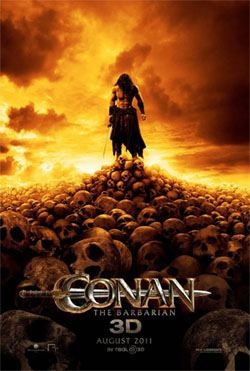
Conan the BarbarianI saw Conan the Barbarian a couple nights ago. Quick thoughts:

  1. It’s a much better movie than its box office.
  2. In fact, I’m comfortable saying that I think it’s a better movie than the Schwarznegger version from ’82.
  3. It is not, however, a great movie. It may not even be a good one. But it’s not a bad one, either. It’s a fun flick: It doesn’t insult your intelligence. The plot makes sense. The action sequences are dynamic. The script doesn’t carry much of the load, but it gets out of the way and lets the actors carry the load for making us care about the characters and the SFX guys carry the load for getting us immersed into the world.
  4. The biggest failing of the movie is the conclusion. It falls very flat and concentrates a lot of problems that were scattered throughout the rest of the film.
  5. It’s literally wall-to-wall action. It’s pretty much ACTION-breath-ACTION-breath-ACTION-breath-ACTION for the duration. I’d like to say that the movie would be better if it was 10 minutes longer and took a minute or two to catch its breath, but that would really only be true if they brought somebody in to punch up the dialogue.
  6. Momoa is a fantastic Conan.

The film has also forced me to revise my understanding of effective fight choreography. I used to break it down into basically two parts:

First, the choreography itself. Is it exciting? Clever? Compelling? Well-paced? The whole nine yards. Plenty of films, of course, don’t clear this basic hurdle.

Second, how the choreography is filmed. Effective cinematography will focus your attention, showcasing and even improving the choreography. But this is where a lot of films have recently been falling down: They get too tight on the action. They cut too rapidly between shots. And the result is that, regardless of how effective the choreography is, you cant see it. It’s as if someone filmed a drama by pumping up the soundtrack so that you can’t hear large chunks of the dialogue while panning away from the actor’s faces. Or like watching ballet in a strobe light performed behind a wall with some random holes punched in it.

Conan the Barbarian, however, manages to achieve both of these elements and yet still frequently fail. It’s forced me to add:

Three, conveying the geography of the scene.

This may really be just a subset of how the choreography is filmed. But I was really struck in Conan by how often I was completely enthralled by the actual, specific choreography of a given fight… only to be confused by how two simultaneous fights were relating to each other; or where the fight was in relationship to the person Conan was trying to save; and so forth.


X-Men: First ClassA couple years ago, I reviewed the disastrously bad X-Men Origins: Wolverine. I concluded by saying that, unless they got Bryan Singer back, I wouldn’t be fooled into seeing another of these movies.

Executive Producer Bryan Singer

Story by Bryan Singer

… well played 20th Century Fox.

The previews also looked good, but I still waited for the reviews. And when the reviews came back positive (the film is currently reviewing better than Thor on Metacritic, and I thought Thor was a pretty good flick) I decided to take the risk.

And I’m really glad that I did.

Not only is X-Men: First Class better than X-Men Origins: Wolverine (a very low hurdle to clear), I think it may be the best X-Men movie they’ve made. It’s not perfect. But it is very, very good and I recommend checking it out. (Particularly if the only reason you’ve been holding back is because, like me, you were so bitterly disappointed by X3 and Wolverine.)

So, in my opinion, that’s two good comic book movies out of two so far this year. And I’ve got my fingers crossed for both Captain America (which looks great in the trailers) and Green Lantern (which will either be amazing or painful).

(Tangentially, I’ve seen a lot of industry “experts” claiming that X-Men: First Class is having a poor box office turn-out because Wolverine isn’t in it. Well… no. It’s having a poor box office turn-out because the last two movies in the franchise sucked and sucked hard. You can’t just bounce back from that. I think the only way they could have avoided a poor opening weekend for this movie would have been to get Bryan Singer back in the director’s chair and prominently advertise that fact. Frankly, I’m surprised they weren’t plastering Singer’s name all over the previews. I had to go digging to find out he was re-involved in the franchise. It would have sent a very clear “sorry about the last two films, please give us another chance” message to the audience.)

(De)Compression in Comics

May 19th, 2011

If you’re unfamiliar with the concept of “decompressed storytelling” in comic books, here’s the short version: It’s a combination of reducing the number of words per panel, increasing the number of panels per moment, and (consequently) stretching a given amount of plot over a larger number of pages/issues. Its proponents describe it as “cinematic” and highlight the ability to savor particular moments and tweak comedic timing. Its detractors say that it’s just a way for writers to stretch out their plots and milk ’em for all they’re worth (to the point of not making them worth much of anything).

My personal opinion has generally been of the, “If it’s done well, it’s great. If it’s done poorly, it’s crap. Just like everything else.” school.

But what I’ve recently realized is that this trend toward decompressed storytelling at the micro-level in comic books has been accompanied by a trend towards drastic compression of storytelling at the macro-level of mainstream superhero comics.

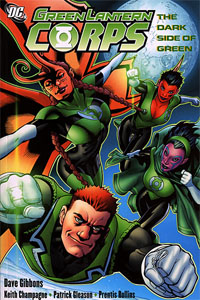
What I mean is the pace at which HUGE and DRAMATIC changes are brought down the pipeline. You can see this most dramatically in the milieu-shattering crossover events which are now essentially annual events at Marvel and DC, but you can find plenty of examples in individual titles, too. For example, when Geoff Johns rebooted the Green Lantern Corps he created a scenario which could have comfortably been used to tell dozens or hundreds of stories. Instead they told roughly 6 before launching into the next sequence of WE’RE CHANGING EVERYTHING.

The combination of (a) taking more time to tell a story while (b) having less time to tell a story is, in my opinion, increasingly disastrous.

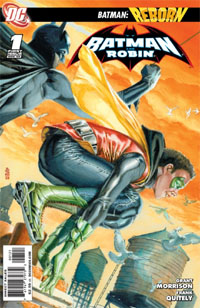
Where this is perhaps most deeply felt is the relationship between characters. Bruce Wayne starts dating Jezebel Jet and the relationship is supposed to be completely changing his life before it turns out that she’s secretly betraying him… but since she appears in maybe a hundred panels between the time she’s introduced and the time she’s revealed to be a traitor, it’s really hard to take any of it seriously. Hal Jordan is in a new relationship with a lady call-signed Cowgirl, but there’s a publishing deadline so there’s no time to actually show us that relationship. Dick Grayson and Damien are supposed to be forging a deep and meaningful bond in their new working relationship as Batman and Robin… but the status quo necessary for us to invest into that relationship never actually exists.

“Status quo.” A potentially deadly phrase. Am I saying I just want comics to enter into a form of stasis? Not at all. I want to see Bruce Wayne fall for Jezebel Jet. I want to see Hal Jordan try to rediscover what it means to be human with Jillian “Cowgirl” Pearlman. I want to watch the comradeship between Dick Grayson and Damien grow into a rich and rewarding partnership.

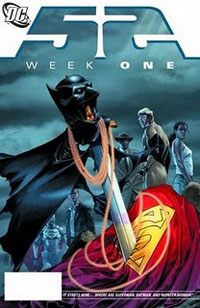
52But that’s not what I’m getting right now. What I’m getting right now is a sort of “highlight reel” of the actual story, followed abruptly by SOMETHING EPIC that CHANGES EVERYTHING.

The shallowness of what I’m experiencing in these (de)compressed books can be contrasted to three other recent comic-reading experiences I’ve had:

First, looking back at 52 I think one of the reasons I really enjoyed it was that the main characters seemed to get more time to just naturally reveal themselves over the course of the series than characters limited to monthly books do. Effectively, it was as if I was reading a comic from an alternate reality where the DC Universe had gone unplagued by a THIS CHANGES EVERYTHING event for more than four years. (Since the DC Universe has effectively been in a perpetual state of THIS CHANGES EVERYTHING for the better part of a decade, the contrast is huge.)

Second, I’ve been reading Walter Simonson’s mid-1980’s run on Thor. I’ve actually only gotten about six issues into it, but this is back in the “compressed” era of comic book storytelling and more shit can happen in 3 panels of this book than in entire issues of “decompressed” stories. The book is not entirely immune from character developments lacking justification (Sif falls for Beta Ray Bill without much in the way of narrative support to back it up), but I do note that the faster pace of events allows certain storytelling beats to be achieved effectively with fewer issues. (For example, Odin’s curse-gift to Beta Ray Bill comes after only knowing the character for a few issues… but you’ve spent so much narrative space with him that you’ve really come to know the character well and the curse-gift resonates beautifully as a result.)

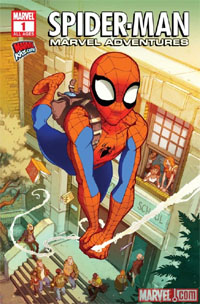
Spider-Man Adventures - Paul TobinThird, Paul Tobin’s work on Spider-Man Adventures as collected in Thwip!, Peter Parker vs. the X-Men, Amazing, and Sensational. These stories conveniently exist in the “Tobin-verse” and are completely separate from mainstream Marvel continuity… which means they’re immune to the macro-compression of the mega-events. Although Tobin uses a more relaxed, decompressed pacing within each issue he’s never forced to wrap things up in time for the next corporate-enforced game-changer. The result is that characters are given the room to breathe and develop; relationships become invested with the sorts of detailed storytelling that make them come alive; and the whole series is simply a delight. They’re also the best Spider-Man stories I’ve read in years.

So what I’m saying here is not “decompression is bad”. I’m not even saying that massive continuity shifts and cross-title mega-events are bad. But I am saying that the two of them together — the (de)compressed pace of modern superhero comics — does not seem to be a healthy combination.

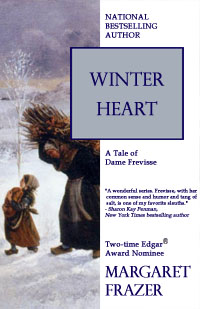
I have something a little out of the ordinary for you today: An interview with Margaret Frazer, the award-winning author of the Dame Frevisse and Player Joliffe mysteries. As I’ve mentioned recently I’ve been producing book trailers for her novels. She’s recently released the e-book novella Winter Heart and she’s on a blog tour to celebrate. (Hence the virtual visit.)

A lot of people reading the Alexandrian are mostly interested in roleplaying games. A big challenge in roleplaying games is creating worlds and getting players to invest in them. In your books you do an amazing job of creating the world of medieval England. How do you get in that mindset? What sort of details do you use for creating that world for the reader and making them care about it?

Margaret: I’m a big fan of going otherwhere and otherwhen. When I got interested in medieval England, lo, these many years ago and wanted to get inside the heads of the people, I started reading everything I could find. I began with the easy-read, no-footnotes kind of books. Those led me on to biographies, and those had not only footnotes but bibliographies, and I’ve ended by reading not just scholarly works about the Middle Ages but what medieval people actually recorded about themselves – the stories they wrote down, their chronicles, the account rolls, the illustrated fight manuals made at the time. When I travelled, I went to medieval places – castles, cathedrals, ordinary churches, ordinary houses, battlefields, highways that have existed since Roman times. Anything and everything that would let me see their world as they did. When I belonged to the Society for Creative Anachronism, I wore medieval clothing, learned and used the manners and some of the arts of the time, authorized in sword and shield fighting and fought in melees. I know what it is to have in my hand a sword so beautiful balanced it practically lives, and what it is to go into close combat with the very real possibility of being hurt – not killed in this case but definitely dramatically bruised and battered!

Relating this to roleplaying, I can tell you I fully understand the adrenalin surge that carries your characters forward into a fight regardless of the danger! Because of all that, I have more than a book-knowledge of medieval life. I have a feel for what it was like, and that feeling informs my stories, making it possible for me to draw the reader in, for them to feel it, too. And what a reader feels, they hopefully care about.

Quite a bit of “Winter Heart” dwells on the matters of memory and age. Are those issues which have a particular resonance for you right now?

Yes. Several chronic ailments have been making my life a tad hellish of late. I’m being forced to embrace my “inner elderly” somewhat before the time I expected. But as with every other happenstance that comes to an author, the thought (unbidden and ineradicable) at the back of the mind remains “I have to remember how this feels. I can use it in a story sometime.”

“Winter Heart” is being released as an e-book. I know you’ve been working to get your older books available online as well. You often joke about living in the Middle Ages, so why are you embracing the “digital age”, so to speak?

Long before I came to medieval England, I was reading science fiction with vast delight, and it’s still where I go for refreshment. Why, I was [insert doddering old geezer’s voice] watching the original “Star Trek” before it was in reruns! So I’m fascinated with the wild things modern technology is coming up with. Also wary and
inclined to keep a safe distance (see above: geezer), but I have sons who keep putting things in my hands and showing me how great they are. That said, when flip-open cell phones first appeared, I had a hard time taking them seriously – I mean – really – they’re straight out of “Star Trek”, right?

The great thing with having my mind spread over several time periods – I like Prehistory as well as Medieval and Modern – is that by doing a kind of time travel, I see modern life from a different perspective than if I were immersed in only it and no other when or where. Those otherwhens and otherwheres let me see my own world with shadows and highlights I might otherwise never perceive.

Will we eventually see some of these books back in “real” print?

Almost certainly. My hope is to eventually have them all available in all the possible forms. It’s not my fault that technology keeps coming up with new forms faster than I (or rather, my Computer Person) can keep up with them! But we’re trying. That said, I must add that “real” print is still majorly important to me. Just a look at my home will tell anyone that. Nearly all available wall space is lined with bookshelves, and the shelves are mostly full. There’s a lot of general reading but nearly half of the books are for research – everything from fashions and fabrics, to recipes and how to set the lord’s high table, to agriculture and village life, to running the royal bureaucracy, to studies of warfare and particular battles, to politics, religion, economics, philosophy, international trade, and more. Medieval times were complex and far more multi-faceted than the clichés of most novels, tv shows, and movies show. I need to understand all of these aspects of medieval life in order to tell my stories well.

Isn’t that a lot to cram into a story?

I leave most of it out of my stories. All of it informs what goes into the stories, but very little actually surfaces. And when it does, I try to make it flow with the narrative, not intrude on and interrupt the story. “Winter Heart” was a particular exercise in this, because a number of aspects of medieval life are wound together to make the plot and yet I couldn’t allow them to obscure the action, only enhance. To put in all the facts needed to take a reader into another time and place, while keeping my research invisible, is the lovely and unending challenge I enjoy in all my books and stories.

That’s interesting. I talk about similar issues for Game Masters trying to parse out necessary information to their players in Getting Your Players to Care. Getting readers (or players) to invest can be tough, but it can be impressive how much depth you can build up — and how immersive you can make a fictional milieu — when you can develop it over time. You’ve been writing the Dame Frevisse books more than two decades now. How do you keep a series like that fresh?

I’ve been asked if I don’t get bored with writing the same book over and over again, and the simple answer to that is that I don’t write the same book over and over again, so I don’t get bored. This notion of writing the same book over and over apparently comes from the fact that a great many books are written to formula. If it’s a mystery, someone has to be dead very early in the book, preferably in the first few pages. Then there has to be a requisite amount of violence, conflict between the detective and some authority figure, and (if the author knows what’s good for her/him) a romantic/sexual entanglement. Following that template over and over would indeed bore me cross-eyed. So I don’t follow it. In many of my books I keep deliberately clear of those clichés. I’ve written one book where someone is dead in the very first pages, but usually there’s no corpse until much later in the book, when the reader has had time to get acquainted with the characters, making the death when it comes a far more personal matter. Too, in the Dame Frevisse series the story is told from two points of view – the main character’s and the title character’s – so that every book explores a different aspect of medieval society, letting me look at the world from all these different angles, keeping the stories fresh, and me very far from bored!


Archives

Recent Posts

Recent Comments

Copyright © The Alexandrian. All rights reserved.