The Alexandrian

Mystery scenarios for roleplaying games have earned a reputation for turning into unmitigated disasters: The PCs will end up veering wildly off-course or failing to find a particular clue and the entire scenario will grind to a screeching halt or go careening off the nearest cliff. The players will become unsure of what they should be doing. The GM will feel as if they’ve done something wrong. And the whole evening will probably end in either boredom or frustration or both.

Here’s a typical example: When the PCs approached a murder scene they don’t search outside the house, so they never find the wolf tracks which transform into the tracks of a human. They fail the Search check to find the hidden love letters, so they never realize that both women were being courted by the same man. They find the broken crate reading DANNER’S MEATS, but rather than going back to check on the local butcher they spoke to earlier they decide to go stake out the nearest meat processing plant instead.

As a result of problems like these, many people reach an erroneous conclusion: Mystery scenarios in RPGs are a bad idea. In a typical murder mystery, for example, the protagonist is a brilliant detective. The players are probably not brilliant detectives. Therefore, mysteries are impossible.

Or, as someone else once put it to me: “The players are not Sherlock Holmes.”
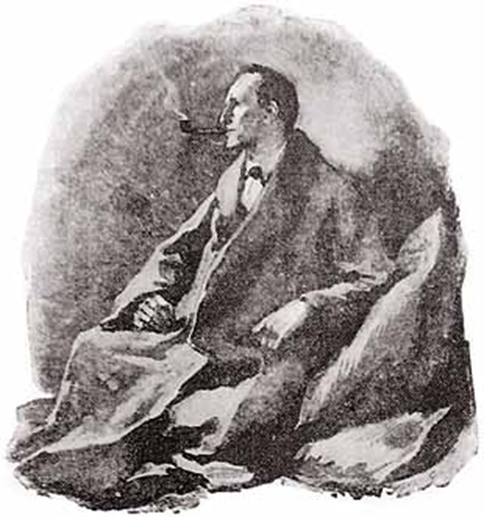
Three Clue Rule - Sherlock Holmes

Although the conclusion is incorrect, there’s an element of truth in this. For example, in A Study in Scarlet, Sherlock Holmes is investigating the scene of a murder. He discovers a small pile of ashes in the corner of the room. He studies them carefully and is able to conclude that the ashes have come from a Trichinopoly cigar.

Now, let’s analyze how this relatively minor example of Holmesian deduction would play out at the game table:

(1) The players would need to successfully search the room.

(2) They would need to care enough about the ashes to examine them.

(3) They would need to succeed at a skill check to identify them.

(4) They would need to use that knowledge to reach the correct conclusion.

That’s four potential points of failure: The PCs could fail to search the room (either because the players don’t think to do it or because their skill checks were poor). The PCs could fail to examine the ashes (because they don’t think them important). The PCs could fail the skill check to identify them. The PCs could fail to make the correct deduction.

If correctly understanding this clue is, in fact, essential to the adventure proceeding — if, for example, the PCs need to go to the nearest specialty cigar shop and start asking questions — then the clue serves as chokepoint: Either the PCs understand the clue or the PCs slam into a wall.

Chokepoints in adventure design are always a big problem and need to be avoided, but we can see that when it comes to a mystery scenario the problem is much worse: Each clue is not just one chokepoint, it’s actually multiple chokepoints.

So the solution here is simple: Remove the chokepoints.

Continued tomorrow…
The Hollow

April 30th, 2008

What the hell happened to April?!

Meanwhile, in other news:

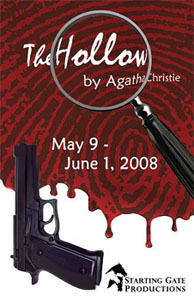
The Hollow - Agatha Christie - Starting Gate Productions

I will be starring as Inspector Colquhoun in Agatha Christie’s The Hollow from May 9th to June 1st at the Mounds Theater in St. Paul.

Fridays – Saturdays at 7:30pm
Sunday Matinees at 2:00pm
Pay What You Can Night – Monday, May 19th, 2008 at 7:30pm
Audio Described Performance – Sunday, May 18th at 2:00pm

An unhappy game of romantic follow-the-leader explodes into murder one weekend at the Hollow, home of Sir Henry and Lucy Angkatell. Nearly everyone has a motive and most had the opportunity. Enter Inspect Colquhoun and Sergeant Penny to solve the crime!

It’s shaping up into a very fun little piece of theater. If you come to see it, please feel free to hang around for a few minutes after the show and say hello.

(No stalkers or axe murderers, please. Thank you.)

George Lucas in Love

March 25th, 2008

This is possible the most awesome thing in creation:

There’s also a DVD available. It’s apparently a couple years old, but I have only just discovered it.

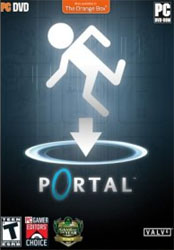
PortalI bought Valve’s Orange Box shortly after it came out. My main reason for wanting it was Half-Life 2: Episode 2, but a close second in terms of desire was Portal. So, needless to say, it’s been months since I played through the game. And I loved it.

But I was in the shower a few moments ago when the following question struck me: “Why didn’t I hate this game?”

I’ve played a lot of FPS games, and I can say that as an almost universal rule that, whenever these games decide to throw a “puzzle” at you, I am annoyed. Whether it’s stacking boxes or hitting switches or navigating an arbitrary maze, I just get annoyed.

So why is it that Portal — an FPS game that is entirely based around puzzles — was so enthralling for me? So enthralling, in fact, that I became a maven for the game, touting its virtues far and wide and citing it as a game that everyone should play.

I see a few possibilities:

(1) Despite years of advocating for games with richer and broader gameplay options — games like Deus Ex where it is equally possible to overcome a challenge through stealth, socialization, or violence — I’m actually fairly narrow in what I want from a game. I want a game to stay on point with a single type of gameplay.

The supporting evidence for this is how often, in recent days, I’ve borrowed from Yahtzee’s Zero Punctuation in saying: “They forgot what makes their game fun!” For example, the designers of God of War kept forgetting what made their game fun (awesome combat combined with epic storytelling) whenever they stuck in a lengthy sequence of balance beams or platform-hopping.

On the flip-side, I can actually point to lots of games — like the aforementioned Deus Ex or Ultima VII or Thief — where I adored the different gameplay options.

(2) Maybe it’s that I want to be able to choose my gameplay. For example, I don’t necessarily want to be forced to first play through a shooter; then a puzzler; then a stealth game — I want to be able to choose, when facing a given challenge, what form of gameplay I want to use to overcome it.

This is probably true to at least some degree. But it doesn’t explain Portal, because there is no choice there: The entire game is puzzle-based and there aren’t any non-puzzle solutions.

(3) It’s possible that what I’m reacting to here is the degree to which the puzzles break my willing suspension of disbelief. For example, it seems odd to hit a section of Half-Life 2 where the only way out of a bomb-shelled ruin is to stack the conveniently placed cement blocks onto one side of the conveniently placed teeter-totter. On the other hand, the entire scenario of Portal explains exactly why these puzzles exist. (And even once you get outside of the structured portion of the game and into a more freeform environment, the designs don’t feel arbitrary.)

(4) Maybe it’s the originality of the gameplay behind Portal‘s puzzles. All of them, after all, rely on the amazingly cool implementation of portal technology. This is just inherently more interesting than loading up the teeter-totter, shoving boxes around to create staircases (Half-Life 1), or whacking random switches (Doom 3).

I suspect that the answer lies somewhere in the combination between the third and the fourth options.

In other words, if I hit a section of Half-Life 2 where I need to move bricks around in order to progress I am immediately (a) bored by it and (b) left with an overwhelming sense that the only reason this section of the game exists is so that they can pad out the “total playing time” stat on the game box. (To Half-Life 2‘s credit, there are very few places where it does this.)

(And I’m pretty much all about quality over quantity: I have absolutely zero interest in grinding XP for 40 hours in your CRPG so that I can enjoy the story and the characters in the other 20 hours of your game.)

Similarly, in God of War, I have no problem navigating my way through the Rube Goldberg machinations of the crazed architect of Pandora’s Temple: Shoving massive bricks around, standing on pressure switches, and searching for hidden passages are all pretty awesome. These mechanics are not only intrinsic to the game world, but are also fairly interesting in their execution.

On the other hand, the pain-in-the-ass balance beam sections in God of War are frustrating not because they switch up the gameplay, but because the resultant gameplay is simply boring. (And, in fact, only challenging because they randomly move the camera around while you’re trying to complete the puzzle.)

So I guess what we can distill from all this are three maxims:

First, remember what makes your game fun.

Second, increase the amount of fun stuff in your games.

Third, if it’s not fun it shouldn’t be in your game.

I would also add to this by saying that, if you give your players the option to choose between different types of gameplay, you dramatically increase the likelihood that they will be able to find a path through your game which they find fun at all times (instead of just some of the time). (Although, on the other hand, you have to weigh that consideration against the difficulty of balancing and polishing multiple types of gameplay.)

It’s Already Over

March 22nd, 2008

Sometimes I forget that, just because I know something, it doesn’t mean that everybody else knows it, too. So here’s a meme that needs to be more widely known:

The race for the Democratic nomination is already over.

The fat lady may not have actually sung (past tense), but she’s definitely singing. Actually, she’s already hit the final note and is just kind of holding onto it at this point.

If you want the full explanation for this, you should check out this piece from the Politico. But the short version goes something like this: If Clinton wins every remaining primary race by a margin of 60-40 (which is essentially impossible), she would still end up trailing Obama in both pledged delegates and the popular vote. So even in her best-case electoral strategy, she’s completely dependent on the Democratic superdelegates to perform a coup — disenfranchising the primary voters and nominating her over Obama.

How likely is that? Not very.

Many superdelegates have already declared their allegiance, of course. Others will declare over the next few weeks (like former presidential candidate Bill Richardson did yesterday). But the superdelegates who have not yet declared are probably content to let these remaining primaries play out because:

(1) The primaries generally appear to be invigorating the party base and pulling new people into the party.

(2) They don’t want to give an appearance of performing a “coup”. The math says that Obama has this nomination locked up, but that’s not the public perception (largely because the MSM is not widely reporting that story).

So, allowing the primaries to proceed is likely to increase Democratic turnout in November. OTOH, rendering the remaining primaries moot (even if they almost certainly are moot) has the real possibility of creating a backlash that would suppress turnout in the November.

Also:

(3) While it’s certainly true that Hillary Clinton’s campaign is ripping into Obama, talking about how this is “hurting him” in the general election seems a little misplaced. It’s not like the Republican hate-machine is going to go any easier on the guy.

If Obama can’t weather these attacks now, there’s no way he’ll be able to weather them 2, 4, or 6 months from now. While I consider the Wright stuff to be a tempest-in-a-teapot with all the meaningful content of attacking Jimmy Carter because his brother Billy was an idiot, I’d still rather see it happening now rather than being stored up by the Rovian machine and trotted out in the middle of October.

(The exception to this is the fact that the Clintons have been practically announcing that they would prefer to see John McCain as president if Obama gets the nomination. Whenever I see another one of these glowing McCain endorsements from Hillary and Bill I have to seriously wonder if they’ve lost their freakin’ minds.)

At the end of the day, though, the candidate who wins the pledged delegate race is almost certainly going to be the nominee. And if that candidate also has the popular vote behind them, then it’s a dead-lock certainty they’ll be the nominee.

And nothing short of Hillary Clinton turning out to be a man who’s spent the last three decades in a secret gay marriage with Bill or Obama secretly being a member of the KKK who has spent his entire life wearing black-face is going to change that.

Archives

Recent Posts

Recent Comments

Copyright © The Alexandrian. All rights reserved.