
There’s a lot of stuff I like about D&D 5th Edition, but there are some pretty deep systemic issues with how the game is designed. Yesterday, for example, I was looking at the Ranger’s Natural Explorer class ability from D&D 2014:
NATURAL EXPLORER
You are particularly familiar with one type of natural environment and are adept at traveling and surviving in such regions. Choose one type of favored terrain: arctic, coast, desert, forest, grassland, mountain, swamp, or the Underdark. When you make an Intelligence or Wisdom check related to your favored terrain, your proficiency bonus is doubled if you are using a skill that you’re proficient in.
While traveling for an hour or more in your favored terrain, you gain the following benefits:
- Difficult terrain doesn’t slow your group’s travel.
- Your group can’t become lost except by magical means.
- Even when you are engaged in another activity while traveling (such as foraging, navigating, or tracking), you remain alert to danger.
- If you are traveling alone, you can move stealthily at a normal pace.
- When you forage, you find twice as much food as you normally would.
- While tracking other creatures, you also learn their exact number, their sizes, and how long ago they passed through the area.
You choose additional favored terrain types at 6th and 10th level.
This is an example of how D&D 5th Edition often models specialization by trivializing the associated actions: If you’re interested in X, you design a character who’s good at X. But the result isn’t doing more of X or doing X in interesting ways, it’s that X becomes automatic and is no longer part of the game.
In Tomb of Annihilation, for example, a big chunk of the campaign is mounting a wilderness exploration into the heart of darkness! If that sounds exciting to you, you’d likely pick a character class like a ranger or a druid that can really contribute to that part of the campaign.
Tomb of Annihilation, however, models the challenges of the expedition through travel speed, a Navigation check, and Dehydration. The Ranger’s Natural Explorer ability, however, eliminates travel speed variation and auto-succeeds on the Navigation check. The Druid, meanwhile, has a 1st-level spell to create water. So if you make characters specialized in wilderness exploration, you take the entire structure presented for wilderness exploration and basically just throw it out.
It’s as if the Fighter had an Auto-Win the Fight ability at 1st level: You choose to be a Fighter because you’re really interested in the combat portion of the game, but the mechanics instead just remove the entire combat system. So rather than creating cool new gameplay, the game just sets up these boring, auto-play interactions.
D&D 2024 replaces Natural Explorer with a new class ability called Deft Explorer:
DEFT EXPLORER
Thanks to your travels, you gain the following benefits.
Expertise. Choose one of your skill proficiencies with which you lack Expertise. You gain Expertise in that skill.
Langauges. You know two languages of your choice from the language tables.
This avoids trivializing wilderness exploration, but instead drifts pretty heavily into what I refer to as mechanical pablum, which is another problem D&D 5th Edition (and particularly the 2024 edition of the rules) frequently suffers from: These are mechanics which purport to be one thing (e.g., how you’re a deft explorer), but are actually just some random bonuses.
These are two very different problems, but I think they both have the same root cause: Both versions of D&D 5th Edition were designed backwards.
DESIGNING BACKWARDS
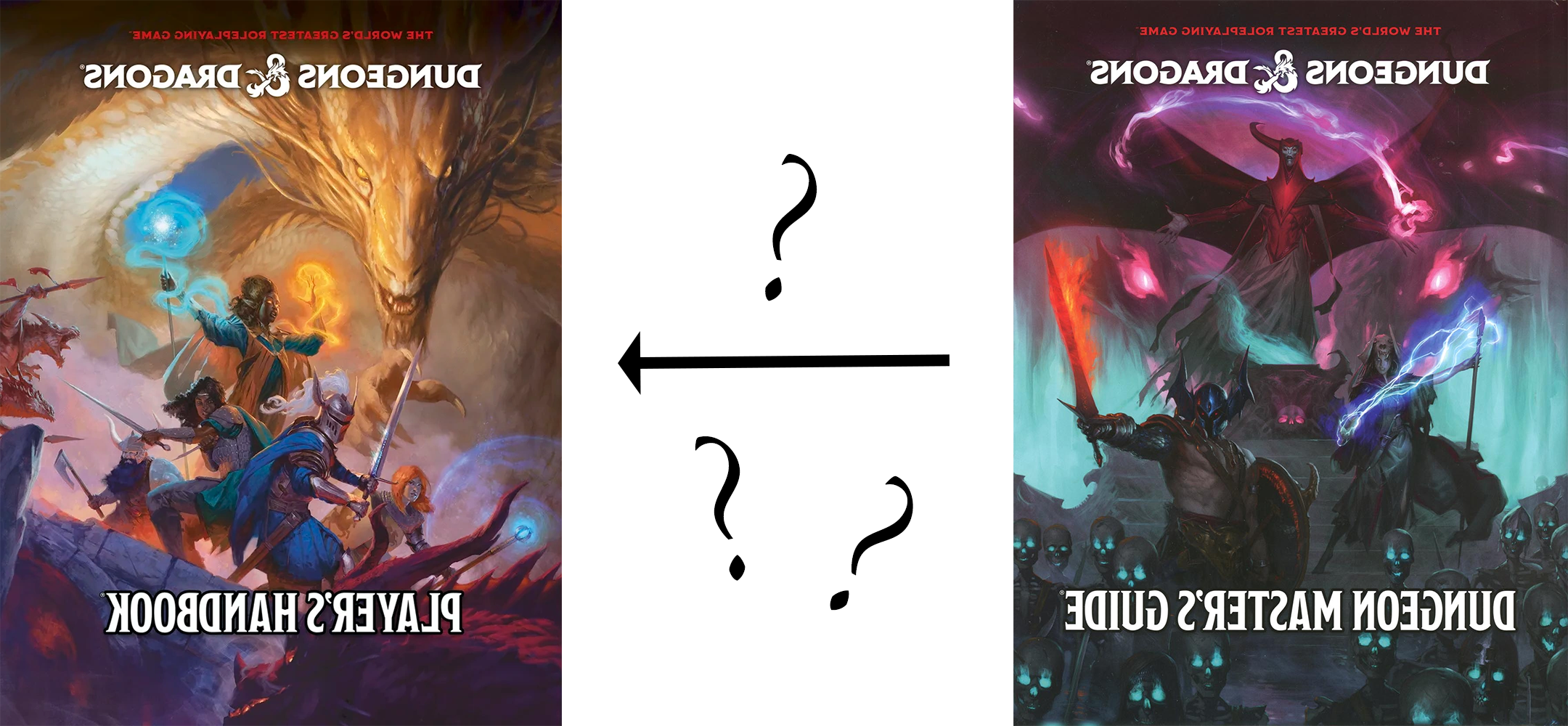
I know from a variety of public interviews and private conversations with designers that the development of both D&D 2014 and D&D 2024 followed a roughly similar path: They developed material, playtested it, finished (or nearly finished) the Player’s Handbook, and then started work on the Dungeon Master’s Guide.
This resulted in the 2014 DMG, in particular, being a rushed product, with very little time for iterative development and with whole new mechanical systems being plugged into the text at literally the last minute.
But I’ve come to believe that the problem here is more fundamental than mere slapdashery.
Imagine that you were part of a team designing Monopoly. Somebody says to you, “Hey, can you design the property cards?”
“Sure,” you say. “What should be on them?”
“Umm… We’re not sure.”
“Well, what are the game mechanics?”
“Good question,” the designer says. “We know there’ll be a board. We’ll put the properties on the board. The players will probably move around the board, landing on the properties and doing stuff.”
“What stuff?”
“Haven’t worked that out yet.”
“But what should go on the card?”
“Like… property stuff. The stuff you’d need when doing real estate stuff.”
“What sort of real estate stuff?”
“We’ll figure it out later!” they say with a big grin. “You’ve got this!”
Well, I’m sure this will be fine, you think to yourself. I guess I can put some placeholder stuff on the property cards and we can revise it as the rest of the game is developed.
Then you find out all the property cards will be getting sent to the printer before the rulebook is written.
This obviously sucks for you. It probably sucks even more for the guy who has to figure out how to make something at least technically playable using whatever arbitrary stuff you end up putting on the property cards. It’s certainly not going to result in a great game.
The situation with D&D 5th Edition is a little less clear-cut, but broadly speaking, it has the same problem.
When it comes to RPG design, there will usually be some form of core mechanic (e.g., roll 1d20 + ability score modifier vs. difficulty), but of far more importance to the game design is the collection of scene and scenario structures that create the core gameplay experience. In D&D 2024, for example, you have combat, journeys, bastions, etc. Other games might put the primary focus on solving mysteries, executing heists, or organizing a planetary defense force. The game designer both makes a decision of which game structures the game will be focused on and designs the details of how those structures will actually work mechanically and procedurally.
The other aspects of the game – character classes, monster stat blocks, etc. – are ideally designed to interface with these game structures. A particularly simple example would be, if your combat system requires attack bonuses, then your monster stat blocks should include attack bonuses. But, similarly, if your scenario structures include random encounter checks, you might want to include a default # Appearing stat for each creature type and/or difficulty level. If your procedures for wilderness exploration include the possibility of bad guys tracking the PCs, then you’ll want to makes sure those stat blocks also include their tracking proficiency.
And now you can see the problem D&D has: The Player’s Handbook includes the combat system, and so, as the designers work on the PHB, the character classes, skills, spells, and other character options in the game can all be properly playtested and iteratively designed in tandem with the combat system.
But all the other structures and procedures of play — dungeons, bastions, journeys, chases, etc. — are over in the Dungeon Master’s Guide. Unlike combat, none of these systems are being developed in tandem with the rules for creating and playing characters. In some cases, work on these systems hadn’t even started when the PHB was finalized. It was literally the Monopoly property cards being sent to print before the rules were written.
Even in cases where there was playtesting happening before the PHB was locked down, I think you can still see the same effect, albeit blunted somewhat, in the final product: On the one hand, character stats have a sort of vibe-based design, where the designer knows, for example, that wilderness travel is going to be part of the game, so they should include abilities (e.g., Natural Explorer or Deft Explorer) that hypothetically plug into it, but with little or no idea what they’re actually plugging into. On the other hand, the final system design is trying to design an outlet that can fit the semi-random assortment of plugs blindly designed for the PHB, resulting in incomplete, awkward, and unsatisfying structures of play.
Does any of this really matter, though? If you’ve read Whither the Dungeon?, then you know that, for many years now, the D&D core rulebooks have not, for example, actually taught new DMs how to design or run dungeons. If they don’t include a structure for dungeon play at all, then there was never going to be opportunity for the game designers to properly link the rules of the game into that procedure.
In reality, of course, this just makes the problem worse. And, to at least some extent, these missing structures of play are another symptom of designing the game backwards. (Although I don’t think it’s the only reason for this systemic failure by Wizards of the Coast.)
The backward legacy of PHB first/DMG later design is driven, in part, by the deep-seated belief that the core rules of D&D should be a 900-page trilogy of rulebooks and the production realities that stem from that decision. It’s also a legacy that dates back to the earliest days of the hobby.
Back in 1979, though, the DMG being released a full year after the PHB was less of an issue because the PHB and DMG were both being developed in the context of the original 1974 edition of the game, which had been holistically designed and honed through actual play. (This is also why the Monster Manual could be released in 1977 before either of the AD&D rulebooks had been written.)
D&D has long relied on legacy design elements and the oral traditions which pass them forward. As those ties are increasingly broken, however, more and more cracks have begun to appear in D&D’s fundamental gameplay, and the price of designing the game backwards is demanding to be paid.











If you had to make 2 distinct changes to the way “survival” is done in dnd 5.5 what would they be? Because it’s definitely interesting how there’s really no in between when it comes to these side diversions. You’re either not great at something or you trivialize it. For survival, what would changes would you make?
My final take with D&D 2014/24 is that it had a couple of interesting ideas but the rules became too bloated over time. They had the opportunity to make a more lean gamebook for 2024 but they went the other way.
This edition spanned many clones, some share the same basic problems (Tales of the Valiant for example) while others try to strip down what worked and what didn’t worked to have a more focused game (like Shadowdark).
I love the example of Natural Explorer in 2014. I think the problem of wanting to make a character that does X and “X becomes automatic and is no longer part of the game” goes back at least to 3E.
I agree that the process of creating the PH and DMG in both ’14 and ’24 hampers integration between systems, but I will argue that the designers don’t seem to want that connectivity. They seem to want the DMG systems to be optional and deliberately disconnected. If we read the ’24 exploration section, it’s all options and approaches, which is fine. It isn’t one approach and thus there is no one thing a class should provide to be a good explorer. Similarly, the UA for how exploration worked came out during D&D Next, way before the ’14 PH was finalized.They knew how exploration would work, more or less. They just didn’t care to connect the class with those systems. I think it’s less the process (though I agree the process is a problem) and more how they want to design. There is also the connected issue that 2024 wants to even further lessen any non-combat integration (see Dwarf Stonecunning changes).
What I’m wondering is … IS this bad? Like, do people have less fun now? I don’t get the impression that D&D players are yearning for more procedures in their games.
The lack of procedures helps explain how the “X becomes automatic” thing is even possible. 2014 actually did have procedures for wilderness journeys/survival which were fine (providing you close the loop where they forgot to tell you how often to make foraging checks) if not exactly thrilling, but most people seem to have missed them because they’re buried deep in the DMG and require putting together rules from a couple different sections.
But most people I’ve played under never use those, and when I’ve asked didn’t even know they existed. So survival defaults to a simple, roll Survival to see if you die/get lost. There’s no structure for what players can do beyond just waiting for the DM to tell them they’re allowed to roll. With so little structure to hang mechanics off of, it becomes difficult to come up with an ability that doesn’t trivialize the whole thing.
By contrast, no one would accept an “I win combat” button because our understanding is that combat is a scene structure that is played out over multiple rounds and actions whose result arises from the aggregate results of those actions. It just feels wrong to collapse all that into a single roll, but as wilderness survival is often run in practice as a single roll anyway, why not just make it automatically succeed? Its more like having an ability in combat that can make an attack automatically succeed once. Not a terrible ability, except if you’re guaranteed that the combat will always be resolved based on that single attack.
@stargazer In my experience it’s not that players are explicitly yearning for more procedures, in many cases because they’ve only ever experienced 5e and aren’t in the rpg adjacent internet, so it never occurs to them there are other ways to play. It’s not even about them feeling like their current play is bad. It’s more that they feel everything could be better, but they can’t put their fingers on how.
But I’ve seen them blown away when I introduce them to non-vibes based gameplay. I had a group who’d only ever played with DMs that handwaved encumbrance and inventory, for example, and they thought it was a little bit of a pain, at first. Until the first time the cleric went down and they had to drag him out of the dungeon under fire, and it suddenly mattered a lot that the halfling fighters carrying capacity did not remotely add up to one dwarf cleric. The constraints forced them to get creative and make tough choices where the lack of them could have just led to saying “okay you dragged him out, no problem”. I know which scene I find more exciting, and so did they.
Long story short. It’s not that games are bad. It’s that they can be better, and I for one like giving my friends the best experience I can.
I don’t think that the 5E 2024 vs 1E distinction works. 2024 is more of a reboot and rework of the rules, or “the PHB and DMG were both being developed in the context of the original [2014] edition of the game, which had been […] honed through actual play.” Your thesis holds fine for 2014, but not for the new update unless you hold against the developers that this is a new edition. But then the DMG does not actually hold enough new systems or rules for that distinction – it’s a great overhaul for new DMs, but not much more (I liked the Greyhawk stuff though).
@stargazer The problem isn’t that the players aren’t having fun, it’s that the *DM’s* aren’t having fun. Trying to run a hexcrawl in 5e drove me up the wall (and not just for the reasons our gracious host identifies here), because everything that the game says that you can do with it simply does not work as written.
As DMs get frustrated and quit running the game, the players (who may not see the same problems with their power fantasy game) have fewer options to play D&D, if that’s what they want to do. Ultimately it’s bad for the health of the hobby, because DMing D&D is frustrating, and players who don’t want to learn new rule systems will either be forced to switch or won’t have games to play.
One of the problems in the design world appears to be the idea that GM procedures should be simulations.
Consider traveling between towns. The sim thing is follow a path or not per period of time, roll for getting lost when off road, encounters per x time unit when traveling vs encamped, use food water etc. Logistics will be tracked. Skills used each time period etc.
An alternate would be over any distance allow three drama points, have procedures for what that drama might be, getting lost, an encounter, being pursued, finding a side trek. Logistics can just be calculated between dramas. Skills can enhance the result. The drama points will call appropriate character abilities at that time, allowing them to be somewhat accentuated and game relevant. So a ranger might increase the chance of a side trek find but reduce the chance of getting lost off road. That would then allow the players to decide if they want to allow an off road component or go the whole way on the road. But unlike the sim method not a tedious set of dice rolls, only at some set points, keeping it fresh and boxed.
AG wrote: “the PHB and DMG were both being developed in the context of the original [2014] edition of the game, which had been […] honed through actual play.”
Did 2014 get honed through play, though?
Take, for example, the 2014 Chase rules. These were ported directly into 2024 without even a revision accounting for the fact that the Exhaustion rules had been changed fro 2024.
In order to be honed through play, it’s not enough to just play the game. You have to actually hone the design.
Yeah, it would make sense for the 2024 D&D design process to have included someone saying, “Okay, we had a bunch of half-designed stuff in the DMG, so we should make sure to actually finish designing and playtesting that stuff for the new edition.” But that didn’t actually happen.
@Danny Stevens
*”One of the problems in the design world appears to be the idea that GM procedures should be simulations.”*
I think you mean that *travel* should be a simulation. I’m not sure that’s a problem, it’s just a different type of game. The drama-first game you describe likely appeals to many players and GMs, but to others, it’s not what they want in an RPG. Simulationists and tactical players will all likely have objections to that approach, just as narrativists and method-actors might enjoy it.
For all that I appreciate a game with clearly-stated design goals that delivers on those intentions, I also appreciate a game such as D&D that allows for a wide-variety of play-styles at the same table and in the same evening. (I won’t go so far as to say “supports.”)
Fair enough, the DMG probably wasn’t much refined (apart from the mentioned organization for new DMs). That means that the PHB24 came out 10 years after the designs for the DMG came out, again proving my point that here, there was no backwards design.
Likely: they saw that those mechanism saw little play and had little support, so they swapped them out for relevant abilities with less flavor that would be used. And they put their effort in the PHB / player facing rules and resigned relatively early to not improve the DMG with those mechanisms and rules that saw little play before. More of a circular logic kind of thing
@Danny Stevens
Mm, this slathers the game in a layer of unreality for me. I’m not sure D&D would ever go that route; when it comes to procedures, every edition has remained hard-S except for 4E, and the D&D Next designers have talked at length about having to peel back the abstraction because it lost them players in that edition.
For me, there is a tactility to interacting with real-world things (distances, time, water, foraging) rather than with abstract narrativist constructs (acts, arcs, drama points, etc.). Ostensibly, this may result in systems that are representational instead of “fun,” but I don’t need a game to be raucous fun all the time – sometimes I just want to know what happens in the fiction.
[…] D&D: Designing Backwards me ha flipado. Llevo unos días pensando si volvería a D&D, no tanto por gusto como por no abandonar esa opción de cara al taller de rol que hago, y la verdad es que tiene sentido que la única explicación a cómo en dos ediciones distintas no han sido capaces de arreglar el explorador como clase: porque primero existen las mecánicas y después hay que encajarlas. […]
@Wesley Paulman “…but as wilderness survival is often run in practice as a single roll anyway, why not just make it automatically succeed?”
That’s assuming you’re running a point crawl, or travel as a scene, but in something like a hex crawl, you might be making those checks for each day of travel, rather than once. Besides which, the problem is trivializing it, even the best hunter will fail at finding quarry at times, even the best guide might get lost if the area is big enough, and drama isn’t born from routine. So the comparison does work.
Pick detective? Auto-solve any riddle, find every clue? How fun is that? I’d say that survival is a cornerstone for exploration as a whole, you need the stakes to BE there, even if they may be circumvented with enough planning, otherwise here’s your participation trophy and call it a day.