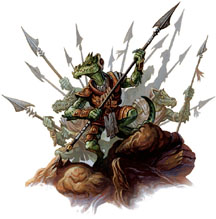
 After studying Keep on the Shadowfell, I came to the conclusion that the only way I could run the module would be if I remixed the module in an effort to overcome some of its shortcomings. I previously demonstrated some detail work on a particularly troublesome encounter, but now I’m going to be taking a look at the big picture: Giving the adventure a stronger backbone and a richer mythology; rearranging the setpieces; fleshing out Winterhaven to give it some unique character and depth; adding extra encounters where possible; and so forth.
SPOILER WARNING!
The following thoughts contain minor spoilers for Keep on the Shadowfell. If you don’t want to be spoiled, don’t read it. And if you’re in my gaming group then you definitely shouldn’t be reading it.
RAW RESOURCES
While working with the kobolds, we basically have the following resources to pillage from Keep on the Shadowfell:
(1) On the Road: Kobold Brigands
(2) A1: Kobold Ambush
(3) A2: Kobold Lair – Outside
(4) A3: Kobold Lair – Inside
Or, to look at that another way, we have the following encounter builds:
(1) Kobold Dragonshields (x2), Kobold Slinger, Kobold Minions (x5)
(2) Kobold Dragonshields (x3), Kobold Skirmisher, Kobold Wyrmpriest
(3) Kobold Dragonshield, Kobold Skirmisher, Kobold Slinger, Kobold Minions (x10)
(4) Irontooth (goblin), Kobold Dragonshields (x2), Kobold Skirmisher (x3), Kobold Wyrmpriest, Kobold Minions (x10) (in two waves)
ON THE ROAD: KOBOLD BRIGANDS
We’re going to leave this encounter largely unchanged. From a conceptual standpoint it serves as a nice introduction to the problems besetting the village of Winterhaven. And from a design standpoint, it’s a relatively simple encounter that serves as a nice way to introduce players and DM alike to the new rules.
However, we do need to make one slight adjustment because of some sloppy design. There are two separate triggers for starting this encounter. The PCs are approaching from the east and trigger #1 is:
The minions make themselves visible, darting from their hiding places, when one or more PCs reach the place in the road between the two easternmost boulder piles.
And trigger #2 is:
Alternatively, if one or more of the PCs decide to move off the road and travel through the grassy terrain, it’s possible that some of the kobolds will be spotted in their hiding places. If a PC moves to a square that provides line of sight to a kobold, that creature lets out a screech that alerts its companions.
Sounds good, but look at the map:
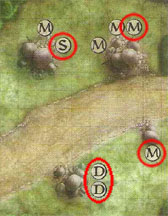
All of these kobolds are going to be visible to PCs traveling along the road long before they reach the easternmost boulders. There is some forest just off the right of the map shown here that will help to obscure the northern minion, but this doesn’t help the southern minion (who can be spotted from the road 30 feet before the boulders) nor the dragonshields and skirmisher (who appear to have been placed on the wrong side of the boulders they’re supposed to be hiding behind).
Worst. Ambush. Ever.
MOVE THE MONSTERS: Obviously we need to move the monsters.
Minions: Put all the kobold minions and hide them behind the western boulders where they can’t be seen before the ambush is sprung.
Slingers: You can’t see it in the picture here, but on the battlemap there’s a small patch of forest just to the west (on the north side of the road). Put the slinger in this patch of forest (where he benefits from cover, but can shoot at the PCs freely).
Dragonshields: Off the east side of the map there is a forest south of the road. Put both dragonshields inside this forest.
PRE-COMBAT: The module suggests the following set-up:
Have the players place the miniatures of their characters on the road within 2 squares of the eastern edge of the map, then give them two rounds to move their characters westward.
I absolutely hate this. First, they’ve gotten their miniature skirmish game all over my roleplaying game. Second, the setup invites metagaming and ruins any element of surprise. (“Gee, I wonder if we’re going to be ambushed…”) Third, it creates two really boring rounds of “action” in which the players all take turns with no motivation beyond “head west… I guess”.
It’s just a poor gameplay experience.
So here’s what you do:
(1) You lay out the scenario: “You are on the King’s Road traveling west towards Winterhaven. How are you travelling?”
(2) At the very least, you want to establish a marching order (sequence and relative positioning). But, without prompting the players, you also want to find out what active precautions they’re taking.
(3) If nobody states that they’re specifically watching out for an ambush, use their passive Perception checks (10 + Perception modifier) to determine whether or not they spot the kobold dragonshields hiding in the woods (DC 19). (This is a bit of a cheat because, given the pregenerated characters, I know none of them will detect the dragonshields with a passive Perception check.)
(4) If they do state they’re watching out for an ambush, allow them to make an active Perception check (d20 + Perception modifier) to determine whether or not they spot the kobold dragonshields hiding in the woods (DC 19).
(5) If they detect the dragonshields, the encounter starts when they get within 30 feet of where the dragonshields are hiding. Lay out the battlemap, position them according to their marching order, and inform whoever rolled high enough on their Perception checks that they’ve spotted the dragonshields lurking in the woods.
(6) If they don’t detect the dragonshields, the encounter starts when they reach the easternmost boulders. Lay out the battlemap, position them according to their marching order, and describe the kobold minions pouring out of their hiding spots to attack them (see below).
TACTICS: Ideally, the PCs are surprised. The minions will swarm out and engage them. The dragonshields will emerge from the forest onto the road behind them, cutting off their escape. The slinger will being shooting at them from the cover of the forest.
If the PCs detect the dragonshields and attack, the minions will swarm out and come to the dragonshields’ defense. The slinger will also emerge from cover, move close enough to attack, and begin firing.
GOALS: Make the ambush actually work as an ambush. Make the start of combat more dramatic, immediate, and exciting.
GUARDING THE KEEP
I talked about this briefly before, but the first two combat encounters in Keep on the Shadowfell are extremely repetitive: In the first, kobolds ambush the PCs on the road. In the second, kobolds ambush the PCs on the road. (And, even worse, if you follow the internal logic of the module, it’s highly unlikely that the PCs will actually be on the road at the time that you’re supposed to use the second encounter.)
So we’re going to completely scrap A1: Kobold Ambush. Instead, we’re going to remix this encounter — using the same opponents in a slightly different scenario.
SETUP: Instead of an ambush, these kobolds are going to be manning a barricade blocking the road leading to the Keep. (Kalarel has placed them here to ensure that he’s not disturbed at the Keep.)
BARRICADE: The wooden barricade is 15 feet high (requiring characters to make an Athletics check to climb over it). There is a 10-foot wide platform at the top of the barricade and a ladder leading down the other side.
TACTICS: The wyrmpriest stands atop the barricade, using his energy orb to attack those drawing near the barricade. The dragonshields and skirmishers ready actions to attack anyone attempting to climb the barricade.
If the PCs reach the top of the barricade, the wyrmpriest will blast them with his dragon breath and then jump down on the other side of the barricade. From there the wyrmpriest will continue using his energy orb, while the dragonshields and skirmishers engage the PCs atop the barricade.
THE SECOND GUARD
An identical barricade is located on the road north of the Keep, too.
DEVELOPMENT: If the PCs wipe out either barricade, the kobolds at the second barricade are pulled back 1d2 days later and lay an ambush in the ruins of the Keep. (I’ll be discussing the ruined keep in a later entry.)
In practice, this likely means that the PCs will head towards the keep, overcome one of the barricades, and then spend some time exploring the keep. Then they’ll pull back to Winterhaven and, when they return, a kobold ambush will have been laid for them at the keep.
If the PCs completely bypass the barricades on their way to the keep (by circling through the woods), Kalarel might end up pulling back both patrols to lay an ambush in the ruins of the keep. (This depends on how threatened Kalarel feels.)
INTERLUDE: FARMER’S JEOPARDY
This encounter is designed to build on the crisis facing the village of Winterhaven (which I’ll be discussing at greater length: The farmers southwest of Winterhaven have been cut off from the village by the kobolds. A dwarven farmer named Terrik Sabanar, however, has attempted to break the blockade and reach Winterhaven with a wagon full of supplies.
FARMERS: Terrik Sabanar is a good-hearted dwarf. While he plans to sell the food he’s hauling for a fair price (he can’t afford not to), his primary motivation for trying to break the blockade is because he knows the people of Winterhaven must be in fairly dire straits.
Terrik was once a member of the Iridescent Guard, a powerful order of dwarven knights. He became disenchanted with the order, however, when his superior officer seduced his wife. Taking his infant son, Alric, Terrik left the dwarven kingdoms and came to Winterhaven. He has adopted the simple lifestyle of a farmer and left his past behind him.
For this dangerous mission, however, Terrik pried up the floorboards of his cottage and took out the +2 resounding warhammer he had once wielded as a knight. Those making a History check (DC 15) can recognize the hilt-marks on the warhammer as belonging to the Iridescent Guard — a strange sight to see in these lands.
Terrik is accompanied by his son, Alric. Alric knows nothing of his father’s history with the Iridescent Guard. Terrik didn’t want to bring Alric along, but the boy begged him until he finally relented (fearing, in fact, that if he refused Alric would merely follow him and be in even greater danger).
STATS: For Terrik, use the stats for the pregenerated fighter PC. However, Terrik wields the +2 resounding warhammer (dealing base damage of 1d10+5 and +2d6 thunder damage on a critical hit). For Alric use the stats for the pregenerated fighter PC, but treat him as a minion.
(If you’ve got the core rulebooks available, feel free to give them unique and/or more appropriate stats as you feel fit.)
SITUATION: Terrik and Alric are ambushed by kobolds along the road. Their wagon is disabled.
KOBOLDS: Use the kobolds from the On the Road: Kobold Brigands encounter, but add two more slingers.
MAP: We can reuse the map from the same encounter, or draw a new one on an erasable battlemap. Roads are easy.
TRIGGER: This encounter can be triggered in several ways:
(1) The PCs are traveling along the road when they hear shouts and the sounds of combat. When they reach the scene, they see the kobold minions and dragonshields clustered around the wagon. Terrik stands atop the wagon, swinging his warhammer.
(2) The PCs in Winterhaven when Alric rides up to the gate begging for help. (As the ambush broke, Terrik dumped Alric onto one of the horses and sent him riding for safety.) The city guard seems confused… perhaps somebody runs to ask permission from Lord Padraig before leaving their posts. (Padraig will be furious that none of his mean seized the initiative, but meanwhile…)
If the PCs think of it, let them make an Intimidate check (DC 20) to convince two of the guards to go with them to help Terrik. If the guards do accompany them, you’ll need to figure out stats for them. (Easy to do if you’ve got the core rulebooks. Otherwise, just use the same stats as Alric.)
If the PCs return with Alric, they see two dead kobolds lying near the wagon. The minions and dragonshields have pulled back, and the kobold slingers are pelting the wagon with their slingstones. Terrik is hiding in the wagon, trying to stay behing cover. (This trigger can be used particularly effectively if Alric rides up to Winterhaven just as the PCs are leaving or entering the village.)
(3) While traveling along the road away from Winterhaven, the PCs pass Terrik and Alric heading in the opposite direction. If they choose to accompany the dwarves, they’ll be there when the ambush breaks out a few minutes later. If they continue on their way, just a couple minutes later they hear shouts and the sounds of combat coming from behind them. (If they need further prompting, have Alric ride after them.)
REWARD: If the PCs rescue them, Terrik will gift them with this +2 resounding warhammer. The weapon deals 1d10 damage, +2d6 thunder damage on critical hits, and has a daily power that can be used as a free action when a target is hit with the warhammer, rendering the target dazed.
FOLLOW-UP: Once the ambush has been dealt with, it takes Terrik about 5 minutes to fix the wagon wheel. (If it was 3rd Edition, we could let the PCs help. But, hey, there’s no Craft skill in 4th Edition. Who would ever need such a thing? It’s not like we could ever be in a situation where you might want to fix a wagon wheel before more kobolds show up. Feel free to throw an ability check in there to compensate for the dumbed down rules.)
The villagers in Winterhaven are thrilled when the supplies, meager as they are, arrive. Terrik, Alric, and the PCs are greeted as heroes.
Continued…

 SPOILER WARNING!
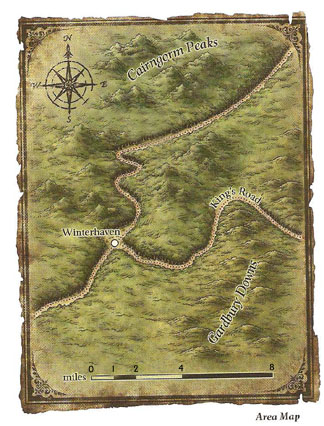 I have modified the map found in the adventure so that it can be used as a player handout without spoiling the adventure.
 (3) The map also shows a huge pile of treasure that fills 400 square feet.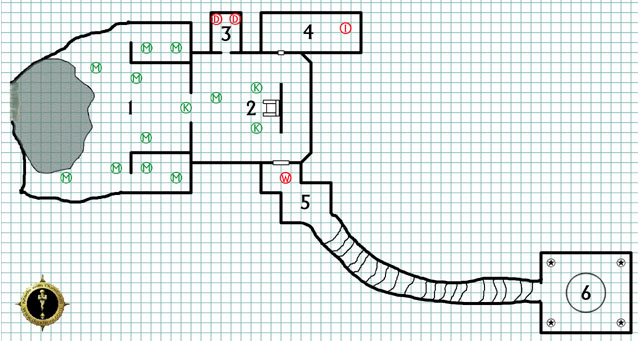
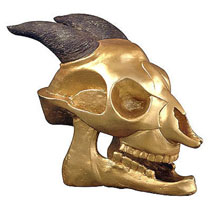 The walls of this crooked chamber appear to have once been covered in colorful mosaics, but these have recently been defaced beyond recognition. In one corner of the room there is a shallow depression in the floor before a plain altar of stone. Atop the altar a golden skull with ram’s horns sits in honor.