The Alexandrian

Blue Butterflies - Stergo

Before scientific experimentation disproved it, most people believed in the spontaneous generation of life (also known as equivocal generation). For example, it was believed the maggots spontaneously generated out of rotting meat. That places of darkness spontaneously generated all manner of crawling things (as could be seen upon lifting up a rock). Worms arose from dirt and even frogs were once thought to come from the mud.

This was a universe literally teeming with life energy.

For the purposes of fantasy, I find it particularly fascinating how many of these theories revolved around places of filth, putrescence, and decay giving rise to vermin: Maggots from rotting flesh, rats from excrement, and so forth.

So when we look around our fantasy milieus and see monstrous forms of vermin — dire rats, giant spiders, and the like — could we use such theories of creation as their basis? I think we can. In the vile places of the earth — the places were the very form of the world itself has begun to decay — such creatures are given form out of the darkness. And thus our dungeons teem with life.

Another interesting facet of the theory of the spontaneous generation of life is that, like many pre-scientific beliefs, it was not extinguished by scientific thought — rather, it retreated before it. Once it was proven that maggots are the larvae of flies, for example, the theory simply moved to become the spontaneous generation of bacteria out of the “life force” of the air. It wasn’t until Louis Pasteur rooted out the last of its hiding places that the theory finally died.

I bring this up to suggest that we can just as easily turn the dial in the opposite direction. We can even add a metaphorical (or perhaps metaphysical) component to the theory.

For example, John Wick’s Orkworld postulates that orcs are actually photosynthetic. But we could just as easily say that the orcs spontaneously arise wherever civilization is not: When empires fall, tribes of orcs appear in the ruins.

And we could elaborate upon further upon the themes of this theory: Mice were known to physically reproduce, but they were also thought to spontaneously generate out of moldy grain. Ergo, our orcs can both spontaneously generate out of the lack of civilization, but also reproduce.

Further, we could build upon this by considering the ideas of Lamarckian evolution — that life, once spontaneously generated, strives to become more and more complex. Thus we could postulate that all humanoid life has its origins in the primordial generation of orcish life from the absence of civilization — orcs, goblins, hobgoblins, and beastmen of all sorts appear spontaneously, but then some among them will breed and improve.

This doesn’t even necessarily need to be true, but it would certainly be an interesting religious belief. For example, your dark elves might believe that orcs, humans, elves, and dark elves all exist along a continuum of improvement. (It might be even more shocking if you made this a secret belief among the elves: They look at humans the same way that humans look at orcs… they’re just too polite to say it.)

You could root all of this cosmology in the apeironic weave of creation. Where that weave becomes weakened, spontaneous generation occurs. When weakened by decay, filth and vermin appear. When weakened by the loss of civilization, orcs appear. When weakened by vile death, undead appear.

Such a cosmology could have interesting implications for how summoning rituals or the creation of undead work. For example, Jean Baptista von Helmont had a receipe for mice: “Place a dirty shirt or some rags in an open pot or barrel containing a few grains of wheat or some wheat bran, and in 21 days, mice will appear.” Magical spells like create undead could directly manipulate the apeironic weave in order to cause undead to appear; but you could also open things up by allowing non-magical manipulation of that weave (through ritualistic murder, for example).

You could also flip the whole conceit of “weakening the weave” on its head. Perhaps clerics and living saints appear in those places where the weave has been strengthened. Perhaps the gods themselves are nothing more than those places where the weave has been unnaturally strengthened through the power of belief or sacrifice or chance.

Rules vs. Rulings?

March 9th, 2009

I’m calling shenanigans.

Of late the meme has arisen that the difference between “new school” and “old school” gaming is “rules, not rulings”. The free Lulu PDF A Quick Primer for Old School Gaming seems to be a primary infection point and I don’t think we’ll go too far wrong by quoting it:

Most of the time in old-style gaming, you don’t use a rule; you make a ruling. It’s easy to understand that sentence, but it takes a flash of insight to really “get it.” The players can describe any action, without needing to look at a character sheet to see if they “can” do it. The referee, in turn, uses common sense to decide what happens or rolls a die if he thinks there’s some random element involved, and then the game moves on. This is why characters have so few numbers on the character sheet, and why they have so few specified abilities.

There are several problems with this meme.

BAD EXAMPLES

The Spot and Search skills tend to get targeted a lot by people trying to explicate the “rules, not rulings” concept. For example, the Quick Primer for Old School Gaming goes into a pair of lengthy examples of “old school” vs. “new school” play.

In the “new school” example, a player says they’re searching a hallway. They find a pit trap. They ask the GM if they can disarm it. The GM rules that they can. They jam the mechanism. (The results of the search and disabling attempt are handled by skill checks.)

In the “old school” example, a player says they’re checking the hallway. They fail to find the pit trap, but they’re suspicious so they try a different method of searching. They find the pit trap. They ask the GM if they can disarm it. The GM rules that it can’t be disarmed. They go around the trap instead. (The results of the search and disabling attempt are handled by GM fiat.)

Now, if you’re trying to establish that the difference in play here is GM fiat vs. dice rolling, then these examples would be just fine. But what the author actually does is load up the “old school” example with a bunch of details — using a 10-foot pole; carefully inspecting the floor; pouring water onto the floor to detect the edges of the trap — and then tries to attribute that additional detail to the GM fiat.

But the GM fiat has nothing to do with it. It’s an artificial conflation of two different distinctions between the examples. The use of GM fiat vs. predefined mechanics only matters in the moment of resolution. The amount of detail that goes into searching a particular stretch of hallway, on the other hand, is an entirely separate issue.

The “old school” example could just as easily read:

GM: A ten-foot wide corridor leads north into the darkness.
Player: I carefully check the floor for traps.
GM: Probing ahead you find a thin crack in the floor — looks like a pit trap.
Player: I try to jam it so it won’t open.
GM: No problem.

And the “new school” example could just as easily read:

GM: A ten-foot wide corridor leads north into the darkness.
Player: I’m suspicious. Can I see any cracks in the floor? Or a tripwire? Anything like that? [makes a Search check]
GM: Nope. There are a million cracks in the floor. If there’s anything particularly sinister about any of them, you certainly don’t see it.
Player: Hmm… I still don’t like it. I’m going to take my waterskin out of backpack. And I’m going to pour some water on the floor.
GM: [calls for a new Search check with a circumstance bonus for using the water] Yeah, the water seems to be puddling a little bit around a square shape in the floor.
Player: Can I disarm it?
GM: How?
Player: Jam the mechanism? [makes a Disable Device check; it fails]
GM: There’s no visible mechanism. The hinge must be recessed.
Player: Is there enough room to walk around it?
GM: About a two-foot clearance on each side.
Player: Okay, we’ll just try walking around it. Everybody watch your step!

Here’s a different example:

What I like mostly is more of the focus on descriptions rather than mechanics.

Player: “How wide is the ledge?”
GM: “Maybe 2 inches..”
(New School) Player: *seeing the modifiers of the Balance skill for that short a span* “Oh, nevermind, I better find another way across.”
(Old School) Player: “Okay … can I press myself up against the cliff face and side-step across?”
GM: “Sure. Since you aren’t pressured and can take your time, you don’t even have to roll anything.”

In other words, it’s more about player (and GM) creativity.

The poster here ascribes the difference to “creativity”, but that’s not what the example is actually demonstrating. Although the poster obfuscates it by giving different outcomes to the “old school” and “new school” games, the core of the example boils down to a single question: “Will I be able to cross this ledge?”

In the “old school” system the GM determines this by fiat (automatic success, automatic failure, or some probability of success based on an arbitrary dice roll). In the “new school” system the chance of success is determined mechnically.

Isn’t the “old school” GM getting to be “creative” because he determines the probability of success? I guess. But, of course, the “new school” GM also gets to determine the probability of success — he set that probability as soon as he described the ledge as being only 2 inches wide.

LOSS OF CONSISTENCY

So we’ve discovered that “rulings, not rules” is really just a mantra for, “I like GM fiat.” Fair enough. What’s the problem with pervasive GM fiat?

The loss of consistency.

Ben Robbins’ essay “Same Description, Same Rules” is an excellent summation of the problem. Here’s a quick quote:

Rules should not surprise players. More specifically, if you describe a situation to the players and then describe the rules or modifiers that will apply because of the situation, the players should not go “whaaaa?”

If they are surprised it’s either because you specified an odd mechanic (a will save to resist poison) or a really implausible modifier (-6 to hit for using a table leg as an impromptu weapon).

[…]

On the other hand if the same thing uses different rules on two different occasions, it’s hard to see how it makes sense no matter who you are. This might just be the result of inconsistency (oops) or you might intentionally be using another rule to get an advantage.

I recommend reading the whole thing. Robbins’ basic point is that players cannot make logical, informed decisions if their actions have inconsistent results.

The problem with pervasive GM fiat is that you are either (a) creating inconsistency or (b) creating house rules on the fly. And if you’re creating house rules on the fly then:

(1) You have to keep track of them.

(2) Hasty decisions will frequently have unintended consequences.

(3) Even if the house rule you came up with on the fly is good the end result is no different than if you’d had a good rule to start with.

OLD SCHOOL DID WHAT NOW?

So you say, “Screw that. Ben’s wrong. Consistency is vastly overrated.” Well, sure, that may be true. Everyone’s entitled to their own tastes and opinions after all.

But that really brings us to the crux of the issue: The whole concept of using “rulings, not rules” as a distinction between “old school” systems and “new school” systems?

It’s complete, unmitigated bullshit.

For example, take a peek at the example given in A Quick Primer for Old School Gaming: The difference between GM fiat and mechanical determination of success in finding and disabling traps. That’s a distinction that’s been around since the Thief class was first introduced in Supplement I: Greyhawk.

In 1975.

And if your contention is that the New School started in 1975, then I think it’s safe to say that your use of the term is out-of-synch with the way that most people use the term.

But this extreme example only highlights the other core failure of the meme: It claims that the great thing about the “old school” is the lack of rules (which, in turn, allows for GM fiat). But all of those “old school” games seem to feature all kinds of incredibly detailed, nitpicky rules — betraying a bugaboo for the exact sort of consistency that the “old school” movement is now trying to forswear.

Having a Search skill changes gameplay? Sure. But let’s not pretend that’s any kind of systematic preference for rulings vs. rules, because you know what else changes gameplay? Explicit mechanics for determining the loyalty of hirelings. And those rules are part of OD&D, but not 3rd Edition or 4th Edition.

The truth is that the game has moved towards GM fiat in some cases and away from GM fiat in other cases.

CONCLUDING THOUGHTS

There is, I think, a legitimate philosophical divison being alluded to here: The difference between “do what you want and we’ll figure out a way to handle it” and “you can only do what the rules say you can do”. But let’s not pretend that this is a division between “old school” and “new school” play. The term “rules lawyer” is older than I am.

In addition, I think the truth is that a properly structured rule system facilitates rulings — assuming, of course, that you’re not using the word “rulings” as an ad hoc synonym for “GM fiat”. The 3rd Edition skill system doesn’t just give you a tool for differentiating character concepts — it also provides a robust and open-ended mechanic which can be used to make any number of rulings.

It’s certainly possible to look at any ruleset as being a set of shackles that prohibits you from doing anything not explicitly proscribed. But, in my opinion, a properly designed ruleset is a flexible foundation on which an infinite number of structures can be securely built.

Honestly? The whole “rules, not rulings” thing was a valiant effort. But you’re going to have to keep trying if you want something more than “old school is what I point to when I say ‘old school'” as your definition.


I <3 JULIA NUNES!

March 8th, 2009

Julia Nunes rocks my world.

Ms. Nunes plays a variety of cover songs and original works in YouTube videos. And she is simply delightful. There is something effervescent in the palpable joy that she brings to her music. You can see it in her face and hear it in her voice. It’s a joy that’s infectious. It leaps from her voice and into your heart.

Let me show you the two videos that turned my into a raging fanboy:


Every time I watch the video I’m impressed anew by the fact that, after starting the song with the wrong lyric, she simply starts again. It’s not just about her self-confidence as a performer in that moment — it’s about the entire atmosphere it creates: “Hey, I’m gonna play some music. Wanna listen? I like this song. Let’s have some fun.”

No matter how many times I listen to that song, in that moment I always accept her offer: I start having fun.


Convinced? Good. Come join the rest of us. We’re having a marvelous time.


Random Spidey

March 7th, 2009

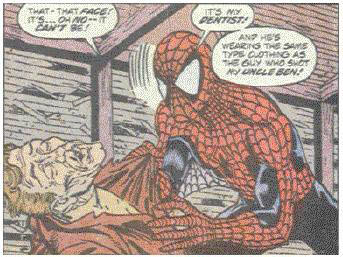
It’s very late as I type this (and that may be a contributing factor), but I found this to be the funniest thing I’ve seen in a mess ‘o Sundays…. Er… Saturdays.

Spidey and His Dentist

That’s from Marvel Comics Presents circa #48-50, written and illustrated by Erik Larsen. I’m not a huge fan of Larsen’s work, but seriously… Mess o’ Saturdays.

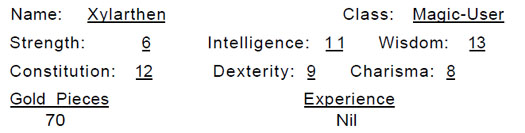
On page 10 of Men & Magic we get the first RPG stat block ever published. “A sample of the record of a character appears like this:”

OD&D Character Stat Block

This is also the closest thing we get to a character sheet in the OD&D rules. (Like many things in OD&D, you have to reverse engineer the general principle out of the example.)

I think the simplicity exemplified by this character sheet is something that a lot of gamers (including myself) look back on fondly: Roll your stats. Pick a class. And you’re ready to go.

Of course, like many things tinged with nostalgia and viewed through rose-colored glasses, this idyllic simplicity never actually existed. Xylarthen’s player still needs to select a race (since he’s an M-U he must be either a human or an elf), equipment (budget those 70 gp wisely), and his spells (well, a spell). And then he still needs to roll or calculate hit points, AC, encumbrance, and speed.

This division between between perception and reality actually proved quite vexing during the early design work for Legends & Labyrinths. I kept trying to get the game to the point where it was literally “(1) Roll ability scores; (2) pick race; (3) pick class”. And, of course, I kept failing. It wasn’t until I took a step back and re-analyzed what I was really trying to accomplish that I was able to get a satisfactory result.

But I digress.

The other interesting thing about Xylarthen is the description of his hypothetical creation: “This supposed player would have progressed faster as a Cleric, but because of a personal preference for magic opted for that class.”

I’m fairly certain that this makes OD&D the only edition of the game to put the idea that not all characters need to perfectly optimized front-and-center. But I also find the passage interesting because it highlights one of the features of rolling your ability scores in order: You are given the raw core for a character. What you choose to do with that core is up to you.

When was the last time you saw a wizard who didn’t have their highest ability score in Intelligence?

The insistence that the game can only be “fun” if your character is perfectly optimized limits the scope of the game. It takes character concepts off the table.

Of course, there are plenty of people who would argue that the guy playing Xylarthen is destined to have “less fun” than if he’d played a cleric. (Or was playing in a game where he could tweak his stats so that Xylarthen looks like every other magic-user in the game.)

And I get that. I can also appreciate that it can be annoying to come to the session saying, “I want to play a magic-user.” And then rolling an Intelligence of 6 and making the character you want to play completely untenable.

And this does, in fact, become less tenable because of the expected longevity of most characters in modern RPG’s. When a character has an expected lifespan of a couple of sessions (if he’s lucky), you can be a bit more philosophical about tackling an unexpected challenge than when you’re expecting to be playing this guy for the next year and a half.

But, on the other hand, Xylarthen sure looks like fun.

The counter-argument, of course, is that nothing stops me from making a wizard with his highest abiltiy score in Wisdom. True. But there is a distinct difference between facing a challenge and dealing with a self-imposed handicap. Just as there is a difference between being given a character and seeing what you can make of it and carefully scultping every detail of the character for yourself.

And I think there’s also a tendency to read the word “challenge” and think that I’m merely talking about the gamist side of the game. But I’m also talking about a creative challenge. The act of creation does not always have to begin with a blank slate. In some cases, deliberately eschewing the blank slate will give unexpected and extraordinary results which might never have been achieved if you limit yourself to a tabula rasa.

The Holmes Basic Set has an interesting section on “Hopeless Characters”:

Sometimes the universe of chance allows a character to appear who is below average in everything. At the Dungeon Master’s discretion, such a character might be declared unsuitable for dangerous adventures and left at home. Another character would then be rolled to take his place.

The act of rolling up a set of ability scores is literally perceived as the moment of creation. When you reject a stat block you aren’t rejecting numbers which aren’t appropriate for your character, you’re rejecting a character who is unsuitable for your play.

The shift in perspective is subtle, but notable.

And this, again, gets back to the idea that character creation itself is a part of the gameplay — not merely a means to an end, but an important part of the process itself. Character creation is not being seen as a prelude activity in which you craft the character you will be playing. Rather, from the moment you pick up 3d6 to roll up their Strength, the game has begun: The ability scores give you the character you will play. And then, from that point forward, it’s your decisions that shape that character’s destiny.

Back to Reactions to OD&D

Archives

Recent Posts

Recent Comments

Copyright © The Alexandrian. All rights reserved.