The Alexandrian

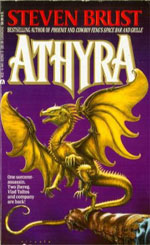
Athyra - Steven Brust“Wolves Beyond the Border” is one of the original Conan stories written by Robert E. Howard. The action, however, does not feature Conan himself. Howard chose to skew his literary camera off to one side and look at the world around his protagonist from a different angle.

This is my first memory of being exposed to this particular technique. It creates a very interesting effect, although — ultimately — I think the story is a failure. In the years since then, I’ve seen the technique used in a variety of series, and the result is more often failure than not.

Which is why, when I realized that Athyra was going to be using this particular approach, I subconsciously bunkered down for a long and painful slog…

… only to be more-than-pleasantly surprised to discover that my fears were unfounded.

In fact, it didn’t take me very long to realize that Vlad Taltos lends himself particularly well to this particular approach. Part of it can simply be boiled down to the fact that the Taltos stories have been told from the POV of Taltos himself. So this is literally our first opportunity to see what he looks like to other people. (Whereas with Conan, for example, the stories are told from a third-person POV, so there’s already some distance from the character.)

But Taltos’ susceptibility to this kind of technique also has a lot to do with the nature of the character himself: Taltos likes to play his cards close to his vest. He plots and he plans, but he usually keeps those plans — and even the information those plans are based on — a closely kept secret. When you’re inside his head, though, he can’t keep any secrets from you. It’s like watching a poker tournament on TV: You can see all the cards.

In Athyra, on the other hand, we suddenly find ourselves on the outside looking in: The cards are hidden from us. And that, in itself, is interesting.

But what really makes it fun is that, at this point, we’ve gotten to know Vlad pretty pretty well. So we still have a pretty deep insight into the types of games he plays and the way he plays them. So, on the one hand, we can suddenly sympathize with the new protagonist who finds himself baffled by Vlad’s hidden strategies (a POV that suddenly gives us a fresh insight into the perspective of many supporting characters from the previous books), but on the other hand we can also appreciate the deeper structure of what Vlad is doing.

I think the other thing that makes Athyra work is the type of story Brust has chosen to tell: The main character is Savn, a young Dragaeran lad on the cusp of reaching adulthood. The novel, in short, falls into the familiar genre of “young boy/girl finds unique bond with exotic mentor while coming of age”. (My personal favorite in this category is probably Stephen King’s Hearts in Atlantis, although you’ll find examples of the genre cropping up everywhere.)

This type of story weds itself well to the enjoyment gleaned from knowing Vlad better than the main character does. In fact, the entire genre is largely driven by the fact that we — either as adults or as the genre-aware — can appreciate the “exotic mysteries” of the mentor figure. Part of the genre’s effectiveness is that it saddles both sides of the chasm which is “coming of age”. On the one hand, we remember the (relative) innocence of our youth. On the other, we know the wider world which is being revealed. In the interstice between the two, we remember what that coming of age was like… and thus become intimately sympathetic with the main character as they follow the same journey.

(When I was a kid, on the other hand, these stories operated on a very different level: The fictional mentor became my mentor as well, and I became intimately sympathetic with the main character because their journey was my journey.)

The other thing about this type of story is that, although it is not told from his POV, the mentor is a main character. When done properly, the story is as much the mentor’s as the student’s. So even though we’re pushed out of Vlad’s head, Vlad in some sense remains a main character (which I think helps make the technique work).


COMING OF IMMORTAL AGE

In my reaction to Yendi I discussed the genre-alteration of familiar tropes. Brust has a talent for taking existing archetypes, running them through the unique characteristics of his fantasy world, and creating something refreshingly unique and entertaining.

In the case of Athyra, Brust is telling a coming of age story for Savn… but Savn is 80+ years old.

Savn is a near-immortal Dragaeran with a lifespan of several hundred (possibly thousand) years. He is also a farmboy still serving in his apprenticeship to a physick. So in terms of social position (and even maturity), Savn is basically a teenager. A very old teenager.

Brust appears to be consciously attempting to explore what it would mean to be a near-immortal living in a society of other near-immortals. It’s a bold challenge. And, in the narrow case of Savn and the story of Athyra, Brust succeeds.

But, to a large extent, he only succeeds by “cheating” — and so, in a broader sense, he also fails.

By “cheating”, I mean that he has placed Savn in a rural community which is socially backwards and largely populated with ignorance. This allows Brust to get away with having Savn be relatively naive and culturally under-developed. In other words, it allows him to largely draw a line of equivalence between “human 16-year old” and “Dragaeran 80-year old”.

Which, as I say, works just fine for the story… but still disappoints on some level because it misses out on what could have been a much bolder and more dynamic challenge.

Let’s try to break this down. If you actually took human lifespans and started lengthening them, what would happen to the concepts of “childhood” and “adulthood”?

Well, to some extent we don’t have to imagine it: It’s been happening all around us for the past hundred years or so. The concept of “teenager”, for example, is a recent one. (The term itself wasn’t even coined until the 20th century.) It represents a rather radical departure from ages past, when people we now consider “kids” would have actually been seen as fully functional adults. And over the past decade or so, I have noted increasing trends to infantilize college students, with a growing expectation that colleges and universities should be acting as some sort of surrogate parents for their students.

And this social trend appears to be expanding even as recent physical trend lines indicate that the onset of puberty is happening at earlier ages.

Speaking in general terms, I see three reasons for this expansion of pre-adulthood:

First, the increase in average lifespan lessens the sense of urgency in reaching adulthood and pursuing adult goals.

Second, the amount of “basic knowledge” expected for someone to function as an adult in society has drastically increased. We’ve gone from the completion of high school being exceptionally rare to a college education being seen as a fairly standard expectation. The acquisition of more knowledge requires more time, and this naturally expands the amount of time it takes to become an adult in the eyes of society.

Third, the amount of leisure time and the economic structure of our society has fundamentally shifted. When it’s an economic necessity for your kids to help you in the field, you’ll get them out there as soon as they’re physically capable of helping you. But the vast majority of modern careers don’t have that kind of structure. This, again, reduces the sense of urgency in reaching the transition from childhood to adulthood.

But there’s an important proviso here: The 16-year old of today is not the functional equivalent of the 10-year old of yesteryear. And this is the mistake that Brust makes when he draws the line of equivalence between a modern 16-year old and a Dragaeran 80-year old. The expansion of childhood isn’t like taking the same chunk of butter and spreading it over a larger slice of bread.

Because, fundamentally, the 80-year old Dragaeran will still have 80 years of experience, even if they’re not functionally an adult in the eyes of their society. And you can kinda duck around that, as Brust does, by putting the character into a situation where they can easily hit a ceiling of knowledge and enter an endless cycle of dreary life.

But I think you’re ducking out of the really interesting question: Whether it’s a matter of physical maturation or social construct (or both), what does it really mean to be 80 years old and still be a child?

Athyra doesn’t try to answer that question. If it did, it might have been a great novel. As it is, it’s merely a fun one.

GRADE: B

Steven Brust
Published: 1993
Publisher: Ace
Cover Price: $7.99
ISBN: 0441033423
Buy Now!
Go to Part 1

I’m continuing the account of our second session of OD&D in the Caverns of Thracia.

FIRST TRAVAIL: FUN WITH PIT TRAPS

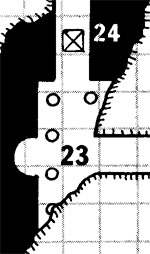
Caverns of Thracia - Area 23The pit trap in this section of the dungeon also led to some hilarity: After detecting its presence, Thalmain spent the better part of 15 minutes working out massively elaborate and overwrought work-arounds for trying to get across it… having missed the fact that there were 1-foot wide walkways to either side of the pit that could be easily walked across.
The funny part was that the other players had heard that information just fine. They, like me, just waited for Thalmain to finish his various exertions with ropes and acrobatics. When he was finished, Herbert calmly walked around the pit trap and patted him on the shoulder. “Can we go now?”

INTERLUDE: SLEEP AND SLEEP ALIKE

Caverns of Thracia - Area 25

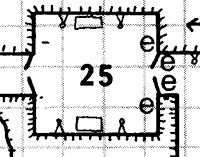
Following their first forays into the dungeon, the Thanatos death cultists had retreated to this chamber. This was going to be a tough encounter in any case and the PCs, unfortunately, alerted the cultists by talking loudly as they approached the heavy wooden doors.

This allowed the cultists to entrench their positions. When the PCs finally battered their way through the doors they found 8 well-accoutered guards in full plate; 2 cultist priests; and a trained black bear awaiting them.

Which is when I was forcibly reminded of just how powerful the sleep spell used to be:

Sleep: A Sleep spell affects from 2-16 1st level types (hit dice of up to 1 + 1), from 2-12 2nd level types (hit dice of up to 2 +1), from 1-6, 3rd level types, and but 1 4th level type (up to 4 +1 hit dice). The spell always affects up to the number of creatures determined by the dice. If more than the number rolled could be affected, determine which “sleep” by random selection. Range: 24″

At low levels it is, effectively, an encounter-ending ability. It was significantly neutered in 2nd Edition and then further neutered in 3.5 to the point where I almost never see it cast any more. But it quickly became apparent why it used to be a staple of the Magic-User class (along with magic missile and fireball):

Trust cast his first spell… and the entire room (except for the black bear) fell asleep. The bear was quickly taken down and a mass throat-slitting ensued.

There was much cheering and general approbation.

I had poetic justice a few minutes later, however, when the party triggered the sleep gas trap on one of the chests in the room. Everyone except for Thalmain was knocked out.

SECOND TRAVAIL: FUN WITH FLAMING OIL

Here we had another fun twist: Earlier in the session, several characters had been afflicted by a paralytic effect. Thalmain had been among those who had tried (unsuccessfully) to wake them. They had been forced to wait for the better part of an hour before the effect wore off. Left all alone, Thalmain now assumed that the sleep gas was, in fact, another paralytic effect.

When Thalmain decided to move their unconscious forms to the far side of the room, I was initially going to declare that the disturbance of being moved was sufficient to wake them up. But then Thalmain’s player specified, out of the blue, that he was moving them very carefully — and I decided that such careful ministrations would not be sufficient to wake them.

This nearly proved their undoing when, a few minutes later, a patrol of lizardmen showed up hoping to parlay with the cultists. Thalmain had spiked the door shut and even tried to bluff them into going away, but the lizardmen weren’t having it. They managed to batter the door open, although Thalmain’s cleverly placed iron spikes managed to wedge it in a position where they could only come through single-file.

But, nevertheless, it was still Thalmain the Halfling against an entire squad of lizardmen.

This would have probably ended badly if it wasn’t for Thalmain’s pyromania: He had, with great forethought, doused the floor in front of the doors with oil. As the lizardmen started to pour through the gap between the doors, he fired a flaming arrow into the middle of it and turned the entrance into a pyre.

A few lizardmen managed to leap through the flames largely unharmed… only to be struck by a second flask of oil that Thalmain had kept in reserve, spreading the inferno even further. The remaining lizardmen tried to pull back… only to be taken down by Thalmain’s archery.

It was a complete rout.

Shortly thereafter, Thalmain realized he could wake the others up by simply slapping them on the cheeks.

On this triumphant note, the characters retreated from the dungeon and the players retired for the evening.

Session 3 – Coming Soon!

Go to Part 1

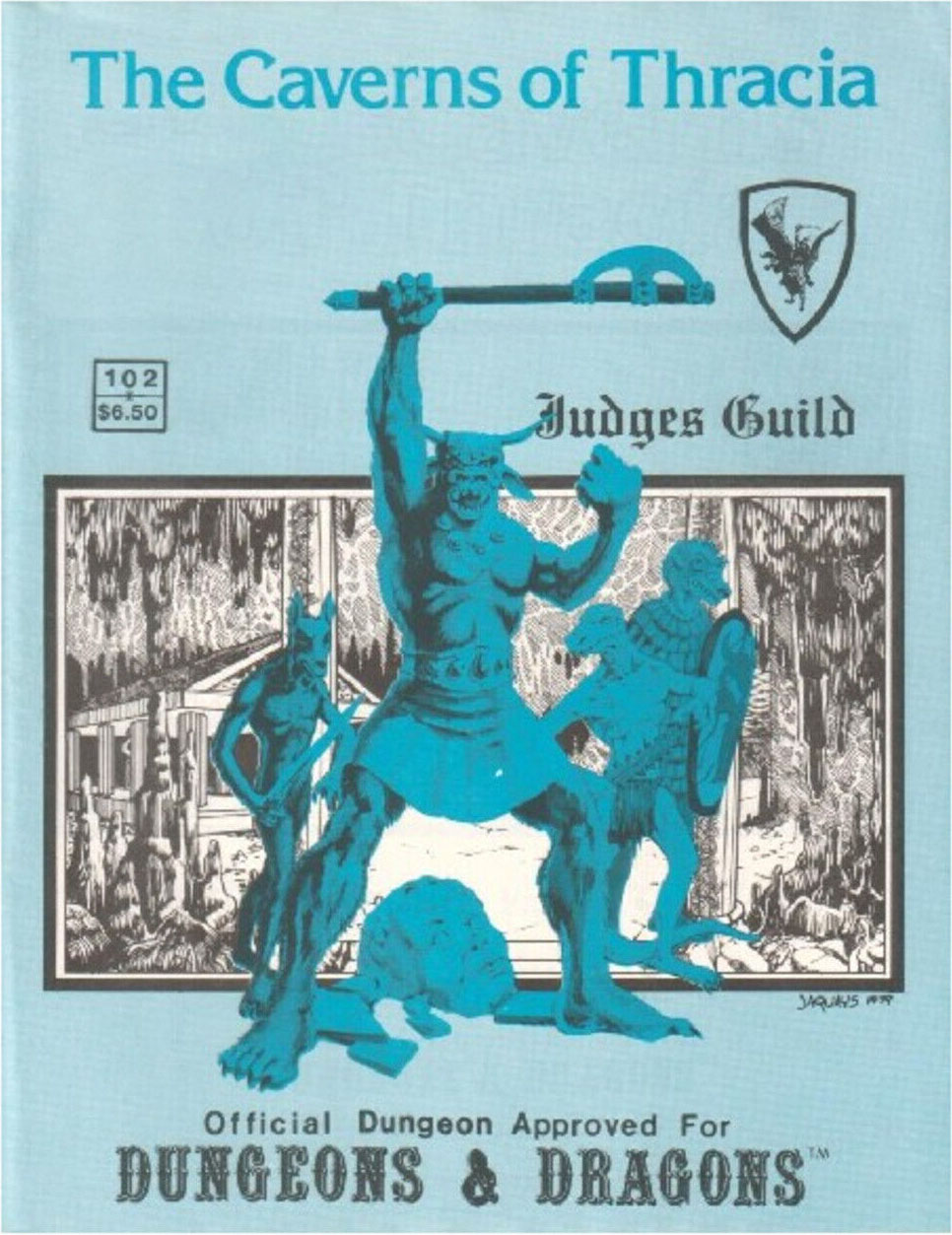
Caverns of Thracia - Jennell JaquaysChristopher B. encouraged me in a post over at Grognardia to prioritize these session summaries of my Caverns of Thracia mini-campaign using OD&D. In Part 5 I wrapped up the end of the first session, which turned out to be such a success in the eyes of my players that several players asked for a follow-up.

Ergo, session two.

For this session, the player roster was shuffled a bit: The player for Reeva couldn’t make it, but we added two new players. We glossed over the escape from the dungeon and moved everybody back to the logging village on the edge of the jungle containing the ruins.

Herbert the Elf had been rescued at the end of the last session and he volunteered to return to the complex to wreak vengeance (and loot treasure). He was joined by the core of the previous party (Thalmain, Trust, and Warrain), as well as new recruits in the form of Dominic and Thaxter.

Thaxter, it turned out, proved to be one of the two main highlights of the evening. Thaxter was an elderly gentleman who presented himself to the party as a worldly and experienced knight. The party was eager to have such an experienced swordarm as part of their expedition.

Unfortunately, Thaxter was nothing of the sort. It turned out that he was, in fact, the chef from the local inn. He’d seen the gold rush adventurers profiting left and right from the various ruins of the Thracian Empire and wanted in on the action.

The truth came out shortly after they had ventured back down into the dungeon complex: As they were crossing one of the rope bridges over the subterranean chasms, a giant bat swooped out of the darkness… Thaxter panicked and cowered like a little child, tossing his torch aside wildly and screaming in terror.

(The torch ended up landing on the rope bridge itself, and started burning one of the ropes. A couple of the players — realizing that they weren’t carrying any water — dropped their trousers and peed on the fire to put it out. This was not their noblest hour…)

In short, Thaxter — as a character concept — was brilliant, clever, funny, and memorable. When he eventually perished (after finally conquering his fear and bravely plugging a hole in the line when Trust was knocked unconscious in a fight against a band of lizardmen), he was applauded by the entire group.

Ironically, the players’ appreciation of Thaxter was not matched by Thaxter’s son — Quinton — who showed up shortly thereafter looking for his father. Quinton proved to be nothing but critical of his father’s (many) shortcomings, which led to this short exchange:

Thalmain: “Okay, look. We’re going to ask you a couple of, umm… hypothetical questions.”

Dominic: “Right. Hypothetical questions.”

Thalmain: “Hypothetically speaking, if you were suddenly faced by a giant bat, what would you do?”

Quinton: “… my father ran away like a little coward, didn’t he?”

Thalmain: “Umm… Yes. Uh… Hypothetically, anyway.”

(UN)FUN WITH MAPPING

For this OD&D mini-campaign, I’m not using any kind of battlemap. I’m also (a) strongly encouraging the players to keep a map and (b) requiring that, if they’re mapping, then their character is mapping. (In other words, they need to have pen and parchment; they need to be carrying them in their hands; and the map itself is a physical item.)

On the first level of the Caverns of Thracia there is a room that looks like this:

Caverns of Thracia - Area 23

It looks easy enough. But attempting to communicate verbally what this room looks like proved to be really confusing. (And I had several opportunities, because the exact same issue came up again in the third session when somebody else was keeping the map.)

“There’s a platform jutting out over a chasm. Directly in front of you, on the far side of the platform, there is a semi-circular protrusion with an altar. Columns lead off to your right, ending in a stone bridge that leads towards a tunnel in the far wall of the chasm.”

At one point I even whipped out a small piece of paper and sketched the shape of the room. The map still got screwed up in ways that weren’t reasonable for characters actually standing in the room and looking at.

This reminded me why I eventually drifted away from this particular conceit in my regular campaigns. Having the characters keep a map can lead to a lot of fun gameplay: Analyzing the map for clues on where to explore next (or where some secret passage might be hidden). Losing the map. Getting lost due to poor mapping. Chewing up valuable time trying to make the map accurate. Using the map to re-orient yourself after getting forcefully lost.

But on the flip-side, the metagame complexity and pace dragging of trying to communicate any kind of non-standard passage or room shape can be incredibly frustrating. It also strongly encourages the design of relatively uniform floorplans (square rooms, straight corridors) to avoid the headache. But, of course, this uniformity ends up undermining the very type of gameplay that this type of mapping is supposed to enable.

I’m still not sure what the best solution is for this. Or if there is one.

Continued…

Design Notes: War-Trained

March 27th, 2009

RPGNow – Lulu PDF – Print Edition

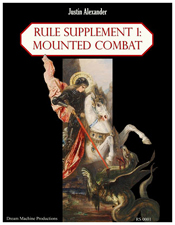
Rule Supplment 1: Mounted CombatI had a conversation this afternoon that reminded me of something I meant to talk about many moons ago regarding the development of Rule Supplement 1: Mounted Combat.

Here’s the question that jogged my memory: “Is a familiar proficient in the same armor as the caster?”

This, it turns out, is not an easy question to answer. It ends up falling into the middle of several rather murky portions of the rules. The Animal type in the SRD reads: “Proficient with no armor unless trained for war.”

The first complication with this is that familiars aren’t actually Animals, they’re Magical Beasts. And the Magical Beast type simply reads: “Proficient with no armor.” So what happens if you take a war-trained animal and make it a familiar? Does it simply lose the proficiency?

The answer to that is: Maybe. The rules for familiars read, “A familiar is a normal animal that gains new powers and becomes a magical beast when summoned to service by a sorcerer or wiard. It retains the appearance, Hit Dice, base attack bonus, base save bonuses, skills, and feats of the normal animal it once was, but it is treated as a magical beast instead of an animal for the purpose of any effect that depends on its type. Only a normal, unmodified animal may become a familiar.”

You’ll note that proficiencies are not listed in the list of things that the familiar retains when it becomes a magical beast. But, on the other hand, proficiencies can also be a type of feat — should all proficiencies be grouped under that catch-all? I’d certainly argue that this interpretation of the passage makes the most sense.

But the passage also says that “only a normal, unmodified animal” can become a familiar. Is a war-trained animal a “normal, unmodified animal”?

Good question. What is a war-trained animal?

And here we come to the second murky area of the question: The term “war-trained” is never actually defined in the rulebook. The term is used in the Animal type (quoted above) and in a few scattered references to warhorses vs. normal horses, but it’s never explained. You would think since it involves training an animal that it would be referenced in the Handle Animal skill… but no such luck.

This was an issue that I needed to resolve for Rule Supplement 1: Mounted Combat. The way I resolved this issue was to create the War-Trained animal purpose. Animals could be trained with this purpose using the Handle Animal skill:

War-trained (DC 20): A war-trained animal knows the tricks attack, come, defend, down, guard, and heel. War-training an animal takes six weeks. You may also “upgrade” an animal trained for riding to a war-training by spending three weeks and making a successful DC 20 Handle Animal check. The new general purpose replaces the animal’s previous purpose. A war-trained animal is proficient with all armors (light, medium, and heavy) and shields (including tower shields).

Problem solved. If you adopt this War-Trained animal purpose as a fix-it for the oversight in the core rulebooks, then I don’t think it’s too much of a leap to allow a familiar to be war-trained (even though they’re technically magical beasts and not animals).

However, the may not be necessary if you’re willing to make a sufficiently liberal interpretation of the rules for familiar. Those rules state that familiars gain the skill ranks and save bonuses of their masters. Proficiencies aren’t mentioned, but that’s likely because (a) standard familiars can’t use weapons and (b) sorcerers and wizards aren’t proficient in any armor. I don’t think it’s too much of a stretch to allow for the familiar to gain the armor and weapon proficiencies of their master.

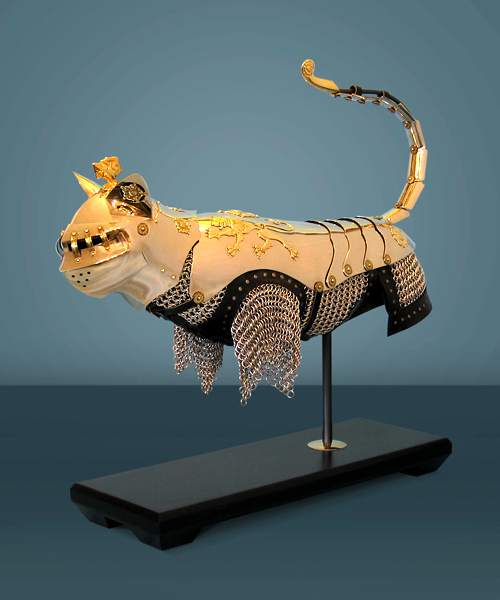
After all, it allows for awesome things like this:

Plate Armor for Cats

And awesome should always win out in the end.

This is an example of prepping a detailed scenario timeline, an important part of scenario-based prep as described in Don’t Prep Plots. It’s taken from my current campaign, In the Shadow of the Spire.

MY PLAYERS SHOULD STOP READING

Read more »

Archives

Recent Posts

Recent Comments

Copyright © The Alexandrian. All rights reserved.