The Alexandrian

Of Lords and Ladies

June 4th, 2009

The etymology of the English word “lord” is interesting: In Middle English it was laverd or loverd, which derived from the Old English hlaford (“master of the house”). But before that it was hlafweard, which meant literally “one who guards loaves of bread” (hlaf meaning “bread or loaf” and weard meaning “guardian, protector, or ward”).

On the other hand, a lady was hlafæta (“one who serves the house”) — or, more literally, “one who gives the loaf”.

In other words, an English lord was one who protected the food and an English lady was one who was responsible for distributing the food (presumably in a fair and efficient fashion).

I think this tells you a great deal about the English tradition of nobility.

You can also find similar etymological roots for other familiar titles: A duke is literally “one who leads”. An earl, on the other hand, was literally a “warrior” or “brave man”. (But it’s even more interesting to note that “earl” was an Anglo-Saxon term. It was equated with the French title of count when the Normans arrived. The term “count” derives from the Latin comitem, which means “companion”. Tells you something about the clashing traditions of nobility in England post-1066, eh?) In Old English a sheriff was the “chief of the shire” (scirgerefa, from scir– meaning “shire” and –gerefa meaning “chief, official, reeve”).

One of the things I enjoy doing while creating a fantasy setting is to create original titles of nobility and position. Not a lot of them (because nobody is really interested in turning a gaming session into a fictional language lesson), but just a few scattered here and there. Think of it as spicing or emphasis… or just a touch of the unnatural.

For example, a number of small nations and city-states in my campaign are ruled by syrs. For example, Dweredell is ruled by Syr Arion. This title is derived from the Draconic word for “lightning” and originally referred to the equivalent of  “duke” or “governor” in an ancient empire that once dominated wide swaths of the world. The empire used “lightning” as a title because the syrs ruled through the threat of destructive power. (Which tells you a great deal about the empire.) When the empire fell, the local syrs were in a position to consolidate power.

There are two tricks to introducing terms like this: Moderation and context.

First, don’t use a lot of them. And introduce them at a very slow pace. (I average about one every 20 sessions.) These things are spicing. And like all spices, less is usually more.

Second, introduce them through the simple and expedient means of using them in context. For example, the first time a group of players entered Dweredell they went looking for the leader of the city. After a Gather Information check I told them they could find Syr Arion at the Twin Keeps, and off they went with nary a question.

Another group started a campaign in the city-state of Amsyr and when I said “you receive an invitation from the syr to attend upon him at the palace”, one of the players asked, “What’s a syr?” And I said, “A local title, like a duke or a prince.” They said, “Oh.” and off we went.

Similarly, in my current campaign, nobody even batted an eye when I started referring to female knights using the title Sera. (Thus, Sir Kabel and Sera Nara.) (Why not use “dame”? For a variety of reasons.)

In both cases the term sort of settled into the common vernacular of the group. And when some of those players later learned that the term nainsyr meant “let there be lightning” (because it was the command word for a magical sword), maybe some connection was made (either consciously or otherwise).

Or maybe not. It doesn’t really matter: My mission was already accomplished. I had already leveraged them a little further away from Generic Fantasy World #961.
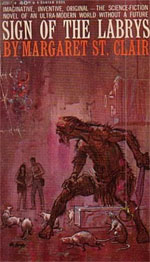
Sign of the Labrys - Margaret St. ClairI came to this novel by way of Gary Gygax by way of Appendix N of the 1st Edition Dungeon Master’s Guide by way of James Maliszewski at Grognardia.

I think it’s safe to say that, if not for that rather remarkable (and lengthy) chain of recommendations, I would probably have never read this slim volume — which, as far as I know, was published in 1963 and never seen again.

Sign of the Labrys is a post-apocalyptic tale of the sort commonly found in mid-20th century science fiction. What sets it apart is that it is also, although it doesn’t strictly look like it at first, science fantasy. (This becomes clear fairly quickly, but the exact reasons for its fantastical nature constitute a spoiler so drastic that I won’t even hint at it here.)

The ways in which Sign of the Labrys inspired Gygax’s dungeoncraft become both rapidly and intriguingly apparent: Sam Sewell, the protagonist of the tale, lives in a vast underground complex of modified caverns that was built as a refuge before the collapse of civilization. The apocalypse thinned out the population (killing nine in ten) and eradicated central authority, leaving behind vast catacombs of uninhabited space which small, spontaneous societies have repurposed in a variety of ways.

In short, Sign of the Labrys reads like a strange hybrid of Dungeons & Dragons and Metamorphosis Alpha. Here we find a clear predecessor of Castle Greyhawk: A multi-cultural, subterranean menagerie laid out in a pattern of levels and sub-levels connected by both the well-known thoroughfares and a plentitude of secret passages and hidden ladders.

This, by itself, would have made Sign of the Labrys a fascinating and worthwhile novel for a D&D afficionado like myself. But I also found the novel to be very entertaining in its own right. Addictive, in fact. It’s got a page-turning, pulpy pace mixed together with some nigh-poetic language and a strange, enigmatic mystery that leaves you yearning to know the answer.

Stylistically Sign of the Labrys reminds me quite favorably of Henry Kuttner and C.L. Moore. It possesses the strange, otherworldly, and fantastical approach to matters of science fiction which characterizes the best of their work. Particularly Moore’s. Like Moore’s classic Jirel of Joiry stories, Sign of the Labrys reminds me of Alice in Wonderland smashed through the broken mirror of another genre’s conceits and set pieces. If I were to say that Sign of the Labrys periodically reads as if the author had taken a tab of LSD before sitting down at her typewriter it would not be wholly inaccurate. (It would, however, be rather less than charitable, as St. Clair’s writing is not merely a drug-induced rambling. In fact, it works consistently towards a larger stylistic and revelatory purpose.)

In the end, I found Sign of the Labrys to be delightfully entertaining. And since, like me, you are unlikely to encounter it by chance, I shall pass on the same recommendation that was given to me: From Gygax to AD&D to Grognardia to me to the Alexandrian and thus to you…

Find a copy if you can.

GRADE: B-

Margaret St. Clair
Published: 1963
Publisher: Bantam Books
Cover Price: $0.60
Buy Now!

X-Men Origins: Wolverine

May 2nd, 2009

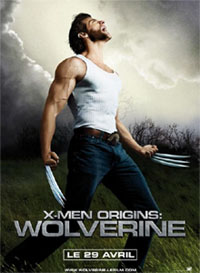
X-Men Origins: WolverineWow. That was really bad.

I just got back from watching X-Men Origins: Wolverine and I feel absolutely compelled to warn others from wasting their money on a cinematic travesty. What’s particularly remarkable about this disastrous failure is that the first half of the film is actually quite good. It’s not a cinematic triumph by any stretch of the imagination, but it’s a solid, entertaining popcorn film.

But then, a little over halfway through the movie, a switch is flipped. Something incredibly stupid happens, and from that point forward the entire film becomes nearly unwatchable: The plot, the characters, and even the editing all become insultingly idiotic.

It’s as if the two halves of the film were made by completely different creative teams.

You probably won’t believe me. I’d certainly seen people giving the thumbs-down to this movie in various places around the ‘net before deciding to go and see it anyway. But consider this: I actually left the theater thinking X-Men 3 wasn’t a complete disaster. (It was a huge disappointment and completely wasted the opportunity created by the first two films. But it was passable.)

And I’m telling you that X-Men Origins: Wolverine is an unwatchable travesty.

From this point forward we’ll have SPOILERS so that I can rant a bit.

(1) First, allow me to reiterate that I thought the first half of the film was actually quite good for a popcorn action flick. The opening sequence with the young brothers; the montage sequence over the opening credits; and Hugh Jackman’s performance through the next section all made the film very entertaining.

(2) First Warning Sign: The scene where Logan is getting injected with the adamantine skeleton.

Stryker: “By the way, here are your dog-tags. Because even though you’re completely naked, laying in a tub of water, and about to be injected with molten metal, I think you should be wearing these.”

Logan: “I want new ones.”

Stryker: “What do you want them to say?”

Logan: “Wolverine.”

Stryker: “Really? Okay. Well, damn. Okay, everybody hold on. Logan, you just stay laying right there. Everybody else just hang out. I’m going to go have completely new dog-tags made.”

And they do…!

(3) Second Warning Sign: Agent Zero has just been killed trying to kill Wolverine.

Nameless Dude: “Agent Zero had no chance. You would need a gun with adamantine bullets. Like this one right here. That we have had all along. And could have easily given him.”

Stryker: “Wasn’t Agent Zero’s mutant power his ability to shoot guns really, really well?”

Nameless Dude: “Don’t forget his ability to leap around like a jackrabbit.”

Stryker: “Right. I see we’re theming these mutant powers well. But since he could shoot really well, wouldn’t it have made more sense to give him this gun?”

Nameless Dude: “… dude. You could have said something like an hour ago.”

(4) The Stupid of No Return: The first time Gambit attacked Wolverine, it made perfect sense. The second time Gambit attacked Wolverine? That was stupid. Really, really, really stupid.

(For those who haven’t seen the film: Gambit hates Sabretooth and wants him dead. He sees Wolverine with his blades to Sabretooth’s throat and hears him say, “I’m going to kill you.” So what does Gambit do? He attacks Wolverine and stops him from killing Sabretooth. Thirty seconds later after Sabretooth has escaped? Gambit is asking Wolverine to help him kill Sabretooth.)

(5) The Rest of the Stupid: I’d try to list it, but there’s really no point. After the Stupid of No Return, virtually every single second of the movie is stupid. So I’ll just highlight one particularly egregrious bit of stupid…

(6) Professor X is a Dick: Remember in the first X-Men movie when Professor X knows nothing about Wolverine? Turns out, he’s a dick. Not only is he telepathically monitoring the entire finale of the movie (and thus probably knows exactly who Wolverine is), but even if he somehow missed Wolverine’s presence telepathically it turns out his first twenty students (including Cyclops!) were all rescued by Wolverine himself!

The fact that the Cyclops himself doesn’t recognize Wolverine makes sense (because they’re actually quite careful about making sure he’s blind and never even hears Wolverine speak). But Professor X? He’s a dick.

Unless they get Bryan Singer back, this is probably the last X-Men movie they’ll be conning me into seeing for awhile.


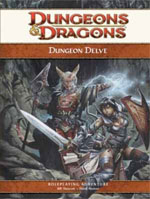
Dungeon Delve – WTF?

April 16th, 2009

Dungeon DelveI was flipping through a friend’s copy of Dungeon Delve and took the opportunity to read through the introduction by Bill Slavicsek, the Director of R&D at WotC. He starts by describing the successful Dungeon Delves that WotC has run at various conventions over the past decade:

But from the opening of the show on Thursday, we knew we had found the crux of a winning formula. (…) The fans ate it up. We had enormous lines at the Delve that entire weekend. They lined up to get into the available party slots. They lined up to witness the action and see whether Monte Cook or Bruce Cordell or Ed Stark (or whoever else was part of the team at that time) could kill more characters as more and more of the Delve was revealed. They lined up to see the next dungeon details and character names get posted to the bulletin board. How far had they gotten? What had they killed? Who didn’t make it out of the last fight?

They had a winning format: A megadungeon serving as the shared campaign setting for a huge pool of players. They basically took core Old School play and condensed it down to a format that could be played rapid-fire over the couse of a convention weekend.

Nifty stuff.

With this book, the Dungeon Delve concept finally takes center stage as a core D&D product. It was a long time coming, but we needed that time to test concepts, try out new formats, and eventually get to the point where this product was not only viable, but in many ways necessary to the evolution of the D&D game.

This makes perfect sense. If you’re in the business of selling RPGs and you’ve got something that’s a proven success with RPG players, you should try to figure out how to bottle that success and sell it to the masses.

For the purpose of this product, a Dungeon Delve is a compact series of encounters appropriate for a specific level of play. This book contains 30 Dungeon Delves, one for each level of play. Each Delve features three encounters, forming a mini-adventure of sorts.

Wait… what?

So you had a format: Megadungeon. High mortality rate attracting lots of attention. Boatloads of players/characters sharing a single setting to create a sense of competition, rivalry, and shared accomplishment.

And your method of bringing this format to “center stage as a core D&D product” is to give us mini-dungeons featuring three encounters incapable of serving as a shared campaign setting in a system explicitly designed for low mortality rates?

WTF?

(And is it even possible for them to devalue the term “core” any more? Describing their splat books as “core” was bad enough, but now they’re actually claiming that their adventure modules are “core” products? Exactly what do you produce that isn’t a “core” product, WotC?)

Let me be clear here: There’s nothing wrong with either style of adventure. I think there’s room in any good campaign for both megadungeons and mini-adventures. I contributed mini-adventures to Atlas Games’ En Route II. My Mini-Adventure 1: Complex of Zombies is pretty much in the same ballpark. I haven’t actually taken a close look at the actual adventures in Dungeon Delve, but conceptually it’s an interesting and potentially useful product.

But what baffles me is a company saying, “Our goal is to do X. And in order to do X, we’re going to do not-X.”

I mean, there are many parts of the design of 4th Edition which followed that pattern: The designers say that they want to do X and then they release mechanics which either don’t do X or do the exact opposite of X.

I had simply assumed that was incompetence. But maybe that’s just the way that Slavicsek and his design team think. (Which would also explain why we got not-D&D when they tried to design D&D.)

This material is covered by the Open Gaming License.

A character can choose to push the limits of their normal abilities in exchange for the character suffering some fatigue from the effort. Immediately after using extra effort, a character becomes fatigued (-2 Strength, -2 Dexterity, cannot run), even if they are normally immune to fatigue. If a character uses extra effort while fatigued they become exhausted (-6 Strength, -6 Dexterity, one-half speed). If a character uses extra effort while exhausted they become unconscious.

A character using extra effort can gain one of the following benefits for a single round:

Activate Class Ability: Gain an additional use of a class ability that has a limited number of uses per day.

Desperate Parry: As an immediate action, gain the the benefits of fighting defensively (or using the Combat Expertise feat) against one attack. If the character was already fighting defensively (or using the Combat Expertise feat), double the bonus gained.

Desperate Speed: Move at double speed for one round or take an additional 5 foot step.

Emulate Feat: Benefit from a feat they don’t have for 1 round. The character must meet the prerequisites of the feat.

Emulate Metamagic: The character can use a metamagic feat they don’t have or don’t have prepared. This increases the casting time of the spell to at least a full round unless using the Quicken Spell feat. A caster with prepared spells must use up a prepared spell of the appropriate level, but can keep the original spell being modified. A spontaneous caster can use extra effort to use a metamagic feat they do know without increasing the casting time of the spell.

Extra Attack: When performing the full attack action, make 1 extra attack at their highest base attack bonus.

Focused Skill Check: Take 10 on a skill check even when they normally couldn’t.

Opportunist: Take an extra attack of opportunity.

Prodigious Strength: Double their carrying capacity for one round or gain a +2 bonus to a single Strength check (or Strength-based skill).

Spell Boost: A caster can use extra effort to gain a +2 bonus to their effective caster level for a single spell. (Must declare before casting the spell.)

Turn the Blow: Automatically negate an opponent’s critical hit (turning it into a normal hit).

Vicious Blow: Automatically confirm a critical without making an additional attack roll. (Must be declared before checking the crit.)


EXHAUSTING EFFORT

A character performing an exhausting effort suffers from exhaustion. If a character is fatigued when performing an exhausting effort, they become unsconsious. Exhausted characters cannot attempt an exhausting effort.

Intense Skill Check: The character can Take 20 on a physical skill check without expending any additional time on the check and even in circumstances where they normally couldn’t.

Recall Spell: Spellcasters who prepare their spells can use exhausting effort to recall any spell previously cast on the same day. The spell can be cast again with no effect on other prepared spells. Spontaneous spellcasters can use extra effort to cast a spell without using one of their daily spell slots.

Second Effort: The character can reroll any one die roll and use whichever result is better.


DESIGN NOTES

The Extra Effort mechanics serve a function similar to Action Points. One key difference is that while Action Points are a dissociated mechanic, the Extra Effort mechanics are associated: They specifically model that moment when a character digs deep and finds the inner reserves necessary to do what must be done.

The specific list of benefits that a character can gain from Extra Effort should be considered a sampler. Players should be encouraged to propose their own, situation-specific benefits from Extra Effort.

In judging whether or not a particular benefit is appropriate, I propose a simple spot-check: If it’s appropriate for a 2nd-level spell, then it’s appropriate for extra effort. If it’s appropriate for a 4th-level spell, then it’s appropriate for an exhausting effort.

The rationale for this is simple: Fatigue can be removed with lesser restoration (a 2nd-level spell) and exhaustion can be removed with restoration (a 4th-level spell). Therefore, in a worst case scenario, the system can’t be abused any farther than a character using extra effort and then immediately wiping it out with a 2nd-level spell or using exhausting effort and then immediately wiping it out with a 4th-level spell.

In playtesting, for example, exhaustive efforts were created when the Recall Spell ability proved too powerful: Characters were getting the benefit of a mnemonic enhancer spell for the use of a lesser restoration spell. Mnemonic enhancer, however, is a 4th-level spell — so if characters want to use a 4th-level restoration spell to more-or-less mimic the effect of another 4th-level spell, I’ve got no problem with that.

Archives

Recent Posts

Recent Comments

Copyright © The Alexandrian. All rights reserved.