The Alexandrian

This, like pretty much everything Google does, is really cool. But either I’m becoming an old fogey, or the fact that Google continues to make us more and more reliant on content that exists only on their servers makes me nervous.

In pondering the implications of the AIs in Greg Egan’s Diaspora immersing themselves so completely in virtual realities that they forgot about the real world, I found a simple saying: “You should never forget where your plug is.” The virtual reality may be indistinguishable from the real world in every way while being filled with endless possibilities far beyond the scope of anything the real world may be able to offer: But if the sun goes supernova in the real world, you’re still going to die, no matter how deeply nestled you’ve become in your artificial life.

In reflecting on cloud computing I think it’s equally important to say: “You should never forget where your data is.”

Because the “cloud” is increasingly becoming a buzz word that means, “If Google ever goes away or chooses to shut down a server or decides to start charging for a service, then you’re all screwed.”

Don’t get me wrong: I use GMail, Google Calendar, and Google Reader. I watch videos on Youtube. I search prices on Froogle. Google Books (along with the Internet Archive) is literally revolutionary in making information widely and rapidly accessible. I’m even convinced that Google Wave has the opportunity to replace e-mail. (Although, notably, one of the reasons I believe that is because Wave is an open protocol and not dependent on Google’s servers.)

But whenever I hear about somebody who has lost their entire blog because their hosting company has gone out of business or failed to back up their servers properly, I’m reminded of the importance of knowing where your data is. The Alexandrian, for example, is actually designed so that the primary copy of every document is kept on my local computer. The website itself is the first of several back-ups. And even though that isn’t an option for many blogs, you should still make a point of making a local back-up on a regular basis.

The same applies to anyone who’s keeping their data exclusively on Google Docs, Flickr, Facebook, or anywhere else on the web. The utility of being able to access and manipulate your data from anywhere is great, but the importance of both knowing and controlling the physical location of your data just cannot be stressed enough.

Which is why, for example, I can’t get excited for Google Chrome OS. In fact, it’s why I can’t figure out why anybody is excited about it. This is an operating system which fails to offer even a single unique feature: Everything it can do, other operating systems already do. In fact, the only thing it can uniquely claim to do is to make your computer completely reliant on the “cloud” — in other words, to force you to give up your control over your own data. For some reason this is supposed to be a “feature”, but I can’t fathom what advantage anyone thinks they’re going to get out of it.
Keep on the Shadowfell was the inaugural introductory product for 4th Edition. When it was released, I shared my initial impressions and eventually ended up writing a lengthy series of essays in which I remixed the entire adventure.

One of the major problems I had at the time was the sheer sloppiness of the module: There were continuity errors in the adventure scenario and numerous self-contradictions in the rules. Ignoring some of the larger creative and structural issues with the adventure, on a very basic level the product was a mess.

In April 2009, Wizards of the Coast released a revised version of the module as a free PDF on their website. I didn’t pay much attention to it because I had already sampled 4th Edition, found it lacking in everything I value in an RPG, and moved on. But I did think it was a rather nice gesture on WotC’s part to make a corrected version of the product available.

Recently, however, I decided to re-visit this material with an eye towards using my remixed version of the module as the basis for an OD&D one-shot. Remembering that the module had been revised, I tracked down the PDF. My plan was to re-read the revised version of the module, see what had been improved, and then adapt my remix notes as necessary if I thought incorporating the changes would be worthwhile.

Unfortunately, I couldn’t even get past the first paragraph of the first encounter before discovering that WotC’s revision was just as sloppy as the original product.

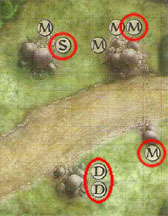
The original module describes the encounter like this (pg. 16): “The player characters are on the King’s Road traveling toward Winterhaven east to west (or right to left on the map).” They are then ambushed by kobolds, as shown on this map:

Kobold Ambush

The obvious problem, as I detailed in my original remix essay, is that the indicated kobolds are all standing in plain sight for characters traveling east to west along the road.

WotC’s keen-eyed revisers noticed the same thing, but they didn’t want to redo the cartography. So they opted to simply change the direction that the PCs are traveling (pg. 6): “The player characters are on the King’s Road traveling toward Winterhaven, west to east (or left to right on the map).”

Problem solved!

… except that’s completely impossible.

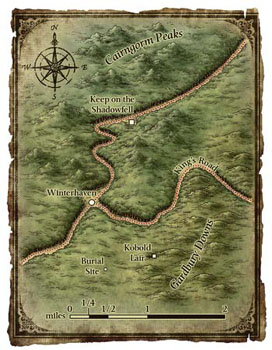
Because two pages earlier in the module we can see this map of the local area:

Winterhaven Area Map

And, as you can clearly see, Winterhaven is at the western end of the King’s Road. You cannot travel west-to-east anywhere on the King’s Road and end up at Winterhaven.

Mistakes, of course, get made. (For example, both the original and revised versions of the module refer multiple times to the Burial Site being southwest of town. You’ll note that it isn’t.) But what you have here is an acknowledgment that there is a problem that needs to be fixed; a decision being made (either deliberately or ignorantly) to not fix the root of the problem; and ending up with a half-assed effort that just creates an entirely different problem.

And it doesn’t even fix the original problem, because there are still kobolds standing in plain sight.

This is symptomatic of WotC’s general culture of not-fixing (or even anti-fixing).

VS.

(prompted by “Signs of Life” at the Society of Torch, Pole, and Rope)

The reason we look for verisimilitude in the rules of a roleplaying game and not in the rules of Monopoly is because we don’t play roleplaying games as if they were a round of Monopoly.

QED.

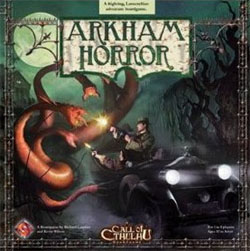
Personally, I look at the rules of a roleplaying game as the interface between me and the game world. I want those rules to be fun and interesting, but I also want them to be transparent: My primary interest is interacting with the game world. If I wanted to interact with the rules of a game, I’d play a boardgame like Monopoly or Arkham Horror.

So if the rules in a roleplaying game get in the way — either due to a lack of verisimilitude; or because they’re boring; or dissociated; or too complicated — then I’m going to be unhappy with those rules.

I Talk About Shakespeare

May 20th, 2010

Twin Cities Theater Connection recently put a panel together of local artists working on summer productions of Shakespeare. You can hear the discussion on their “Summer of Shakespeare” podcast. So if you’ve always wanted to know what I sound like (and can’t afford to spring for the Call of Cthulhu audio book I did), this is your chance.

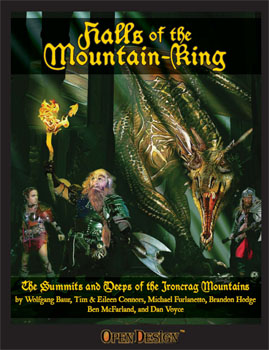
The Hall of the Mountain King

WORST. PLAN. EVAH.

Dwarves: Oh no! All the gold in our mountain has been cursed!

Dwarven God: That sounds sucky. Here’s a magical artifact to remove the curse.

Dwarf 1: Think we should use it?

Dwarf 2: Nope. Let’s lock all the dwarves afflicted by the curse into the lower vaults.

Dwarf 1: And then use it?

Dwarf 2: Nope. Let’s evacuate the mountain.

Dwarf 1: And then we’ll use it?

Dwarf 2: Nope. We’ll hide the magical artifact in the depths of the mountain.

Dwarf 1: And… then use it?

Dwarf 2: Nope. We’ll create clockwork bodies for ourselves and inscribe the secret of how to find the artifact on the gears and cogs.

Dwarf 1: And… wait, what?

Dwarf 2: Then we’ll go senile. And centuries from now the grandchildren of our disciples will “con” a small group of adventurers into retrieving and using the magical artifact.

Dwarf 1: What the hell are you talking about?

I guess this is what happens when you write adventure modules by committee. (I really wish I was exaggerating this, but I’m not. Although they technically didn’t plan to go senile, this is, in fact, the background used in the module.)

THE SIMPLE FIX

The artifact wasn’t ready-to-use out of the box. The Secret Masters of the dwarves collected the tears of the Hundred Widows who had lost their husbands to the corruption of the curse. The fist-sized teardrop of gold they forged from the cursed gold needed to bathe for a hundred years in the widows’ tears before it could cleanse the mountain itself.

Unfortunately, long before the teardrop was ready, the dwarves had been forced to abandon the fortress. Or perhaps the Secret Masters arranged for the evacuation, planning to return a century later. Whatever the case may be, things didn’t go according to plan: A hundred years passed and, deep in the bowels of the mountain, the Golden Teardrop was completed. But the dwarves were never able to return to the Golden Citadel, and so the teardrop lay forgotten…

Archives

Recent Posts

Recent Comments

Copyright © The Alexandrian. All rights reserved.