The Alexandrian

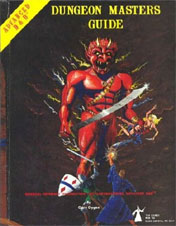
Dungeon Master's Guide - AD&D 1st EditionI’ve been spending quite a bit of time delving through the 1st Edition Dungeon Master’s Guide recently. Which means I’ve spent more than my fair share of time staring at the cover… which I have always hated.

The poses are stiff. The composition boring. The anatomy problematic. It is, in short, a disappointing and amateurish piece of work.

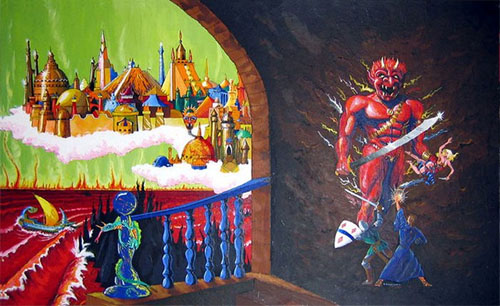
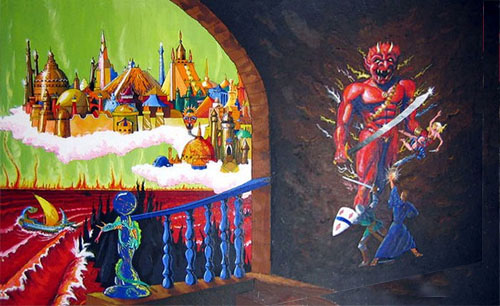
And this is particular true when you compare it to the back cover of the same book, which depicts a glorious, panoramic shot of the City of Brass which seems to invite you to a world of adventure in a dozen different ways.

The interesting thing, of course, is that these are both the same piece of art. It’s a panoramic cover that wraps around the spine. Because of its composition, however, this can be rather difficult to appreciate unless you can look at the whole thing all at once:
Dungeon Master's Guide - Full Cover

I really like the framing effect which the fully visible arch has on the City of Brass. That half of the painting is great.

Sadly, seeing the full piece in context only makes the other half of the painting look even worse. I mean, the composition of the efreeti and the adventurers was already suffering from some internal problems with its perspective. But once you put them into the context of the larger scene, where exactly are they supposed to be standing?

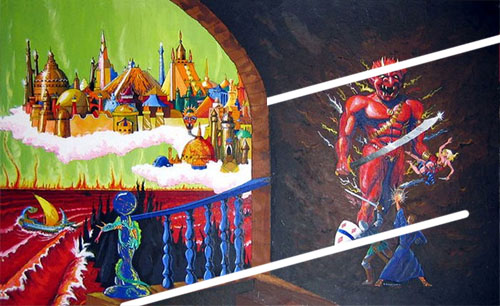
Look at what happens when you draw in the perspective lines of the wall:
Dungeon Master's Guide - Full Cover with Perspective Lines

As far as I can tell, the efreeti is standing in the wall.

I’m as much a fan of non-Euclidean geometry as the next guy. But this just looks sloppy to me. And it actively repulses my eye.

EDIT: Those of you suggesting in the comments that the efreeti and possibly the adventurers have actually been painted on the wall have an interesting theory. But if that were actually the case, we would expect the cover to look something like this:
Dungeon Master's Guide - Distorted Wall Mural

Which, of course, it doesn’t.

I suppose one could argue that this is a painting of another painting which has been painted in order to appear 3D from the position which the meta-painter has placed his easel… But, honestly, there comes a point when you’re just making excuses for sub-standard art.
RPG Art Thru History

May 11th, 2011

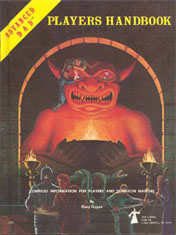
Player's Handbook - AD&D 1st EditionCommon meme: Art is eating our RPG books. The number of illustrations have been increasing per page.  Customers won’t buy books without a lot of art in them. And this is totally new. Didn’t used to be this way. Back in the day we were willing to buy books even if they didn’t have any art at all.

Really?

Fact check time.

OD&D White Box: 44 illustrations, 116 half pages = 0.37 illustrations per page (0.75 per full page)

AD&D1 PHB: 35 illustrations, 128 pages = 0.27 illustrations per page
AD&D1 DMG: 50 illustrations, 240 pages = 0.20 illustrations per page
AD&D1 MM: 246 illustrations, 112 pages = 2.19 illustrations per page
AD&D 1st Edition Total: 0.61 illustrations per page

AD&D2 PHB: 95 illustrations, 256 pages = 0.37 illustrations per page
AD&D2 DMG: 81 illustrations, 192 pages = 0.42 illustrations per page
AD&D2 MM: 326 illustrations, 384 pages = 0.84 illustrations per page
AD&D 2nd Edition Total: 0.60 illustrations per page

D&D3.5 PHB: 68 illustrations, 317 pages = 0.21 illustrations per page
D&D3.5 DMG: 71 illustrations, 320 pages = 0.22 illustrations per page
D&D3.5 MM: 203 illustrations, 320 pages = 0.63 illustrations per page
D&D3.5 Total: 0.36 illustrations per page

D&D4 PHB: 67 illustrations, 317 pages = 0.21 illustrations per page
D&D4 DMG: 48 illustrations, 221 pages = 0.22 illustrations per page
D&D4 MM: 208 illustrations, 288 pages = 0.72 illustrations per page
D&D4 Total: 0.39 illustrations per page

Exact counts may vary.  (For example, I didn’t count the 23 illustrations on pg. 21 of Volume 3 of the White Box depicting various types of construction as separate illustrations. I just counted the whole pageonce.) But the conclusion is self-evident: The number of illustrations per full page in D&D’s core rulebooks has actually decreased over time. If we want to talk about black-and-white art vs. full color art or the merits of border art, let’s have it. But RPGs have been art-rich literally since day one.

“But, Justin,” you say. “That’s just D&D. What about Traveller? The little black box practically had no illustrations at all!”

True. The original Traveller black box only has 3 illustrations in 150 half pages. On the other hand, the relatively recent Shock: Social Science Fiction has 3 illustrations in 90 two-third pages. Books that feature stark, austere layouts haven’t exactly vanished off the face of the planet.

Now, if there is one trend that has appeared in the last 20 years its the technique of putting a big piece of art behind the text. And I think we can all agree that this technique should be taken out into the desert and left to die.

But if you want to complain about how much gosh-darn art there is in roleplaying games these days?

Check your facts.

Site Updates

May 10th, 2011

The slow slog of converting posts from the old site onto the new site continues. I’ve now finished everything up through the end of 2009.

Some good stuff from 2009:

Fixing Munchkin Quest: Some house rules that helped fix the pacing problems of Munchkin Quest. At the time, I was very hopeful that this game would become my go-to dungeoncrawler. Unfortunately, it didn’t prove a keeper in the long run: The game is too long for its shallow mechanics and the end game bogs down. It was defunct at my table even before Castle Ravenloft and Wrath of Ashardalon came long. But if you’re going to play Munchkin Quest, I highly recommend this easy fix to the gameplay sequence.

A Nomenclature of D&D Editions: A one-stop guide to all 10 editions of D&D, including the covers of each edition.

Reactions to OD&D: This series received the bulk of its entries. Basically my early thoughts on reading and playing White Box-only D&D from 1974. A lot of this stuff has been influencing the design of Legends  & Labyrinths.

Don’t Prep Plots: This is the core manifesto for how I design and run RPG campaigns. Everything else — the Three Clue Rule, Node-Based Scenario Design, Adversary Rosters, Megadungeons — are just various means to achieving this end.

Halls of the Mad Mage: The Halls of the Mad Mage twist back on themselves in impossible spatial contortions. Here you’ll find everfalling rivers, endless stairs, and mobius chambers. A one-page dungeon that won Best Geometry in the One Page Dungeon Contest.

Stripmining Adventure Modules: Buying an adventure module can be a gamble. This is how I hedge my bets.

So You Want to Write a Railroad?: A sarcastic inversion of Don’t Prep Plots.

In other news, the arithmetic captchas for authenticating comments have proven to be a huge success. I was having 500+ spam comments hitting my spam filter every single day before implementing the captchas, which made it impossible to sort through them looking for comments which had erroneously been filtered. The math problems have essentially eliminated the spam. There’s apparently one guy from Russia who comes by every day and posts a single comment, but that’s it. (Apparently my posts on proxy translating The Seagull have convinced the Russian spammers that this is a Russian website.) This has allowed me to salvage more than a dozen comments in the last month that would otherwise have hit the bit bucket.

Finally, apologies to anyone who may be waiting for a reply to an e-mail you’ve sent. Since launching the new site I think my e-mail address has been easier to find and my inbox is insane. I’m hoping to have some time in the near future to dig through everything in there and catch up, but right now it’s completely swamped. Sorry!

I’ve had this video open in a tab for several days now. It features some truly breathtaking time-lapse photography, and I’ve been playing it whenever I want a little inspiration for wilderness exploration.

The Mountain from Terje Sorgjerd on Vimeo.

Go to Part 1 – Go to Map

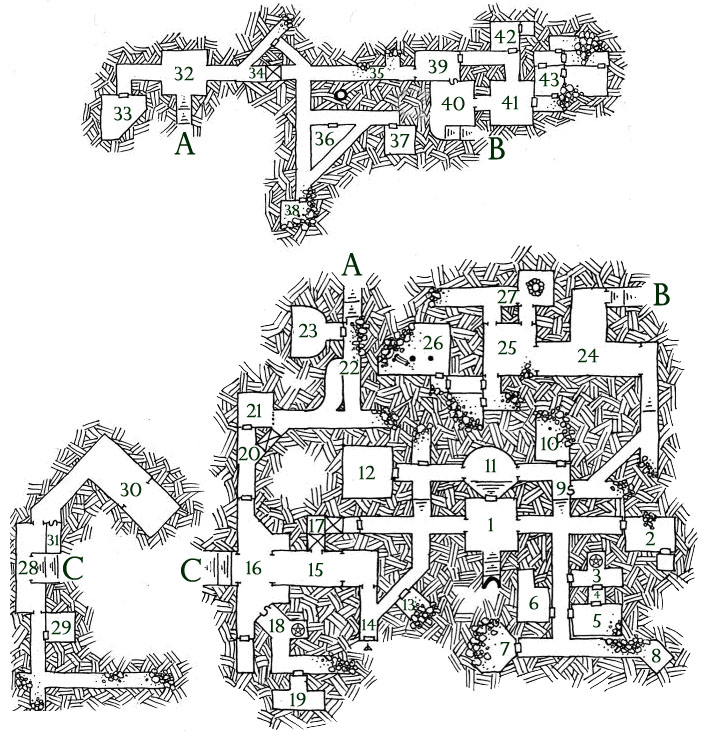
The key posted over the last several days for the Ruined Temple of Illhan represents the temple as it was discovered by my players. If you’re interested in running through the temple in the days after that hardy group of wanderers passed through it, you’ll want to make the following changes:

AREA 9: The secret door has been wedged open with iron spike.

AREA 20: The stone block has been propped up with three iron chests, holding it far enough off the ground for halflings and unarmored characters to crawl under.

AREA 21: Portcullis has been raised (using the control level in area 23).

AREA 26: The ceiling of this room has collapsed, leaving behind a solid wall of rubble in the doorway.

AREA 30: The iron chests and treasure have been removed.

AREA 36: Spear has been removed.

AREA 43: All of these doors have been chopped through with axes.

Thanks again to Dyson Logos for giving me permission to share his re-keyed map. I very much recommend checking out his site; he’s got a plethora of terrific stuff over there ripe for pillaging.

The Ruined Temple of Illhan - Dungeons

Archives

Recent Posts

Recent Comments

Copyright © The Alexandrian. All rights reserved.