Tagline: Fading Suns is AD&D in space, but it keeps the best parts and gets rid of the worst. Its system is much like what AD&D could have become if it had kept pace with the rest of the industry and its setting combines the best of pulp sci-fi and moody Dark Age fantasy. Fading Suns is flawed only by a surprisingly poor organization.
Writing reviews for RPGNet is what first taught me rudimentary HTML coding skills, and it started with this review. (I know this because my original copy of this review is a Word document filled with HTML coding.) The reason for this was simple: My reviews were getting longer and more complex (I’ll talk about this a little more at the end of the review), and I needed to use HTML coding in order to format the reviews into something that could actually be read. So it wasn’t just a new set of skills: It was also a burgeoning understanding that format and structure is important in clear communication.
 Fading Suns is a game full of surprises – not all of them good.
When I first read through the game I was pleasantly surprised by a background which teemed with exciting possibilities and unexplored avenues, by a rule set which seemed simple and well conceived, and by evocative and primally powerful artwork. It was a package which was surprisingly well done and with quality material inside it. I sat down to prepare a properly enthusiastic two-thumbs-up, five-star review.
In doing a review of a main rulebook the first thing I prepare are my “cheat sheets” for the game. These cheat sheets summarize all the rules of the system – from character creation to basic resolution to combat resolution to any optional, secondary rulesets (for disease, etc.) that might be used by the system in question. I also include the game’s lists (skill list, equipment list, etc.). I can then use these “cheat sheets” to both create characters for the game and also to run the game in question. They are exceptionally useful, and I have also found that in preparing a review for the game they improve my explanation of the basic mechanics and help me put my thoughts in order so that I don’t just ramble on and on.
In creating the cheat sheets for Fading Suns, however, I began running into some rather unpleasant surprises. The rules are not well laid out or organized. There are combat rules in the character creation section, and character creation rules in the combat section. Crucial information for running combat is relegated to what appears to be a summary sidebar and poorly explained. Repeatedly through-out the creation of the cheat sheet I would find myself mysteriously leaving the sheet devoted to combat in order to return to character creation because I had stumbled across yet another rule which properly belonged in a chapter fifty to one hundred pages earlier.
When I first read through Fading Suns I was struck by its similarities to the AD&D game. In my mind the setting (a mix of feudalism, fantasy, and pulp science fiction) was the best “AD&D/fantasy in space” I’ve seen in a long time. The rule mechanic (based around a d20) looks much like what AD&D might’ve looked like if the designers at TSR had kept abreast of industry developments during the past 20 years. The two magic systems (Psi and Theurgy) looked much like what AD&D’s magic systems would look like if the problems were fixed (they are based on levels of ability, but use a much more logical system of usage). Fading Suns, in my mind, was everything AD&D could have been and should be in a space setting. It’s as if Holistic Design is actually a company from another dimension in which AD&D is actually a good system in comparison with other systems on the market today and they are merely licensing it from TSR in order to create this game.
After spending 12 hours of work creating the cheat sheets for the game (which normally takes me no more than 3-4 hours), I decided they had also decided to emulate AD&D’s editors. Rules and information scattered wherever it had “first occurred” to the designers, and then kept there through iteration after iteration of the rules. At first glance Fading Suns seems to be a book which is well organized, but in actually attempting to access that information (either in gameplay or for the creation of my cheat sheets) you discover a distinct lack of intuitiveness about where information is placed and some downright stupid omissions from charts which are supposedly central reference points. Fortunately there is an index, but this doesn’t wholly solve the problem because you will still be thwarted in some situations because you continually receive the impression you’ve gotten all the rules for covering a certain situation, but in actuality there is still one rule floating around 50 pages away from where all the other rules for this situation are located.
Fading Suns still receives my approval, but be aware of this poor lay-out and organization of material. Keep in mind that you’re going to have to be well-versed in this material (or create the equivalent of my cheat sheets and organize the information yourself) unless you want to have frustrating delays during game play while you try to track down a rule.
MECHANICS
The Fading Suns rules are elegant and simple. Character Creation is based on the selection of a Character Role and the expenditure of points in different areas. Resolution (combat and otherwise) is based around a single d20 roll with the degree of success or failure specifically interpreted by the ruleset.
These mechanics, as mentioned, are difficult to get a firm grasp on because of the way in which they are presented. However, once you’ve got that grasp I believe you’ll find them to be an incredibly simple, but powerful, set of tools for your roleplaying sessions.
CHARACTER CREATION
Character creation is a six-step process, only five of which actually have anything to do with rules.
Step one is practically a given, but it’s still nice to see game designers specifically mention it for any new players out there: You have to formulate a character concept (who your character is, what they’ve done, etc.)
Step two is the selection of your character’s Role. The first thing that crosses your mind as you enter this section of the rules is, “Oh my god, it’s a class system.” As you begin to look at what’s being done here though, you become impressed by the way in which it is being handled. Don’t think of these Roles as classes, think of them more as mandatory templates. First, they are much more basic in the degree to which they define your character. Second, they don’t restrict your options as to which directions you wish your character to develop. Finally, because they are tailored for a very specific and limited setting they don’t present a problem. Again, it’s as if AD&D’s class system had been repaired. (Although, actually, it’s more like BECMI D&D’s class system because non-human races are treated as separate roles – again, it works because of the way the setting is constructed.)
Step three is the selection and buying of Characteristics. The characteristics are split into three groups (Body, Mind, Spirit). There are three Body characteristics (Strength, Dexterity, and Endurance) and three Mind characteristics (Wits, Perception, Tech). Spirit characteristics are split into four pairs — Extrovert vs. Introvert, Passion vs. Calm, Faith vs. Ego, and Human vs. Alien. You receive 20 points to split between the characteristics (on a one-for-one correspondence). Body and Mind characteristics start with a base of 3. The player must decide which one of Spirit characteristics in each pair is primary for his character – that characteristic starts at 3 while the opposing characteristic starts at 1 (except for Alien, which starts at 0 if it is secondary). No characteristic can be bought above level 10, but there is a further stipulation that no pair of Spirit characteristics can total more than 10 together.
Step four is the selection of skills. Fading Suns is a broad-based skill system (meaning that each individual skill covers a great deal of territory). The player receives 30 points to split among skills (again, on a one-for-one basis). Learned skills start at a base of 0, but there are several Natural skills (dodge, etc.) that practically everyone knows and these start at a base of 3.
Step five is the selection of Benefices and Afflictions. These are basically advantages and disadvantages, with a couple of setting-specific twists. Only 10 points can be spent on Benefices, but Afflictions naturally give more points for additional Benefices.
Step six is the expenditure of “extra points”. 40 extra points are given and then used to flesh out the various aspects of the character in any way which the player chooses. In addition to the stuff mentioned above, extra points can also be spent to purchase psychic or theurgic powers (magic) and specific fighting techniques.
There’s some other minor calculations to be carried out (figuring out Vitality for combat and Wyrd for psychics), but that’s character creation in a nutshell. It is a very simple system – reminiscent of AD&D, GURPS, and the World of Darkness games all at the same time. There are some oddities with the chapters which detail both the process of character creation and the specifics of characteristics and skills.
First, there is a bonus to damage inflicted during hand-to-hand combat which is based on the Strength characteristic. Why is it listed here, but not in the Combat chapter? There’s no practical use to it being located here (there’s nothing you write down on the character sheet), and every logical reason for it to be included in the combat section (where all the other rules you’ll be referencing during combat are included).
Second, and more annoying, is the fact that Skills and Characteristics are lumped into a single chapter entitled “Traits”. Referring to these two facets of character quantification under a single title makes sense for FUDGE (which treats them identically for all intents and purposes), but doesn’t make any sense for a game like Fading Suns in which they are treated entirely differently from each other. Using the term “trait” (which has no real meaning in the system) adds an unnecessary layer of complexity and possible confusion. Organizing both skills and characteristics into a single chapter without definition between them (despite the fact that the system treats them distinctly from each other) is simply confusing.
BASIC MECHANICS
The basic resolution mechanic of Fading Suns is cunningly designed to absolutely minimize the modifications and additions which must be made to it in order to handle combat.
The first step is to determine initiative (if necessary) – this is done by comparing the skill levels of everyone who is attempting to go faster than everyone else. Hence, the more skilled you are in something the faster you will be able to do it – if you’re doing something you are very skilled in and the other person is not, you’re going to be able to do it faster than the other person and hence get a chance to go first. It’s a very nice system which, in a few decoy runs I performed, seemed to create a very nice effect – particularly when two people are trying to use the same skill against each other (swordfighting for example). A slight problem immediately crops up here, however. In the case of ties the Wits characteristic of the two characters is consulted – whoever has the highest Wits rating will go first. If the comparison of Wits again results in a tie, the two actions are considered to happen simultaneously.
Wits?
Wits?
There is a certain sort of tenuous logic there, but wouldn’t Dexterity make a far more logical choice in determining the speed with which you respond? If you felt that created unrealistic results for cerebral activities I could see making the rule “compare Dexterity if the action is physical, compare Wits if the action is mental” – but if you’re going to choose one or the other (presumably for expediency and simplicity) it makes far more sense to choose Dexterity since you know the initiative system is going to be most often used in combat situations.
The next step is to determine the Goal Number for a specific action. You determine this by adding the character’s skill and the character’s characteristic together. You then roll a d20 in an attempt to roll lower than the Goal Number.
Now, as you may have already guessed, it is time to determine how successfully your character performed. In Fading Suns you accomplish this by merely looking at the number which was rolled – did you roll a 17 and succeed? You have 17 successes. Did you roll a 6 and succeed? You have 6 successes.
That may confuse some of you momentarily, but a moment’s reflection will show that it produces the same results as adding or subtracting numbers to determine a margin of success or failure – it may be a little more intuitive for some than that method, and for others it will probably be a little less. You are still more likely to succeed better if your skill-characteristic combination is high than if your skill-characteristic combination is low (since if you have a combination of only 10 you can never get 17 successes).
This interesting approach, however, does allow for an interesting set of optional rules which Fading Suns refers to as “Accents”. Essentially you either throw a lot of power into an action at the loss of expertise (making success less likely, but if you do succeed it will be more powerful) or you attempt to finesse your way through the situation with the loss of some power (making it more likely to succeed, but less powerful when you do). Essentially you decide to apply a positive or negative modifier (no greater than the skill level of the action you’re attempting) to your goal roll – if you choose to give yourself a positive modifier you make it less likely that you will succeed, but the success will be better if you do succeed. If you give yourself a negative modifier you will be more likely to succeed, but that success will be less effective.
When it is necessary to determine exactly how effective your success was (in combat for the purposes of calculating damage, for example) you compare the number of successes you received to the Victory Chart. The Victory Chart translates the number of successes into either Victory Points (which are primarily useful in determining sustained actions) or Effects Dice. You then roll the number of Effects Dice against a Goal Number of 13, counting the number of dice which succeed (not the total number of successes across all rolls). You can also choose to pull your punch and reduce the number of Effects Dice you use.
There are also some other, minor rules which effect this roll. Automatic success takes place on a roll of 1, automatic failure on a roll of 19, a critical failure on a roll of 20, differing rules for sustained actions (you have to receive a certain number of Victory Points before success is achieved), contested actions (whoever gets more successes), etc.
Finally, critical successes in Fading Suns occur when the number rolled on the d20 is identical to the Goal Number (recognizing that no number on a d20 is more likely to come up than any other). As the designers, say, the difference between a critical success for a fledgling musician and a critical success for Beethoven is that when the fledgling musician gets a critical success he manages to get through the high school concert and get a standing ovation. When Beethoven gets a critical success, he composes the 9th Symphony.
COMBAT
As I mentioned the combat system is a very natural extension of the basic resolution system, doing exactly what a combat system should do – providing rules for keeping track of damage done to your character and providing guidelines of sufficient strictness so that arguments over a section of the game with potentially “deadly” results are eliminated or at least kept to a minimum.
This extremely effective system, however, is presented in the most bizarre manner possible. Of the three step procedure to combat action resolution (Initiative, Goal Roll, and Damage Roll) only one is actually discussed in the main text – Initiative (which is identical to normal initiative which is described earlier in the book, but receives an equally detailed, reworded treatment). The rest of combat resolution is never discussed in the main text and is, instead, relegated to a sidebar located 2-3 pages into the chapter. Anyone familiar with other roleplaying games will immediately recognize this sidebar as the ever present “quick combat order reference” found in many games – except that in Fading Suns it is the only reference.
As a result of this short treatment the elements of combat are not well explained. This isn’t a tragic loss, since the system is merely an extension of the basic resolution system. As a result two of three steps (Initiative and the Goal Roll) are identical. The resolution of Damage, though, takes a bit of work. I had to read through the twelve half-lines of material several times before I was fairly sure I had understood what I was supposed to do. If I was successful, damage supposedly works like this:
After rolling a successful Goal Roll you determine how many Damage Dice you get. This is determined by adding the Weapon’s Damage Dice to the number of Victory Points you scored on your Goal Roll (multiply this number by 2 if you scored a critical success). You then roll the damage dice against a Goal Number of 13 – each die which rolls a success means that one point of damage was done (do not count the number of successes – count the number of dice which succeeded).
Damage which the character actually incurs is then determined by subtracting the armor value of the victim from the damage done, and subtracting that total from the victim’s Vitality. Vitality is basically a hit point system. For those who have developed a phobia against hit points from AD&D, be pacified. Since the number of hit points doesn’t inflate, it acts essentially like a standard wound level system minus the paperwork and a little bit of the so-called accuracy of wound level systems.
The remainder of the Fading Suns combat rules are dedicated to discussing specific actions, movement, and modifiers to combat goal numbers. To avoid the common complaint against World of Darkness games, actions have been specifically defined as to what attribute determines them. This creates an Action Chart which I personally find annoying, but which is the only way to solve the “problems” the Storyteller engine supposedly possesses.
Now we move into the oddities of this combat system. First, when more damage is done to a character in a single blow than his Endurance rating, the character must make an Endurance + Vigor check in order to stay conscious – if he succeeds he is stunned, if he fails he is knocked unconscious for a number of rounds equal to the amount of damage taken. This sounds pretty good, but doesn’t work. 15 seconds of proper playtesting (or just a little critical reading) would reveal that although you have made it more difficult to knockout a person with high endurance, you have also guaranteed that a person with higher endurance will tend to stay unconscious longer on average than a person with lower endurance. The rule should read “unconscious for a number of round equal to the amount of damage taken minus the victim’s endurance”.
The details on weapons (damage done, etc.) is presented, as in most games, in a series of charts. For reasons unknown the order of the columns in 1 of these charts was changed from the order in which this information is presented in all the other charts. Brilliant.
Finally, the largest idiocy of the entire game is found in “Chapter Six: Combat” – and it was the one which finally pushed me over the edge into broadly condemning the game as having been the victim of poor organization. Fading Suns handles Martial Arts, Fencing, and special actions with firearms (reloading, burst shots, etc.) by assigning special “actions” which must be learned in addition to the basic applicable skill at varying levels of difficulty. For example, you might possess a skill level of 5 in Fencing, but you’d only be able to attempt a Feint (which first requires a skill level of 5 in Fencing) if you had bought it. (The exception to this are the Firearm Actions, which only require possession of the appropriate level in the Shooting skill.)
This actually works quite nicely, here’s the problem: This is the only place in the rules these things are mentioned. All the rules for purchasing these things (both at character creation and during character advancement) are located here – and are not referenced in the handy tables three chapters earlier which supposedly summarize the point costs for all elements of character creation and advancement. The full descriptions for each action are also located here, instead of where they logically belong (back in the Skills section). It makes sense to have the entries for these actions on the Action Charts – it makes no sense to make this place the depository for this information, any more than it would make sense to put combat-related skills in this section.
Nonetheless, once you have worked your way around these impediments to your comprehension you find an elegant combat system which is easily and intuitively built off the basic resolution system in such a way that there is really very little definition between the two except in the degree of strictness in which they are applied. (I would have done without the Action Charts, but that’s just my personal opinion.)
PSI AND THEURGY
The Psychic and Theurgic powers of the Fading Suns game can be summed up in four words: “AD&D magic done right.”
The central mechanic of both these systems are an opposed occult characteristic (Psi vs. Urge and Theurgy vs. Hubris – though this has to be inferred from context and from the character sheet because it is never explicitly explained in the text) and Wyrd points. Wyrd points are determined at character creation in various ways and can be used in non-psychic/theurgic functions as well. For a psychic they are determined from the Extrovert or Introvert characteristic (whichever is primary), for the theurgic they are determined from the Faith.
Psychic powers are split into various paths – along each path there are powers at nine discreet levels of power (there is also a 10th level, but it is not defined in the rules). To progress along a path you must buy a power at each level (so to learn a 7th level power you must first possess at least one power at each of the levels between 1 and 6). Using a Psychic requires the expenditure of a variable number of Wyrd points (depending on the power in question and the type of effect desired) and a goal roll.
There is a catch, however, a dark side to Psychic powers. This is known as the Urge, and it is a dark twin of the character. If the character ever fumbles a Psi roll, the Urge takes control of the character. There are several ways in which the character can attempt to take control back from the Urge twin, but if he fails the Urge twin will grow stronger by the attempts. The Urge possesses its own path of twisted, dark psi powers.
The Psi vs. Urge characteristics doesn’t behave quite like other opposed characteristics. It is possible to have a total Psi + Urge higher than 10. To accomplish that the character must “face his Urge” – roleplaying through a scenario and rolling some dice to see if he was successful in overcoming the Urge and improving his psychic potential. It is also possible to lose or increase Urge through actions which you take.
Theurgy is handled similarly, but differently from Psi. If Psi powers are most analogous to magic spells in AD&D (with “paths” instead of “circles” and a logical methodology behind the system), then Theurgy is akin to priestly magic in AD&D. Again, Fading Suns gets right everything that AD&D gets wrong.
Theurgic Rituals are also divided into various paths of learning – but each of these paths is unique to one sect of the Church. Theurgy also adds the mechanics of Components and Vestments. Components can be Liturgy (spoken words), Gestures, or Prayer (meditation). Vestments are various relics of the individual’s faith and belief that improve his chances of success in requesting the Pancreator’s (God’s) aid. Holy relics can also aid the attempt.
Like the power of the psychics, however, theurgy has a dark side as well – and that is the side of Hubris. Unlike the Urge the dark powers of Hubris do not take control, they merely alter what exists as the relationship between the priest and the Pancreator changes. Their effects are generally permanent (unless the character’s Hubris is reduced).
CAMPAIGN SETTING
The rules of Fading Suns raise my ire because of their poor lay-out and (at times) abysmal explanation. No such claim can be laid against the setting of the game, which is expertly presented and described. No one is going to say this is a realistic future, but then it isn’t really trying to be. It is pulp science fiction at its best, with the dab of fantasy thrown into the mix.
Little is known of interstellar history before the arrival of humanity in space, but this is: Long in the past two ancient races seem to have seeded the galaxy with life and to have accomplished great technological marvels … before inexplicably disappearing. The earlier of these two races (referred to as Jumpmasters, Gatekeepers, or a handful of other names) constructed an interstellar transportation system consisting of jumpgates – gates which (as you’ll now if you’re any sort of science fiction fan) connect various solar systems at faster-than-light speeds. The younger race, known as the Successors or Marauders, apparently entered into some kind of war with the Jumpmasters. It is supposed that this Great War was the cause of their sudden disappearance – leaving behind only ruins and their direct descendant races the Ur-Ukar and Ur-Obun. This happened at approximately 100 AD.
Meanwhile, back on Earth, mankind will realize their dream of a one-world government by the 22nd century. It’s not quite all we dreamed of – although referred to as the First Republic, it is also referred to as the Human Combine because it was really controlled by oligarchic mercantile interests. It was during the time of the First Republic that mankind found the jumpgate orbiting at the outer extremities of the solar system (in the year 2305).
By 2500 AD the First Republic had spread throughout a fair portion of the galaxy, but its leadership had become ingrown – the elite of mankind was ignoring the pleas for fair leadership from the underclass. The First Republic collapsed under its own weight and ineffectiveness, and the age of the Diaspora began. A time of balkanization and independence, it saw a great confusion as man’s extra-solar colonies found new ways of life. A nobility arises. During this time period the Prophet appeared, preaching a new religion designed for the stars. His god – the Pancreator – became wildly popular. After his death the majority of his close followers would see to the development of a highly-structured Church which followed his teachings, a Church which has become ever more regimented as time goes by.
In 2700 man’s conception of himself changed radically as they encountered the first intelligent species besides themselves. The results were disastrous. The Shantor – an equine race – were subjugated and over time were banished to reservations. They have yet to recover from this maltreatment, and this once proud people are spread throughout the galaxy. Unfortunately, rather than proving the exception to the rule the treatment became a model for subsequent human treatment of intelligent species they encountered.
In 2945, however, this devil-be-damned attitude finally caught up to humanity. “Pacifying” a peaceful race they were surprised to discover this race had big friends – in this case a powerful society even more technologically advanced than humanity, known as the Vau. The Vau were willing to leave well enough alone … so long as humanity didn’t cross the line they chose to draw in the intergalactic sand.
Ten years later in 2955 mankind found their second challenge – the Ur-Ukar. The Church, however, was able to unite mankind against this common enemy. The Ukar were crushed and the Church rose to control all of humanity.
In 3500 merchant interests managed to overpower the Church’s influence and establish the Second Republic. What starts as a mercantile-controlled empire becomes a Republic. The next 500 years are the Golden Age of mankind’s existence – the Known Worlds are terraformed, government is a pure Republic, and the people are prosperous and happy.
Around the beginning of the 5th millennium, however, the Republic fell prey to mass-unemployment. The nobility (which had clung onto existence since the time of the Diaspora) leapt into the power vacuum. A Dark Age ensues and a hostile feudalism slips into place with a power balance between the lords, the Church, and the merchant guilds. Technology and society collapse and humanity loses hundreds of years worth of advancement. During this time period of terror and confusion many systems seal their jumpgates – cutting off contact with the rest of humanity. Known Space shrinks.
In 4525 a jumpgate opened onto Known Space and the Barbarian Invasions began. In 4540 Vladimir I used the Barbarian Invasions to unite humanity beneath his imperial rule. In 4550 Vladimir is successful, but is assassinated on his coronation day. For the next 450 years no emperor would rule, power passes from powerless regent to powerless regent. In 4900 a strange race known as the Symbiots attack humanity – they are capable of biologically converting any sentient into one of their own. This conflict slips into a cold war. In 4956 the Emperor Wars begin. They end in 4995 with Alexius I crowned Emperor.
Which brings us to the present day. Emperor Alexius I is interested in turning outward once again, but first he must cement his power base. The Emperor, the Lords, the Church, and the Guilds all face each other in a mad game of power and at stake are the lives and freedoms of millions. For the first time in centuries humanity has hope, but it could also plunge back into darkness all too easily.
Oh, and did I forget to mention? The stars are fading. Their light is dying, and not even the powerful science of the Second Republic could explain it when it began over half a millennia ago.
SUMMARY
Fading Suns is a great game. The rule system it is constructed on is fantastic, although it is here (due to the poor lay-out, organization, and explanation) that the game possesses its single flaw. This system is coupled with a fantastic setting – active politically, socially and technologically it provides endless possibilities for adventure: from politics to exploration to looting to mystery.
It’s flaws are minor and it’s strengths are great. Fading Suns is definitely on my list of recommended games.
Style: 4
Substance: 4
Title: Fading Suns
Writers: Bill Bridges and Andrew Greenberg
Publisher: Holistic Design
Price: $25.00
Page Count: 260+
ISBN: 1-888906-00-6
Originally Published: 1998/06/25
One of the things I became known for with my RPGNet reviews was, for better or for worse, length. Length and completeness. I thought of my reviews as a way to have a conversation about a game, and I felt no particular compunction in a digital space about needing to cut my thoughts short. So the more complex and interesting a game was, the longer my review would be.
I mention this here because this review of the first edition of Fading Suns was my longest review to date (11 pages of single-spaced text) and, if my memory serves me correctly, it provoked a significant debate on the site about whether or not a review could be “too long”. (My review of Immortal also factored into this discussion.) The issue of whether or not anachronistic concerns about “space” have any sort of significance in a digital age probably isn’t going away any time soon. (For example, Wikipedia’s endless “relevancy” debate is riddled with it.)
Tangentially, given the fact that both Fading Suns and 3rd Edition were, in my opinion, “AD&D done right” it’s still somewhat shocking to me that the D20 version of Fading Suns was so poorly done. I still feel that a properly executed D20 conversion of Fading Suns would (a) be an excellent game and (b) add a lot great stuff to the D20 system.
For an explanation of where these reviews came from and why you can no longer find them at RPGNet, click here.

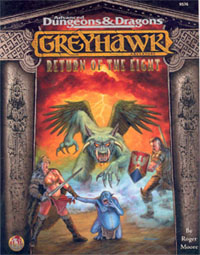 Personally I looked forward with great anticipation to the return of the Greyhawk setting to the TSR line-up. When the line was canceled several years back I was among the protesters who thought this a bad idea. Greyhawk was your all-around “typical AD&D campaign world”, with good cause since it was one of the first. Its loss meant that you had very atypical settings (Ravenloft, Dark Sun, etc.), the super-powered Forgotten Realms, and the legend-oriented Dragonlance setting. Besides, there’s a lot of interesting stuff on Oerth – it may not have sold well in comparison to TSR’s other settings, but that might have had something to do with the fact that unlike the “three supplements a month” Forgotten Realms, Greyhawk was never adequately supported after Gygax’s departure from the company. Properly supported it would definitely, I thought (and continue to think), be a strong part of TSR’s line-up.