Go to Part 1
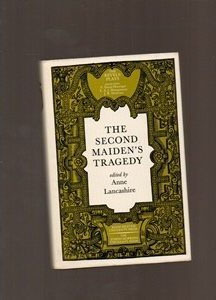
This is the primary plot of The Second Maiden’s Tragedy:
At the beginning of the play, the Tyrant has overthrown the rightful king Govianus in an effort to win the love of Govianus’ wife (the Lady). When the Lady rejects him in favor of Govianus despite his victory, the Tyrant is enraged and chooses to imprison both of them in the same house, but “divided into several rooms / where he may only have sight of her”.
When next we see them, Giovanus and the Lady have suborned the guards and have free reign in the house. The Lady’s father (Helvetius) comes to her in an effort to woo her on behalf of the Tyrant, but she manages to shame him back into ethical behavior. So the Tyrant dispatches another of his nobles, Sophonirus, to take the Lady by force.
When they learn of Sophonirus’ intention, however, the Lady asks Giovanus to kill her before the Tyrant can steal her virtue. Giovanus runs at her with a bared sword, but faints dead away before the deed is done. The Lady takes her sword and kills herself.
Giovanus buries the Lady in her family’s tomb. But the Tyrant, consumed by his lust, digs up her corpse. When Giovanus comes to the tomb to mourn her death, the Lady’s ghost appears before him and tells him that the Tyrant is doing unspeakable things to her body.
Meanwhile, the Tyrant has become concerned by how pale the Lady has become. He sends his lords to find a painter to give her a makeover. Giovanus, disguised as a painter, presents himself and paints the Lady’s face with poison. When the Tyrant kisses the poisoned lipstick, he dies. Giovanus is returned to the throne, the Lady is returned to her tomb, and everyone lives happily ever after (except the Lady and the Tyrant).
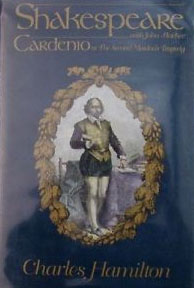
One can immediately note the most immediate problem with Hamilton’s thesis: If The Second Maiden’s Tragedy is to be properly called Cardenio, why does the play lack a character named Cardenio?
To explain this oversight, Hamilton concocts a truly amazing sequence of events:
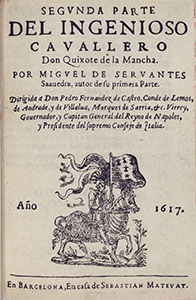 (1) Shakespeare and/or Fletcher either read Don Quixote in the original Spanish or gained access to the translation of Don Quixote before it was published. (This seems plausible. As Hamilton points out, “We do not know whether Shakespeare or Fletcher could read Spanish, but we do know that Fletcher used Spanish sources frequently and that he likely was fluent in the language.”)
(2) They decided to write a play based on the story of Cardenio, but also decided not to use the original names of the character. (This is also plausible. There are many instances of Elizabethan and Jacobean playwrights, including Shakespeare himself, choosing to change the names from their source material.)
(3) After stripping the old names off but before adding new names to the characters, they submitted the script to the censor. (This doesn’t make much sense: The censor needed to see the performance version of the text. He wouldn’t sign off on a rough draft. It becomes even less likely when one considers that Shakespeare is widely known for naming even his minor characters; often he even gives names to characters in the stage directions which are never mentioned in the dialogue itself. While it is not unknown for an unnamed Duke to put in an appearance, it seems utterly out of character for Shakespeare to leave his major love interest and the main villain of the play unnamed.)
(4) Before the play was actually performed, however, Don Quixote was translated, published, and proved to be extremely popular.
(5) So Shakespeare and Fletcher promptly put back the exact same names they had just removed.
But the manuscript we have wasn’t just the copy sent to the censor. It also served as the prompt-copy used in the theater to manage the performances of the play. Hamilton anticipates the obvious objection to his convoluted theory by writing, “You may well ask: If Shakespeare and Fletcher altered the names of their characters as I have indicated, why didn’t they make these changes in the manuscript? They made no changes because no changes were necessary. Shakespeare’s original manuscript served as the prompt copy, which, in Shakespeare’s day, was known as “˜the book’. The keeper of the book, or “˜book-keeper’, was a managerial factotum who, among other duties, copied out from the book the parts for each actor to memorize and acted as the stage prompter. … The book-keeper, of course, virtually knew the play by memory and was familiar with the roles of all the players. As stage prompter, he could easily change the names orally and no revisions were necessary in the manuscript.”
Hamilton is apparently using a definition of the phrase “of course” which means “it would be nonsense to claim that”. The entire point of maintaining a prompt-book was specifically to provide an authoritative reference for staging the production. (And it remains so to this day.) And specifically because it was the authoritative reference, the prompt-book would be changed whenever the production was changed. In fact, the reason we know the manuscript for the Second Maiden’s Tragedy was a prompt-book is because changes were made to it reflecting performance practice. If a change so drastic as the names of the major characters were to be made, there is simply no reasonable explanation for why such a change would not be reflected in the prompt-book.
Furthermore, to support his nonsensical assertion, Hamilton is forced to make a truly ludicrous claim about the mental faculties of the book-keeper. Elizabethan and Jacobean theaters were known to produce 40 different plays in a single year: So Hamilton is asserting that an Elizabethan book-keeper would, at any given time, “virtually know” 40 different plays “by memory” and was so “familiar with the roles of the players” that he would be able to keep track of every change to their lines without reference to a written copy of the play.
The fact that no one could be expected to do that is why prompt books were kept in the first place.
This nonsense aside, Hamilton’s theory of disappearing and reappearing names might bear some consideration if, in fact, the plot of Second Maiden’s Tragedy was actually based on the story of Cardenio.
But this is the plot of the story of Cardenio, from Cervantes’ Don Quixote, as summarized by Charles Hamilton:
They discover … Cardenio, a strange individual who leaps from rock to rock and tuft to tuft in the Sierra Morena. … As he dissolves from one violent fit of madness to another, Cardenio screams his hatred of Don Fernando. … Cardenio then relates the tale of his ill-starred love for the rich and beautiful Luscinda. He had received from Luscinda a letter hinting that she would accept his proposal of marriage. … Cardenio asks his noble friend Don Fernando to arrange the wedding. The highborn, rich Don Fernando has but recently seduced a beautiful maiden named Dorotea, whom he promised to marry, but upon meeting Luscinda he falls for her charms and jilts Dorotea. …
Don Fernando dispatches Cardenio on a fool’s errand …. Several days later, upon receipt of a letter from Luscinda containing the news that Don Fernando has double-crossed him … Cardenio rushes back to his “own Citie” and seeks out Luscinda.
[Cardenio meets with Luscinda. She is “attired in my wedding garments” and “in the Hall do wait for me, the traitor Don Fernando, and my covetous father with other witnesses, which shall rather be such of my death, then of my espousal. … If I cannot hinder by my persuasions and reasons, I carry hidden about me a poniard secretly, which may hinder more resolute forces by giving end to my life.’]
Cardenio conceals himself behind a tapestry to watch the wedding. [But Luscinda, instead of killing herself, marries Don Fernando.] At this awful turn of events … Cardenio was filled with conflicting emotions. Finally he mounted his donkey and rode out of town. …
Cardenio, smoldering with hatred for Don Fernando, turns into a crag-bounding lunatic. Luscinda also runs away and Don Fernando pursues her. … Dorotea, who has also escaped from Don Fernando with the aid of a faithful servant whom she later shoves over a cliff because he makes improper advances, joins Cardenio, Don Fernando, and Luscinda, all the loose ends are gauchely tied by Cervantes. Instead of skewering Don Fernando, Cardenio meekly accepts his apology and is reunited with Luscinda. (Cervantes had obviously forgotten that Luscinda and Don Fernando were legally married.) The penitent Don Fernando finally ends up with Dorotea.
None of this is to be found in The Second Maiden’s Tragedy. In fact, the only thing the two stories have in common is that both involve a love triangle involving two men and one woman. But if that’s all it takes for a story to be based on Cardenio, then Cardenio is the basis for half of Western literature!
In fact, the story isn’t even a love triangle in Cardenio: The character of Dorotea provides a fourth love interest. That means, dates of composition aside, it would be more accurate to describe Two Gentlemen of Verona and A Midsummer Night’s Dream as being “based on Cardenio” than it would for The Second Maiden’s Tragedy to be so.
Even discounting the character of Dorotea, the two stories have nothing in common: The Tyrant and the Lady die in Second Maiden’s Tragedy; Don Fernando and Luscinda do not. Don Fernando steals the woman he is supposed to be wooing and marries her himself; but the Tyrant literally overthrows the government in order to claim a woman who has already been married. Cardenio flees the country; Giovanus is imprisoned. And nowhere in the story of Cardenio do we find necrophilia, ghosts, or any of the other elements which are the notable and distinguishing characteristics of The Second Maiden’s Tragedy.
In short, Hamilton wants us to accept that a play which doesn’t star a character named Cardenio and isn’t based on the story of Cardenio was, for some reason, called The History of Cardenio.
(It should be noted at this juncture that the sub-plot of The Second Maiden’s Tragedy is, in fact, based on a story from Don Quixote: “The History of the Curious Impertinent”. Here we find a virtually identical plot, coupled with characters bearing identical or, at least, recognizable names. But this story is not, in fact, part of the Cardenio story. And its handling in The Second Maiden’s Tragedy only begs the question of why the names would have been expurgated from the main plot but left largely untouched in the sub-plot.)
Go to Part 5
Originally posted August 2010.