The Alexandrian

IN THE SHADOW OF THE SPIRE

Harvesttime – Part 2: Dominic and the Guidance of Vehthyl

When Dominic headed across the bridge into the Temple District, he made gentle inquiries into the worship of Vehthyl and discovered four options: First, the Order of the Silver God. Second, the Temple of the Clockwork God. Third, the Temple of the Ebon Hand. And, finally, an itinerant minotaur priest named Shibata.

What I’m going to talk about here isn’t really a preconceived or formal technique. It’s something that I’ve just kind of instinctively done in the past without even really thinking of it as being a distinct “thing” that I’ve been doing. But as I was re-reading the campaign journal and thinking about what I had done as a GM, it kind of jumped out and bit me. I’m not even sure I would have noticed at all if it wasn’t for the close proximity of what I did with Tor and Dominic here.

So this installment of Running the Campaign is probably going to be a little more rough around the edges as I kind of grope my way towards both understanding and articulating the technique here.

To start with, you have a PC who has an interest.

  • Tor is interested in becoming a knight.
  • Dominic is interested in learning more about Vehthyl.

Dominic’s interest has arisen out of play and is primarily player-driven, and so the response is being created on-the-fly. (Fairly literally in this case, as the bluebooking for this session allowed me to basically roll along with the player’s intentions and develop material in a very reactive way.) Tor’s interest was collaboratively built up in character creation, so I built a good chunk of this material up in parallel with that character creation process and have been waiting to incorporate it into the campaign for several sessions now.

(Although the specific impetus, it should be noted, was still ultimately player-driven even here: Tor’s player had seen the tourney fields on the map of the city and said, “I want to go to there.” I just needed to figure out how I could use the existing material I built in support of this impulse, and vice versa.)

He cantered Blue over to the Board of Ranks, on display just outside of the lists. Each name was noted with heraldry, and he noted that most of the names were accompanied by the three prominent heraldries on display (along with a smattering of others): The cross upon a field of a crimson of the Knights of the Golden Cross; the sword-and-vortex of the Knights of the Pale; and the dawning sun above the martial field of the Order of the Dawn.

The key technique here is that, in response to these PC interests, I haven’t built one thing which would satisfy that interest: There’s not one Church of Vehthyl for Dominic to go ask his questions at. There’s not a single order of knighthood in Ptolus for Tor to pursue.

Instead, I’ve created – or pulled forward – a nest of factions surrounding their area of interest. In the case of this particular session, the factions are actually quite explicitly spelled out (although that doesn’t necessarily need to be the case; there are a lot of different ways to introduce these factions into play), as you can see in the quotes above.

These factions all inherently have overlapping interests and competing agendas regarding those interests because they’re all specifically related to the PCs interests. (Which means that the PC – and presumably their player – will also be inherently vested in those interests.) At this point, I don’t really have a firm idea of how the interactions between these factions are going to play out, but if you’ve got enough people pointing guns at each other (either literally or figuratively) something interesting is probably going to fall out as a result of the PCs bouncing around like ping-pong balls.

WHY DOES THIS WORK?

First, it gives the player a meaningful choice in how their character is going to pursue their interest.

What you want to avoid here, of course, is reverting this back to a meaningless choice where, for example, there are eight different Churches of Vehthyl, but it doesn’t matter which one the player chooses. The factions Dominic has to choose between can, on a certain level, be boiled down to:

  • The Imperial Church
  • A well-established Reformist Church
  • A Reformist cult
  • A lone, unaffiliated religious teacher

Ignoring all of the other details about those factions, this essential choice about where Dominic will turn first in his desperate need for guidance is going to speak volumes about his faith and about who he is as a person.

Tor, by contrast, isn’t really in need during this session. He’s really just checking out the buffet and seeing what’s available, so you can see that the distinctions between the different orders of knighthood are not as sharply drawn here. That’s partly because the player wasn’t motivated to dig deeper: Tor could’ve taken the opportunity of the tourney to meet more of the knights and learn more about their different missions and ideologies. The fact he didn’t at this particular time is actually a meaningful choice in itself. But even if it wasn’t, that’s fine: The meaningful choices are going to come later for Tor and they are going to have a ton of weight.

Second, the inter-relationships between the factions turns the PC into a billiard ball. The player’s initial choice is their first shot, and the effect they’ll have on the table full of balls is impossible to predict. As a result, the outcome of that choice (and their subsequent choices) will be completely surprising to everyone at the table, including the GM. The campaign will be forever different as a result, and it’s quite likely the campaign world will be, too.

As a result, it’s not just a meaningful choice, it’s a momentous choice.

Players can sense that. They know when their choices have completely and irrevocably shaped what the experience of the campaign is. And they love it. They eat it up.

OTHER THOUGHTS

As you’ll see, Tor’s and Dominic’s factions actually end up overlapping and interacting with each other as the campaign continues. This increases the chaotic unpredictability of your campaign once you set these forces in motion; it also helps to draw the PCs closer together.

This overlap is something that you can specifically design into the factions when you set them up, but you’ll also find it arising organically through play: After all, these factions will all end up having a common connection through the PCs. Eventually, that will bring them into orbit with each other… and send them crashing into each other.

What about wasted prep? I’ve been talking about smart prep lately, and here I seem to have deliberately set up wasted prep: Dominic chooses one of the Vehthyl-related factions to seek advice from and then nothing happens with the others.

Well, first, this stuff usually doesn’t require a heavy initial prep load. Most of the time you can probably get away with one or two paragraphs, and then you can develop more in response to the direction the PC chooses to leap. Prep will also overlap. For example, knowing how the orders of knighthood operate in the Five Empires is going to be meaningful to Tor’s character goals regardless of which order of knighthood he chooses to pursue.

More importantly, the prep you don’t immediately use will almost certainly end up getting reincorporated in other ways down the line. These are, after all, significant factions. The whole point is that they’re deeply involved in your campaign world. And they are, after all, related to each other, so no matter which one the PC chooses, the others are likely not too far away.
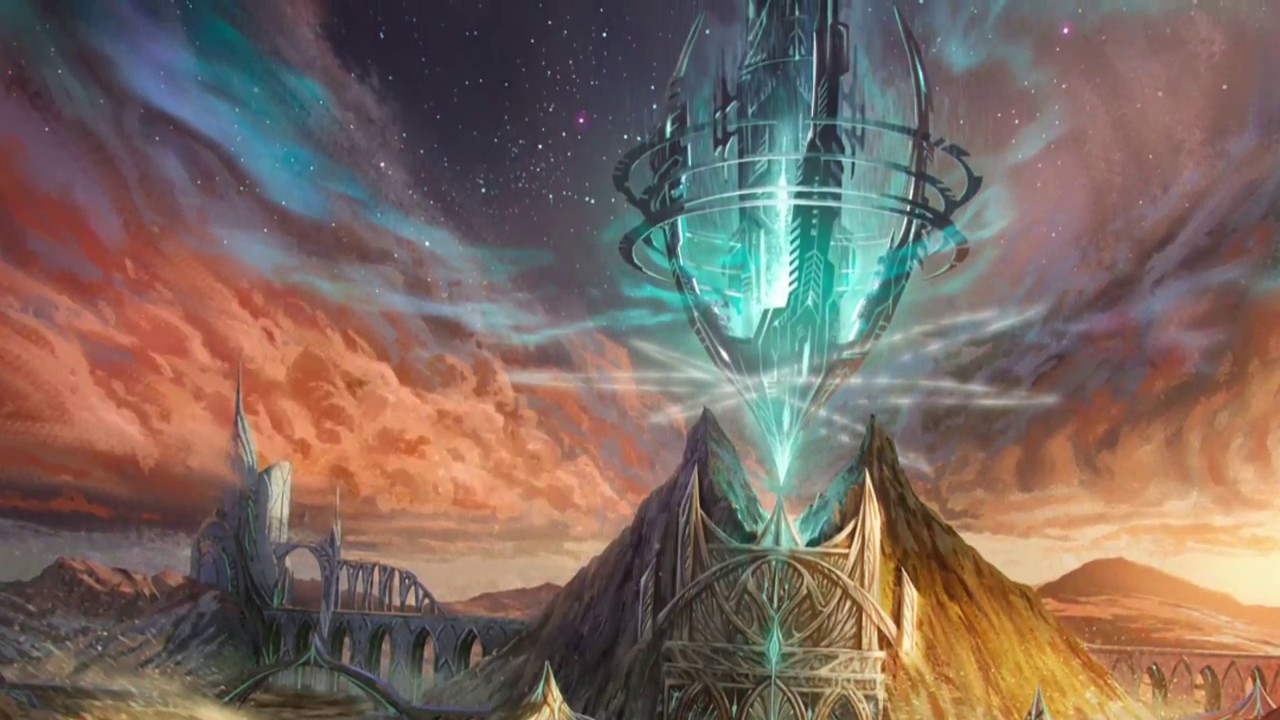
Ptolus - In the Shadow of the Spire

IN THE SHADOW OF THE SPIRE

HARVESTTIME – PART 2: DOMINIC AND THE GUIDANCE OF VEHTHYL

PBeM – November 12th through December 1st, 2007
Harvesttime in the 790th Year of the Seyrunian Dynasty

Although he didn’t speak of it to the others, the loss of his memory worried at Dominic’s soul. Given a day in which to pursue his own goals with a freedom of conscience, Dominic quickly ate his own breakfast and then headed towards the Temple District – intent on seeking out the guidance of Vehthyl, the god of mysteries whose strange holy symbol he had found upon awaking at the Ghostly Minstrel. Read more »

Numenera - Monte Cook Games

A couple days ago, in response to Numenera: The Aldeia Approach, Tomas mentioned that he was “still trying to find the right way to describe Numenera” to new and prospective players. This can be tricky, particularly if your players aren’t familiar with the source material Monte Cook is drawing inspiration from. (If you can only read one thing to grok Numenera, I recommend The Book of the New Sun by Gene Wolfe.)

My approach is to try to let the players appreciate how utterly incomprehensible the gulf between our world and the Ninth World is. That fundamental, existential mystery – that the history of the world is beyond human understanding, and yet that history inexorably shapes every facet of the world in which their characters live – is, in my opinion, the heart of what makes Numenera special.

So I structure my introduction to the Ninth World around five bullet points.

FIRST

The Ninth World exists one billion years in the future. Between now and then there have been eight mega-civilizations. These mega-civilizations are literally beyond our understanding. Our life here in the 21st century isn’t a mega-civilization; it’s barely a precursor to one of them. And the people of the Ninth World know very little about them as well. We know that one of them mastered time travel; another ruled over a galactic empire; another explored a multiverse of different dimensions. We also know that at least one of them wasn’t human and that, in fact, for a time there were no humans on Earth at all. (We also don’t know how or why humans came back.)

SECOND

To get some sense of what the mega-civilizations were like, look at the Clock of Kala. (At this point I’ll point at the map: I printed out a large, poster-size version of the map on vinyl. I either hang it on the wall or roll it out on the table, depending on the venue. But you can just as easily open the book and point.) It’s a massive, perfectly circular plateau several thousand miles across. Vast features of the landscape (on a scale larger than the tallest mountain) are utterly artificial extrusions from the dim recesses of a forgotten prehistory.

THIRD

But the Clock of Kala is nothing but a toy to these mega-civilizations. To give some sense of what they were capable of, consider that the planet Mercury is gone. The people of the Ninth World don’t miss it because they never knew it existed, but at some point in the past the entire planet was plucked from its orbit and they did something with it. What? We don’t know.

FOURTH

But the touch of the mega-civilizations can also be seen at the other end of the scale: Even the dirt beneath our feet is, in fact, artificial – particles of plastic and metal and biotechnical growths which have been eroded by incomprehensible aeons; each bucket of soil filled not with stone arrowheads, but with compact power supplies and the cracked crystals of ancient data storage devices.

FIFTH

Our game begins in the Steadfast. You can think of the Steadfast as a Renaissance civilization. But instead of rediscovering the technology of Ancient Greece and Rome, the Steadfast is rediscovering the technology of these mega-civilizations. This technology is known as numenera, which mechanically take the form of cyphers (items which can generally be used once) and artifacts (items which can be used repeatedly before breaking down). It should be understood that most of the time it can be assumed that people are NOT using these items the way they were originally intended; their original purposes are often completely enigmatical. But we can do the equivalent of finding a CD and using it as a mirror; or finding a cellphone and using its screen as a flashlight.

From here you should be able to pivot to a pertinent discussion of whatever location or other campaign frame you’re planning to use, whether that’s the Wandering Walk or an aldeia or something even more esoteric.

HOW MUCH WEIRD TO PUT IN THE GAME?

The ineffable mystery of the Ninth World’s history, unfortunately, seems to create some barriers in itself. The minute you quantify something or define its precise outline, the mystery ends and that which was engagingly enigmatic instead becomes pedestrian. The rulebook thus frequently emphasizes how important it is that the GM never allow the players to box the setting in like that.

Some have interpreted this advice to mean that the GM should just make everything random and inexplicable (which they naturally find frustrating). But that’s not the point. The point is that no matter how much you figure out, there will remain more that you don’t. This doesn’t render exploration or investigation pointless or without reward, any more than the fact that real world scientists haven’t completely solved the Grand Unified Theory makes the work of Newton or Galileo or Einstein pointless or without value.

There’s a Lovecraftian aspect here: The world (and the past epochs of the mega-civilizations) are fundamentally not comprehensible by mere humanity; and if we were to do what was necessary for us to truly understand them, we would no longer truly be human.

So how much weirdness should you, as the GM, put in the game? Too much and the game turns into random ramblings. Too little, though, and you end up with something pedestrian; something lack the essential spark that makes Numenera special.

The first thing to understand, perhaps, is that the amount of weird will vary by circumstance. There’ll be places with very little weird. And there will be places which are through the looking glass. That internal contrast is essential, actually, because it allows the “weird” to define itself.

With that being said, if you find yourself creating something for Numenera that feels a little too normal – something that you could just as easily find in a game of D&D or Star Wars or vanilla Traveller – take a moment to step back and figure out how to add at least a little dash of the weird. Take at least one aspect of it and think about how you can twist it; how the influence of the numenera could transform it.

The Aldeia Approach is actually a specific example of how you can do this: Basically you take a typical Renaissance village, add one piece of numenera, and ask yourself, “How does that change everything?” As you’re getting up to speed with the Ninth World, that kind of showcasing of a single weird aspect of the setting will take you a long way.

RUNNING WITH NUMENERA

I’m also asked with a surprising frequency why I spend so much time talking about Numenera here on the Alexandrian. As with most of the RPG-related stuff you’ll find posted here, it’s a reflection of what I’m actually running and playing at the table. I’m at 40+ sessions of Numenera and, honestly, my players just keep screaming for more. I literally can’t run it often enough to keep up with the demand.

So as long as we’re discussing how to introduce the game to new players, let me also talk about why, once you start, Numenera is a game you’re going to keep playing for a long time to come:

Numenera: Discovery & Destiny - Monte CookSimple Prep. Everything in the game basically boils down to assigning it a level. It literally can’t get any easier than that. But the great thing is that the system allows you to selectively do more detailed prep whenever you feel it’s necessary by assigning things additional levels specific to certain tasks or abilities. This sort of fractal complexity, where the game only becomes more mechanically complicated when you think the cost is worth the reward, is incredibly effective. You never feel unnecessarily bogged down by the rules; you also never feel limited by them.

Creative Lubricant. The entire system is designed around some simple mechanisms which encourage the GM and players to take creative chances. GM intrusions for example provide a safety net that allows the GM to take really big chances because the players have a streamlined mechanism for telling the GM that they’ve gone too far. Major and Minor Effects also get the players thinking creatively outside of the box.

Tremendous Support. The Numenera product line is phenomenal. There’s fantastic setting material, a multitude of scenarios, fabulous bestiaries, and even more amazing stuff on the way. (My prep for Numenera often consists of just flipping through one of the bestiaries and saying, “I wonder what will happen when they see one of those things?”)

The game also features a large dynamic range when it comes to PC abilities, which allows the game to shift its focus and content over the course of a campaign (which helps to keep things fresh). And I’m very much expecting this to become even more true with the greater emphasis being placed on PCs getting involved in managing communities, building organizations, and the like in the upcoming second edition of the game.

FURTHER READING
Numenera – System Cheat Sheet
Numenera: Calibrating Your Expectations
The Art of GM Intrusions
The Aldeia Approach
Fractal NPCs

Soldiers on Patrol

This article is a patron request from Robert Rendell. Help support the Alexandrian by visiting my Patreon.

This isn’t the first time I’ve talked about stealth here at the Alexandrian. Much of what I’ve written about is how to adjudicate stealth in a way which makes it a viable strategy for the PCs to pursue: Far too many GMs resolve stealth by having every PC in the group make a Stealth check opposed by the Notice check of every single NPC who could possibly see them. (In some systems it’s even worse, with GMs requiring every PC to make multiple checks opposed by every single NPC that could possibly see them.)

One way of dealing with this is to just have the PCs’ skill at stealth completely outclass the NPCs around them. Even in systems where the PCs are allowed to achieve supreme levels of power, however, this is usually doesn’t happen: The game world too often levels up with them, and because it seems that game designers are generally terribly paranoid about their bad guys NOT noticing the PCs, virtually every single NPC has their Notice checks cranked up through the roof. Even if this was generally true, however, I wouldn’t be entirely satisfied with the results. My goal isn’t to make Stealth automatically successful; it’s to make it viable. I don’t want to take the consequences of failing a Stealth check off the table (they can be interesting); I just don’t want that to be the de facto outcome every time Stealth is attempted (because, in short order, nobody will attempt Stealth any more).

So I generally suggest two broad paradigms when resolving Stealth attempts.

First, reduce the number of required rolls. When you call for a separate check against every single NPC, you’re usually rolling to failure. Avoid that by using let it ride techniques, resolving entire Stealth approaches in a single mechanical resolution. (For an example of how effective this can be in practice, check out Let it Ride on the Death Star.)

Second, reduce the number of people rolling. You’ll note that this also reduces the number of rolls required. If you have seven PCs roll to resolve a Stealth attempt whereas normally only one PC needs to roll a skill in order to accomplish an objective (like opening a locked door, for example), you’ve created a situation very analogous to rolling to failure and with the same unappealing probability curve; you’re just doing it all at once.

Generally speaking, you want to get the Stealth resolution boiled down to a single mechanical check (just like 99% of all other resolution checks you make in the game). One way to do that is to specify that the character with the lowest Stealth skill in the group makes the check. This makes sense because they’re the one pulling the rest of the group down, right? Personally, though, I’m not a fan of this approach. It penalizes the Stealth specialist in a way that other specialists are NOT punished, robbing the Stealth specialist of their well-deserved spotlight. I also think it’s more reasonable to assume that a character skilled in stealth can help their companions sneak into situations that they wouldn’t normally be able to sneak into.

Instead, I like to institute some form of piggybacking. This often requires a little bit of mechanical finagling in the system of your choice, but it’s worth the effort because once you have the mechanical structure you’ll find it coming in useful time and time again. For more discussion on this, check out Group Checks.

A PARADIGM FOR STEALTH

When designing the Infinity Roleplaying Game, I designed a new game structure for resolving stealth. I think it provides a clear paradigm for GMs to use in making rulings about stealth, and I Infinity RPGalso think you’ll find it easy to adapt to most any game system.

STEALTH STATES: Characters exist in one of three stealth states.

  • Revealed characters are visible to their enemies and their precise location is known.
  • Detected characters cannot currently be seen by their enemies, but their presence and approximate location are known. (“I heard something in the bushes over there.” or “The shot came from that apartment building!”)
  • Hidden characters cannot currently be seen, heard, or otherwise perceived by the enemies. Although an enemy may be aware of their presence, their actual location is not known. (“Someone broke a lock on Entrance 3A. Sweep the building.”)

The states of “detected” and “hidden” are referred to as “stealthy states”.

STEALTH STATE TESTS: When a character in a stealthy state takes an action, they may need to make a stealth state check. Opponents can also take action to force characters in a stealthy state make a stealth state test. (“I’m going to check the warehouse again.”) The exact mechanic you use to resolve a stealth state check will obviously depend on what game you’re using.

STEALTHY ACTIONS: Becoming hidden is an action which requires a stealth state test. Once a character is in a stealthy state, they remain in that state until either they or an opponent takes an action which threatens that state. In general, these actions are not specifically classified. This is not a laundry list; it’s a paradigm that GMs can use to make their rulings.

  • A silent action does not change the stealth state of the character performing it.
  • A sneaky action requires a stealth state test, which is performed as part of the same action. If the test fails, the character’s stealth state is reduced by one step.
  • A noisy action allows opponents to automatically make some form of Observation test (with a difficulty determined by exactly how noisy the action is) in order to detect the character, reducing their stealth state by one step.

Design Note: You’ll probably also want some mechanism by which the reaction to a noisy action can be escalated to a two step reduction: Margin of success or possibly an additional action of some type. In Infinity the Observation test was made at difficulty 0 (making it essentially automatic unless the environment, special equipment, or special training applied a difficulty modifier to the Observation test), and success allowed for an immediate Reaction to force an opposed stealth state test to escalate to a two step loss (immediately revealing a previously Hidden character).

You may also want some mechanism by which stealthy characters can reduce the severity of a stealthy action by one or two steps. In Infinity, for example, you can spend 2 Momentum to reduce a noisy action to a sneaky action or a sneaky action to a silent action. But there are any number of options beyond bennie spends.

COMMON SENSE PREVAILS: Many actions that directly affect a target (like shooting them) will automatically result in a stealthy character becoming detected by the target (even if they perform the attack in perfect silence from a state of impenetrable invisibility). Characters can also choose to simply stop being stealthy, either deliberately or as an obvious consequence to their actions. (“I’m going to walk out into the well-lit parking lot with my hands on my head and shout out my surrender.”)

MANY FORMS OF STEALTH: The Infinity Roleplaying Game takes this paradigm one step further by applying the same core structure to stealthy actions in other contexts (such as the hacking sequences of Infowar scenes and the social confrontations of Psywar scenes). This is part of a wider design methodology I used in Infinity to unify mechanical paradigms and structures in Alley in Sloveniaorder to keep the system easy to learn and use even though it needed to cover the vast panoply of structures found in a full-blown space opera. (This, however, is a topic for another time.)

STEALTH AND ENHANCED PERCEPTIONS

Something that I think can be a struggle for GMs in general are characters who possess some form of enhanced perception: You’re already trying to keep a consistent picture of the campaign world in your head using the five senses you’re familiar with, and now you suddenly need to also try to imagine that setting through totally alien eyes. There’s a wider discussion to be had about enhanced perceptions in RPGs, but they also clearly have an impact on the rulings you make about stealth specifically.

For example, Eclipse Phase is a game where a truly dizzying array of enhanced perceptions are virtually commonplace. They include (just counting perception of the physical world):

  • IR
  • UV
  • T-Ray
  • Radar
  • Enhanced Smell
  • Electrical Sensitivity
  • Magnetic Sensitivity
  • Radiation Sense
  • Zoom Vision

And this doesn’t even include the more esoteric examples, like the completely bizarre array of senses available to the suryas (space whales).

Often the best way to get a grip on this sort of thing is to take your cue from the resolution: Note that a character has, for example, infrared vision. If they successfully spot someone trying to sneak past them, think about how their infrared vision could have helped them do that and frame your description of what happens accordingly. Conversely, if they fail to spot someone trying to sneak past them, think about how that person could have thwarted their infrared vision (finding a hot background to hide against, for example) and describe accordingly. In doing so you’ll not only be teaching yourself to think about the world in terms of these enhanced perceptions, you’ll also be slowly introducing these concepts to the players. As both you and the players gain expertise over time, these enhanced senses will become integrated into your vision of the game world and you’ll likely begin preemptively taking them into account.

For example, your players might start saying before the check that they’re going to choose an approach that will let them mask their heat signature. When that happens, remember that player expertise can trump character expertise and rule accordingly.

Something else to keep in mind, however, is that enhanced perceptions may not be strictly beneficial; they can also have drawbacks. (Think of the guy in night vision goggles who suddenly gets blinded when the lights get flipped on.) In an e-mail to me, Robert Rendell pointed out the interesting consequences of this:

For creatures who can see fine in the dark (such as most monsters who inhabit unlit areas of dungeons), a nearby light source might not be anywhere near as obvious. If you have darkvision and can already see your surroundings perfectly well, someone bringing a light source near you won’t make much of a difference [i.e., it won’t allow them to see anything they couldn’t already see; it would be like carrying a candle into an already lit room… you might notice, but you might not]. You might start noticing colours, but that’s nowhere near as stark as going from blind to not blind.

Obviously, since darkvision has a fixed range, someone with a light source beyond that range would still tend to stand out. Intelligent creatures with darkvision might take advantage of that, attempting to have guard stations which have more than 60′ of clear sight along straight approaches to their lairs so approaching light sources are more obvious. They could also take other precautions: Having bright colours near their guard stations which will leap out when light is brought near, or even writing “Intruders!” in coloured paint on the wall to alert them when light is nearby.

This is obviously dependent on exactly how you choose to metaphysically interpret “darkvision” (and that might vary from one type of darkvision to another). But it’s a really cool idea, and highlights a way in which you can make this panoply of perceptions in fantastical worlds really come alive, creating a truly unique world with experiences you could never have in the here and now.

Another way to think about this within our wider paradigm for stealth is that actions might be classified differently depending on the senses which are perceiving them: For example, walking through a dark dungeon with a candle in your hand might qualify as a noisy action if someone with normal vision is trying to spot you. But the light might be totally irrelevant to a creature who can perceive the world only through radar, effectively rendering the candle-carrying a silent action vs. those creatures. Whether used in various gradations or as hard binaries, this can give some concrete mechanical oomph to the unique properties of these different types of perception.

Numenera 2: Discovery and Destiny

Numenera 2: Discovery and Destiny, the second edition of the game making the exciting promise of expanding its core gameplay to include developing local communities and rebuilding civilization in the ruins of the past worlds, is just around the corner.

One response that I’ve seen frequently to Numenera from GMs is that they can’t quite wrap their head around the setting: The core rulebook uses a combination of techniques for presenting the Ninth World, and for many people one or more of those techniques clicks. For others, they don’t. Or, worse yet, the combination of techniques is baffling in its own right. So what I’d like to do here is to focus on just one way of approaching the Ninth World. It’s not one that gets much attention in the core rulebook, so it might work for those who couldn’t find anything to latch onto in the core rulebook, and the focus on just one angle of approach might also be useful for those who find the totality of the Ninth World just a little too much to take in all at once.

Perhaps more importantly, as a GM I’ve found this particular angle — which I’m going to refer to as the Aldeia Approach — to be specifically valuable when it comes to creating cool scenarios for the setting. It’s kind of like a “default action” for the GM: The setting is capable of doing all kinds of other cool stuff, but if you’re ever at a loss for what to do next (or what your first step with Numenera should be), the Aldeia Approach will faithfully serve up something you can use.

A FEW BASICS

Before we dive into the Aldeia Approach, a few general words on grokking the Numenera setting.

First, it’s not a bad idea to read some of the fiction that Monte Cook cites as the primary influence for the game. Not just because it will help you tune into the milieu, but because it’s all really fantastic fiction that you should read in any case. I would direct your particular attention to:

Second, pay attention to how Cook has structured the setting to make it accessible to newcomers (particularly new players): The core of the setting described in the core rulebook is the Steadfast, where a Renaissance movement is reclaiming the lost technology of past civilizations the same way that Western Europe reclaimed the science and technology from Ancient Greece and Rome. The Steadfast very specifically resembles the real world Renaissance in both culture and civilization so that you can easily latch onto it as an entrypoint into the world.

As you move beyond that entry point — into an area of world literally referred to as the “Beyond” by residents of the Steadfast — you begin encountering larger and larger amounts of the weird. Exploring the Beyond is really the point where you start dipping your toes into the truly exotic bizarrity which the Ninth World can be. As you move even farther out into the world, you’ll start encountering the truly alien aspects of the Ninth World.

I’ve seen a number of people complain that the setting (by which they really just mean the Steadfast) is just “D&D with a patina of science fiction”. That’s not really true, because the Ninth World is fundamentally different from D&D. But it is true that both D&D and Numenera use a heavily fictionalized version of the Renaissance as a common starting point to provide something that’s easy-to-run and easy-to-understand. And you can, in fact, have entire glorious campaigns solely within the comfortable confines of the Steadfast. Nothing wrong with that. But there’s also nothing wrong with skipping the Steadfast entirely and jumping straight into the more outrageous aspects of what the Ninth World has to offer.

THE ALDEIA APPROACH

The word aldeia is another name for “village” in the Steadfast and the Beyond, and buried away in one obscure corner of the core rulebook is this text:

Around these claves [of Aeon Priests], small villages and communities known as aldeia have arisen. Each clave has discovered and mastered various bits of the numenera, giving every aldeia a distinct identity. In one, the inhabitants might raise unique bioengineered beasts for food. In another, people may pilot gravity-defying gliders and race along the rooftops of ancient ruins. In still another aldeia, the priests of the clave may have developed the means to stop the aging process almost entirely, making the residents nearly immortal, and some are no doubt willing to sell the secret — for a staggering price. Because the aldeia are remote and separated by dangerous distances, trade of these discoveries is occasional and haphazard.

So communities often have some form of numenera that they’re capable of exploiting. But that construction can also be inverted: Aldeia arise because there is an exploitable form of numenera in a particular region. They’re like technological mining towns; communities growing up around an economic resource.

And the Aldeia Approach basically latches onto that concept: If you’re wondering what to do with Numenera, you can’t go too far wrong by looking for an artifact or cypher and then asking, “What happens if an entire community is based around this?” In my experience, at least one (and usually several) playable scenario hooks will become obvious as you’re answering that question.

In terms of introducing the setting and building its complexity over time (for both the GM and the players), the Aldeia Approach is also an ideal way to launch a campaign: Frame the PCs as some form of itinerant wanderers, and simply have them encounter interesting aldeia in the course of their travels. When you feel like you’re starting to get a grip on things, move up to a small regional town: Such towns would be based around trade with several smaller aldeia, so list a half dozen or so prevalent numenera technologies the city has access to and think about what the resulting town looks like. (Maybe you even run an urbancrawl there.)

The Aldeia Approach is so robust that you can practically randomize it. For example, let’s combine the random numenera tables from Sir Arthour’s Guide to the Numenera (you could just as easily use the tables from the core rulebook alone) with S. John Ross’ Big List of RPG Plots (which I’ll just use in order for the sake of argument) and see what we end up with.

GOLD ‘NADO

Deployer (Atmospheric): “The device collects the most widely available atmospheric aerosols within long range (such as drit dust, water droplets, pollen, bacteria, or smoke). It brings these aerosols together in a whirling tornado that centers around the device itself.” An aldeia has figured out how to reverse engineer a deployer and produce them in a bespoke industry. In combination Numenera - Skysmasherwith specially designed filters, they’re used to mine surface gold. (Or perhaps something more exotic?) Combine with Any Port in the Storm: An unforeseen interaction between the deployers cause their “prospecting ‘nados” to collapse into a single, massive tornado which now threatens the aldeia. (Maybe this even happens with some regularity and the aldeia has gotten used to “battening down the hatches” when it happens?) The PCs are forced to take refuge… but the real danger is in whatever location they’ve taken refuge in.

The threat could be human in nature (a serial killer in a locked up inn, perhaps). But let’s pick a random page from the Ninth World Bestiary and see if we can end up with a threat: “A skysmasher arrives as a red blaze across the sky, leaving a trail of light and smoke. (…) Skysmashers live out most of their span in some useable above the sky, crashing down to solid groun only to spawn and lay eggs.” What if the skysmasher crash actually triggered the malfunction in the prospecting ‘nados? What if its eggs hatch very quickly after being brought to earth and begin trying to breach the PCs’ sanctuary?

THE KINGDOM’S HELM

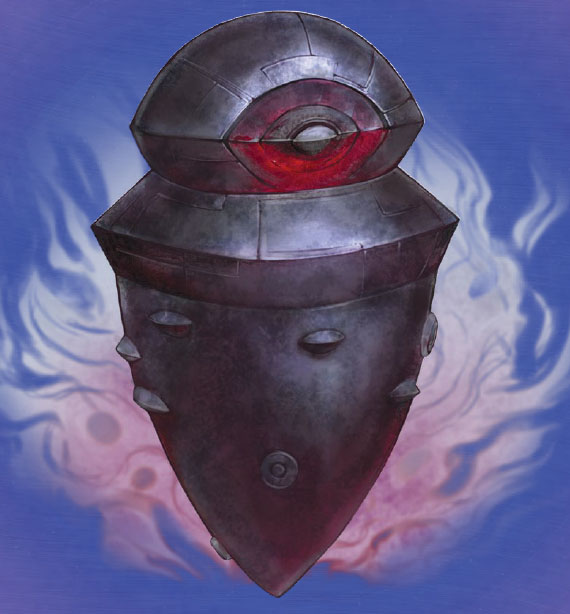
Ocular Helm: “The wearer of this strange helm sees a variety of visual sensors, clarity enhancers, viewfinders, rangefinders, and other aids to sight.” Let’s say that there’s a great lake which is perpetually covered in a strange, silver-green mist. Navigating through this mist has proven virtually impossible using traditional means, but a set of island kingdoms within the mist control a limited number of ocular helms. The Elite Order of Helmsmen are charged with navigating the lake, guaranteeing Numenera - Ocular Helmthe security and prosperity of the islands. Better Late Than Never: Someone has stolen one of the ocular helms. The PCs are hired to track them down (or maybe there’s just a bounty and a bunch of people are trying to find it).

Another option: The PCs find an ocular helm in the course of some other adventure (probably while exploring some mouldering ruins). When the island kingdoms receive word of this, they can’t let the PCs keep it. It’s a huge security risk! But even if (some) of the kingdoms are willing to just make a generous offer, there are other factions in play that will just try to steal it from the PCs.

And another: Some strange technophage has destroyed the ocular helms controlled by the Elite Order. The kingdoms desperately need to secure another: Cue a heist in the great city of Qi, or maybe just a treasure hunt in pursuit of ancient rumors.

EXACTION EXHALATION

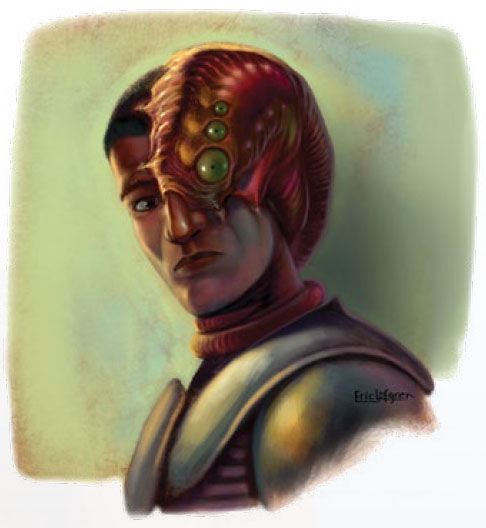
So I initially roll up Device Enhancer (Restorer), a cypher which can be attached to a different cypher or artifact and that device now restores a total of 4 points each time it is activated (in addition to its normal function) or 2 additional points if the device already restores points. So I roll again and I get Exalted Vapor, Numenera - Exalted Vaporwhich allows the user to inhale a potent chemical that restores 6 points to any pool. So what we end up with is a vapor which restores 8 points of Might when inhaled.

Let’s go with the obvious: A secluded village where special sauna chambers filled with strange vapors restore the afflicted to health. The exalted vapor cyphers that are placed in these chambers are created by a set of ancient machines held in caverns deep beneath the village.

Combine this with Blackmail: When the PCs arrive in the village, they are surprised to see it clutched by poverty and hardship. The wealth flowing into the saunas seems to just vanish into the vapor. Poking around, they discover that a murden has stolen a crucial numenera artifact which creates one of the reagents required for the exalted vapor. The murden is blackmailing the town into crippling payments and is threatening to destroy the irreplaceable device if they don’t comply.

Archives

Recent Posts

Recent Comments

Copyright © The Alexandrian. All rights reserved.