And from those teeming places of shadow and virulent beds of life and seething pits of chaos, the Natharl’nacna bent the substance of the world unto their will. From the work came the least of their servants, a swarming brood of anarchy and despite.
This slim folder of supple hide, clasped shut with a length of emerald green ribbon, contains a dozen or so individual sheets of parchment. Written in an archaic – almost alien – form of the Common tongue, they tell a sad and cautionary tale.
In a time of great strife and a war, a race of high sorcerers fled the mortal world and took refuge within “a spired realm of the Dreaming.” For long years without count this race dominated their new home – they were masters of magic and builders of wonder; they lived in peace and glory.
They were called the Akop and the years of their golden age seemed without end.
But there came a time when this proud race faced a problem they could not overcome: “Although they lived within the halls of Dreaming, yet their arts had never mastered the dream-craft. They worked marvels within dreams, but were not of the Dream themselves.”
Their world was dying. And in its slow decay, it had become severed from the mortal realm from which the Akop had first come. “From the fraught-prison of their own creation, there was no flight.”
In their desperation they turned to a creature referred to in the text only as the Kindred. The Kindred had the power to free them from their self-inflicted prison, but he demanded a high price: “Through his gates they would pass, but once passed they would blood-bind their hearts to serve him for unto a generation of their race.”
Faced with obliteration, the Akop agreed. But the Kindred was treacherous: The gates which took the Akop from their world were foully enchanted. As they emerged into the “deep eurl-realms of chaos”, the Akop were transformed into insubstantial creatures of living shadow, bereft of mortal form. “Of the flesh, they could not be harmed. But nor could they breed of the flesh. There would be no passing of their generations and upon their oath the Kindred had bound them for all eternity. And so the Kindred became the Enslaver of Races.”
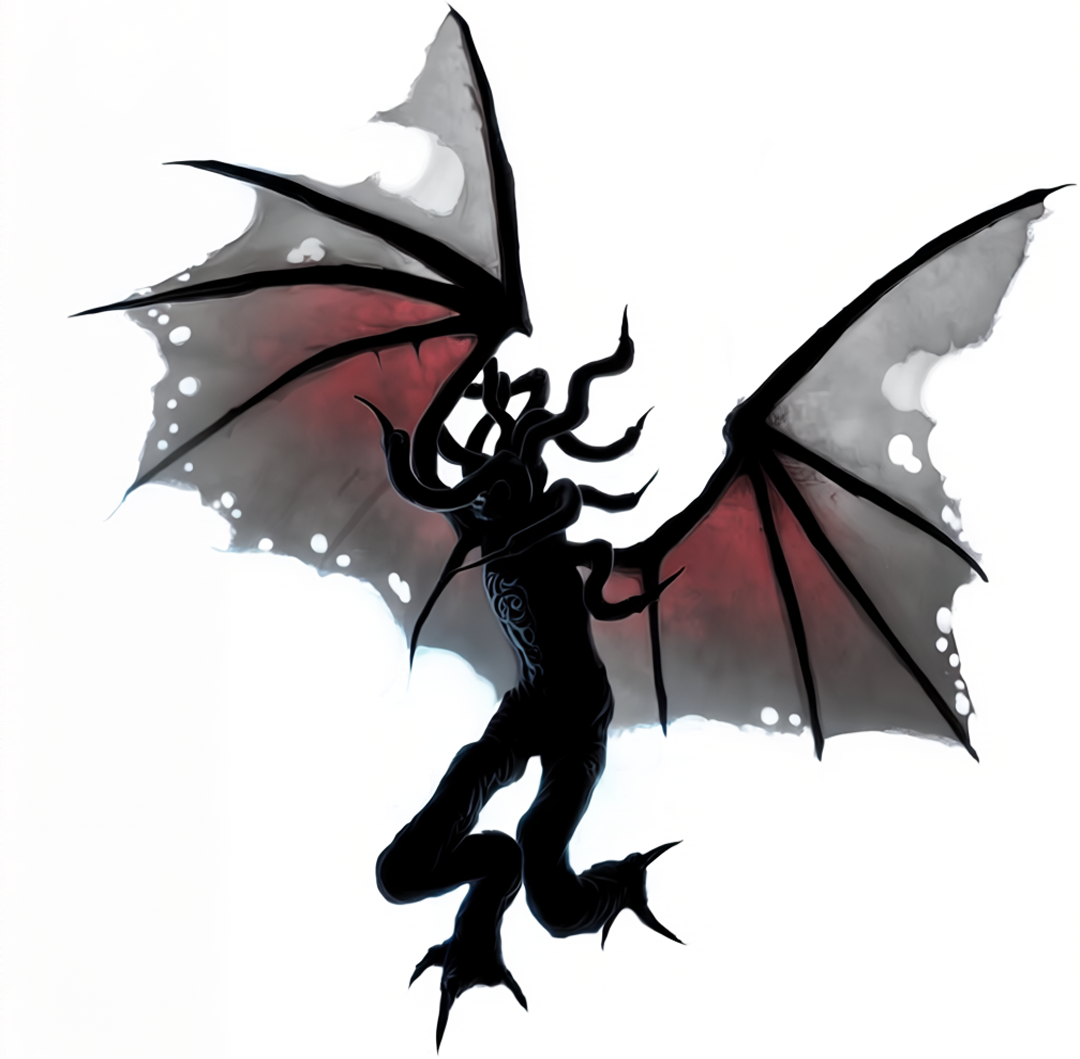
In their new form, the akop became members of the Elder Brood – a foul mixture of twisted races that are described as “servitors of the Kindred and the kindred of the Kindred”. There they “took their place among the essyat and gadacro; the nintha and the obaan”. Over the years that followed, the akop degenerated – losing first their magic and then their sanity.
“In their madness, the Kindred found he could not command them; could not control them; could not rule them. But yet, in madness, they ever-serve the mad-mind of the Kindred and work unto his ends.”
THE NAUGHT-FLESH OF THE AKOP
The akop are incorporeal beings of shadow. “And they loathe those luck-fated to still wear their flesh. They blood-boil to battle-lust and long to bring all those of their former kindred into their 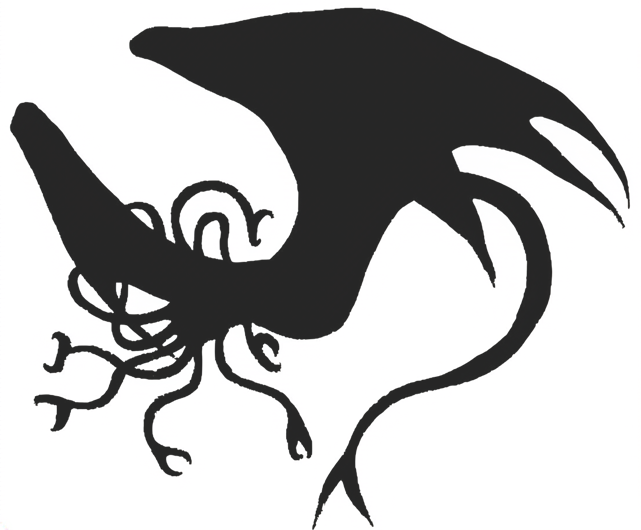 madness of the cur-kin. But in this the curse of the Kindred tightens, for with each akop who passes in the battle-fraught, their race-pride is brought one step closer to its end-utter.”
THE TOUCH OF THE AKOP: “Fear the shadow-flesh which is not, for in its touch the madness of a dying race shall seep through pore and blood into the bone and brain. Those afflicted by the touch of the akop shall be driven to their Dream of madness.”
It seems that those driven insane by the akop are thrust into dreams of apocalyptic vision. There seems to be a shared quality to these dreams (among those whose shattered minds have recovered enough to communicate), and it is believed that they are the race memories of the Realm in which the akop once lived – twisted through the memory of its destruction and their own madness.
At this point, in a separate hand, there is a report of many such visions collated from various sources. Some are not given any textual authority, but seem to have been gathered first-hand (and perhaps deliberately so). They conjure strange visions of ruptured towers of obsidian; cascades of shattered stone glittering with chaos-tossed magicks; of great forests ripping apart in silent desolation; of rivers plunging into ourobouric self-destruction.
SUMMONING THE AKOP
A final selection of papers details the particular details of the summoning ritual necessary to “summon a brood-swarm of akop to give the truest service of chaos”.
Using these notes, a summon fiend spell can be modified in one of two ways.
First, it can be cast using a 1st-level spell slot, in which case it will temporarily call forth an akop for 1 hour. Due to the madness of the akop, however, the control of the spell is not perfect. The akop is allowed to make a Wisdom saving throw when summoned. On a success, the control of the spell is broken and the akop is free to act in whatever manner their madness dictates. (When in doubt, have them act as if under the effects of a confusion spell.) On a failure, the akop is controlled normally, but may retry the Wisdom saving throw once every 10 minutes.
Second, it can be cast using a 6th-level spell slot to permanently bring a swarm of 1d6+2 akops to the caster’s location. These are not summoned creatures, but have been brought from the Elder Brood into the mortal plane. These akop, too, are difficult to control, although the rites involved in summoning them give them disadvantage on their saving throws. If these akop fail their saving throw, they can reattempt it once per day.
DESIGN NOTES
Although the elder brood are described as being teemless in their variety, only three varieties can be found in the Chaositech sourcebook. So I cracked open one of my favorite bestiaries — Green Ronin’s The Book of Fiends — and started scavenging some of those fantastic monsters, like the akop, to fill out the ranks of the elder brood. The Book of Fiends has been updated for D&D 5th Edition, so it’s quite easy to add these to your own Ptolus campaign, regardless of which edition you’re using.