The Alexandrian

Posts tagged ‘games unplugged’

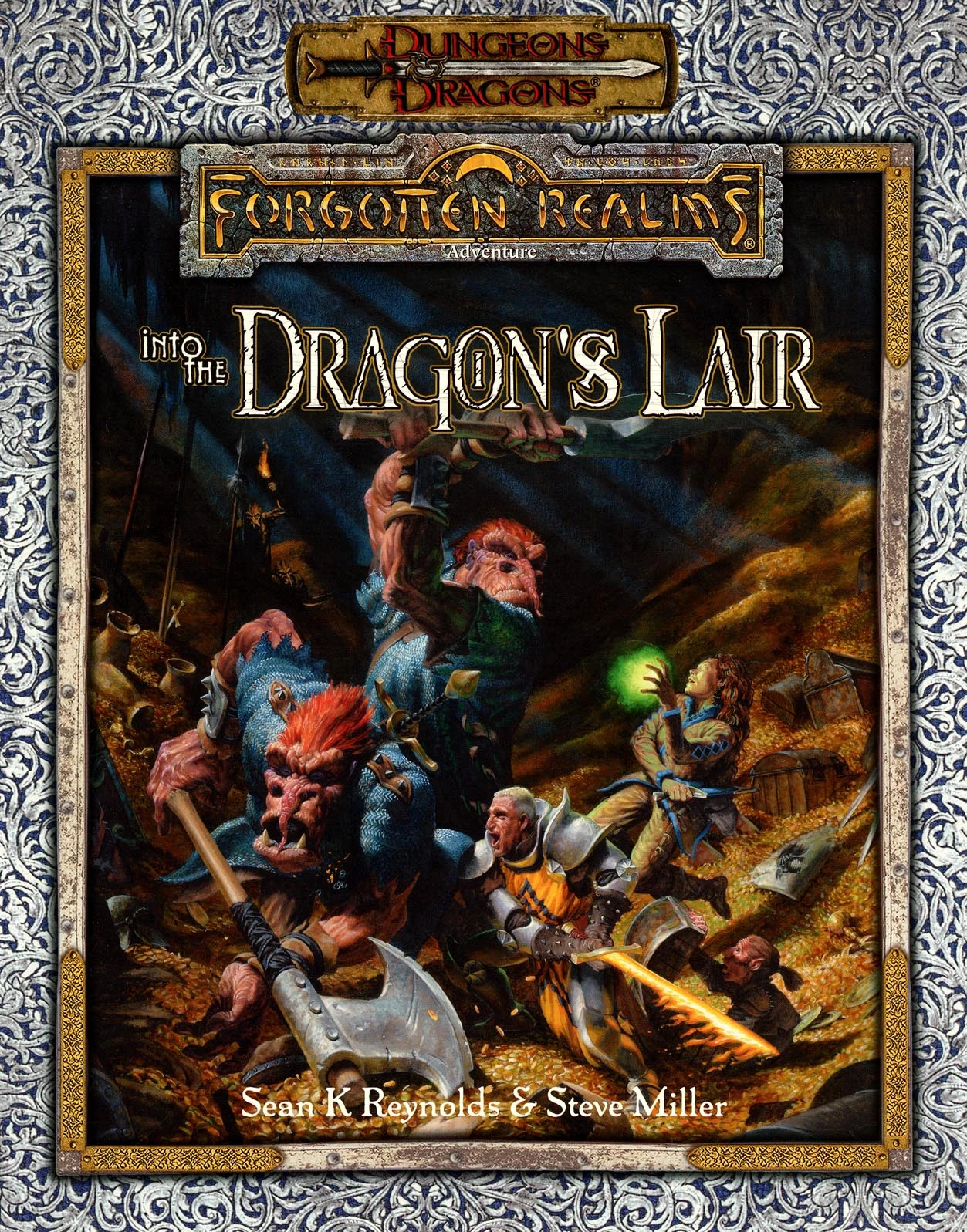
D&D - Forgotten Realms: Into the Dragon's Lair (Wizards of the Coast)

Originally Published in Games Unplugged Webzine – May 1st, 2001

Warning: This review will contain spoilers for Into the Dragon’s Lair. Players who may end up playing in this module are encouraged to stop reading now. Proceed at your own risk.

Into the Dragon’s Lair is a 96-page module, written by Sean K. Reynolds and Steve Miller, inspired by and designed around the events detailed in the Forgotten Realms novel Death of the Dragon by Ed Greenwood and Troy Denning.

The plot goes something like this: Cormyr was laid waste and her king slain by a dragon who has an ancient blood grudge against the royal line. During the fighting which followed the dragon was killed. (That’s what happened in the novel – and it’s all summarized for the DM at the front of the module.) The PCs are asked to track down the dragon’s lair and liberate the treasure to be found there for the good of Cormyr. (I would have liked to see a few alternate adventure hooks, including the self-obvious: “We’re adventurers, we’ve heard about abandoned treasure, and we’re off to get it.”) Of course, the PCs are not alone in their hunt for the treasure – they’re in a race against time against a half dozen other adventurers and adventuring parties (although it would have been nice if the adventure had been designed so that they could actually lose the race).

The adventure basically breaks into three major sections at this point: First, the PCs need to travel cross country to the dragon’s lair. When they penetrate the lair they will discover its secret: The dragon’s orcish thralls are actually the inhabitants of a demi-plane and the dragon herself exists in a pocket dimension outside of that pocket dimension. The PCs need to work or fight their way through the demi-plane of orcs in order to find the entrance to the dragon’s pocket dimension. The dragon’s pocket dimension is inhabited by evil elves who had sworn loyalty to the dragon. Once they’ve liberated the treasure (if they can do successfully), they have to find some way to transport it back to Cormyr.

There are a couple of really nice features to this product: First, Reynolds and Miller have made sure that it remains accessible – even for those Forgotten Realms players who aren’t familiar with the novel which provides the background out of which this adventure is constructed. (Including me.) Second, the whole structure of competing with other adventuring parties for the deserted dragon’s horde is really cool – and carried out with relatively few flaws. Finally, the entire adventure has an epic quality – which is not only nice to see, but surprising given that the adventure has a novel as its basis for existence: All too often, novel-based adventures are just linear railroads where the players are forced to pantomime the actions of the original protagonists.

There are also some rather unfortunate flaws in this product: First, the map on page 26 (which shows how the PCs get to the dragon’s lair) has misplaced the location of the ambush so that it doesn’t match the description in the text. Second, there are quite a few elements in Into the Dragon’s Lair which are brought up and then never capitalized on – orcish politics, a mysterious valley of fog, some of the interactions with the other parties. In other areas, plot threads are simply left dangling without resolution or explanation. Executing on these would have made the difference between a good module and an excellent one.

If the premise of Into the Dragon’s Lair has you interested, you should definitely check it out – it delivers. If the only reason you’ve been holding back on it is because you’re (understandably) leery of novel tie-ins, then definitely check it out because they’ve avoided all the pitfalls with this one.

But there’s nothing here which is going to make this a “must-have, instant classic”. It’s a good idea, with above average execution, and its definitely worth the cover charge. Beyond that, your own judgment must reign.

Grade: B

Writers: Sean K. Reynolds and Steve Miller
Publisher: Wizards of the Coast
Price: $17.95
Page Count: 96
ISBN: 0-7869-1634-6
Product Code: TSR11634

This is an oft-overlooked adventure from the very earliest days of D&D 3rd Edition. If I recall correctly, it was actually the second official adventure published by Wizards of the Coast, actually predating The Forge of Fury, but no one really paid any attention to it for some reason. I only ended up reading it because I got a review copy, and I’ve just discovered that it’s actually missing from the Wikipedia article listing all official D&D adventures (although I’m sure someone will fix that shortly).

Part of the problem was likely that it was a 10th-level adventure released within just a few weeks of D&D 3rd Edition being released, so it’s unlikely anyone had a group leveled up and ready to play this when it released.

In truth, though, I also have no memory of the adventure itself at this point. I wonder if, in light of of the Race to the Prize scenario structure, I would still be impressed by its handling of the rival adventuring teams?
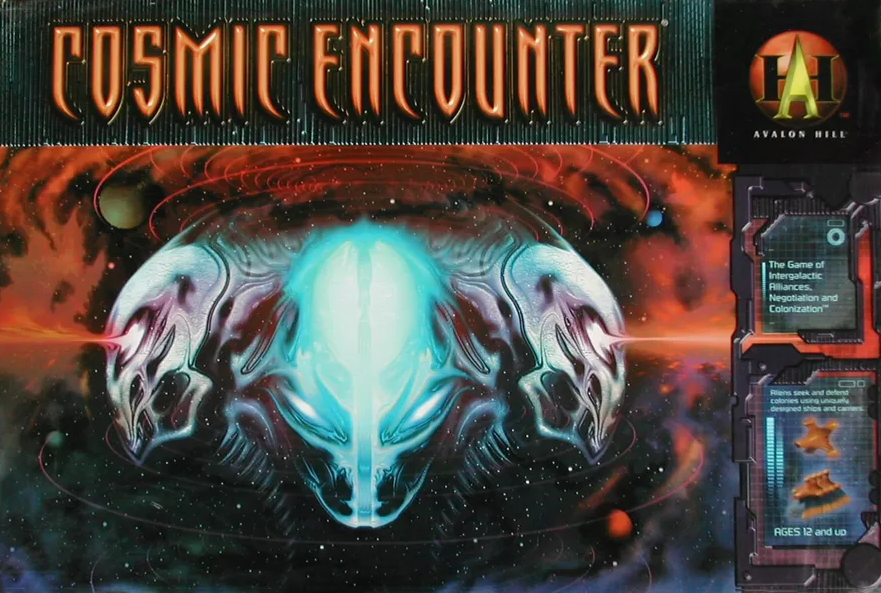
Cosmic Encounters (Avalon Hill)

Originally Published in Games Unplugged – March 2001

The latest release of Cosmic Encounter by Avalon Hill marks roughly the third incarnation of this game (depending on how one counts such things). Originally developed by Eon Games it was subsequently distributed briefly by West End Games and Games Workshop before ending up with Mayfair Games, and then disappearing with that company’s demise a few years back.

Despite its somewhat rocky history, the game has established itself as a classic – arguably the best boardgame ever designed.

The concept: You play an alien race which is attempting to invade the home worlds of the other players and establish colonies there. You do so by sending ships from your homeworlds to attack the homeworlds of other players. You can also ally (and have other players ally with you) during these attacks. The more ships you risk on attacks, the fewer you have to defend your own planets.

The catch: Each alien race has a special power – allowing them to break the rules of the game in a specific fashion. This simple twist gives rise to a complex variety in the strategic and tactical gameplay of Cosmic Encounter – all arising out of a simple, elegant set of rules. Cosmic Encounter is easy to learn, but you will most likely never discover all of its subtleties.

The beauty: This latest version of Cosmic Encounter is simply beautiful. The gameplay, which has always been rock solid, has been coupled with some absolutely gorgeous physical design.

Some reservations: This basic set only supports four players and twenty alien powers (compared with the Mayfair version, which supported six players out of the box and forty-eight alien powers). That being said, Cosmic Encounter has always been a game which invites the possibility of expansion – not just for including more players, but also new aliens, new powers, and new rules. Indeed, the original Eon Games version had nine expansion sets, while the Mayfair Games version had two. Based on my conversations with Peter Olotke and his son at GenCon this year, it is apparent that Avalon Hill has plans to release expansion sets in the future. So keep an eye out for those.

My only other reservation as far as Cosmic Encounter goes is this: There is a large piece of plastic in this game called the Mothership which you use to transport your offensive ships. After some reflection, I concluded that this large piece of plastic is not only unnecessary – it’s cumbersome. You are far better off leaving it in the box and simply using your Carriers – which are designed for carrying your allying ships – for both attacks and allying. Doing so simplified and sped up gameplay in my experience. As complaints go, of course, this one is fairly minor.

The verdict: Cosmic Encounter is a classic, and this version could easily become its greatest incarnation. Whether you’re a new player or old, you should definitely check this one out.

Grade: A+

Authors: Bill Eberle, Jack Kittredge, Bill Norton, and Peter Olotka
Company: Avalon Hill/Hasbro
Price: $40.00

The current edition of Cosmic Encounters is published by Fantasy Flight Games. It remains a classic. I still love the aesthetics of the Avalon Hill edition, although a haze of nostalgia and the memories of many great game nights with friends and family may be coloring that assessment, but there’s little question that the FFG version is superior, including more alien options out of the box, plus a plethora of expansions.

Truth be told, though, I haven’t played Cosmic Encounters in years. I still think it’s a ton of fun, but it seems to be pretty easily get edged out by other options these days.

Spookshow - Aaron Rosenberg

Originally Published in Games Unplugged Webzine – December 27th, 2000

Spookshow is one of those games which has a really great concept – ghosts are real and they’re working as spies – which then utterly fails to develop that concept in any appreciable way.

Adding to its sin, Spookshow seems eerily aware of its limitations: An oversized, double-spaced font dominates the entire presentation. A number of interesting elements which could have taken this sketchy concept and given its real legs are, instead, presented into a section of two paragraph “wouldn’t it be nifty if we’d developed any of these ideas?” grab bags.

In general, I think Spookshow’s overriding problem – of which the pervasive lack of development is merely a symptom – is that it is a sloppy job carried out in a lazy fashion. For example, the game’s system is based around the Bearing mechanic: Each ghostly character is assigned a d6 that represents their mortal nature and a d10 which represents their “ghostly” nature. When entering any new situation, and at the beginning of every round of combat, these dice are rolled for the character to “get their bearings”. So long as neither side is a 1 or a max for that side, you can use both sides without penalty. If both dice roll the same number, then you can only use one side (which you choose). If you roll a maximum number on one die, then that side of you is at a +1 bonus to actions on that side. If you roll a 1 on one of the dice, you can’t use that side. And if you roll a 1 on both dice you freeze up completely.

It’s a good idea… totally screwed up because they didn’t spend three seconds thinking the probabilities through. Instead of fulfilling the stated intention (with the ghostly side having a greater importance because, after all, they’re ghosts), it’s the physical side which dominates the situation. Think it through: 1/6th of the time your physical side is going to be dominant (receiving a +1 bonus); while the supernatural side will only be dominant 1/10th of the time. Plus, its the physical die which has the most impact on almost every other element of this system – from when you freeze up, to when you need to decide on one side or the other, and so forth.

But then they make it even worse: Your Bearings roll is also added as a modifier to your action resolution attempts (creating a confusing situation in which “terrestial” and “noncorporeal” – for some reason they can never settle on just one set of terms to distinguish between the physical and ghostly worlds in the system – tasks have a completely different difficulty scale). You then take the “free die” and roll it (so if you’re doing something noncorporeal you add your ghostly Bearing modifier, and then roll your physical die). This grainy, inconsistent mess again emphasizes the physical existence over the noncorporeal existence.

The designers of Spookshow are also guilty of one of the cardinal sins of game design: They let their game terminology constantly leak over into the game world. For example, all the intelligence organizations in the world – apparently – use the names of the Spookshow archetypes (hitter, hacker, etc.) to describe their agents. They also engage in the unpleasant phenomenon of “needless binding” – in which, for example, all the ghosts who share a similar philosophy also have the same mystic abilities. For example, a Will o’ Wisp is a ghost who believes that the afterlife affords them a chance to visit all the places and do all the things they never could during life. According to Spookshow all Will o’ Wisps have the ability to Levitate (because it “enables them to travel more freely and quickly”). But why couldn’t a ghost with this philosophy develop (or possess) the Morphology ability (which would allow them to easily pass themselves off as a wide variety of different people)? It’s the classic D&D “only thieves can learn how to pick a lock”, without even the excuse of game balance lying behind it. It’s rules for the sake of rules, and restriction where there doesn’t need to be restriction.

Don’t get me wrong, there are some interesting things to be found between these covers: A fairly solid first level primer on the intelligence organizations of the real world. An interesting breakdown of character creation into Relic/Specter/Persona (who you were, what you are, and who you’re pretending to be).

Ultimately, though, Spookshow is a game which should’ve gone in one of two directions: Either all of the non-essential fluff and endless expanses of empty space in this rulebook should have been stripped away to create a tight package that could’ve have marketed around $10; or the current material should’ve been radically expanded to give us something more than “a neat concept which we’ll develop in the supplements”. Unfortunately, Spookshow does neither of these things – and is inexorably trapped in a middle ground of questionable design and nebulous worth.

Grade: C+

Writers: Aaron Rosenberg
Price: $25.00
Page Count: 208
ISBN: 1-892544-10-5
Product Code: CLK0020

This was a strange review to come back and re-read for the first time in twenty-five years.

I suspect my overall assessment of the mechanics and underdeveloped premise were likely correct, but the primary thing I’ve thought about when looking at this book over the years is, “That had a really great primer on intelligence operations!” In fact, there have been numerous occasions when I’ve cracked the cover to review that material. As a result, when I cracked open this file I was honestly expecting to read a positive review and was surprised to find a pretty harsh judgment.

Aaron Rosenberg has gone on to do a lot of great stuff, in both fiction and roleplaying.

I think I should revisit this one. It would also be interesting to compare it now with Night’s Black Agents, which is kind of playing in the same ballpark.

Heavy Gear: Tactical Space Support (Dream Pod 9)

Tactical Space Support is filled with a plethora of high-quality material – including two complete tactical systems – providing a breadth and depth of coverage that make this an invaluable resource for any campaign that gets within spitting distance of orbital velocity.

Review Originally Published in Games Unplugged Webzine – June 16th, 2000
Republished at RPGnet – May 22nd, 2001

The title is Tactical Space Support, but make no mistake: This book provides as much support, if not more, for a roleplayer as it does for a tactical Heavy Gear player.

In the fashion which their fans have become quite accustomed to, the Podsters have crammed more material into this slim, 96-page volume than most publishers include in massively oversized tomes. The short list: A history of space travel in the Heavy Gear universe; campaign background material; coverage of hardware, spacecraft, outposts, and space life; along with a vehicle compendium of specific vehicles – all discussed with a depth of understanding and breadth of coverage that makes this book absolutely invaluable for a Heavy Gear campaign which gets within even spitting distance of orbital velocity.

In addition to all this, roleplayers will find adventure seeds and NPC archetypes, plus expanded rules covering common space hazards — such as lack of atmosphere, effects of gravity, and exposure to radiation. In constructing these rules Vézina, the author, demonstrates what good game design is all about: A wealth of scientific research is boiled down to a set of formulas simple enough to be used at the gaming table, while still bringing with them all the reality you need.

The tactical player, on the other hand, will find two complete tactical systems, along with expansions for the VDS (Vehicle Design System) and additions to the standard Heavy Gear tactical game. Both of the new tactical systems use the core of the Silhouette system, but in a radically different way than a standard tactical game. The first, and primary, space tactical system abstracts the entire process – eliminating hex maps and miniatures altogether. This is due to the nature of space combat in the Heavy Gear universe, where secrecy, stealth, and first strike capability are of key importance. The second system is optimized for simulating a lightning strike combat situation – where two fleets pass each other at extremely high velocities and the entire combat lasts for a few fractions of a second.

Unfortunately, a couple of problems with recent Dream Pod 9 releases also crops up here: Specifically, a continuing fight with typos and copy-editing errors and the decreasing size of the average Pod release (from 112 or 128 pages down to 96 pages over the past year). In the former case, I am happy to report, the battle is obviously being won – Tactical Space Support is (almost) typo-free. The latter, however, makes its presence keenly felt in the total absence of tactical scenarios, and the shallowness of some of the other game-oriented resources (only four adventure seeds and NPC archetypes, for example). These slimmer books are still high quality products, and well worth the price of admission, but those dozen or two dozen pages make all the difference between a product being sublime and merely excellent.

While bearing some reservations in mind, there can still be only one verdict where Tactical Space Support is concerned: This is a fantastic book. If you have any intention of taking your Heavy Gear campaign to the stars, then you’d be making a serious mistake to pass this one up.

Grade: A-

Writers: Marc-Alexandre Vézina
Publisher: Dream Pod 9
Price: $18.95
Page Count: 96
ISBN: 1-896776-68-X

In 2001, I used RPGnet to archive a review which was no longer available on Games Unplugged’s website. Now here I am, finding new ways to archive it and make it available. It seems that much of a writer’s life — and perhaps any artist’s life — is finding new ways to enshrine and distribute their work.

I think I was a little too kind with my grading on this one. Or, rather, I was grading on a curve reflective of the other reviews appearing in Games Unplugged at the time. Proper scenario support feels really essential for novel mechanics/structures like this, and its absence here probably drops the book down to a B in my own grading scheme.

For an explanation of where these reviews came from and why you can no longer find them at RPGNet, click here.

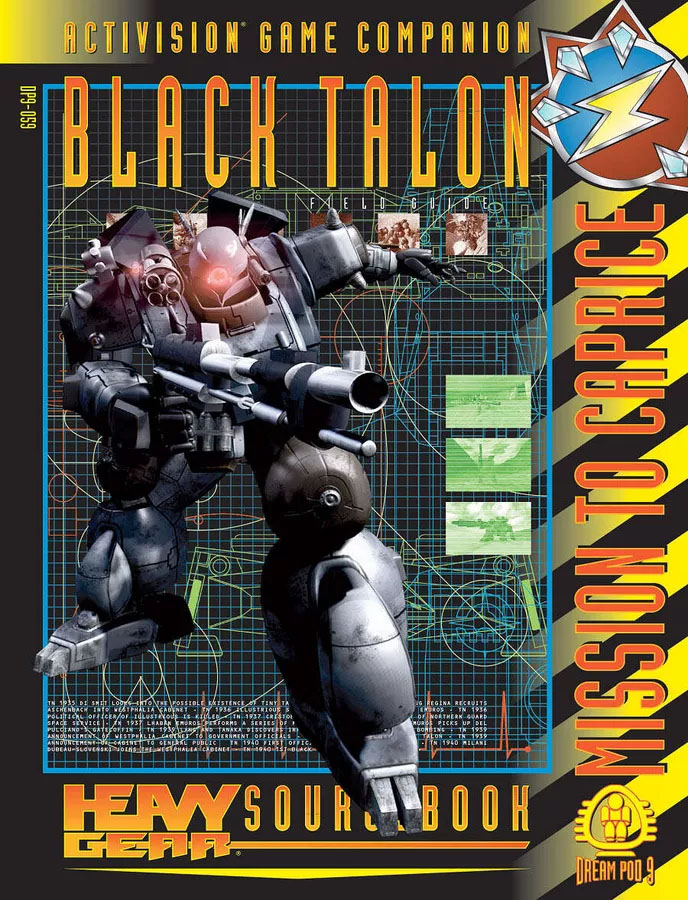
Heavy Gear - Black Talon: Mission to Caprice

Review Originally Published in Games Unplugged (July 2000)
Republished at RPGNet – May 22nd, 2001

Heavy Gear is headed for the stars.

Activision’s Heavy Gear II computer game focuses upon the trial by fire of the 1st Black Talons, the inaugural squadron of a new Terranovan fighting force designed to take the fight against the Terran aggressors back to Caprice. The Black Talon Field Guide, designed as a companion to this game, serves as a massive campaign resource for setting your own Heavy Gear games within the auspices of the expanding Black Talon program, or the wider struggle against Earth as a whole. The book is more than capable of standing on its own, but will be strengthened for some campaigns with the use of Tactical Space Support (detailing specialized rules for space combat) and Life on Caprice (the core sourcebook describing the planet of primary operations for the Black Talon program).

The only serious weakness of this book is a slight confusion over the time period when the material is set – the book is primarily presented as taking place after the events of the Heavy Gear II computer game, but some sections of the book instead seem to slip back to a time period just before the first Black Talon mission was launched. This is combined with numerous instances of copyediting errors and typos, which continue to make their debilitating presence felt in Dream Pod 9 products.

But these minor flaws are far outweighed by the sheer wealth of material which is present here. Some sections of the text will be familiar to veteran Heavy Gear players (but this is to be expected since the book is designed for new players brought to Heavy Gear by the computer game), but even they will be able to wade hip-deep in this one. When you can turn the page of a roleplaying supplement and say, “My god, there’s more?!” you know you’ve got a winner. This one’s a winner.

Grade: A

Writers: Marc-Alexandre Vezina
Publisher: Dream Pod 9
Price: $20.95
Page Count: 128
ISBN: 1-896776-63-9

This review is shorter than my typical reviews because it was written as a non-featured review for Games Unplugged magazine and I was writing for a very specific word count. One of the interesting things about GU reviews is that they would publish short recap versions of the review in subsequent issues, providing a much larger wealth of information in each issue. These recaps were written by the original review authors. Here’s the one I wrote for this review:

Recap: Heavy Gear is headed for the stars. The Black Talon Field Guide, serving as a companion to Activision’s Heavy Gear II computer game, serves as a massive campaign resource for setting your own Heavy Gear campaign within the auspices of the expanding Black Talon program. A sheer wealth of material makes this a highly desirable book for neophytes and veteran players alike.

I found that the recaps were an art in themselves: How to capture the key points in a VERY limited space, while still being a comprehensible to new readers.

Revisiting these older reviews really makes me want to run all the Heavy Gear campaigns I never got a chance to when I was younger.

For an explanation of where these reviews came from and why you can no longer find them at RPGNet, click here.

Archives

Recent Posts

Recent Comments

Copyright © The Alexandrian. All rights reserved.