

B. asks:
I just finished the first session of a new campaign. One of my players pitched a character who was “very strange, but in a charming way.” In the first scene she told the chief of police that his eyes reminded her of her dead mother, then she ran in circles around another NPC, sat down cross-legged on the floor in front of him, and asked what his favorite color was.
Both NPCs reacted poorly. Not hostile. But definitely “I don’t want to talk to this nutjob.” My player then reminded me that, while her character is strange, other people are supposed to find the strangeness charming.
I’m not sure what to do. This PC is a stranger in town and she basically just accosted these people. I had the NPCs react the way that I thought they would naturally react to someone behaving like this.
What should I do? Should I just have NPCs find her antics charming, even if I don’t?
I suspect your player is aiming for what I think of as the “feral weirdo” or “hyper-kooky” archetype, often seen in anime. Examples off the top of my head include:
- Edward from Cowboy Bebop
- Mako from Kill la Kill
- Naruto from Naruto (particularly in the first couple arcs, then he socializes a bit)
- Anya from Spy x Family
Non-anime examples include Anya from Buffy the Vampire Slayer and Luna Lovegood from Harry Potter.
There’s a wide range to these characters and the types of stories they can exist in, but the less comical the tone, the more delicate the balance is.
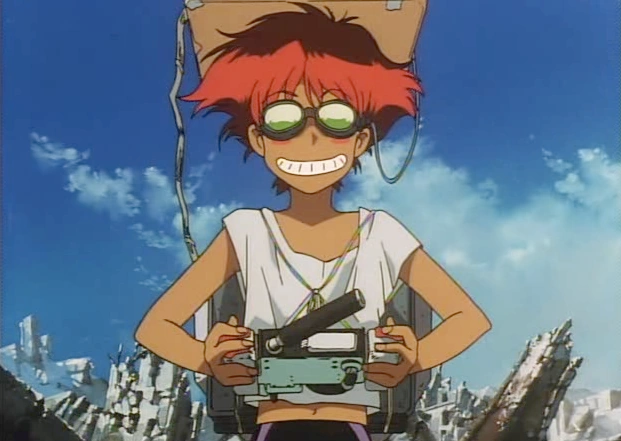
Assuming that this is what your player is aiming for:
If you don’t think this is an archetype you can support at the table, then you need to have a frank discussion with the player. Try to avoid being judgmental. I don’t think this player did anything wrong by aiming for this archetype, but the tonal mismatch between what you’re running and the character they want to play is going to make for a frustrating experience.
If, understanding the archetype, you want to support the player, I think you’ll still need to have a frank discussion with them: Yes, there are people who will find the feral hyper-weirdo charming. But there will also be people (often lots of people) who don’t. Often even people who end up being the hyper-weirdo’s best friends will initially be, “WTF?”
This is a two-way contract: The player needs to make sure that their antics do, in fact, have a charming, whimsical quality to them. The player also needs to accept that not everyone will like them — Luna Lovegood has to interact with Draco Malfoy; Mako with Nanon and Nui; etc. On the other hand, you’ll be promising that there will be characters who DO accept them and find them charming. If you can’t do that, then circle back to, “I can’t support this archetype in this game.”
The more general tip here is, if you don’t understand a character concept or the actions that a player is taking in your game, it can be very useful to cut straight to the point and ask them what their goal is. Using analogies to characters from other mediums isn’t the only way to figure things out, but it can be a very effective way of quickly understanding what the player is aiming for and the types of responses and outcomes they expect their actions to have.










Sometimes the players can be your guide. If they are greatly entertained then go with the flow. If they are just as confused as you are, then I don’t see a big problem with the NPC being confused too.
> Yes, there are people who will find the feral hyper-weirdo charming. But there will also be people (often lots of people) who don’t. Often even people who end up being the hyper-weirdo’s best friends will initially be, “WTF?”
This is important IMHO, notably because there’s nothing that makes a character quirky if everyone finds what they do perfectly normal. Being strange is by definition a step outside of normality so the majority of people should find that behaviour abnormal. That doesn’t mean they have to reject the character or react aggressively of course, but it provides an opportunity into the psychology of the characters: how do they view things that are outside the norm? Do they view them as threats? As things to be fixed? To be embraced?
I do think the player asserting “people find it charming” should be taken into consideration to bridge their expectation with their (maybe) an imperfect roleplay that doesn’t quite manage to be as charming in real life, but it shouldn’t on its own justify most characters of the world finding it endearing or normal IMHO.
Maybe a good question to ask would be what kind of reaction the player expects from the characters? If you’re uncertain of how to manage the situation, that could bring ideas (maybe its own reaction table, formalizing the fact that the character is viewed differently and that people react differently to them?).
I think I’ve always interpreted this Feral Weirdo behavior as being the hallmark of a player who isn’t a particularly gifted wordsmith but really wants to play a fast-talker or savior-faire character who spins words to confuse and distract NPCs into going along with whatever player plan they’ve concocted—the strange behavior and non-sequiturs are just placeholders for, “I’m saying something so confounding that this guard will dissolve in a heap of mental jelly and let me pass.” I’m thankful for this other perspective about an archetype I wasn’t aware of.
You know once you have zeroed in on the concept you can run with a reaction roll for more generic complete stranger NPCs – have the reaction roll be modified by the environment- if the environment is relaxed maybe a modifier in the player’s favor – if its a high stress/dangerous situation the modifier goes against the players favor. So an ally might react fine in a happenstance meeting in a relaxed bar but might react negatively if the pc runs antics during a firefight.
I’ve been watching Leverage lately, so the example that immediately came to my mind was Parker. The comment about the eyes sounds like exactly the sort of thing she would say (if she actually remembered her mother, that is). Other non-anime examples include Mork from Ork, multiple characters from Farscape, and others I know I’ve seen but can’t remember right now.
If that is indeed what the player is going for, it sounds like she’s overlooking the fact that those sorts of characters are meant to be endearing to the audience, not the other characters in the story. Even Parker’s teammates like her in spite of her oddities, not because of them.
Perhaps the OP could suggest to the player that she tone it down. In real life there’s a difference between “quirky” (which many people find charming) and “aggressively weird” (which almost nobody does).
Damn, this is really good advice – thanks!
The player can’t just say, “My character concept is that other people find me charming,” and then wield that as a cudgel against the DM when NPCs react reasonably and realistically to not-charming antics! That’s like a player with a fighter PC saying their character concept is “I’m good at fighting” and then complaining when a battle goes poorly because of their bad tactics. Your PC’s background / character concept isn’t an “I win” button, inside or outside of combat. Players still need to make good choices to get results. That’s the whole point of RPGs!
I would argue that a key element of the feral weirdo archetype is a certain amount of “hyper competency”. Let’s take Ed from Cowboy Bebop as an example. 100% a feral wierdo with no social skills, but they have skills and information that the Bebop’s crew needs to collect their bounty. Theough the episode, it’s clear that the crew is just putting up with Ed and don’t intend to let them join the crew. Ed literallt has to hijack the ship in order to force them to let Ed join. It takes time for the crew to build a relationship beyond tolerance with Ed. In cases where the feral weirdo is an entreched part of a community, the stoey arc usually ends with a reveal that the person has some key skill that the community needed/needs and they got use to them over time. Take Sheldon in the Big Bang Theory. Lenord’s “friendship” with Sheldon is based around the time that Sheldon saved Lenord’s life from a failed experiment. In either case, the hyper competence forces tolerance which them develops into charm. It’s not something that happens with random people that the character doesn’t have a relationship with.
There is potential for a character arc here, but I think it is the kind of thing that should be discussed in a session 0. The feral weirdo’s behaviour can be frustrating and potentially disruptive for other players, so it’s something that the whole group should get buy in on.
I have struggled with a similar question with less wacky characters. Sometimes someone wants to play a cute character or a gregarious character or an authoritative character — less so in DnD, more so if they’re just running with the idea of roleplaying. And I’ve seen and been disappointments when other players/GM have instinctively not accepted the character someone imagined.
And some of that is defined by stats, but a lot isn’t. I usually wing “does everyone in the bar look up when you come in and listen when you talk”, based on character vibe, and only roll when it’s significant. And I think I base that on my view of the character.
My view of the character is naturally based on how the player plays the character, but I’ve been trying to pay attention to what the player wants. Here, I think I’d ask, would it be *fun* if the NPCs treated the PC like a loveable weirdo. If so, I’d roll with it even if it isn’t realistic. If it clashes with the tone of the game, I’d ask the player not to do that.
I’ve also toyed with the idea of giving character building some points to spend towards that sort of intangible stuff. Do you want to be the one people instinctively trust? The one that everyone Just Knows will keep their word? The one people flinch from and don’t cross? Well, actually that’s interesting (and it doesn’t replace charisma). Not literally reputation, because it works like films everyone judges that by body language and vibes even if they don’t know you. Using points not so much to limit people, but to encourage people to choose the demeanours which they want to take advantage of.
There are also lower-key examples, such as L from Death Note, who might play a little better in a game with a more serious tone. Or there’s playing characters where some level of alienness is to be expected in order to be able to get away with a bit more, like playing a sphinx (I’ll note that I’ve had Flamewind from Eberron *sniff* the PCs’ dragonmarks, for example).
Point of order: nobody, in the setting/story of Cowboy Bebop, finds Ed charming. People, including the crew, find her bizarre and frustrating; two or three characters understand that she’s a genius and respect her for it, but they also don’t find her antics charming. At most, they benevolently disregard them. *Otakus* find Ed charming. The reasons for this can be debated and many of the possible explanations are unflattering, to say the least, but whatever cause one wants to adduce for it, the fact is that Ed is canonically just an annoying weirdo.