The Alexandrian

Posts tagged ‘rpgnet reviews’

This is one of my most-requested reviews, largely due to what one reader described as its “transformational” aspect. I very deliberately wrote the review to serve as a resource which would actually improve the quality of the book for those who read it. Given the feedback I’ve gotten over the years, I apparently succeeded at this goal. One reader told me that I had “salvaged” the game for him and that he had gotten a pretty awesome campaign out of it.

Some readers have accused me of somehow “cheating”; or that this sort of critical content is somehow inappropriate for a review. But while I believe that the primary goal of a review is to inform a reader’s decision on whether or not to purchase the product, I was also heavily influenced by the writing of Harlan Ellison and Walter Kerr: Reviews have the ability to be the forum for a more valuable critical discourse.
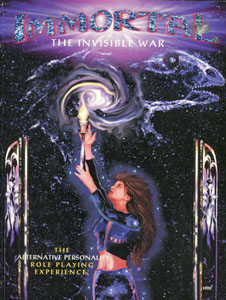
Immortal: The Invisible War - Ran AckelsReviewing this game is one of the most difficult writing tasks one could have — because you, the reader, are almost certain to come away with the wrong impression.

I am going to tell you that the setting for this game seems to be an amalgamation of all the different White Wolf games with a bit of primal myth, a dab of the Illuminatus Trilogy and a touch of the Highlander movies thrown in . . . and you’re going to misunderstand me and think I’m saying the setting is just a cheap rip-off. It isn’t.

I am going to tell you that the rules are beautifully integrated into the world . . . but good luck figuring them out without reading through them a dozen or so times because they are laid out poorly and organized worse. But the rules are excellent, and it will be well worth your effort to root them out.

I am going to tell you that the setting is detailed . . . but is difficult to understand because it appears the designers assumed you were already intimately familiar with it before sitting down to read this book. Yet the setting is so rich, that it is worth working your way around the holes and puzzling through the details.

I am going to tell you that whoever was in charge of editing this book should have his head examined because both setting and rules are almost impossible to follow . . . and you’re going to think I’m telling you not to pick the book up. You definitely should.

The problem is that everything which is bad about Immortal is imminently simple to qualify and explain . . . while everything which is good about it is all too easy to be glanced over and misunderstood.

So, what’s Immortal‘s strengths? Its setting. Its rules. Its attitude. Its potential.

And what are the weaknesses? The lay-out, the organization, and the presentation.

I’m going to split the remainder of this review into three sections: The Problem With this Game, The World, and The Rules. We’re going to deal with the problem first and get it out of the way.

THE PROBLEM WITH THIS GAME

Reading through this book is like trying to learn differential equations while maneuvering through an obstacle course. The principle failing — in my mind — is the poor structure given to the setting. You have a modern world coldly mirrored in the style of White Wolf’s World of Darkness, but which delves even deeper into the primal depths of history and mythology to give depth and character to the world, along with a mix of Illuminatus-style hidden societies and plots within plots within plots, plus a good dash of pseudo-dimensional travel and strange, otherworldly places. Once you’ve given this world a detailed history which extends over 65 million years, you’d think you’d have a setting which was so rich and deep that you’d have material to play campaigns in this place for years to come.

And you’d be right . . . if you can get past the fact that following the material is next to impossible. Like many other games, Immortal drops you into the middle of the world in media res — what the writer apparently forgot, however, was that other games which do this will quickly, after the initial shock of exposure has been played up, explain what the basics of the world are like before delving into ever increasing depth. With Immortal you never get that basic primer, you just keep delving deeper and deeper. The problem is, in fact, made even worse by the fact that the Immortal setting is so incredibly rich — just when you think you’ve finally got the basic architecture down an entirely new level is revealed, more complex the one you just figured out. This effect lasts up to the very end of the book and is much like reading the Illuminatus Trilogy and hoping, after your first read, to have figured out what’s really going on — a trait which is charming in the novels, but slightly upsetting in a game setting which you have to understand in order to run it for your players. You will need to read this book through two or even three times before you finally have more than a verysimplistic , hazy picture of the world.

The problem, when you come to the rules, is even worse. For some unknown reason they blend the rules through a major portion of the book — switching seamlessly between rule and setting. So the rules aren’t all in one place and nicely pulled together. As you try to puzzle out ever-increasing complexity in the game world, you are given the further puzzle of trying to figure out the mechanics as well. The mechanics are sufficiently different from most mechanics which you will be familiar with from other games that you will not catch them all on your first time through. However — just as with the setting — the mechanics are worth your efforts. I suggest, after you have figured them out, constructing a cheat sheet so that you can have them all in one place. (You might even want to do this with the setting — trying to organize the material into a format from which it is easily accessible.)

None of this would be indomitable, of course, if it weren’t for the fact that a very crucial element is missing: An Index. We have all complained about games which lack decent indexes, but Immortal doesn’t have one. At all. “Well,” you think, “I’ll just look at the table of contents, see if I can find it that way.” Not effectively. The book is composed of thirteen very large chapters, plus an appendix — and information is, as I’ve said, spread willy-nilly throughout them. The table of contents gives you only the chapter titles and page numbers.

This game, as I’ve said, has a very rich, deep character to it — which means there is a plethora of alien terms and important individuals. It would be nice to have an easily accessible glossary to refer to (particularly since they have a nasty habit of referring to an individual, term, or historical event dozens or even hundreds of pages before explaining what it is).

They do have a glossary. In fact they have two. One runs sporadically along the bottom of the first 260 pages in alphabetical order. Another runs sporadically along the side of the first 160 pages (with the occasional rule reference thrown in just for kicks) — this one is not in alphabetical order. The two glossaries are generally, but not always, mutually exclusive — which is also unfortunate because while the one along the bottom of the page is direct and to the point, the one along the side of the page generally takes the form of an interesting quote which usually does very little to actually inform you about the term in question.

Have I convinced you that understanding and referencing this game will be an absolute hell on earth? Good. Now let’s move onto the portions of this game which contain sufficient reasons to ignore all the weaknesses discussed so far and buy a copy.

THE WORLD

I am about to explain the game world to you in a very short, very direct, very easily understandable way. In so doing I will have vastly improved the game for when you actually purchase it, because this is the exact sort of basic primer and guideline which is missing from the book. In fact, save this review right now and refer to this portion of it (and the rules portion below) before reading the book itself. It will make much more sense to you. There is much more to the world than what I am describing to you (it is one of the richest game worlds I have encountered), but these are the basics which will help you understand everything else.

There are eleven distinct regions to the Immortal universe: The Habitat, the Crucible, the Dominions, the Blue Air, the Mantles, the Morpheum, Sheol, the Underworld, the Sunedrion, the Ys, and the Maelstrom.

The Crucible is a sphere which surrounds the planet and is also all around us — it is the wellspring from which all the energy of life comes. This energy of life is known as Immaculum and it forms the characteristics of the physical body and mind. The Immaculum of all living creatures is held in a multi-hued Halo around the body. The colors and strengths of the Halo determine the physical and mental characteristics of a living creature — Red is Resolve, Orange is Force, Yellow is Expertise, Green is Movement, Blue is Awareness, and Violet is Resilience.

65 million years ago a creature known as the Sanguinary left or was exiled from the Crucible and came to our world — a place which members of the Perpetual Society refer to as the Habitat. When it did so it shattered into what are known as Conundrum. It did not die, however, and its evil influence continues to infect the Habitat to this day through various Avatars.

Throughout history creatures have — by accident or design — symbiotically joined with the Condundrum. Those that have done so become immortal. The first great immortals were the Abzulim — members of the Saurian species who hunted the other dinosaurs to extinction 62 million years ago.

60 million years ago a great tree reached its roots down into the Crucible and became sentient — it became known as the Sunedrion. Wherever it spread its seedlings and its influence became known as the Dominions, places where the culture of the original Immortals were preserved for millions of years.

Over the ensuing years other species joined with shards of the conundrum, gaining sentience and immortality. A few general details on Immortals are now in order. It is important to note that with this immortality came the ability to change shape — so many of the immortals were originally wolves or spiders or bears or tigers. This primal form — an aspect of the Immortal’s soul — is known as the Himsati, and may be reverted to at times. It is a feral quality and the contamination of the Sanguinary which remains within the Immortals.

Immortals are personified by their Vox — their voice. Silencing an Immortal’s vox by cutting off their head is the only means of slaying am Immortal. But when you slay an immortal, you do not truly destroy them — they, instead, return to the ethereal realm of the Blue Air as Gossamers. Gossamers are ephemeral beings unable to interact with the physical world until they can regain physical form — which they can do by returning or remaining in the Habitat and collecting immaculum.

The Immortals have also perfected a set of rituals known as Serenades. As the rulebook says: “The Abzulim, over millions of years of flourishing and decaying, peered deeply into the crucible, watching the loom upon which the universe was ceaselessly spun.” Common ‘threads’ of the universe were called Attentions, and by manipulating these attentions through the use of serenades exploiting the power of the vox and the immortal’s immaculum, the immortal is capable of changing the world around him. However, the danger in performing a serenade is that you are tampering with the world — and the immaculum which you use to accomplish that tampering become Tainted. This Taint renders the immaculum unusable in the Habitat until it can be removed or the affected immaculum expunged from the immortal. The Taint is the evil touch of the Sanguinary, and through it the Sanguinary gains control over the Immortal and is capable of reducing them to the Himsati form.

Immortal society is organized into various Prides — each Pride consisting of a similar belief system.

Twilights (the Immortal term for mortals) have an ability known as Religarum — the superstition and/or belief of the mortal made tangible, it gives the Twilight the ability to physically alter Immortals through unconscious or deliberate choice, making use of the mortal’s lust, fear, belief, or need.

Finally, Immortals also have a rite known as Lethe — by which they forget their previous existence and assume the guise of mortality. Each time they enter Lethe, however, they are essentially splintering their personality — and each personality can never be completely removed thereafter, becoming subconscious avatars to which the current intellect of the Immortal can temporarily grant or control . . . or even completely lose control to.

The Abzulim immortals raised a great society, but they came into conflict with the Primals — immortals who were not born of the symbiosis of conundrum and animal, but the symbiosis of conundrum and the elemental matter which makes up the Maelstrom. The supremacy of the Abzulim finally came to an end in a great war 7 million years ago.

A final element of the ancient Immortal cosmology are the Trine. Like the Sanguinary, the Trine are three creatures called forth from the Crucible — this time by members of the Immortal pride known as the Anopheles. The Trine are three creatures: The Leviathan, the Dracul, and the Rukshasa.

In 400,000 BC a millenia-long plot of the Sanguinary came to conclusion. For aeons the Sanguinary had been acting through his mortal and immortal subjects to cut down the Sunedrion and transform its sap into what came to be known as the Malice Shard. Pride Anopheles rode against the Sanguinary’s forces and destroyed the Malice shard — but in so doing they separated the twin worlds of the Habitat and the Dominion, setting the realms of the Dominion adrift within the Blue Air. The great Immortal societies of primeval history came to an end at this time.

Then, in 320,000 BC, Humans managed to destroy the Red Shard — the shard of the conundrum which still contained the heart of the Sanguinary consciousness. The Sanguinary narrowly avoided destruction by fleeing into the Morpheum — the land of dreams. Mortals enter the Morpheum whenever they enter REM sleep, and have hence — in the eyes of the immortals — subjected themselves to influence from the Sanguinary which makes them potentially dangerous allies. To Immortals, dreaming and entering the Morpheum is an intense pleasure, but a pleasure now denied to them because of the subjection to which the Sanguinary can curse them if they enter the Morpheum untrained.

In 65,200 BC, a conflict known as the Shouting War broke out throughout the Dominions. A plague known as the Lash was born of the taints incurred by the massive use of serenades during this conflict. In 50,000 BC, the Lash reached its peak, destroying and desolating the Dominions and sending Immortals fleeing into the Habitat. In 10,200 BC, the Shouting War comes to an end as Pride Nimrod emerges supreme above the other prides, locking them with Sheol — a dark place where the Sanguinary first came to our universe.

During this time two more important events take place: The emergence of the second avatar of the Sanguinary (the Dust), and the emergence of the Apocrypha and Quiet Culture.

The Apocrypha were a group of mortals initiated to the knowledge of the Immortal world by Pride Magdalen. Breaking free from Magdalen control they committed themselves to the absolute destruction of Immortals within the Habitat. Another group almost immediately broke off from the Apocrypha, however. Known as the Quiet Culture they, too, know of the Immortal world; but instead of trying to destroy it, they seek to aid and even worship Immortals.

In 7000 BC, Pride Banjax escaped from the prison of Sheol and freed the other prides imprisoned there. Within another thousand years, however, conflict between the prides was again on the rise — and a new society was brought into being. Powerful Immortals known only as the Jury imposed a structure known as the Stratagem upon Immortal life — instead of actively killing other immortals, and hence risking Taint and strengthening the Sanguinary, the Stratagem calls for “calling coup” upon other Immortals and other Prides. The pride who wins the most respect under the rules of the Stratagem and in the judgment of the Jury will be the pride to lead all Immortals when the day comes to lead the attack against the Sanguinary. Part of this is the Silence — an imposition to never use serenades in a manner which draws the attention of the Sanguinary. Having established the Stratagem, the Jury withdrew into the Dominions — places where other Immortals rarely go willingly.

In 5900 BC a period known as the Mingling began. Immortals went to Atlantis — a society founded by the Immortal Solitaire — and lived in peace and tranquility with one another. In 4735 BC, however, Atlantis was destroyed and Solitaire assassinated. “Disillusioned, Immortals filtered back into the Habitat.”

The pace of things begins to pick up in the modern world, and I am going to skip over many details. In 1666 AD, however, the Dust is cornered in London and the Great Fire is started in order to destroy it. This effort is successful.

Shortly thereafter a period in Immortal history began which came to be known as the Exodus — extending from 1666 to the present day, it’s a time when thousands upon thousands of Immortals entered the state of Lethe. Pride Magdalen is suspected of initiating this movement, but no one is sure.

In 1925 AD the third avatar of the Sanguinary — the Silhouette — appears. In 1990 AD the Femme Darkle — an artifact containing pieces of the Malice Shard — is stolen, initiating the Invisible War. It is believed the final days of judgment for the Immortal race are approaching, when one pride shall emerge as a leader to destroy the Sanguinary forces . . . or be destroyed by them.

In 1994 (the year the game was published), the Exodus came to an end. Immortals awakened from Lethe and re-entered the Perpetual society. It was the beginning of the Waking Age.

This information is the barest glimmerings of the full picture of the Immortal universe. Some of you have probably already noticed I have completely glanced over the realms of Ys (the world under the oceans), the Mantles (areas hidden from mortal eyes which preserve the world of the past as if it still existed today, maintained by the long-lived children of mortal and immortal unions), or the Underworld (a hidden world beneath the surface of our own) — but these are all fascinating places in their own respects. I have not discussed the origins of the prides — although some of these are fascinating and amazing. I have barely scratched the surface, and will not be able to tell you more here. As I have said before, this world is a rich tapestry which I encourage you to experience.

THE RULES

The rules of Immortal clearly demonstrate why rules specifically tailored to a particular setting will outshine any of the generic rules currently on the market. A well-constructed set of rules for a setting creates the feel of the universe for those playing it. Rolling dice is hardly the same thing as performing stunning martial arts maneuvers – yet that’s the feel the Feng Shui system manages to convey. Similarly, comparing attributes is hardly the same thing as the careful interplay of rapiers – yet that’s what Amber accomplishes.

Creating a character who has lived for centuries and is now just realizing that fact is not the same thing as actually being a person who has lived for centuries – but that’s what Immortal does successfully.

Ironically the exceptional rule design of Immortal, when combined with the poor layout of the entire product, only adds to your feeling of confusion and muddiness. You can be reading what you think to be a section of the book dealing with the background of the world, only to suddenly discover that these are actually rules. It would be a refreshing change from many games, where you feel as if they got together and designed the setting, and then designed the rules separately and in a complete vacuum – hoping that somehow the two would magically come together like Peter Pan and his shadow – except for the fact that due to poor layout this effect is lost to general frustration as you try to figure out what the hell you’re reading.

Character creation in Immortal takes place under an absolutely fabulous point-based system. I know I’ve used the word a lot in this review, but it bears using once more: Ironically, the points themselves are the only really questionable portion of the Immortal rule system. The character creation rules assume that the PCs are characters who are just emerging from the state of lethe and the character creation points are therefore referred to as MEMORY POINTS – with the idea being that as you spend them your character is “remembering” skills and abilities from their previous existence. This mechanic has a very good feel to it . . . what it desperately needs, however, is a complementary set of points in order to represent the learning of new skills (if my character went into lethe back in 1672, I’m not going to “remember” my skill at computer programming). Despite this slight conceptual jar, the system itself works just fine – you can purchase computer programming with memory points just as easily as swordfighting.

Remember our discussion of immaculum and halos back in the world description? How immaculum in the halo created the physical and mental traits of an individual? Red was resolve, orange was force, yellow expertise, green movement, blue awareness, and violet resilience. It should come as no surprise that setting the attributes of a character in Immortal is a process of assigning IMMACULUM to each of the six colors in a character’s HALO.

Units in Immortal are referred to as MOTES. Motes are “attributed to memory, immaculum, or other aspects of the mechanics” and, conceptually, “are visible in the halo of an immortal as revolving sparks of colored light.” This is exactly what I’m talking about – if there’s a rule in immortal nine times out of ten it means that there’s a world-equivalent reason for its existence. With the exception of dice rolling itself, nothing is there as a simple abstract quantification.

There are two types of immaculum motes in a character’s halo – FORTE are motes which are fixed to a particular color/attribute, FREE IMMACULUM are motes which can be freely exchanged between halo colors to augment various abilities. Of course free immaculum costs more memory points to purchase, and creates a more powerful and versatile character. All characters start off with 15 points of forte in their halo, which can be assigned to any of the six halo colors/attributes.

TALENTS are the learned abilities of characters, and are – similarly – purchased through memory points.

The resolution mechanic of the Immortal system, however, is truly fantastic, in my opinion. It uses nine different colors of ten-sided dice: Six for each of the colors in a character’s halo (red, orange, yellow, green, blue, and violet) as well as three more (black, gray, and white) for a special type of serenade. Ignoring the black, gray, and white dice because this summary is not going to attempt to look at serenades, let’s take a closer look at how these dice are used.

Each color die represents one set of HOSTILES. The idea is basically familiar to most roleplayers. Given a standard set of average circumstances a character will generally succeed automatically, but when complications arise in the environment or someone else is resisting the attempted action DIFFICULTIES arise, and these difficulties are quantified as numbers which negatively affect the dice rolls used to determine success or failure. The difference between Immortal and other systems is that these difficulties are assigned to one of the HOSTILES – for example, if a thick fog is responsible for the GM assigning a difficulty to a task that difficulty would be assigned to the Blue hostile since it would be impairing the character’s Awareness.

Once all the difficulties for an action have been assigned to hostiles, the hostiles which have difficulties assigned to them are rolled. Add to the result of each of these the number of immaculum motes assigned to the applicable color in the character’s halo (both forte and free immaculum which has been assigned) as well as the applicable talent for the action being accomplished. The resulting total on all the hostiles must exceed the difficulty assigned to that hostile, or the action will fail.

In short, from character creation through action resolution this system has been designed to not only make playing in the world possible, but to evoke the feeling of living in that world. This masterful set of mechanics is marred by the poor layout, over analyzation, and general lack of clarity with which they are presented – but it is worth stripping away the mistakes of this presentation in order to find the core construct underlying it.

CONCLUSION

If there was ever a game which desperately cried out for a second edition, this is it. The world of Immortal is a rich tapestry which has been badly woven. Its rules are an elegant construction, which has been shoddily put together. Nonetheless, if you are willing to reweave the tapestry and repair the construct — you will be blessed with an exciting, deep, rich world and a set of rules which complement it perfectly. I heartily suggest the purchase of this book.

Style: 2 (Needs Work)
Substance: 5 (Excellent!)

Author: Ran Ackels
Company/Publisher: Precedence Publishing
Cost: $24.95
Page count: 296
ISBN: 1-885681-00-3
Originally Posted: 05/01/98

A second edition of the game — Immortal Millennium — was published in 1999. It didn’t fix the problems. Worse yet, it was split into four books which were never actually published in their entirety (as far as I know). In 2008, apparently, a third edition was attempted. It, too, was incomplete.
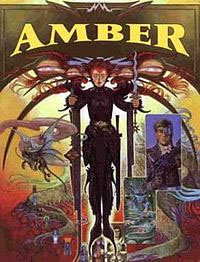
Like my review of The Paxton Gambit, this review was also posted to the Amber DRPG mailing list. What I can’t remember is whether I originally wrote it for the mailing list and then recycled it later for use on RPGNet (as I had done with the Paxton Gambit review), or if I wrote it for RPGNet and then posted it simultaneously to the mailing list. I guess we can add that to column of Mysteries Nobody Actually Cares About.

Amber Diceless Roleplaying Game - Erick WujcikAmber: The Diceless Role-Playing Game (ADRPG), based on the series of novels by Roger Zelazny, was the first diceless RPG. While some games may claim to be “diceless” role-playing and actually cop out and use cards or coins or a stopwatch to resolve actions, Amber truly is diceless: the only thing determining whether or not the actions of the players succeed is the GM.

What this means of course, is that the players have to trust their GM — in who final authority lies. Any group who has an antagonistic relationship will not have any fun.

Player: I punch him in the face!

GM: You missed. He whips out his gun and shoots you. You’re dead.

The game also requires — in my experience — GMs and players who have a bit of poetry and storytelling blood in their veins. If you play RPGs in order to fight badguys, then dice provide a neutral challenge to the situation — if you play such a scenario in Amber you know that your GM probably won’t kill you, and if he does you’re going to feel bad about it. (Although this doesn’t mean you can’t die in ADRPG. If it serves the story and everyone is mature enough to handle it, it’s fully capable of happening.) Nor is Amber particularly good for those who play RPGs in an attempt to accurately simulate reality — reality is random, and dice introduce that element to the game.

No, Amber is designed solely for the storytellers.

The system is a good one for what it attempts to do — simulate the environment of the Chronicles of Amber by Roger Zelazny. Everything is based off of four attributes — Strength, Endurance, Warfare, and Psyche. Strength is a measure of both physical power and skill in unarmed combat. Endurance is a measure of how long a character can do things before collapsing. Warfare is a measure of a character’s armed combat and tactical skill. Psyche is a measure of a person’s psychic ability and mental acuity. While for some situations this would seem to be a gross and inefficient generalization, for Amber characters it actually works perfectly.

These attributes are purchased through an “auction” — all players start the game with 100 points to build their characters with. During the first phase of character creation they bid, with the GM as auctioneer, for their ranks in the four attributes. Those who bid highest get 1st rank and the best ability. Those who don’t bid at all get “Amber” rank in the attribute — meaning you’ll trounce any mortal who comes wandering along without any effort whatsoever. After the auction you are able to purchase up by spending points equal to those who bid for actual ranks, although you will never be as good as the people who actually bid for those ranks (if you spend as many points as the person who claimed first rank, for example, you are actually rank “1.5”). To get more points you can lower your attributes to Chaos rank (-10 points) or Human rank (-25 points). There is also an alternate system for simply spending points on the various attributes and skipping the auction — but the auction is actually quite a bit of fun, and, in fact, once again creates the feel of the Amber universe quite effectively.

Skills? As Wujcik says, Amberites live so long they can be skilled in anything they like. Plus, due to the realities of shadow, if you aren’t skilled in something you can jump to a shadow where time runs much faster, train for a decade, come back the next day local time and hit the ground running. How do you build a skill system to represent that? Answer: you don’t. As long as its consistent with your character background, you can do anything like a pro.

So, besides attributes, what else can you spend points on? Well, there’s the powers. Pattern Imprint, Logrus Mastery, Trump Artist, Sorcery, Conjuration, Power Words. Everything from both the first and second series of books, plus a few extra things. You can also spend points on creatures and artifacts — things with similar abilities to Corwin’s sword Greyswandir or the horse of Julian in the books.

And the system for resolving actions? The GM looks at the character’s attributes and determines if he’s skilled enough or strong enough to accomplish the task. What about when two characters go head-to-head? Compare the attributes of the two characters in question. Equal? They’ll fight to a standstill. Little different? It’ll be a long, drawn out conflict. Big difference? It’s going to be short.

Although I make light, the system is — in fact — extremely elegant. As I said before this is a game for storytellers and when the GM is looking at an attribute to see if the character is capable, more often than not he is also asking the question: “Will it make for a good story?” The system really shines in combat, and the book goes into extensive details on how to run it. The chosen attributes play off each other with amazing alacrity. You may be better at swordplay than the other person (Warfare), but if they’ve got a better Strength then they can always try to close within fighting distance — unless you’ve got a significantly better Warfare, in which case you can avoid their attempt to grapple with you. If you’re both fairly even in your skill, then the person who can last longer (Endurance) is going to take the day. Psychic attacks, of course, can always figure in as well — and since you need to be in physical contact to make those work, they balance with the other attributes as well. Add in the powers and you have an exquisite interplay of elements which means that success is in more than just the numbers — the tactics you choose to employ become as crucial to your success as the size your attributes.

The game has two serious weaknesses, however, which mar its perfection:

First, despite the fact that the overall system is perfectly matched to its source material, some of the details fall flat. It is a well-reputed fact that the power systems as the game describes them raises the eyebrows of readers of the books — “Where did Eric Wujcik get that from?” You can play the game quite happily with what is there, however, so this is not a serious problem — particularly since there are highly-detailed alternatives to this system sprinkled across the web. Since Amber is a very freeform RPG it is also very easy to simply say: “Describe what you want to do, and I’ll assign a point cost for it.” No stats means that all you need is an idea and a description.

The other problem, I think, actually springs from that freeform quality of the system. It’s not well laid out and the presentation is inferior to other games on the market today. Fortunately the system is so simple that working around the lay-out isn’t a serious problem — you can literally read through the book once and have all the major rules memorized without any effort whatsoever. Only some of the specifics of the powers get more complicated.

In addition to all this, the book also provides stats for all the main characters from the First Chronicles of Amber and a plethora of ideas for campaigns, plus a handful of more fully developed scenarios to put your players through.

To sum it up: The central system is fantastic, and is probably the best adaptation of a specific work I’ve seen in RPGs (with the possible exception of the Star Wars RPG from West End Games). The power system, like the central system, is well balanced and works perfectly — but it falls down in the adaptation department. The entire game suffers from a poor lay-out, but there’s a lot of raw material in there.

Definitely worth the $23 if you’re at all interested in either the works of Roger Zelazny or in seeing a marvelous piece of system design.

Style: 3 (Average)
Substance: 4 (Meaty)

Author: Eric Wujcik
Company/Publisher: Phage Press
Cost: $22.95
Page count: 255
ISBN: 1-880494-00-0
Originally Posted: 04/20/98

Amber: The Diceless Role-Playing Game (ADRPG), based on the series of novels by Roger Zelazny, was the first diceless RPG. While some games may claim to be “diceless” role-playing and actually cop out and use cards or coins or a stopwatch to resolve actions, Amber truly is diceless: the only thing determining whether or not the actions of the players succeed is the GM.

What this means of course, is that the players have to trust their GM — in who final authority lies. Any group who has an antagonistic relationship will not have any fun.

Player: I punch him in the face!

GM: You missed. He whips out his gun and shoots you. You’re dead.

The game also requires — in my experience — GMs and players who have a bit of poetry and storytelling blood in their veins. If you play RPGs in order to fight badguys, then dice provide a neutral challenge to the situation — if you play such a scenario in Amber you know that your GM probably won’t kill you, and if he does you’re going to feel bad about it. (Although this doesn’t mean you can’t die in ADRPG. If it serves the story and everyone is mature enough to handle it, it’s fully capable of happening.) Nor is Amber particularly good for those who play RPGs in an attempt to accurately simulate reality — reality is random, and dice introduce that element to the game.

No, Amber is designed solely for the storytellers.

The system is a good one for what it attempts to do — simulate the environment of the Chronicles of Amber by Roger Zelazny. Everything is based off of four attributes — Strength, Endurance, Warfare, and Psyche. Strength is a measure of both physical power and skill in unarmed combat. Endurance is a measure of how long a character can do things before collapsing. Warfare is a measure of a character’s armed combat and tactical skill. Psyche is a measure of a person’s psychic ability and mental acuity. While for some situations this would seem to be a gross and inefficient generalization, for Amber characters it actually works perfectly.

These attributes are purchased through an “auction” — all players start the game with 100 points to build their characters with. During the first phase of character creation they bid, with the GM as auctioneer, for their ranks in the four attributes. Those who bid highest get 1st rank and the best ability. Those who don’t bid at all get “Amber” rank in the attribute — meaning you’ll trounce any mortal who comes wandering along without any effort whatsoever. After the auction you are able to purchase up by spending points equal to those who bid for actual ranks, although you will never be as good as the people who actually bid for those ranks (if you spend as many points as the person who claimed first rank, for example, you are actually rank “1.5”). To get more points you can lower your attributes to Chaos rank (-10 points) or Human rank (-25 points). There is also an alternate system for simply spending points on the various attributes and skipping the auction — but the auction is actually quite a bit of fun, and, in fact, once again creates the feel of the Amber universe quite effectively.

Skills? As Wujcik says, Amberites live so long they can be skilled in anything they like. Plus, due to the realities of shadow, if you aren’t skilled in something you jump to a shadow where time runs much faster, train for a decade, come back the next day local time and hit the ground running. How do you build a skill system to represent that? Answer: you don’t. As long as its consistent with your character background, you can do anything like a pro.

So, besides attributes, what else can you spend points on? Well, there’s the powers. Pattern Imprint, Logrus Mastery, Trump Artist, Sorcery, Conjuration, Power Words. Everything from both the first and second series of books, plus a few extra things. You can also spend points on creatures and artifacts — things with similar abilities to Corwin’s sword Greyswandir or the horse of Julian in the books.

And the system for resolving actions? The GM looks at the character’s attributes and determines if he’s skilled enough or strong enough to accomplish the task. What about when two characters go head-to-head? Compare the attributes of the two characters in question. Equal? They’ll fight to a standstill. Little different? It’ll be a long, drawn out conflict. Big difference? It’s going to be short.

Although I make light, the system is — in fact — extremely elegant. As I said before this is a game for storytellers and when the GM is looking at an attribute to see if the character is capable, more often than not he is also asking the question: “Will it make for a good story?” The system really shines in combat, and the book goes into extensive details on how to run it. The chosen attributes play off each other with amazing alacrity. You may be better at swordplay than the other person (Warfare), but if they’ve got a better Strength then they can always try to close within fighting distance — unless you’ve got a significantly better Warfare, in which case you can avoid their attempt to grapple with you. If you’re both fairly even in your skill, then the person who can last longer (Endurance) is going to take the day. Psychic attacks, of course, can always figure in as well — and since you need to be in physical contact to make those work, they balance with the other attributes as well. Add in the powers and you have an exquisite interplay of elements which means that success is in more than just the numbers — the tactics you choose to employ become as crucial to your success as the size your attributes.

The game has two serious weaknesses, however, which mar its perfection:

First, despite the fact that the overall system is perfectly matched to its source material, some of the details fall flat. It is a well-reputed fact that the power systems as the game describes them raises the eyebrows of readers of the books — “Where did Eric Wujcik *get* that from?” You can play the game quite happily with what is there, however, so this is not a serious problem — particularly since there are highly-detailed alternatives to this system sprinkled across the web. Since Amber is a very freeform RPG it is also very easy to simply say: “Describe what you want to do, and I’ll assign a point cost for it.” No stats means that all you need is an idea and a description.

The other problem, I think, actually springs from that freeform quality of the system. It’s not well laid out and the presentation is inferior to other games on the market today. Fortunately the system is so simple that working around the lay-out isn’t a serious problem — you can literally read through the book once and have all the major rules memorized without any effort whatsoever. Only some of the specifics of the powers get more complicated.

In addition to all this, the book also provides stats for all the main characters from the First Chronicles of Amber and a plethora of ideas for campaigns, plus a handful of more fully developed scenarios to put your players through.

To sum it up: The central system is fantastic, and is probably the best adaptation of a specific work I’ve seen in RPGs (with the possible exception of the Star Wars RPG from West End Games). The power system, like the central system, is well balanced and works perfectly — but it falls down in the adaptation department. The entire game suffers from a poor lay-out, but there’s a lot of raw material in there.

Definitely worth the $23 if you’re at all interested in either the works of Roger Zelazny or in seeing a marvelous piece of system design.

After posting my review of The Paxton Gambit, this was the first review I wrote explicitly for RPGNet in 1998.

White Wolf had been trying to get a science fiction game published for awhile. Mark Rein*Hagen had spent a couple of years developing Exile, and when Aeon was first announced there was wide speculation that it was going to be a heavily retooled version of the same. It wasn’t.

Adding to the confusion, the owners of Aeon Flux sent a cease and desist order to White Wolf — apparently claiming a wide ownership of the name “Aeon” when used to describe any science fiction setting. So the game was retitled Trinity, but not before the initial, limited edition of the game had already shipped.

This edition of the game featured a hard shell of black plastic protecting a ring-bound document. This was controversial, but even years later I’m a fan. Unlike normal ring-binding, this was attractive and durable. But like normal ring-binding, it allowed the book to easily lay flat for easy reference during game sessions.

(What isn’t controversial is that the replacement edition — using a cheap cardboard shell and titled Trinity — was dreadful. Several years later, however, a great little softcover edition of the game was issued.)

Aeon TrinityI picked up the limited edition of the Aeon game (now known as Trinity) for four reasons:

(1) I had been hearing about it and I knew it was going to be a major release. I try to stay on top of major releases so that I have my finger on the pulse of the gaming industry.

(2) Whatever else might be said about White Wolf games, I have always been able to rely on them for fantastic settings.

(3) I heard they had done some fix-up work on their Storyteller system — since I’ve always felt the system to be a good one at heart, despite some serious flaws, I wanted to see if they had finally fixed the problems with it.

(4) That black folder-flap design was just so sexy, you had to buy it.

So how does it stand up after my first read-through?

First, Trinity (the Game Formerly Known As Aeon) is definitely a major release and — with the recent death of the new Traveller game — has every chance of being the science fiction game for the next few years to come. I have no confidence in what I’ve seen of the Alternity game coming from TSR in the near future, and the only other strong contenders in the market right now would be Heavy Gear and Jovian Chronicles from Dream Pod 9 — both games which I feel fit better into the genre of “mecha games” than the genre of “science fiction games”. The graphical lay-out of the piece is the best I’ve seen from White Wolf, which is saying quite a bit given White Wolf’s history of strong graphical releases.

The setting, as is typical for White Wolf games, comes first — before the rules. It is told in the form of a “press release” or “official history” told from the perspective of the Aeon Trinity organization. The Aeon Trinity is a benign conspiracy of sorts which got its start in the early 20th century with a mission statement of helping guide humanity towards Unity (the first of three words which you’ll see on all of the Trinity ads). In the near future humans with bizarre psychic powers appear — these Aberrants get their powers from a tumorous growth in their brains referred to as the Mazarin-Rashoud node (after the scientists who discovered and explored it). Unfortunately this node also had the effect of slowly, over time, driving all of the Aberrants malevolently insane. The Aberrant War which ensued tore the world apart — destroying much of North America and Europe — until China threatened to destroy the planet from orbital nuclear stations unless the Aberrants left. Members of the Aeon Trinity left with them, in a supreme Sacrifice (the second of those three words) to help preserve mankind. China then, for reasons unknown, relinquished the incredible amount of power they had over the world.

The world then proceeded to rebuild itself. A few years ago people known only as Proxies appeared, and through an electrochemical process awakened the latent psi powers of mankind a second time. With the aid of the Aeon Trinity they revealed themselves to the world as benevolent helpers. The in the pseudo-science of the game, psi powers work by the manipulation of a previously undiscovered sub-atomic force particle named a “psion”. Due to the idiocy of the public the name of the force particle was extended to the psychic humans themselves and, along with several other nicknames, psions become the moniker of these new psychics.

With the aid of the psions specializing in teleportation mankind began to reach out into deep space — and made contact with their first alien species, the Qin.

A sidenote here: The treatment of aliens in Trinity is some of the best in RPGs to date. They aren’t just humans in fancy costumes, they think and behave differently than we do.

Then the Aberrants came back — and in a particularly vicious assault on an orbiting Earth station sent it crashing into France, destroying much of that country. Simultaneously with this assault the teleporters disappeared, cutting Earth off from its deep space settlements.

Now, a few years later, the first in a line of jumpships capable of interstellar travel without the aid of the teleporters is coming on-line. It’s time to take the fight back to the Aberrants with the aid of the psions — more limited in their power than the Aberrants, but capable of teamwork. The psions have given mankind Hope (and there’s the last of the three words).

Add to this the Chromatics, an apparently hostile race who appeared on the edges of human explored space just before the teleporters appeared, and the Coalition — a group of aliens who mysteriously attacked an Earth ship just as the game begins — and you’ve got an action packed game. And we haven’t even gotten into all the Earthside conflicts in the setting.

Unfortunately, there are a few problems. First, the book tells us almost nothing about what the Aberrants have been up to since their disappearance. This is all right since we can just have a few periphereal attacks until supplements telling us more come out so that we can take the fight to their own worlds, but far more egregious is the oversight of telling us what happened to the colony worlds in our years of absence. When a major plot of the game is supposedly “taking the fight back out there” it’s a little difficult to do that when we don’t know what it’s like out there — have our colonies all been destroyed? Are only some of them destroyed? Which ones?

Then we come to the Coalition. Literally the only thing we are told about them is that there has been contact between them and one of our ships, our ship was destroyed, and we don’t know anything else about them. Well, I guess I won’t be using them in any games until I’ve spent another $20 on a supplement to find out who the hell they are.

Nor are we told who the Proxies really are — which wouldn’t be so bad, but we aren’t told what their plans are. We are told again and agian of the “great plans” of the Proxies, yet we are never told what they are or given enough information about the Proxies to guess what they might be.

Only the Chromatics are usable as-is, but we don’t know much about them — so don’t use them too much.

Also, the psion “orders” are organized by both function and the predominant type of psion power found in them. This makes little sense — since one of the main things touted over and over again is the way different psions cooperate, the orders should be defined purely as functions, not functions and powers. The function of one order, for example, is to take the fight out to the Aberrants — yet there is only one type of psi power present in the order? This makes little sense.

So the setting is good, there’s just some fairly major holes left in it. Cliffhangers are good in fiction, and they can also be good in RPGs (witness the Heavy Gear game) — however, when everything important to the game is an unexplained cliffhanger I have some problems.

Which brings us to the system. If you’ve never had any problems with the Storyteller system before, this game will pose no problem. The Psi powers are nicely built into the game, although you may find them a little limiting in places due to the fact that you are railroaded along once you’ve selected your development paths.

If you’ve had problems with previous versions of the Storyteller system, this might be a good time to revisit it. In the original Storyteller system the most egregious problem was the fact that, above certain difficulty levels, the chance for you to botch on any given roll began to increase as your skill increased. To changes have been instituted in this new system to eliminate this problem. First, the target number is no longer variable and remains a stationary 7. Second, the “Rule of One” has been altered.

Another significant changes comes in the combat system, where a system of “Lethal damage” has been added — damage which cannot be soaked. This makes guns far more deadly in Trinity than they have been previously.

While both these changes fix a few problems which have been raised about Storyteller systems in the past, they do not fix them all (the probability curve is still more difficult to predict than your more traditional sytems). Nor do they change the basic aesthetic feel of the game. If you have a problem adding an attribute and a stat together based on the situation in question — or with rolling a fistful of d10s and counting successes — then you’re still not going to like the Storyteller system.

And what about that black cover? Well, it’s sexy and it’s cool. I don’t know if that still holds true for the new cover on the regular version of the game though.

So, to sum up:

The setting is great — if you don’t mind buying supplements. Otherwise you’re going to be left creating a lot of stuff from scratch and — worse yet — finding yourself incompatible with future releases when they do come out. About the only serious problem is the dual-definition of orders as both power-type and function — I would suggest GMs just quietly ignore one or the other and move on.

The system — while fixing many problems — is still the Storyteller system. If you’ve played the World of Darkness games you’re learning curve will not be steep, nor do I think you’ll find any of the changes to the rules harmful (although if you like non-deadly combat you might want to take those lethal damage rules back out again). If you simply dislike the idea of rolling many dice and counting successes — or the idea of finding both the most appropriate skill and attribute — you’re going to have to find something else to play the game with, or simply pass it over.

Overall, I would suggest buying this game. It’s a strong product. It does have its weak points however, and you might be advised to hold off for awhile until White Wolf’s supplements fill in some of those gaps.

Style: 5 (Excellent!)
Substance: 4 (Meaty)

Author: Andrew Bates and Ken Cliffe (Developers)
Category: game
Company/Publisher: White Wolf
Cost: $30.00
Page count: 320
ISBN: 1-56504-757-5
Originally Posted: 04/18/98

This review was cited by White Wolf developers as one of the factors that led to them revising the rulebook when it was re-released to include the key setting information necessary to run the game.

On a personal level, it played a major role in shaping my own personal theories on how roleplaying game lines could be effectively structured. I was accused of being “anti-supplement”, but that’s not the case: I just feel that supplements should be supplementary. An RPG’s core gameplay needs to be playable out of the rulebook.

I was also accused of being “anti-creative”, but obviously that’s not true, either. I do, however, feel that the point of buying an RPG product is that you don’t have to do the work for yourself. Saying that leaving out chunks of key information necessary for playing the game is OK because the GM can just “make it up for themselves” is just a variation on the Rule 0 Fallacy. You can make up your own rules, but the point of buying a rulebook is to save you the time, take advantage of someone else’s expertise, to try something new, or all of the above. And the same holds true for game settings and adventures.

As discussed previously, this was the first review I posted to RPGNet. It was originally written for the Heavy Gear Mailing List and then reposted to RPGNet when Dream Pod 9 requested that HGML posters report their reviews at the site.

This, of course, also means that this is some of the earliest writing I ever did for a semi-professional audience. Be gentle in your judgments.

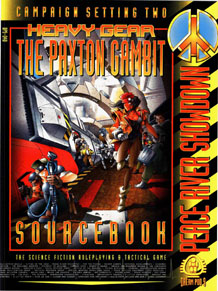
Heavy Gear - The Paxton Gambit[ Warning: This review will contain spoilers of the adventure series contained in this product. If you are intending to play through the story told in this product you should stop reading now. ]

The Paxton Gambit, unsurprisingly, is another sterling DP9 product for their Heavy Gear line. The first 25 pages expand upon the information given on Peace River previously (in Into the Badlands and the Second Edition Heavy Gear rulebook). The next 32 pages are a campaign supplement, and the remaining 6 are Paxton Gear designs.

Peace River has been covered previously, so what’s there in terms of background is pretty scarce — you get some new info on the political situation as of 1935, details of the Badlands Quarter, some detailed maps, an overview of the POC structure, and a number of new NPCs (all of which are important in the campaign portion of the book).

The Paxton Gear designs are … well, they’re Gears. What do you want?

The campaign supplement is, however, the book’s strength, in my opinion. You get 27 pages of story material stretching over nearly 20 days and nine gaming sessions (your mileage may vary, of course). You also get a page of “Continuing Hooks” which tell you where to go next if you want to continue the campaign, and four pages of handouts for the players.

The main section of the campaign is separated into three acts, each containing three scenarios. Each scenario consists of “Milestones”, which detail each important scene or sequence for the players to engage in. They also contain “Complications and Continuing Hooks” — little extras unessential to the main plot, but which can be thrown in to add complexity to the sessions themselves or cause headaches down the line for the players.

The plot of the campaign is thus (these are the spoilers):

In the wake of the Oxford Agreement (see CoF) Emir Shirow of Basal can no longer rely on the CNCS or NLC to supply him with arms in his rebellion, leaving him with only one serious option: Paxton Arms. He dispatches his lover and ambassador Victorya Hiro to Peace River to negotiate the deal. However, he doesn’t have enough money to fund the project completely. Therefore, Hiro will also be secretly negotiating with the NLC in order to get the money to make the deal with Paxton Arms. Jacques Molay will be dispatching SRID operatives to break up the deal because he doesn’t like the Basal rebellion for personal reasons, but this also means that these operatives have a chance of uncovering the NLC deal, which will break the Oxford Agreement and bring down the SR’s wrath on Shirow. Added to this is the fact that the SRID typically deals with the Forzi in Peace River for this type of low-profile work, but the Forzi in Peace River are actually controlled by the BRF’s local leader Sund! ra Gabriel, and she would like nothing better than to screw this deal up herself and make things tough on Paxton Arms. And, of course, the Patriarch of the ESE has gotten wind of the deal and dispatched agents to eliminate the Basal forces involved in the deal. This is the point where the players enter.

The campaign is designed so that, with a minimal amount of work, the GM can sit down with his players and start playing. Indeed, if you’re particularly effective at off-the-cuff playing you could probably run the thing untouched once you’ve got the material down and copies made of the hand-outs. The scenario is also designed, however, to allow existing campaigns to intersect with the story with a bit more work involved. Clearly you can see with all these different groups coming together over one deal (CNCS and NLC, SRID, BRF, Paxton/Peace River security and executives, Basal Uprising, ESE, etc.) there are a multitude of different ways for a GM to get his players involved in the events of this story. But the campaign is designed around the idea that players will be assuming the roles of Peace Officers.

They are introduced into the action as honor guards to the arrival of the Basalite ambassadors, and are put under the temporary command of Colonel Lenaris. They are also introduced at this point to Helen Luka, a reporter in search of the big scoop. The next day they are put on surveillance of a group arriving on a cargo maglev line — clearly undercover. These are the NLC negotiators arriving.

>From this point on in they are drawn into a dizzying array of political events and placed under the direct command of Lenaris as they become the only agents he can trust in this matter. Early on in the campaign they eliminate the Patriarch’s force in Peace River and think they’re doing pretty well, until the depths of the BRF and SRID involvement is revealed.

By the time the dust clears it is fully possible for the players to have been instrumental in completely destroying the SRID and BRF presence in Basal, Sundra Gabriel will be dead, they will have saved all Peace River from a reactor meltdown, the deal will have gone off perfectly, and they will be trusted agents of both Lenaris and HEO DuBeau-Slovenski.

So are where are the weaknesses? Well, one of them is Helen Luka. She hangs around the players like a faithful dog during the first act, and then abruptly disappears from the campaign entirely. Considering she’s given a full page write-up I would expect her to be of slightly more importance in the campaign. Also odd is the complete lock-down on any communication or travel in or out of Peace River for nearly 24 hours during the course of the adventure. While I have no doubt — PR being an arcology and all — that this would be possible, the repercussions on a major export economy of this happening are never mentioned (not even in the “Continuing Hooks” section) in the book.

The latter is, perhaps, a matter of selective blindness and saying that the resolution “takes place off-stage”. The former is a major plot oversight, in my opinion, and should be resolved by any GM considering running this campaign.

However, despite those reservations I would say that the story is a strong one, and I think all GMs should consider picking the book up if their players would have any chance of intersecting with the events detailed therein, it will be well worth your while. It is also a good example of how to tie players into the larger events of Terra Nova without disrupting the main flow of the primary storyline (if you ignore the complete rout of BRF forces in Peace River, which is clearly a major plot point in the continuing saga of Terra Nova — the adventure could just as easily be completed without this type of major conclusion).

Style: 5 (Excellent!)
Substance: 4 (Meaty)

Author: Michael Butler and Guy-Francis Vella
Category: game
Company/Publisher: Dream Pod 9
Cost: $15.95
Page count: 64
ISBN: 1-896776-33-7
Originally Posted: 04/17/98.

RPGNet and Me

October 6th, 2011

Way back on July 4th, 2005, I launched the Alexandrian with the cleverly titled post “Welcome to the Alexandrian“. In that post, I talked about how I had become a freelance writer. The 100+ reviews I wrote for RPGNet played a major role in that story, but I wrapped up my post by saying: “But if you go to RPGNet today, you won’t find any of my reviews there. What happened? Well, that’s another story for another day.”

Then I didn’t really follow-up on that, largely because there were more interesting things to talk about.

But I’ve had people pinging me for awhile now wanting access to some of the content from my older reviews. And the original (and continuing) purpose of the Alexandrian is to archive my creative work. To that end, I’m going to start posting those old reviews in order to properly archive them away. Which means that “another day” has finally arrived.

THE RPGNet Logo 1998REVIEWS

I posted my first review to RPGNet in the spring of 1998.

It was a review of The Paxton Gambit, a campaign supplement for the Heavy Gear roleplaying game, and it had originally been written for and posted to the Heavy Gear Mailing List. RPGNet had been around for a couple of years at that point, but the site was just beginning to get noticed by the larger RPG community. One of the people who noticed was Phillippe Boulle, who — at the time — was an editor at Dream Pod 9. He, in turn, posted a message to the Heavy Gear Mailing List asking that fans of the game go to RPGNet and post reviews of their favorite Dream Pod 9 products. When I saw Phillippe’s message, I took the review I had already written, popped over to RPGNet, and posted it.

That was a lot of fun and, to make a long story short, I kept doing it. In fact, over the next four years I would do it 165 times.

In those early days, the RPGNet community was heavily focused on the reviews: There was no general forum, but there was a discussion thread associated with each review. That meant that all of the discussion on the site was focused through whatever reviews had been posted in the last couple of weeks. It meant that the community was radically neophilic and intensely focused on RPGs.

It also meant that, if you were a successful reviewer, you were the genesis point for sprawling discussions that could go on for dozens or even hundreds of posts.

In retrospect, it’s pretty easy to recognize that RPGNet was actually serving as one of the pioneers in the newly-emerging blogosphere: Each review was effectively a blog post and the emergent community was blog-focused. At the time, it was just exciting. I’d been participating in online discussion groups since 1988 or ’89; but here I was actually finding an audience.

RPGNet Logo 2000From ’98 through ’02, I was one of the top three or four reviewers on RPGNet. During this time period, the site went through several changes of ownership, one of which nearly destroyed the site before it was returned to Sandy Antunes (the founder). In 2001, it was then sold to Skotos Tech.

Throughout this time period I continued writing reviews. In May 2001, in fact, the site ran a “Justin Bacon Review Week” in which all of the reviews posted that week (20+ total) were written by me. That was pretty awesome and I felt very honored. Around this same time, I was asked by Sandy Antunes to help develop content for a D20 Nation website that he wanted to launch as a partner-site with RPGNet. (Unfortunately, those plans never came to fruition.)

The site was also changing, however.

Forum software had been installed at some point. This was almost certainly a good thing (the site would have probably died completely during the period when its owners weren’t updating the content if it hadn’t been for the forum), but it also meant that the character of the site was changing: The community was becoming forum-oriented instead of review-oriented.

(One memory from this time period in particular: The early forum software didn’t have any accounts. You just typed in your name and left your message. There was a period of a couple weeks where somebody was deliberately trolling the forums by posting incendiary posts under my name. It took me awhile to figure out what the heck was going on, and eventually the guy responsible confessed. I suspect this incident contributed significantly to the site updating to new forum software with registered accounts shortly thereafter.)

In mid-2002, I posted what was essentially my last review at RPGNet. (In mid-2004, I posted a review of A Game of Thrones. But it was a fluke.) Partly this was because professional work was chewing up more and more of my time. Partly it was because the RPG review community had completely fetishized the reviewing of typography and binding quality instead of actual content and gameplay. But largely it was because the audience for reviews at RPGNet had severely atrophied.

PARTING OF THE WAYS

I remained an active member of the RPGNet community, however, until 2004.

In October 2003, I was participating in a thread where somebody was voicing incredulity at the idea of someone owning more than a hundred RPGs, claiming that a hundred RPGs didn’t even exist. I pointed out that hundreds of free RPGs were available on the web; so you could own hundreds of RPGs without even spending a dollar. After a couple rounds of this, I compiled and typed up a very lengthy list of the free RPGs I owned and posted it. This took about 2-3 hours worth of effort.

This list prompted several pages worth of interesting discussion. Several days later, however, one of the forum moderators did a drive-by on the thread and deleted the entire post as “threadcrapping”. I was irate at having 2-3 hours of work eradicated and responded with, “Fuck You.”

RPGNet Logo 2002In retrospect, I probably should have saved a local copy of the post. And I probably could have been more politic in my response to the atrociously poor moderation. But I wasn’t and I got hit with a 90-day ban for mouthing off to the incompetent moderator.

Several months later, after the ban had expired, I came back and found that I couldn’t log into my account. Reconstructing events after the fact, it appears that one of the moderators (probably a fellow named Brian Hollenbeck, operating under the name “Kuma”) had decided to change the password and e-mail address on my account in an effort to secretly turn a temporary ban into a permanent one. E-mails to RPGNet went unanswered, so I created a new account under the name “Justin A. Bacon” and continued posting.

In August or September of 2004, Kuma started trying to IP ban me from the forum. Since I was posting from a dynamic IP, this completely failed. (I wasn’t even aware he was doing it, since he’d posted his intentions in a thread I was no longer reading.) After several weeks of this, another moderator apparently got around to banning the “Justin A. Bacon” account for “avoiding a ban”. (This was, of course, completely untrue. For several years after this it was quite hilarious because the “Justin Bacon” account had still never been banned, although it looks like they finally got around to “fixing” that recently.)

I sent an e-mail to the site and was told to wait a couple of days for the issue to be resolved. After a week or so, it hadn’t been.

At this point I posted to Trouble Tickets asking for an explanation. None was forthcoming. It took several days and many other people posting to both the forum thread and e-mailing RPGNet before they finally got around to posting their explanation: They believed that I had posted at some point during my 90-day ban and were, therefore, permabanning me.

Did they have a link to that post? No.

Could they find a link to that post? No.

Was there any way to fix this issue? Yes. Within 1-2 days, they would confirm the existence or nonexistence of the post Kuma claimed existed.

… only they didn’t do that. Instead they closed the thread so that no one could post to it.

A month and a half later, somebody else posted a thread asking: “Hey. What’s going on here?” The moderators still had no explanation.

During this time period, I was being contacted by others. Something was deeply, deeply rotten in the moderation team at RPGNet and I wasn’t the only one having problems.

I decided to raise the stakes: I publicly announced that if RPGNet didn’t want me as a member of the community, then I would pull my reviews.

The point was to raise the profile not only of my issues with the moderation team, but the general issues the community was having with the moderation team. I was hoping that it would force the new owners of the site to put their cards of the table and make it clear what sort of site RPGNet was going to be. In this I was successful, although not in the way that I had hoped: Still unable to produce the posts demonstrating that there was any justification whatsoever for my permabanning, the owners of the site instead permabanned me for daring to exercise my IP rights.

I shrugged and walked away. The RPGNet I had once fervently supported was obviously dead and gone.

POSTSCRIPT

RPGNet Logo 2010I do remember quite vividly, though, my final e-mail exchange with the ownership. They wanted to give me “one last chance” to let them keep my reviews on the site. They wrote: “By removing them from RPGNet, you’re destroying the value of your reviews.”


This taught me an important lesson: When an organization believes that your work has value because they allow it to appear in their venue (rather than the reality, which is that the content is what gives a venue value) then you’re probably better off getting away from that organization as quickly as possible.

In the years since then, the situation at RPGNet has only worsened. The Tangency forums have become the tail wagging the dog. There are members of the moderation team who take great pride in the fact that they’ve never played an RPG. (This fact boggles my mind every time somebody mentions it.)

The site, which once made its name on the participation of major RPG professionals (priding itself as the “Inside Scoop on Gaming”), has become increasingly hostile to them. It’s become a popular past time for posters to bait professionals posting to the boards so that the professionals will get banned. At one point, this was coupled with a ludicrous policy of banning discussions of games written by people who had been banned.

A couple years ago a friend of mine told me he was being accused by RPGNet’s mods of being my sock-puppet because he included links to products I had written (and he had helped edit) in his .sig. Last year I had a complete stranger send me an e-mail saying that RPGNet’s mods were making the same accusations towards him.

I’m not sure what to tell either of them. I enjoy discussing and debating RPGs. It improves my games. It improves my writing.

But RPGNet? It’s a cesspool. And, sadly, it’s a cesspool that’s been created by the very mechanism which is supposed to be keeping the water clean.

In any case, that’s the nutshell version of my rollercoaster ride with RPGNet. Hopefully you found it at least mildly entertaining. But mostly it’s my way of introducing the reposting and archiving of the reviews I wrote for RPGNet “back in the day”. I’ll be starting later today and posting them semi-regularly until I’m done.

Archives

Recent Posts

Recent Comments

Copyright © The Alexandrian. All rights reserved.