The Alexandrian

Posts tagged ‘rpgnet reviews’

Tagline: Ghost Dancers details the Indian societies and tribal beliefs of the Weird West. An above-average supplement, it is highly recommended for any GM running a Deadlands game and will prove useful to anyone playing an Indian character.

If I recall correctly, Ghost Dancers was the first time I received a review copy of a book. (At the time, RPGNet maintained a Wish List function for people who had posted reviews on the site. They probably still do. Here’s a document somewhat contemporary to this review describing their review policy.) Getting that review copy was terribly exciting for me at the time. I kept meaning to go back and write a review of the core Deadlands game, but for one reason and another it never happened. The half-finished file still lurks on my hard drive as a poor derelict.
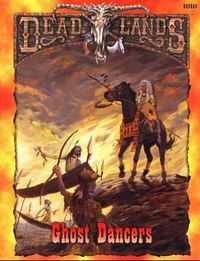
Deadlands: Ghost DancersGhost Dancers is the sourcebook for the Indians of the Weird West. It does it’s job well – giving a highly effective overview of Indian political, cultural, and religious life. Those of you familiar with the Deadlands game will know that many of the crucial events which lead to the development of the Weird West (instead of our historical Wild West) are the result of various Indian factions – as a result this book is a crucial key to understanding some of the background to the world itself. Since it also details the Hunting Grounds in great detail, this book is a must for any Deadlands GM.

I also suggest, but not quite so highly, this book for any player with an Indian character who feels that the main rulebook isn’t giving him enough flavor or options for his character. If you are generally unfamiliar with Indian belief and culture, this book will also give you a good one-point stopping place for learning more. (Of course you should beware of taking things in this book as absolute historical fact – the designer himself is careful to point out that not only is the book simplifying many things about Indian culture, the Weird West is not an historical place by any stretch of the imagination.)

The book follows the traditional (and extremely advantageous) breakdown of all Deadlands material: a section for the players (Posse Territory), material that the GM should know and reveal only to select players (No Man’s Land), and material for the GM’s eyes only (Marshal’s Handbook). In Ghost Dancers, however, this has been changed to The War Party, Sacred Grounds, and The Chief’s Words – because “those white guys at Pinnacle Entertainment mistitled the sections in the previous books.” (Any product with the ability to look at itself humorously earns high points with me.) This lay-out is very nice – too often source material is only useful for the GM or reveals world secrets to the players because it lumps all the information about organizations and locations together. Nor have I seen this lay-out lead to useless regurgitation of the same information in each section. Pinnacle always seems to be careful in giving the GM just the extra information, without restating what has been said 50 pages earlier.

STYLE AND LAYOUT

My one persistent problem with Deadlands products is that the graphical presentation of the books fails to do anything for me. It is clearly meant to be evocative, but it just sits like a lump of clay for me. The cover art of Ghost Dancers, like all Deadlands products I’ve seen is a high-quality, excellent piece of work. The interior art, on the other hand, varies wildly from just slightly above average to pathetically horrid. The special font they use for headings is supposed to be mood-setting I suppose, but I’m pretty much indifferent. They have, however, solved one of my big problems with the main Deadlands rulebook – the type font is a nicely readable size, as opposed to the unnecessarily huge size used earlier.

One last minor complaint. Deadlands products use a nice referencing system to take you from one section of the book to another (for example, if you’re reading a section on the Sioux Nations in the War Party section you might get a page reference indicating that more material on this subject can be found in the Chief’s Words section). For this referencing system they use three miniature pictures – a gun and hatchet for the War Party, a holy symbol for the Sacred Ground, and a chief’s head and headdress for the Chief’s Words. These three pictures are then repeated on the title pages of each of the three sections. The problem comes because they apparently created these images at the thumbnail size for the referencing system and then just blew them up for a full-page presentation on the title pages. Anyone who has done this will know that you end up with a fuzzy image at the larger scale – and that’s precisely what you get in Deadlands products. Suggestion: Compose the pictures at the larger scale and then shrink them down to the smaller scale.

None of these are serious problems in my opinion, they just don’t click with me properly. A quick flip-through of the book should be enough for you to judge whether or not you agree with me.

Indeed, these problems are inconsequential. The lay-out of the product is excellent. Material is laid out in an intuitive and consistent fashion and a detailed table of contents will make it easy to find what you’re looking for. You won’t find any weird placement of information – such as sticking a section on weapon damage in the equipment section rather than the combat section with the rest of the weapon damage information – that seems to be trendy with certain companies.

So, to sum up: Externally this product is visually fantastic. Internally, it is visually boring. The lay-out is useful, productive, and easy-to-use however – and that’s the most important thing. It is only my aesthetic sense which is offended.

THE WAR PARTY

The first section of the book serves both as a reference for players and as a general introduction to the book. The first chapter (“Welcome to the Lodge”), serves as that general introduction.

Chapter Two (“Indian Country”) gives a broad overview of Indian history, as well as comprehensive look at the major tribes and organization of Indian society. Chapter Three (“Making an Indian”) provides details on modifying the basic character creation rules found in the main rulebook for Indian characters – including your role in Indian society, the selection of your Guardian Spirit, and new aptitudes, edges, hindrances, knacks, and gear. The section of the book also contains new archetypes for use by the GM and players both.

Chapter Four (“Guardian Spirits”) details the workings of Guardian Spirits, while Chapter Five (“Strange Medicine”) expands and improves upon the medicine rules found in the main rulebook, providing more options and details.

SACRED GROUND

Chapter Six (“Objects Sacred and Profane”) detail the rules for creating and using ‘medicine objects’ (magical items). This is an exceptionally useful resource for the GM, as is the next chapter (Chapter Seven – “The Hunting Grounds”) which details the extradimensional realm of the Hunting Grounds.

If there is one reason above all others to buy this book it is the material found in Chapter Seven. With amazing grace the designers allow the Hunting Grounds to be not only something of significance and importance to Indians, but to all religious groups. In the Weird West the magical forces which have been interpreted through the faith and religion of humanity are all too real – and it was the release of those forces from what the Indians call the Hunting Grounds (and Christians would call Heaven, Purgatory, and Hell) during the Reckoning that created the alternate history which Deadlands details.

In my mind, therefore, understanding and being able to use the Hunting Grounds in a Deadlands campaign is extremely important – and this book is the key to allowing that. As a result, every Marshal/Chief/GM should own a copy of Ghost Dancers.

THE CHIEF’S WORDS

Chapter Eight (“The Chief’s Guide”) provides everything about the Indians of the Weird West that the players just aren’t supposed to know. I won’t go into details here, because there are probably several players reading this review, but some of the stuff you uncover here is truly exciting and made me want to go out and start writing adventures.

Chapter Nine (“Secret Societies”) details the Ghost Dance (from which the book gets its name) and the Raven Cult. The Ghost Dance is a ritual revealed to the Paiute tribe – it preaches of peace and tolerance, and foretells of a time when the white man will be driven from his lands and the red man shall return to power. A time which shall be prophesied in the birth of a pure white buffalo calf.

The Raven Cult — as anyone whose familiar with the Deadlands game knows – is responsible for the Reckoning. They, too, foretell a future where the white man has been driven from the lands of the Indians – but they see the way to this future as one paved in blood and violence.

The GM will learn everything he needs to know about these two secret societies. Once again this is important information and mandates buying this sourcebook. The information on the Raven Cult is important because of the role in the origins of the Weird West setting. The Ghost Dance is important because they are clearly going to become important in the future of the Weird West.

SUMMARY

This book is an excellent and required resource for the GM of a Deadlands game, but only of mild interest to a player (even if the player happens to have an Indian character). I suggest that only one copy is really necessary for any gaming group, but that one copy is necessary for any long-term campaigns set in the Weird West.

Style: 3
Substance: 4

Author: Paul Beakley
Company/Publisher: Pinnacle Entertainment Group
Cost: $20.00
Page count: 128
ISBN: 1-889546-20-8
Originally Posted: 1998/06/19
THIS

Ex-RPGNet Reviews – Twitch

November 24th, 2011

Tagline: Wizards of the Coast and the Bourbaki card game design team strike again in this surprisingly fascinating and addictive card game, the first in a line of non-collectible games meant to provide competition with games like Uno and Skip-Bo.

Thirteen years later, Twitch remains one of my favorite card games. My review speaks highly of it, but a game with that kind of staying power deserves special attention. Sadly, it is long out of print and virtually unattainable as I write this. If you get a chance, though, I recommend you grab a copy ASAP.

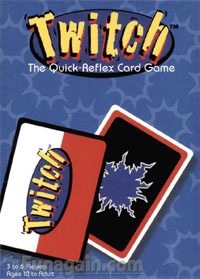
Twitch - Wizards of the CoastThe premise of the game is simple: Someone plays a card. The cards tells you who goes next. If it’s you, you’ve got to play another card before someone challenges you and you have to take the entire stack of cards. If it’s not you, you’ve got to figure out who it is and challenge them before they can play. Be careful, if you play or challenge wrong you’ll end up taking those cards.
Simple, right? Right.

Until you start playing the game, that is. Then what seems so simple on the surface suddenly seems to be the most complicated thing you’ve ever done.

The basic game centers around eight different cards. The four basic cards are Left, Right, 2 Left and 2 Right. These cards tell you who goes next (the player to your left, your right, two seats to your left, and two seats to your right – respectively). In addition the card Ditto means that the last card’s effect is repeated, the card Back At Ya! sends the turn back to the last player to play a card. The last trick is that all players are given a color card, and a duplicate of this card is place in the play deck. When that color card is played the person to who it belongs must play next. Finally there are the challenge cards – these cards are keyed to the colors of the players. If a player is too slow or if they make a mistake, you can challenge them with the challenge card corresponding to their color.

The name of the game is speed, and once you’re into the heat of the chase you’re going to find that these simple rules are more than challenge enough.

Now let’s take another step, into the Advanced Game. At this point we add three more cards: Pick a Color, Rotate Colors, and Left to Right. These are called “Pause Cards”, when they are played gameplay temporarily stops while their results are gauged. Pick a Color means that the person who just played the card picks the color of another player, and then that player plays a card (resuming play). Rotate colors means that everyone takes their color card (indicating what color they are) and hand them to the player on their left – this causes confusion regarding what color to use to challenge which players and what color you are when the color cards come up during gameplay. Finally, Left to Right means that all cards referring to a particular direction mean exactly the opposite – left means right and right means left. Conveniently there are exactly two of these cards, meaning that once play is reversed, it will eventually turn back the other way.

Twitch is the first in a line of games Wizards of the Coast is producing in order to apparently attempt to compete with traditional family games. On the strength of this product I intend to go out of my way to also purchase Pivot, Alpha Blitz, and GoWild! — the other products in this line-up.

At seven bucks you can’t lose with this game. It won’t be put on the shelf next to your Magic cards or your Doomtown cards, but I think it more than amply deserves a place alongside such classic games as Uno and Skip-Bo.

Style: 4
Substance: 5

Author: Richard Garfield, Skaff Elias, Jim Lin, and Dave Pettey
Company/Publisher: Wizards of the Coast
Cost: $6.95
Page count: n/a
ISBN: 1-57530-581-X
Originally Posted: 1998/05/30

Tagline: “Chess will never be the same!” This innocent looking pack of 80 cards completely alters the game of Chess – from a static strategic puzzle to a dynamic tactical conflict. Moody and evocative art by Rogerio Vilela. Translated from the original French.

I actually have quite vivid memories of writing this review. It was the first time I really became aware of how thoroughly I’d been bitten by the reviewing “bug” because I started thinking about how I would write the review of the game as I was playing the game.

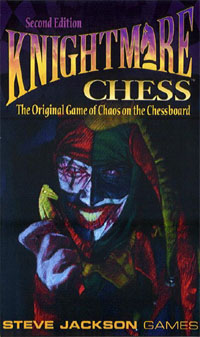
Knightmare ChessThe tagline of Knightmare Chess is, “Move a piece. Play a Card. Chess will never be the same…”

There you have the whole game. In the elegant box in which Knightmare Chess comes you will find 80 cards – each of which subtly alters the rules of Chess in different ways. These cards let you do all the things you always wish you could do in a tight moment during a game of Chess – resurrect a piece which has been captured, move a piece out of the way, take not one piece, but many on a single move. On each of your turns you can play one card.

When first approaching this game I was both anticipatory and doubtful. Anticipatory because it sounded like a fun thing to do once or twice. Doubtful because chess is an ancient game – its grace and its beauty come from the fact that its rules are carefully balanced, all the pieces are known, and the challenge comes from manipulating a known set of variables in a strategic way to overcome your opponent.

The premise of Knightmare Chess, while seemingly innocuous, actually radically alters the very basic appeal and structure of the game. The rules are no longer balanced, they are in constant flux. The pieces are not known, they can be altered and rearranged. There is no known set of variables, the variables are unknown and changing.

At first glance, therefore, Knightmare Chess has the potential to completely screw the only appeal chess has – its strategic component.

After playing the game awhile I realized I was wrong. Knightmare Chess transformed Chess into a radically different game, but it did not destroy it. Where Chess is a static strategic puzzle (with its elements known and the possible interactions between pieces completely proscribed), Knightmare Chess is a dynamic tactical conflict. Just because the rules are always changing, doesn’t mean that Knightmare Chess is an inferior game. It does mean, however, that it appeals to an entirely different aesthetic than Chess.

Chess has often been described as a wargame. Indeed, in some ways it is – if you are willing to accept a certain degree of abstraction. Nonetheless, it is an odd one – one in which you have only a certain number of troops, in which both sides are equal, and in which everything is ultimately predictable. If Knightmare Chess is similarly a wargame carried to an extreme degree of abstraction, then it presents a model of modern warfare – where the sides can quickly become unequal, where reinforcement is conceivable, and where combat is anything but predictable.

Knightmare Chess is a fascinating game. If you are a chess player, approach it with an open mind. If you have no taste for chess, then it is entirely conceivable that this game will appeal to you nonetheless.

It should be noted that I am using a copy of the Second Edition for the purposes of this review. The differences between the first and second editions are extremely subtle and largely inconsequential to the overall gameplay and assessment of this game. For a list of differences you can check Steve Jackson Game’s website.

Style: 4
Substance: 5

Author: Pierre Clequin and Bruno Faidutti
Company/Publisher: Steve Jackson Games
Cost: $14.95
Page count: n/a
ISBN: 1-55634-319-1
Originally Posted: 1998/05/30

Tagline: The Heavy Gear universe is perhaps the best in all of role-playing and tactical gaming – practically unmatched in depth, detail, texture, and life. This book is the key which opens this magical treasure trove of adventure.

My first review on RPGNet was of a Heavy Gear sourcebook and I would go on to post more reviews of Heavy Gear sourcebooks than of any other RPG. This is largely because I was more enthused about Heavy Gear than any other RPG of the time: I reviewed what I read; I read what I liked. This is one of the advantages of being an amateur reviewer: The professionals only get to review some of what they read and rarely get to read what they like.

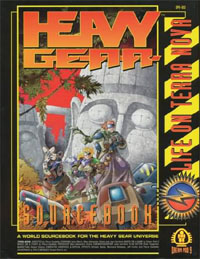
Heavy Gear - Life on Terra NovaWhen you delve into science fiction or fantasy you will often find yourself encountering worlds either entirely separated from our own or at least placed so far in the future that the extrapolations from our current time have rendered them almost wholly different from what we know. When you encounter these worlds you will find that they often break down into two broad categories – those worlds which might actually exist and those worlds which have clearly been created merely to suit the whims of the author’s story and couldn’t possibly exist.

In role-playing we have all encountered the latter many, many times. (“If this dungeon is so close to the town why hasn’t it been looted over the centuries?” “Because the locals are all frightened by the monsters.” “Yeah, speaking of those monsters – what are they eating down there?” “Look, do you want to play or don’t you?”) Fortunately those of the former have grown increasingly frequent in our hobby (although, frustratingly, we are often prohibited from playing certain characters by the rules of the game).

Sometimes, however, you come across a real jewel of a world. A world so intricately detailed, so deeply described, and so excellently constructed that you realize that not only can you tell “science fiction stories” in this setting, but any story in this setting. Terra Nova – the world of the Heavy Gear game – is such a world.

THE WORLD OF TERRA NOVA

For more details on the history of humanity (which is presented in great detail within this volume) in the 4000 years which separate its time and our own see my review of the second edition of Heavy Gear elsewhere on RPGNet the Alexandrian.

Terra Nova is a world divided into two lush polar regions by the great deserts referred to collectively as the Badlands around its equator. Following a period of chaos in Terra Nova’s past the two polar regions coalesced into a series of leagues. Those leagues eventually allied with themselves to form the two great polar alliances – the Allied Southern Territories (AST) and the Confederated Northern City-States (CNCS). The Badlands have a few centers of power in the forms of city-states, but are largely settled only by isolated villages which are focused around “oasis towers”. Because the Badlands generally lacks the political power of the two polar alliances, it is easily exploited as a “neutral” battleground between the two. A little over a decade ago all of Terra Nova came together in order to beat back aggressive conquerors from Earth who had returned to reclaim their colony.

To begin in the south, the AST is composed of four leagues – the Southern Republic, the Humanist Alliance, the Mekong Dominion, and the Eastern Sun Emirates. The Humanist Alliance was, in fact, the first league to form on Terra Nova. Based on the teaching of Yuri Gropius it is a realized utopia similar to the teachings of the ancient Greek philosophers (most notably Plato) – the only price of this utopian existence is freedom. The Mekong Dominion is a society based entirely upon the corporate structure. It is the economic and production center of the entire South. The Eastern Sun Emirates is a feudal society which formed around the power garnered from the distribution of supplies from the space freighter the Eastern Sun during the time of chaos which plagued Terra Nova centuries ago. Finally, the Southern Republic is supposedly a free democratic society – in truth the people have bargained away their power as voters in exchange for a comfortable and luxurious lifestyle. Further, the Southern Republic rules the AST – having been responsible for its formation in their wars of aggression.

In the North the CNCS is composed of three leagues – the Northern Lights Confederacy, the United Mercantile Federation, and the Western Frontier Protectorates. Similar to the Mekong Dominion the UMF is focused upon production. Unlike the Dominion, however, the UMF focuses more heavily upon the work ethic than upon the philosophy of “business is war”. The society of the WFP is focused upon its military forces. Like the society detailed by Heinlein in Starship Troopers (the book, not the movie) only citizens who have served in the military for a certain amount of time are allowed the right to vote – not out of fascist beliefs, but out of the belief that only those who are willing to die for their country should be allowed to control the destiny of their country. The NLC is a democratic society which is increasingly dominated by religious fundamentalism – although it, like the Southern Republic, is both the most powerful league of its alliance and has fought wars of aggression in the past it did not – like the Republic – force the formation of its league, and does not rule it with an iron glove.

There are two important city-states in the Badlands – Peace River and Port Arthur.  Peace River is ruled by a company known as Paxton Arms, and most of its citizens are employees of the corporation. Peace River and Paxton Arms have recently come into conflict with Port Arthur (a city-state established by Earth troops abandoned after the recent invasion, but which has since become a haven for Badlanders in need) because both city-states see it as their duty to protect the Badlands – and have different ideologies about how that protection is to take place.

This, in brief, is a broad picture of the world. Unfortunately I cannot go into the details of this world – unfortunate because it is in the details that this world truly shines. Every league (and the Badlands as a whole)  is a hotbed of activity. Besides the main conflict between the CNCS and AST (and, indirectly, the NLC and Southern Republic), there are numerous other conflicts at large. The Badlands are torn apart by the Badlands Revolutionary Front, the Saragossa People’s Front for Independence fights the oppressive government of the Southern Republic, revolutions dot the Eastern Sun Emirates, the Humanist Alliance is attempting to secretly prepare for a break from the Southern Republic, and the entire globe is plummeting towards war.

Beyond simple conflict, this world is exquisitely detailed. Not only do you learn of the “big picture”, but you learn the little details which can be so important while roleplaying. What foods do people eat in a given location? What drives the local economy? What do people wear? What music is popular right now?

You will be hard put to find a campaign setting – particularly a science fiction campaign setting – on the market today that allows you so many options and provides you with so much detail.

CONCLUSION

Although not a direct part of this product, it is important to remember that the story of Terra Nova is not only evolving – it is evolving in a very deliberate, easy to understand, easy to follow method that is alien to nearly every other game system I have ever encountered. (See my review of the second edition rulebook for more details on this.)

As a result in buying into this world you not only buy into a world of incredible depth and detail – but a world where that depth and detail is evolving and progression.

In short, not only should you buy Life on Terra Nova because of the incredible strength of the product itself, but due to the incredible strength of supplementary products which the purchase of this book will open up for you.

Style: 5
Substance: 5

Author: Gene Marcil and others
Company/Publisher: Dream Pod 9
Cost: $19.95
Page count: 160
ISBN: 1-896-776-00-0
Originally Posted: 1998/05/16

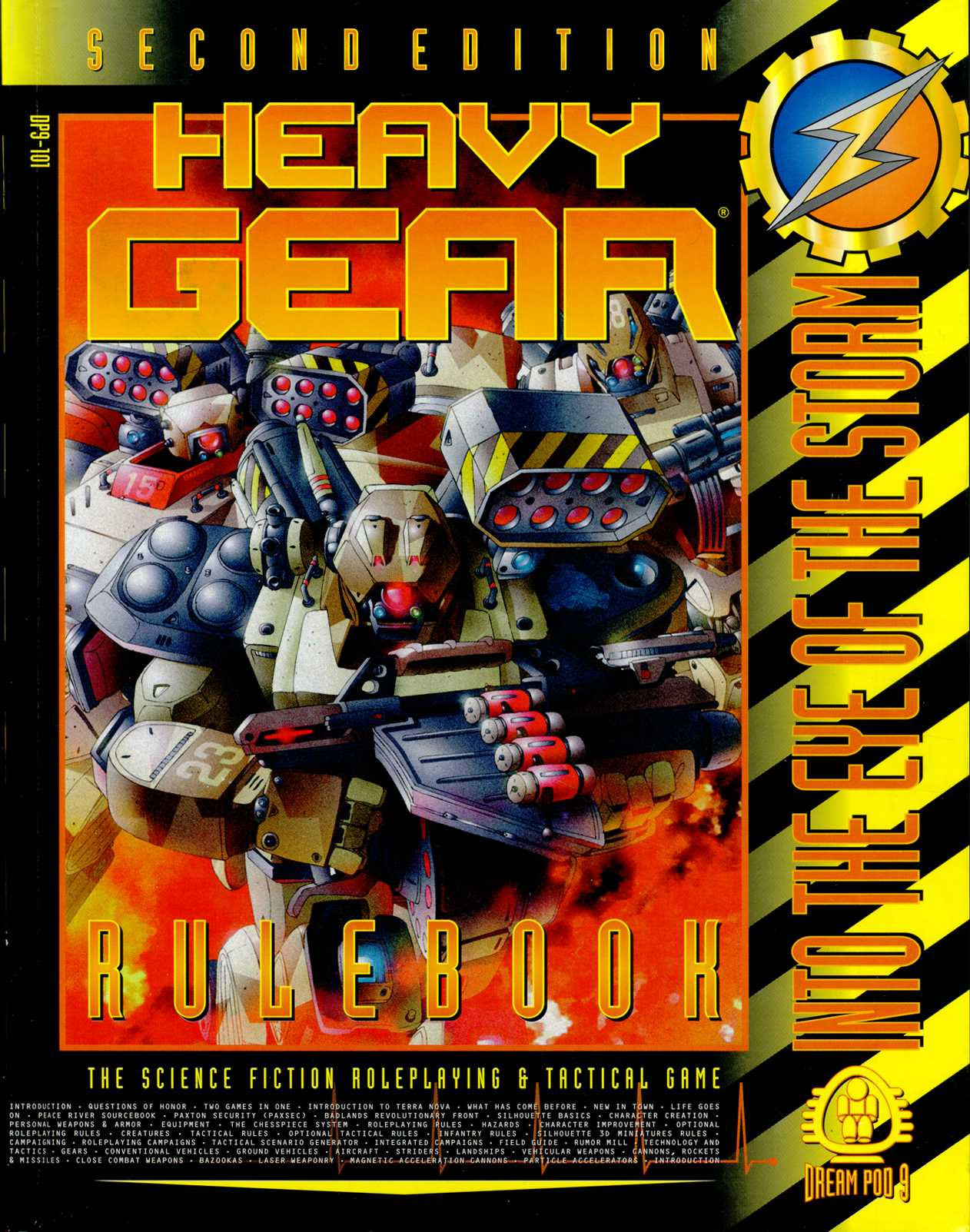
Tagline: Heavy Gear is, in the words of the publisher, “not your father’s giant robot game”. One of the best games of the ’90s, the second edition of this game is everything a second edition should be and more.

This review gushes a bit, but more than a decade later Heavy Gear is still one of my favorite games and Terra Nova is one of my favorite settings. I will also say that the Heavy Gear game line during its first and second editions remains an almost perfect example of how RPG product lines should be organized.

Heavy Gear - Second EditionThere are a lot of games out there and there are a lot of settings out there and, usually, even if I like a game or setting in general there are products for that game or setting with which I am not happy. We can all think of an example where the publisher’s of our favorite game have let us down by releasing an inferior product.

It has been a pleasant surprise, therefore, for me to encounter the games of Dream Pod 9 – although I have yet to purchase every supplement for their games, I have bought the majority of them and can testify that not a single one of them has been a disappointment. Whereas other game companies have to prove to me that their product is worth my money, Dream Pod 9 would have to prove to me that their product is not worth my money before I would consider not buying it. I may not own all the supplements yet, but I intend to the minute it is within my financial ability.

It therefore came as no surprise to me that the second edition of their Heavy Gear game proved to be a textbook case of not only how to do a core rulebook, but how to do a second edition.

The first edition of the Heavy Gear game (“A New Era Has Just Begun”) was released three years ago in 1995. I didn’t pick it up until just last year (literally the day before the second edition was announced on Dream Pod 9’s website). With fully integrated rules for both roleplaying and tactical play it had a powerful system with a lot of potential in a visually stunning package. It was possessed with some minor flaws, of course (no game is perfect): the material was very tightly packed with some degree of muddiness in the lay-out and the chapter on the world of Terra Nova (where Heavy Gear is set) was only six pages long.

Over the next two years Dream Pod 9’s general competency at laying out material would increase and it would be revealed (through supplements such as Life on Terra Nova) that the universe of Heavy Gear and the story being told there are even better than the rules.

This is where the second edition comes in. The folks down at Dream Pod 9 managed to perfectly target every problem area of the first edition, leave every feature of the first edition intact, and release a second edition which every other game publisher in this industry should take as a model. The first edition of Heavy Gear was fantastic. The second is sublime.

First, they have taken advantage of two years of experience and player feedback. Specific problem areas in the rules have been resolved and cleaned up. The overall lay-out and structure of the book has been redone in a manner which is both clean and logical – making the game easier to learn for newcomers and easier to reference for active players.

Second, they have added an extensive chapter on the background of the game – with general information on the entire world of Terra Nova along with an in-depth look at the city of Peace River in order to provide a beginning location for new GMs. This section also contains a beautiful full-color map of Terra Nova. The first edition of the game presented an odd dichotomy – everyone said the outstanding setting and developing story of Terra Nova was the biggest strength of the game, yet the rulebook contained almost no information on that setting or story. The second edition has resolved this problem.

Third, they have left intact everything which was good in the first edition. The rules are still simple, yet powerful. They still provide perfect integration between roleplaying and tactical games for those who are interested. The visual presentation is still stunning.

Too often when publishers release second editions of great games they have spoiled what was there to begin with – cluttering the elegant design of the first edition with unnecessary rules and complexity, destroying the essence of the original game, and catering towards people who are already playing the original edition. The second edition of Heavy Gear has done none of this.

THE RULES

In my discussion of the rules I am only going to deal with the roleplaying components of them – as I am not an experienced tactical player with this system. The tactical system is 100% compatible with the roleplaying system (with only a simple scale change involved), however, and is (by all reports) of excellent quality in its own right.

The central mechanic of Heavy Gear is simple. To perform any task you perform an Action Test. Roll a number of six-sided dice – whichever die is the highest is your total. If more than one six is rolled, each additional six is treated as a +1 (so rolling three sixes would result in a total of 8 (6+1+1)). If you roll all 1’s you have fumbled. Certain modifiers may add to or subtract from your total.

In a Standard Action Test, unless you fumble, you compare your total to a Threshold assigned by your GM to the action in question. If your total is higher than the Threshold, you have succeeded. If it is lower, you have failed. Your Margin of Success is the total of your die roll minus the Threshold. Your Margin of Failure is the Threshold minus your die roll.

In an Opposed Action Test you simply compare the two rolls – whichever is higher succeeds. A draw is a marginal success for the person resisting an action. The Margin of Success is determined by subtracting the lower total from the higher total.

This basic mechanic will be used most often to perform a Skill Check (there are also Attribute Checks and Chance Tests). In a Skill Check the number of dice you roll is equal to your rating in the skill you are attempting to us. Whatever attribute is effecting the roll acts as a positive modifier to the roll.

An example: Miranda Petite is attempting to do a backflip. She has a skill level of 2 in Acrobatics and her rating in the Agility attribute is 3. Because she has a skill level of 2 she rolls two dice. She rolls a 5 and a 4, so her total die roll is 5. She adds 3 to this (from her Agility attribute) for a final total of 8. If the GM had assigned a Threshold of 3 (Easy) to this task, Miranda would succeed with a Margin of Success of 5 (8 – 3).

Combat is handled as a series of opposed action tests, with various modifiers applied according to factors (cover behind which your target is hiding, lighting, the amount of time you spend aiming, the accuracy of your weapon, etc.). Damage is calculated from the Margin of Success of the attack by multiplying the MoS and the damage rating of the weapon. A character has three Wound Thresholds – Flesh Wound, Deep Wound, and Instant Death. The damage is compared to the Wound Threshold of the character – if it exceeds the character’s thresholds, the character takes a wound.

Character creation is a process of purchasing attributes and skills, as well as calculating secondary traits. The points for attributes and skills are separated – but there is provision for converting unused characters points (used for purchasing attributes) into skill points. There are ten attributes (Agility, Appearance, Build, Creativity, Fitness, Influence, Knowledge, Perception, Psyche, and Willpower) and nine secondary traits (Strength, Health, Stamina, Unarmed Damage, Armed Damage, Flesh Wounding Score, Deep Wounding Score, Instant Death Score, and System Shock).

THE SETTING

Heavy Gear is set 4000 years in the future. During that time we have perfected a system of interstellar travel using “Tannhauser gates” (named after the scientist who’s Grand Unified Theory explained time-space discontinuities – the “gates”) and begun to settle the galaxy – including the Helios system where the planet of Terra Nova is located.

Terra Nova is a largely dry planet. Slightly larger than Earth it’s equatorial region is a vast desert referred to collectively as the Badlands. Its polar regions, however are fertile and were centers of the colonization effort.

At the end of the 58th century, however, Earth decided that the benefits of the colony worlds was no longer worth the financial burden of supporting them and withdrew their support – including the massive gateships required for interstellar travel. Terra Nova suddenly found itself isolated from the rest of humanity.

Years of chaos ensued. Slowly, however, means of staying alive on this strange and hostile world without the aid of the home world were found. Political leagues were formed – in the southern hemisphere the Southern Republic, the Humanist Alliance, the Mekong Dominion, and the Eastern Sun Emirates; in the northern hemisphere the Northern Lights Confederacy, the United Mercantile Federation, and the Western Frontier Protectorate. The polar leagues eventually formed two polar alliances – the Allied Southern Territories and the Confederated Northern City-States. The Badlands, however, remained largely a hostile and volatile geopolitical area with various city-states and smaller communities.

Then Earth returned – in the form of the Colonial Expeditionary Forces (CEF). What ensued was the War of the Alliance – as the two polar confederations, typically political enemies, allied with each other against the common foe. Finally the CEF forced to retreat back through the gates and the spirit of cooperation did not last long after their leaving. Now, nearly two decades later, the two polar alliances are on the verge of war.

The rules of Heavy Gear are simple and elegant, but the setting is a work of art. The cultures of the various leagues are rich tapestries – each with their own character and individuality. The political spectrum of this world is complicated and detailed. As you delve into the supplements you get details not only on broad patterns, but also on how people actually live their lives. You will not find a better game world on the market today, in my opinion. Period.

HEAVY GEAR: THE GAME LINE

At the beginning of this review I mentioned the supplementary products for the Heavy Gear game. There are not many games so well supported as Heavy Gear. In an industry which suffers alternatively from vaporware deadlines and large gaps of time between releases, Dream Pod 9 has committed themselves to both an adherence to deadlines and near monthly release schedule for the Heavy Gear game since its inception. And the products released do not suffer from the speed at which they are produced. Quite the opposite, the quality of Heavy Gear products is consistently among the best in the industry (they were nominated for two Origin awards this year, for example).

My favorite aspect of the entire game, however, are the Storyline books – coupled with the Timewatch(TM) system. Although only one (Crisis of Faith) has been released so far, the concept is fantastic and should, I think, be emulated by other games. The universe of Heavy Gear, like many others, has an advancing timeline – let’s call it a meta-story which is told behind which the primary stories (those told by the GMs and players). The problem many other games have is that following that meta-story becomes increasingly difficult as more and more products are released. Take Shadowrun, for example. There are dozens upon dozens of products available for Shadowrun, and through those products a story is told – but new players have very few clues available to them as to where to start. The other problem is that – because that story is told over the course of all those different products – to follow it requires an ever-increasing financial investment. I, as a new player to Shadowrun, found that investment quite daunting and – instead – chose to create the material myself.

The Storyline books and Timewatch(TM) system which are part of the Heavy Gear line, however, solve both these problems. First, the Timewatch(TM) appears on the back of all Heavy Gear products – giving the game year in which the product is set. For example, the Second Edition Rulebook is set in TN 1934. This makes it very easy for new players to know exactly when a product is set. Second, the Storyline books are designed to push the meta-story of the world forward. Although they capitalize on hints and material found in the other sourcebooks, they are stand-alone products and tell the most important parts of the evolving story of Heavy Gear.

What this means is that, first, any supplements that players buy for the game can be quickly identified as to the time period they are discussing. Second, for players who don’t want to obsessively buy every product which comes out for the game, they can still follow the evolving meta-story. This means that if I wanted to run a campaign in the Humanist Alliance I wouldn’t have to buy supplements for the completely unrelated area of the Northern Lights Confederacy because the NLC sourcebook contains elements of the evolving meta-story I will require to understand future products released concerning the area I am really interested in, the Humanist Alliance.

CONCLUSION

Heavy Gear is blessed with a great system (which supports both roleplaying and tactical playing), a fantastic setting, and an excellent line of support (in quality, in timeliness, in detail, and in organization).

Dream Pod 9’s recent advertising for this game has included the tag line: “This is definitely not your father’s giant robot game.” I think it’s important to note that this 100% true. Many giant robot games tend to focus more on the technology than on the characters, but the world of Terra Nova is so deeply and richly textured that it is more than possible to adventure there without ever seeing or getting into one of the “gears” from which the game gets its name (you’ll note that they have not once come up previously in my review). They are part of the world, but they are not the entirety of the world by any stretch of the imagination.

The world is so wonderfully detailed, in fact, that I have seen games run within their fictional cultures which could just as easily have been run in a modern setting with a few minor technological changes. This game can be satisfying to those interested in any genre of play, because the world is large enough and realistic enough to realize that interesting stories can be told about anybody and anything.

I said earlier that no game is without a flaw. The second edition of Heavy Gear is no exception, although I had to look for quite some time to find it: A lot of the artwork is recycled. This would not be a bad thing if it was merely recycled from the first edition rulebook – however, many of the pieces are, in fact, from other sourcebooks. For those of us who are Heavy Gear junkies and used to every book getting a fresh and excellent art treatment, seeing these pictures a second time was an unwelcome surprise. New players entering the game will undoubtedly get the unfortunate impression that Dream Pod 9 is in the business of recycling art for their supplements.

As flaws go, this one is so insignificant as to be meaningless. This is a game you should buy. Right now. In fact, get up from your computers, go to your car, drive to you game store, buy it. Right now. Go.

What are you still doing here?

Style: 5
Substance: 5

Author: Philippe R. Boulle, Jean Carrieres, Elie Charest, Gene Marcil, Guy-Francis Vella, Marc A. Vezina, and other contributors.
Company/Publisher: Dream Pod 9
Cost: $29.95
Page count: 240
ISBN: 1-896776-32-9
Originally Posted: 1998/05/08

Archives

Recent Posts

Recent Comments

Copyright © The Alexandrian. All rights reserved.