
The Alexandrian

Posts tagged ‘pyramid reviews’

Big Eyes, Small Mouth - Hot Rods & Gun Bunnies

Originally Published June 20th, 2000

This is how you write a supplement.

Why? Well, for starters, what makes a good supplement? First off, the book should be good enough that you want to buy it – but the underlying system should have been designed well enough that you don’t need to buy it. In other words, the supplement should live up to it’s name: It should supplement the gaming process, and not be an integrally necessary piece of it.

Second, the book should contain a wealth of background information and source material. By the time I finish reading a supplement on, for example, a “guys-with-cars and girls-with-guns in a cops and robbers game”, I should know everything I ever wanted to know about cars, guns, and the men and women who use them to catch crooks and rob things.

Finally, the supplement should work by itself, but also work in synthesis with the other supplements for a game. In other words, I should be able to pick up Hot Rods and Gun Bunnies™ and be able to use the book without suddenly discovering that I also need to pick up The Complete Book of Cars and The Totally Insane Guide to Guns. At the same time, though, if I decide to pick up The Totally Insane Guide to Guns it should add to my experience using Hot Rods and Gun Bunnies™, and vice versa.

Needless to say, Hot Rods and Gun Bunnies™ (HRGB) succeeds at all of this with the fine polish of a new ‘vette and the lightning impact of Colt .457. Even though its twice as long as the core Big Eyes, Small Mouth™ (BESM) manual, at no point in time do you feel as if you actually needed to buy this book. At the same time, though, every single page is chock full of material so good that you will never regret, even for an instant, the hard earned cash you laid on the line to pick it up.

Basically the content of HRGB can be broken down into three categories: New Rules, Equipment, and Campaign Info.

NEW RULES

Character creation in the basic Tri-Stat System (on which BESM is based) is a process of seven steps. HRGB not only elaborates on how each of these seven steps can be tailored towards a campaign of high-octane action, but strategically expands the rules for maximum impact. An example of this is found in Step 4: Character Attributes – in which not only are all of the attributes in the core manual assessed as to their appropriateness in an HRGB campaign, but several attributes are specifically modified for easier use in such a campaign, and a set of brand new attributes are introduced.

But HRGB doesn’t stop there, it also goes on to insert new steps and sub-steps into the character creation process – expanding and adapting the character creation process. The most notable example of this is the presentation of a skill system for BESM (which first made its debut in the stand-alone Tri-Stat game Dominion Tank Police). This skill system is not only dynamic, it also fits almost perfectly into the overall feel and nature of the system as a whole. One would expect this type of thing to either feel like a completely tacked on addition or, alternatively, something which should have been included in the basic BESM manual to begin with. The truth is that you feel cheated neither in the skill system itself nor its lack in the core rulebook — an accomplishment that speaks highly not only of HRGB, but the Tri-Stat system as a whole.

Beyond the rules for skill resolution, the only other noteworthy addition to the basic Tri-Stat rules takes the form of a brief section describing genre combat, including a surprisingly wide array of optional rules and tweaks.

EQUIPMENT

A supplement about hot rods and gun bunnies which lacked a description of cars and firearms would, of course, be remiss. It should come as no surprise that HRGB lives up to the task admirably in Chapter 3: Boom and Vroom, tossing in bombs along with the titular autos and guns.

Not only is this section a sizable and well-researched portion of the book, it also excels at maximizing the value of everything it gives to you. By implementing a template system (so that, for example, the same set of stats covers not only an H&K MP5, but also an Ingram M10) they maximize their coverage. And all of this is backed up by rock solid research which is presented in a clear, easy-to-understand, and easy-to-use format for the GM.

This section is also a good example of the modular design to the BESM product line I was discussing earlier: In the Big Robots, Cool Starships™ supplement for BESM a complete vehicle construction system is presented for the game. Now, HRGB could have required the purchase of this separate book or – worse yet – simply reprinted the material. Instead, Guardians of Order have presented us with this entirely new template system, which is not only a better fit for the material covered by HRGB, but is also completely compatible with BRCS for those who want the added flexibility the complete VCS gives.

CAMPAIGN INFO

Between the new rules and equipment guide, HRGB has already justified its existence as a supplement – but it doesn’t stop there. Jim Crocker goes on to provide a wealth of campaign detail. This material ranges from an overview of pertinent anime titles in the genre (such as Gunsmith Cats and Riding Bean); to a breakdown of campaign styles, themes, categories and ratings (and how the rules can be tailored to each of them); to a set of character archetypes; to a stand-alone module; to (finally) an overview of firearm laws, motor vehicle laws, and bounty hunting and bail in America, Canada, and Japan (accompanied by a general description of “Law and Order in Japan” and America’s Miranda Warning).

All of this material is immediately useful and pertinently selected – there’s no deadweight to be found here, and its organized and presented in an easily referenced and accessible manner.

Of course, nothing is truly perfect – and HRGB is no exception to this truism. The book has a minor typo problem, particularly in the first few chapters. The new attributes added to HRGB have six levels (instead of the standard five of the core BESM rules) – this works, but it lends an unbalanced feel to the system. Although the new skill system is excellent (as noted above), this particular presentation of it is definitely slanted towards an HRGB campaign. Clearly this isn’t a flaw, but if you’re picking this book up solely for the skill system you should go in with the knowledge that you’re going to have to adapt it to other types of BESM campaigns.

But at the end of the day there is only one conclusion which can be reached: Guardians of Order was good to begin with, and with each new supplement they get better and better. Hot Rods and Gun Bunnies is a textbook case of “how to do it right” – and it’s well worth your time and money.

Writers: Jim Crocker, David L. Pulver
Publisher: Guardians of Order
Price: $15.95
Page Count: 124
ISBN: 1-894225-07-8
Children of Fire

Originally Published July 14th, 2000

When you think about the typical roleplaying game made available over the internet for free, the thing that springs to mind is that it is, above all else, free. Because there is no serious investment necessary to present the material to us, we see a cascade of secondary effects as the standard norm: Poor presentation. Poor artwork. Questionable system design. Lots of rehashed ideas. Little research. Less development. No support.

If we wanted to generalize a little more we’d note that most freebies are one-man shows, and, thus, even if something stands out for some reason, it will usually never stand out in more ways than one or two. You might get a good artist, but what are the odds of them also being a good writer? And if they happen to be both, how likely is it they’re going to be good at system design, too?

So the odds are against you when you start surfing around looking through these freebies. But there are a lot of diamonds out there – and not all of them are in the rough. What you need is a little guidance to point you in the right direction…

Which brings us to Children of Fire.

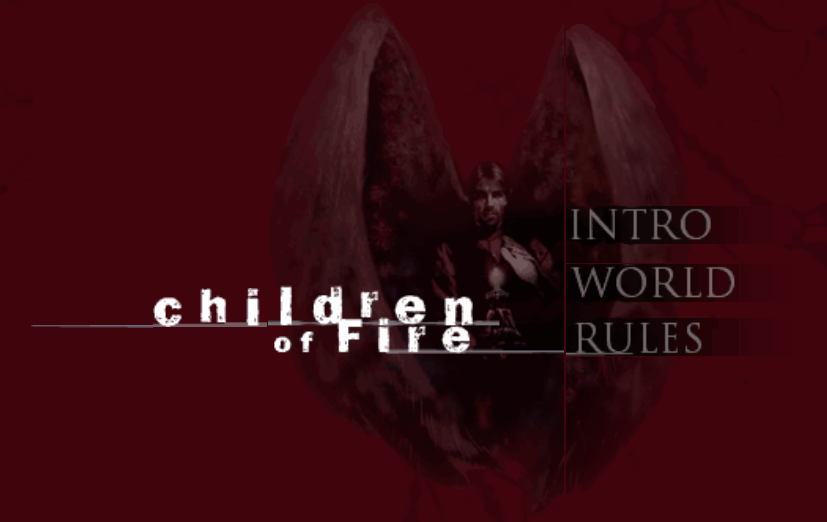
The first thing you’ll notice when you go to the webpage are the lavish illustrations which accompany the text. While lacking substantial content, the richness of visual design which supports the skillfully utilitarian lay-out of text and information not only supplements the writing (while not overpowering it or distracting from it), but also lets us begin checking things off of our mental checklist: Good presentation. Strong artwork.

Is there anything lying beneath this visual feast, though? Or are we looking at a shiny apple with a rotten core?

The central concept of Children of Fire is that the PCs are angels (the children of fire) sent to Earth to protect humanity (the children of clay) — both from itself, and from other supernatural forces (including the obvious fallen angels, but also the Grigori, the Anakim, the Nephilim, and human Sorcerers). This is territory which has been well-covered before, so the key question really becomes whether or not Children of Fire succeeds at bringing anything new to the arena: It does.

The problem a game of angels has is that, when you get right down to it, angels – as they are understood today in popular culture – are simply not interesting characters to play. An interesting character is a flawed character – a character who has to struggle against themselves as much as an exterior foe. Angels, on the other hand, are perceived as perfect beings who wander the universe doing nothing but good. Thus a typical game of this nature will have players taking on the roles of lost or even fallen angels, or it will “modernize” the angels by sullying them in one way or another.

Ironically, Children of Fire avoids the problems which typically lead to “modernization” by simply turning back the hands on the clock. Instead of adopting the cliches of today, CoF opts to base its setting on the rich mythology which was understood in ages past, but which has been lost in the gloss of the 20th century. Backed up with an array of solid research, Erich Wambach (the author) succeeds at bringing a very different look to some familiar territory. The nine choirs are flawed creations, but even in their imperfection they are viewed with awe and fear by the bulk of humanity.

So, we have some fresh ideas which are backed up with strong research. We can knock a couple more slots off of our checklist. What about system design?

Children of Fire uses a simple, relatively loose, set of rules based around a fairly standard 2d10 mechanic (roll the dice, add a score from the character sheet, compare to a difficulty number set by the nature of the task and the GM). This is a good fit for the material, amply covering the broad nature of angelic abilities.

Character creation is a ten step program, but focuses primarily on the assignation of points to various Aspects (Knowledge, Understanding, Power, Vigor, and Glory – which are roughly equivalent to Attributes in most games) and Virtues (Justice, Prudence, Temperance, and Fortitude – which are a mapping of the angel’s moral make-up). This entire system, while bearing semblance to a typical set of character creation rules, actually emphasizes the utterly alien nature of angels. The fact that angels are quantified in ways which are completely different from the ways in which humans are quantified is a subtle, but powerful, game design tool.

Those are the strengths. Now, what are the weaknesses? The primary failing of Children of Fire is a lack of depth. There are only sixty pages of material in the basic book and certain elements of the background material read more as introductory pamphlets, rather than a solid tour guide. On the other hand, Children of Fire is receiving continuing support (a supplement, Children of Clay, is already available) – and I expect to see the setting appropriately fleshed out. This wouldn’t be acceptable if I had paid $20 or $30 for Children of Fire, but I didn’t – and the free nature of Children of Fire allows its creators to take an approach that wouldn’t work under different circumstances.

There are also some flaws in the general presentation of the material. Although the website itself is graphically rich, the PDF file available for download is not (I would have preferred the option of downloading a larger PDF which contained the graphics). Proofreading is sadly lacking and the text is replete with typos, homonyms, and other errors (for example, the book can’t quite figure out whether it wants 250,000,000 angels or 250,000 angels). The prose intermittently becomes stilted and awkward, a problem compounded by the occasionally condescending and annoyingly self-righteous implications of “this is the way you’re supposed to game”.

Those problems aside, Children of Fire is definitely worth taking the time to check out: A simple, effective system coupled to a setting replete with possibility.

Writers: Erich Wambach
Publisher: Methods in the Madness
Price: Free!
Page Count: 60

This review was written as part of a pitch to Pyramid Magazine to publish a review column focused on free RPGs available online. (Back in 2000, I was trying really hard to land a regular column gig for one of the RPG magazines because it would’ve given me a reliable income for paying rent.) At the time, these free RPGs were still something of a novelty: GMs who’d been running their homebrewed systems could suddenly use the World Wide Web to share them with the world, and they did! I thought this was incredibly cool and downloaded literally hundreds of them. I also thought it was a shame that so many of them were basically unknown and that it would be great to shine a spotlight on them.

Pyramid bought the review, but weren’t sold on the idea of a dedicated column. C’est la vie.

DriveThruRPG and RPGNow largely brought an end to the wild west of free RPGs, with creators these days mostly preferring to make PDF versions of their games available for sale instead.

Children of Fire remained available online until just a couple years ago, but can still be found on the Internet Archive. While poking around to see if the game had a modern home on the ‘net, discovered that Wambach published a board game with the same name back in 2005.

Archives

Recent Posts

Recent Comments

Copyright © The Alexandrian. All rights reserved.