The Alexandrian

Posts tagged ‘mothership’

I’ve been thinking about jump travel in Mothership. Here’s a quick summary, as described in the core rulebooks:

  • Jump points are rated from Jump-1 to Jump-9.
  • Utilizing a jump point requires a jump drive of equal to higher rating.
  • For the crew of the ship, the jump always takes 2d10 days.
  • Jumps usually seem to take the same amount of time for the rest of the universe, but each jump carries the risk of an unusual time dilation: Ships might disappear for months or even years instead of days.
  • The longer/higher rated the jump, the more dangerous and severe the time dilation appears to be. It’s possible that some of the Jump-9 deep space exploration vehicles that have gone missing will reappear a thousand years in the future.

The rulebooks, however, leave these time dilation effects up to the GM’s discretion. I thought it might be useful to instead resolve the mechanically.

TIME DILATION

When a ship performs a jump, roll 1d10 per Jump rating (e.g., if a ship is making a Jump-3, roll 3d10).

For each 1 rolled on a d10, the actual trip duration increases by one step:

  • days
  • weeks
  • months
  • years
  • decades
  • centuries

If you’re making a standard Jump-1, you have a minimal risk of the trip taking 2d10 weeks instead of 2d10 days. If you attempt a Jump-3, on the other hand, there is a 1-in-1000 risk that you’ll roll three 1’s and return 2d10 years later.

Note: This does not change the subjective time experienced by the ship. For the crew, a jump trip seems to take 2d10 days, regardless of how much time passes in the wider universe.

Other Chaotic Effects: At the GM’s discretion, each 1 rolled on the time dilation check instead triggers a different chaotic effect. Examples might include:

  • a crew member is replaced by a completely different person
  • time dilation is inverted (the trip takes minutes or seconds instead of days) or reversed (they arrive before they left)
  • subjective time experienced by the crew is dilated instead
  • strange hallucinations or manifestations
  • crew is unexpected awoken from cryosleep during the voyage
  • the ship arrives in the wrong place

ASTRONAVIGATION

Calculating a jump requires an Intellect (Hyperspace) check. This check is made with [+} if the astronavigator remains awake during the jump, monitoring the astronavigation computers.

Success: You made it!

Critical Success: Roll one fewer d10 when making the time dilation check for the jump. For a Jump-1 trade route, roll 2d10 and only have the ship experience time dilation if both dice roll a 1.

Failure: Something goes wrong! The GM chooses one:

  • Double the number of dice rolled for the time dilation check.
  • The ship arrives in the wrong place. (1 in 10 chance you arrive back where you started after 4d10 days, having traversed a Calabi-Ricci spacetime loop.)
  • The ship is damaged by jump turbulence, roll a Repair (SBT, p. 39).

Critical Failure: You could have killed us all! All three consequences of Failure happen simultaneously.

TRADE ROUTES

According to the Shipbreaker’s Toolkit, “regular Jump-1 trade routes seem to wear down the chaotic effects” of jump travel. Navigational calculations become more precise with each additional jump that’s recorded along a route, and ships traveling through the jump point can effectively wear a “groove” into spacetime.

At the GM’s discretion, ships jumping along a route which has been “worn” by regular travel reduce the number of d10s rolled for the time dilation check by one. For a Jump-1 trade route, roll 2d10 and only have the ship experience time dilation if both dice roll a 1.

UNCHARTED JUMPS

Most interstellar travel happens along charted jump routes: Jump points that have well-plotted navigational solutions (even if they shift slightly due to stellar drift) and are known to be stable.

These are not the only jump points in space, however. Once you’re away from planets, asteroids, and stations, it turns out there are many unstable points in the fabric of space which are constantly being created, destroyed, and shifting according to complex spacetime geometries.

The GM determines the base Jump rating of the uncharted route. (This can usually default to the total value of all Jump-ratings along the known path from the current system to the destination system. For example, if you could normally get to the other system through a known Jump-1 route, the base Jump rating for an uncharted route would also be Jump-1. If you would normally need to make a Jump-1 followed by a Jump-3, then the base Jump rating for the route would be Jump-4.)

Plotting the uncharted jump requires an Intellect (Hyperspace) check. This includes identifying the location of the jump point you need to use, which you will then need to travel to (as shown on the table below). If you’re in the Inner System or in orbit around a planet, increase the time required by one step. (Weeks become months.)

Success: Add 1d2 to the base Jump rating. This is the Jump rating of the uncharted route, which is then resolved normally.

Critical Success: -1 to the base Jump rating (minimum 1). In addition, roll 1d10. On a roll of 1, the jump path you’ve discovered is a new stable route. (Depending on the value of the route, selling the location of this new jump point might be worth thousands or millions of credits.)

Failure: Add 1d5 to the required jump rating. If you roll 5, roll again and add the result to the jump rating. If the result is 10 or higher, you have been unable to find any jump points leading to your desired destination.

Critical Failure: You thought you could get from here to there via a safe jump, but you were very wrong. Your Astronavigation check automatically fails. In addition, determine the jump rating as per a Failure, but you attempted the jump no matter what the result is. If the result was higher than the rating of your Jump drive, your ship suffers 1d2 MDMG and emerges from hyperspace in a completely random and unexpected location. (This is a good way to end up adrift in interstellar space.)

Armored science fiction figure

In Mothership, armor is rated in Armor Points (AP). Any damage you suffer is reduced by your current AP. However, if you suffer damage equal to or greater than the Armor’s AP, then the Armor is immediately destroyed.

I’ve been running Mothership for a while, though, and I’ve decided I don’t like this rule. The primary problem is that damage values in the system are high enough that armor is almost always immediately destroyed in the first hit. The intention is almost certainly to crank up the feeling of horror (not even your advanced battle dress can save you now!), but in practice it just feels cheap and kind of confusing. I’ve had multiple players new to the system who become completely baffled the first time they go into a fight, because it just feels as if something is wrong.

I’ve begun using the house rule below in my Mothership games, and we’ve had some pretty good success with it. It maintains the imagery of xenomorphs and nanoplagues slowly ripping their way through a PC’s armor, but it extends the experience over several rounds (which gives really great vibes at the table) without making armor feel pointless.

(And it works the other way, too, with PCs needing to apply significant force over time to cut their way through enemy AP!)

If you use these rules, let me know how it goes! I’m planning to continue tweaking these.

HOUSE RULE: ABLATIVE AP

If a character wearing armor takes damage equal to or greater than their AP value (including Cover), their armor becomes damaged and the AP of the armor is reduced by 1.

The armor is permanently destroyed if its AP is reduced to 0.

ANTI-ARMOR: An anti-armor weapon ignores AP. It automatically reduces AP by 1 on any hit and by an additional 1 point if it deals damage equal to or greater than the character’s AP value. On a critical hit, anti-armor weapons instantly destroy any armor, regardless of its AP value.

REPAIR: Damaged armor can be repaired with appropriate facilities for half the original cost of the armor.

Note: This rule does not apply to Cover. Cover is still immediately destroyed if an attack deals damage equal to or larger than the Cover’s AP rating.

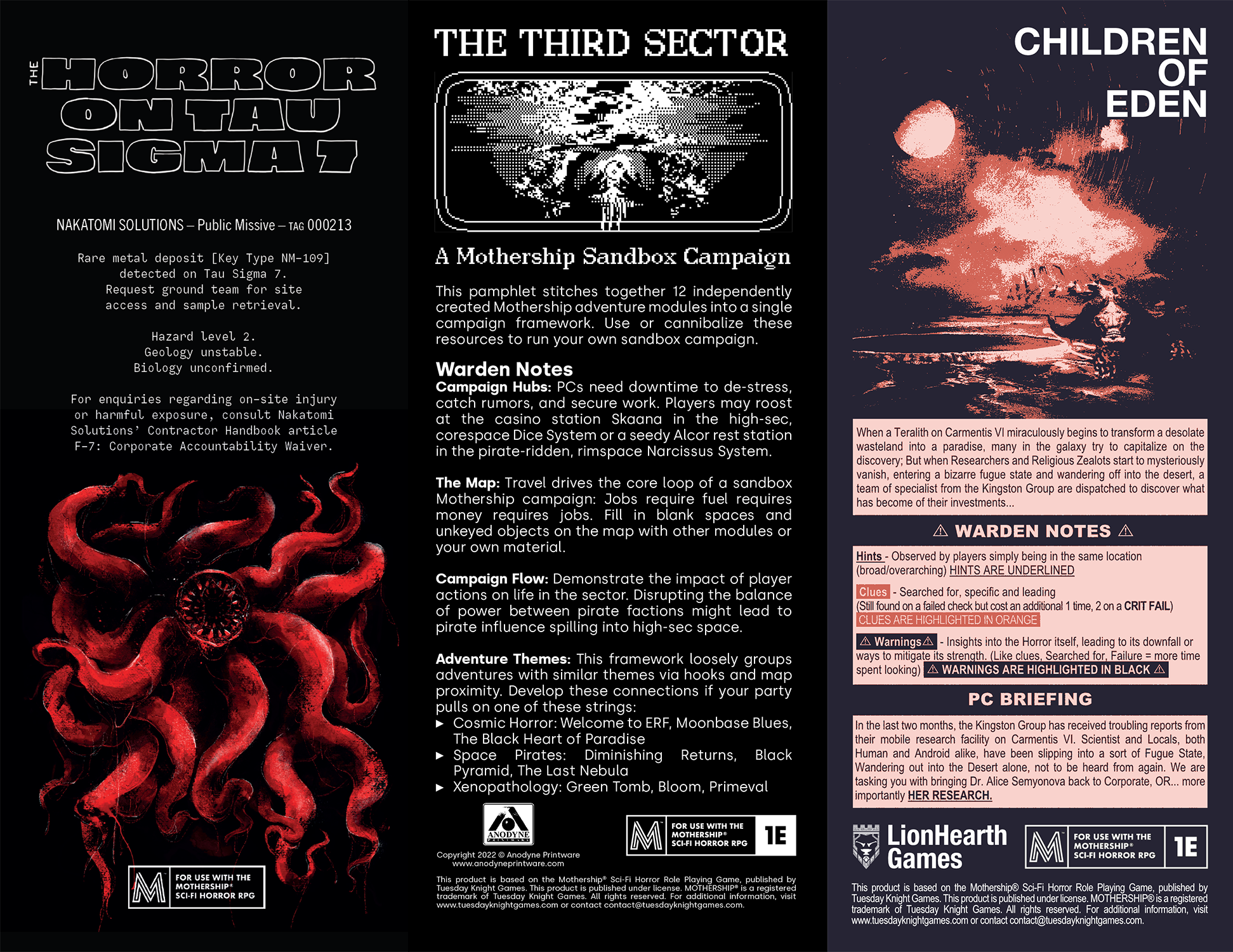
The Horror on Tau Sigma 7 / The Third Sector / Children of Eden

Go to Part 1

THE THIRD SECTOR

I really love the concept of Ian Yusem’s The Third Sector: Take a dozen different third-party Mothership adventures and weave them together into a sandbox spanning five solar systems. Hypothetically you should be able to do some light remixing, add a little connective tissue, and have a great little campaign-in-a-box showcasing the best of the best.

Unfortunately, The Third Sector really shouldn’t have been packaged as trifold module.

The limited space of the trifold format lends itself to material which is either too brief or broad. But the work required to coherently bind disparate published adventures together is, in fact, entirely in the details.

The two central pillars of The Third Sector are the sector map and the scenario hooks added to each adventure.

The sector map is attractive in a retro, 8-bit-graphics style, but curiously lacking a lot of pertinent details (e.g., the names of planets).

The scenario hooks are designed to link the adventures to each other (so, for example, you’ll find hooks in the Green Tomb that will lead you to Moonbase Blues, Alcor Station, and Echoes in the Graveyard). A minor problem here is that the section is incomplete, with some of the scenarios not receiving scenario hooks for reasons which are entirely unclear to me.

A more significant problem is that most of the scenario hooks are either unengaged (they mention a place exists, but gives no reason for the PCs to go there), non-actionable (they indicate that a place exists, but don’t tell the PCs how to find it), or both. This is likely, once again, due to the limited space, since vague references are easier to squeeze into a single sentence than meaningful, actionable information.

Probably the most interesting thing in The Third Sector is the random encounter which reads, “[Corporation] acquired [other corporation]. (Choose 2 from random adventures each time rumor rolled.”) This is an intriguing procedural method for unifying the disparate hypercorps found scattered throughout the source adventures over time.

In practice, though, that unification — and not just of  hypercorps — is exactly the sort of considered, careful, creative work that would have made The Third Sector a truly useful resource.

GRADE: F

WRATH OF GOD

Wrath of God - Ian Yusem

Wrath of God is another example of a supplement that’s just trying to cram WAY too much into the trifold format. In this case, that includes:

  • A complete skirmish system for space fighter combat.
  • A hex-based Battlefield map keyed with various Locations of Interest.
  • A prequel to a longer adventure called The Drain.

In this case, the result is basically incoherent. I’ve been backwards and forwards through Wrath of God and I honestly don’t have the slightest inkling of what this adventure is supposed to be.

For example, the skirmish system includes a Skirmish Map keyed with symbols, but what these symbols mean (if they mean anything) doesn’t seem to be indicated. The Battlefield Map similarly has a bunch of symbols, although most of these seem to be related to the content keyed to these hexes… except not all such hexes are keyed. (Although some of the unkeyed hexes are referenced in other keyed hexes, which is an insanely confusing layout that I can only imagine is due to the space limitations unnecessarily imposed by the trifold format here.)

I also only have the vaguest sense of what the Battlefield Map represents. Maybe it’s a war currently being fought? Or many wars currently being fought? Or the wreckage of older wars?

There are Bogeys who will attack the PCs. But… why? And who are they, exactly? Where did they come from? Where are they going? Your guess is as good as mine.

“Okay,” I think. “This is a prequel to The Drain. So maybe I need that full adventure to understand this one.”

Unfortunately, no, that doesn’t help. Because (a) it turns out that Wrath of God doesn’t seem to actually sync up with The Drain and (b) nothing is actually explained. The PCs are seeking the 3rd Testament, which is apparently a radio broadcast being sent from a colony called Within Wheels. What is the 3rd Testament? No idea. Why is the colony transmitting it? No idea. How are they transmitting it? Possibly from something called the Grail. How’d the Grail get there? Stop asking questions, please.

GRADE: F

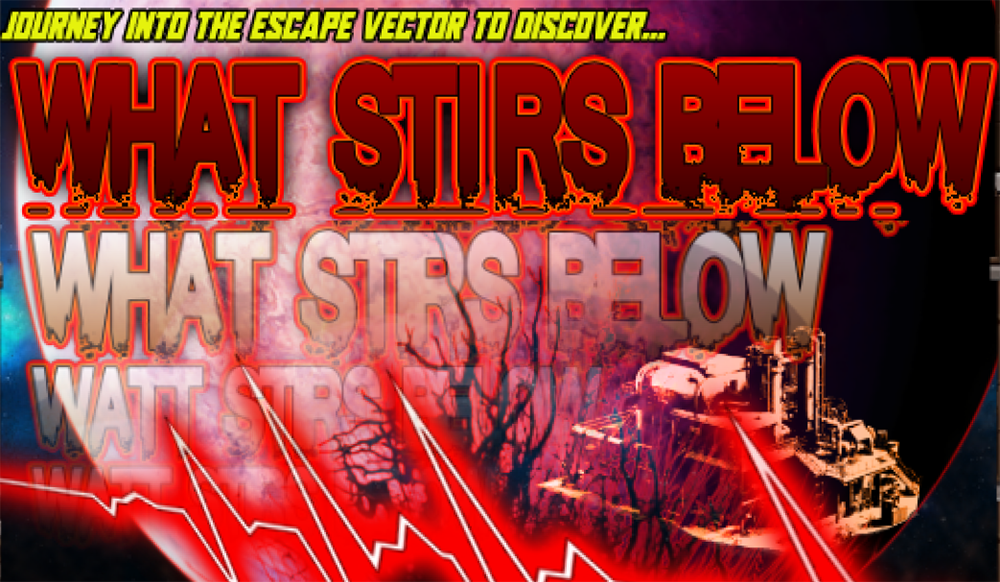
WHAT STIRS BELOW

What Stirs Below

Something has gone wrong at a geological survey station and the PCs are dispatched to (a) figure out what happened and (b) rescue as many VIPs as possible.

What Stirs Below includes a helpful What The Hell Is Going On? section:

There is an ancient power station deep below the surface. A skeleton crew of ancient aliens uses giant worms to generate energy and sustain the crew’s near-immortality. With enough power generated, this moon will depart on a 10k-year interstellar journey toward Earth… or whatever is a good fit at your table.

It’s a cool concept, which is unfortunately held back from its potential by a number of problems.

First, and probably most intractable, is that the size of the adventure doesn’t match the scope of the adventure. There’s this implication of a huge, hollowed-out moon filled with aliens preparing for some sort of multi-millennia odyssey… but a nine-room location-crawl can’t really deliver on that promise.

This kind of size/scope mismatch is not uncommon in RPG adventures, and I find that they consistently create a mixture of disappointment and confusion in players, while pushing me into a weird, dissociated fugue state between what the adventure actually is and what it’s asking me to convey.

Second, there are a number of execution issues which will leave you confused and disoriented:

  • The map of the adventure has a literal ? where a room should be, and I simply can’t figure out why.
  • The survey station has been destabilized by the tunnels below the station collapsing, which has created a sinkhole the PCs can use to access the alien chambers. This sinkhole is located… somewhere? The adventure never seems to specify.
  • The adventure key is filled with typos. For example, Area A5 has an exit that leads to… Area A5? (I think the rooms were renumbered on the map at some point and the key wasn’t correctly updated, but I’m not 100% sure.)
  • There’s an android who, Alien-style, will attempt to impede the PCs’ investigation and even “self-destruct if necessary.” But… why? No explanation is given.

Related to these issues, the PCs are instructed to determine what happened at the station, but I honestly can’t even figure that out for myself: It’s not clear what (if anything) triggered the geological collapse. It’s not clear what any of the NPCs did in the aftermath of the collapse or what the timeline of events was. It’s not even clear why the hypercorp lost contact with the NPCs and needed to send the PCs.

The end result is an adventure that’s… mostly OK. But I would probably end up completely re-keying the entire thing before I would feel comfortable running it.

GRADE: C-

THE HORROR OF TAU SIGMA 7

The Horror on Tau Sigma 7

A routine system survey has detected the signature for the rare mineral NM-109 on Tau Sigma 7. The PCs are sent in as a survey team to confirm the presence of the mineral.

What they discover, while exploring a nearby cavern, is an alien bioplastic cyst-complex which is an untriggered hatchery for a long-extinct alien species. (It sure would be a pity if the PCs accidentally triggered the birthing process, wouldn’t it?)

In The Horror on Tau Sigma 7, D.G. Chapman delivers a creeptacular location-crawl. The excellently xandered, truly three-dimensional environment and accompanying key would be strong enough to recommend this adventure entirely on their own merits, but he also spikes the punch with several scenario-spanning elements:

  • The entire complex is a living organism, and responds to the PCs’ presence and actions through an Immune Response Level that escalates and transforms the adventure.
  • The complex is suffused with a strange, red liquid referred to as Lifeblood. Essential to the alien biology, it creates numerous strange effects (particularly to exposed PCs).
  • Strange cave paintings can be found throughout the complex, which change and evolve as the Immune Response Level increases.

The result is fabulous. I highly recommend inviting your players to Tau Sigma 7.

GRADE: B+

CHILDREN OF EDEN

Children of Eden

Graham T. Richardson fills Children of Eden to the gills with an astoundingly rich assortment of alien and exotic worldbuilding: The 200+ meter-tall teralith; an alien skeleton worshiped by the Children of Eden as a god. The Salvage Seal, where a gravitational anomaly yanks vessels out of hyperspace and crash lands them on a fungi-ridden planet. The corrupted Theogeny Engine, an alien terraforming ship buried near the teralith which has recently reactivated, leading to the religious belief that the teralith itself is miraculously transforming a wasteland into paradise. A ruined scientific research center trying to probe the truth of this strange terraforming.

And all of this is supported by a rich cast of characters and a disquieting mystery occluded by a hypercorp’s desire to exploit and religious zealots’ desire to believe.

It’s truly amazing just how much richly detailed and soul-searingly evocative material can be found on these two pages. It’s simply inspiring. Richardson creates a vivid world that compels you to share it with your players.

My only real complaint is that there’s so much stuff in Children of Eden that the connective tissue between all of these elements is often obscured. It can be a little unclear exactly where stuff is in relation to each other, for example, which can make it difficult to figure out how you should be presenting this rich world to the players. There are just places where I’d probably be a little happier if the implied setting was a little more explicit and, therefore, easier to access during play.

To at least some extent, though, this is just grousing over having too much of a good thing. I’ll happily draw up a map, work up a timeline of events, and jot down a revelation list to help keep things clear at the table if it means that I can visit the Children of Eden.

GRADE: B

Note: LionHearth Games provided me with a review copy of Children of Eden.

Go to Part 4

Dinoplex Cataclysm - So You've Been Chump-Dumped - Year of the Rat

Go to Part 1

DINOPLEX CATACLYSM

It’s Jurassic Park, but on a space station!

This is a cool idea for an adventure, but this scenario is, unfortunately, sabotaged by lackluster execution.

For example, there’s a player handout designed as a kid’s activity game where they’re supposed to find all twelve dinosaurs in the Dinoplex! If they can find them all, they get a free sticker set! But there aren’t twelve types of dinosaurs in the adventure. Even if you include the wooly mammoths and sabretooths which, despite the adventure’s claims, are clearly not dinosaurs, there’s still only eleven creatures listed. I really want this to be something clever – are they supposed to count Tony the T-Rex, the park’s mascot, as a separate dino? is the task deliberately impossible so the park never needs to give the kiddies their sticker sets? – but I’m pretty sure it’s just a mistake.

The adventure primarily consists of six park zones, each given a brief description, a list of attractions, a list of “dinosaurs”, and a one sentence description of how everything is changed “post-disaster.” I can hazard a few guesses on how this material could be used to actually run the adventure – a sector crawl seems like a good fit? but the park map is a hexmap, so maybe per-hex random encounter checks? – but at a certain point I’m no longer really describing the published adventure.

Dinoplex Catalcysm also briefly flirts with the idea that the resort could be used as a shore leave location, possibly more than once, before the disaster strikes. Since taking shore leave is a central mechanic in Mothership, required for characters to recover and advance, this is a very clever idea that could really give the scenario some extra punch. Unfortunately, it’s not actually developed into something useable: First, it’s not integrated into the actual shore leave mechanics. Second, the pre-disaster amusement park activities are largely not interesting enough to support any meaningful spotlight during actual play.

The same problem is found in the meat of the scenario: The post-disaster details of the park are simply too shallow, in my opinion, to support meaningful play. The fundamental details of the park are also too sketchy, with, for example, tundra environments requiring specialized cold weather gear being located a couple hundred meters from humid swamps with no explanation beyond possibly a vague wave in the direction of a “weather system.” Even the “disaster” which triggers the adventure is a headscratcher. I actually missed it entirely during my first read-through of the adventure because it’s hidden away as a single sentence in a sub-bullet point.

Ultimately, this seems to be more the concept of an adventure than an actual adventure.

GRADE: D

YEAR OF THE RAT

Year of the Rat - Written by Owen O'Donnell, layout and art by Lettuce

The PCs are sent to retrieve the black box from a curiously nameless casino ship that went missing a month ago. Unbeknownst to the former owners or the insurance company looking to avoid a costly payout, the ship has become infested by a rat-like alien species.

The adventure primarily consists of a one-page map-and-key spread detailing the ship. This has some really nice details, although the ship consisting of only a single two-dimensional deck feels a little wonky.

An important note: Although at first glance this appears to be formatted as a trifold module with six panels of information, for some inexplicable it’s not actually designed to be folded into a pamphlet. So if you do, in fact, print the adventure, fold it up, and attempt to read it, you will be very confused.

This disorientation is not helped by a layout which is clearly more interested in looking “cool” – with lots of graphical artifacts, “dirt,” and the like — than being usable or even legible.

Also worth being aware that, since the PCs will be looting a casino ship, their payout from this job is quite likely to be incredibly large. (And that’s before factoring in the insurance company’s payment to the PCs being salvage rights for the entire ship… which doesn’t quite make sense to me. You might also want to interrogate the logic of “ship went missing, here are the coordinates where it’s located” before running this.)

Despite a few rough edges, though, Year of the Rat is a solid adventure that can be a lot of fun in play. The rat-like aliens are, of course, the stars, and they can be a wonderful change of pace in a long-running Mothership campaign: Creepy, varied, and interesting, but also an infestation that the PCs can actually triumph over and clear out. With the same discordance that marks the entire adventure, however, the stat blocks for the rats are also incomplete and broken, so you’ll need to re-stat them before running the adventure.

GRADE: B-

MITOSIS: ESCAPE FROM STAR STATION

Mitosis: Escape from Star Station - by Chris Airiau

At a cutting-edge research station, a bacterial and/or viral outbreak causes some humans to mutate into either Lethian Braniacs or Cyberviral Goons. These mutants seem to have formed gangs and divided the station between them. Oat milk inhibits the Braniacs, but causes the Goons to go berserk. Walnut oil has the opposite effect.

There’s a map that’s very difficult to read, with lots of symbols that are unexplained. There’s a random encounter table consisting of either goons, brainiacs, or goons AND brainiacs.

The key for Area 0 seems to suggest that the PCs are pirates who were captured and then locked up in the prison and then their pirate captain promised escape, but the escape never happened, and also the captain (who they might meet later) doesn’t seem to know who they are.

To be honest, there’s like five different things going on in Mitosis: Escape From Star Station, and none of them are properly explained. This includes the nature, reason, and timeline of the outbreak itself, with just a vague reference to the “Mitosis-bacteria breach” and the “Mitosis-bolstered cybervirus.” (But also “Mitosis” is a board game that was being played in the cafeteria?) The color version of the module is also essentially unintelligible, although thankfully a black-and-white version is included.

What little coherency I can piece out from the text seems more like a parody of Mothership than anything else. There is a zany, schlock horror that seems promising if the idea of playing through a movie that Mystery Science 3000 would mock is appealing to you.

But, particularly at $6, I really can’t recommend this one.

GRADE: F

SO YOU’VE BEEN CHUMP-DUMPED

So You've Been Chump-Dumped

This is an odd adventure because the title and pitch — while being quite evocative! — really have nothing to do with the actual adventure.

The pitch is:

A cheap Jump-1 ticket? You thought you got lucky.

Now, stuck in the airlock with the other marks, you couldn’t feel lower. Then the warning lights flash. You hear a loud clunk, and your stomach sinks. In a blink, you’re all gulped into the nothing beyond with a brief whoosh.

Stars spin as you tumble through space, screaming promises of violence upon the friend who said they knew the perfect guy, who turned you into a doomed chump. The sounds just rattle around inside your helmet. Your only hope is this vaccsuit you were lucky enough to save for, or inherit, or steal and paranoid enough to don before leaving solid ground.

I was really intrigued by this! A unique survival scenario with vibes similar to Alfonso Cuarón’s Gravity? In addition to the proposed jump-travel scam, you could imagine whipping out this adventure in any number of situations: Things go wrong for the PCs when pirates board their ship! A catastrophic hull breach! The only way to kill the alien horror is by blowing the airlock!

How will the PCs survive?!

Unfortunately, it turns out that this isn’t the adventure So You’ve Been Chump-Dumped delivers. Instead, the answer to, “How will the PCs survive?” is, “They immediately bump into a covert science vessel where an alien experiment has recently escaped confinement.”

How convenient.

It turns out, though, that this other adventure is really quite good. The adventure key describing the ship is colorful and engaging. The alien organism is creative and dynamic, driven by procedural generators that will create a unique playing experience for every group.

Other than the bait-and-switch, my only real quibble is the adventure map, which supposedly depicts the deckplans of the science vessel:

Node map of the spaceship

I’m obviously not opposed to a good pointmap, but this one is abstract to the point where it becomes impossible to actually describe the ship to my players. There are also some rather key questions raised by this map — like what, exactly, is the nature of these hallways? and what’s going on with this random vent system? — that I think you’ll want to straighten out before running this one.

I’ll definitely be drawing up a version of that map for myself soon, though, because So You’ve Been Chump-Dumped is definitely going into my open table rotation.

GRADE: B-

Go to Part 3

Mothership adventures lying in a spread on a table.

I’m a big believer in open and community licenses that allow third-party creators to publish and sell adventures and supplements for RPGs. Aesthetically, roleplaying games are not just artistic works in their own right; each RPG is a unique medium for creating new works. It’s good for society itself for these mediums not to be encumbered and stifled.

And from a practical standpoint, third-party content is of huge value to the original IP creator. Fears of competition have long since been shown to be irrelevant, as the primacy of the official, first-party content remains supreme among players and GMs. On the other hand, an RPG — much like a computer operating system — gains an immense commercial benefit from having a large and robust library of compatible support material: Each third-party supplement is an opportunity to capture the imagination of a gamer and propel them to the gaming table, which in turn exposes even more players to the game, driving both sales and gaming in a virtuous cycle.

The problem, unfortunately, is that most third-party licenses in the RPG industry have failed. Third-party supplements will generally only sell a small fraction of what first-party supplements will sell; and most first-party supplements only sell to a small fraction of the people who bought the rulebook and/or are playing the game. For third-party publishers to find success, therefore, the RPG they’re supporting needs to already have a very large audience — an audience so large that a fraction of a fraction of that audience is large enough to make a third-party supplement profitable.

And the reality is that the vast majority of RPGs — even those you likely think of as being big success stories — simply don’t have a large enough player base.

As a result, most third-party licenses simply fail. Most of the “success” stories revolve around games with enthusiastic hobbyist designers creating stuff for the love of the game. And good for them! But the games which have managed to create truly professional and thriving third-party markets can almost certainly be counted on the fingers of one hand.

What Mothership, the sci-fi horror roleplaying game from Tuesday Knight Games, has accomplished, therefore, is truly remarkable. First released in 2018, the game quickly invited third-party support not only via a third party license, but by generously and copiously helping to put the spotlight on these supplements. The result is that literally hundreds of third-party supplements have been created, and with the release of the Mothership boxed set this year, the market is, if anything, getting even stronger.

I think another important factor in Mothership’s third-party success is the game’s embrace of the trifold adventure format. I’ve already written a review of the really great first-party trifold adventures, each just two pages long and designed to be folded up into a trifold pamphlet. These are great for a GM because they’re designed to be picked up, read through in just ten to fifteen minutes, and then immediately run. But they’re also great for third-party creators, because they can (a) be quickly produced with a low investment of time and money and (b) given impulse-buy prices that make it easy for GMs to take a risk.

The result is that dozens and dozens of these third-party trifold adventures have been published, and they are an absolute treasure trove for GMs. I’ve launched a Mothership open table, in large part because the library of easy-to-run adventure content makes it easy to always have something ready for the next group of players.

The sheer number of projects made possible by the trifold format has also helped to create an audience looking for those third-party Mothership projects. The existence of this audience, in turn, encourages creators to pursue even more projects and more daring projects. And the audience is willing to take bigger risks on creators shooting for the moon when those creators have already built a rep through their more accessible projects.

This is a virtuous cycle which has already resulted in the creation of several large and impressive Mothership supplements. I’ll likely be taking a closer look at those in the near future. For today, though, I want to start by putting my own spotlight on some of the great third-party Mothership adventures I’ve been exploring. (And also, for better or worse, some of the less-great ones, too.)

SPOILERS AHEAD!

CIRCLE THE FLAME

Circle of Flames

Joel Hines’ Circle the Flame is one of those adventures that’s almost effortless to drop into your campaign: The Tinea Weather Station, a circular space station, is in orbit around the water world of Mani. Unfortunately, that orbit is now decaying and its corporate overlords have announced a bounty for any troubleshooters willing to board the station and retrieve the valuable scientific data and IP before everything burns up.

Including the semi-uplifted chimpanzee named Boopsie.

(Who the PCs will quickly discover has gone into a bloodythirsty rage, killing anyone she encounters and generally wrecking the joint.)

The adventure consists of a simple map-and-key of the station, along with a simple countdown mechanic, at the end of which the station plunges into the atmosphere of Mani and burns up.

Tick, tick. Time to roll out!

Whether following the corporate bounty or opportunistically responding to Tinea Station’s SOS, it’s easy to hook PCs into this.

The only thing really holding Circle the Flame back are the curious lacunae in the text. For example, the adventure often refers to Boopsie “retreating to the ducts,” but these are neither included on the map nor detailed on the text.

The most significant of these gaps, though, are:

  • What happened to Boopsie? At one point we’re told that someone was hired “as a backup operator in case the unthinkable happened to Boopsie.” Is that just a euphemism for death? Or something else? And if something else, is that what caused Boopsie to go bloodthirsty?
  • What happened to the station? At first I assumed that Boopsie going nuts was the cause of everything else going wrong, but at the very end of the adventure we’re told that, “Operation logs reveal orbital distance was modified below safety constraints by remote command originating from an encrypted transmission planetside.” But… from who? And why?

My view is that the author of a published adventure should consider themselves a co-conspirator with the GM. That means clearly and concisely explaining what the plan is. It’s strangely common for published adventures to instead try to pull a fast one on the GM.

In this case, I’m not sure if Hines is trying to pull a fast one, or if he just ran out of space. I was initially so convinced that the mysterious transmission from Mani was a teaser for Hines’ Tide World of Mani supplement that I went out and grabbed a copy, but there doesn’t seem to be any follow-up there.

Despite these lacunae being rather frustrating, it’s not terribly difficult to fill them in. (The mystery ducts are probably the most troublesome in terms of actual play.) And you’ll certainly want to fill them in, since Circle the Flame is a tight, well-paced one-shot.

GRADE: B-

CLAWS OUT

Claws Out

Some lacunae are a bit harder to puzzle out.

In Charles Macdonald’s Claws Out, the PCs are onboard the Agamemnon transport ship heading to the Banquo Mining Facility, which is about to be reopened. Most of the passengers are mining personnel getting shipped in. (It’s unclear why the PCs are here, but there are any number of possibilities, including heading somewhere else and Banquo just being one stop along the way.)

The adventure does a nice job of providing tight, effective write-ups for everyone onboard, setting you up for a social-driven mystery scenario rife with paranoia and murder.

Unfortunately, there are three major problems that largely cripple this adventure.

First, there’s something funny going on at Banquo. Apparently alien artifacts have been discovered at the site and the “miners” are actually all undercover scientists sent to investigate them. (There’s also a corporate agent “sent to prevent miners from discovering the true nature of the facility,” but there are no actual miners onboard the Agamemnon and the agent is immediately killed, so that dramatic thread doesn’t really go anywhere.)

The big problem is that everyone onboard has a secret Banquo-related agenda and secret information about what’s happening at Banquo… but “alien artifacts have been discovered” is literally the only thing the GM is told about it.

So as nice as the character write-ups are, they’re mostly a secret homework assignment.

Second, the core plot of the scenario is that there’s an alien shapeshifter onboard which starts killing people. (It’s completely unrelated to the alien artifacts on Banquo.)

The most egregious oversight here is that they forgot to provide a stat block for the creature. It’s kinda tricky to run a bug hunt scenario without that.

But the monster is also just kind of vague in general: It’s a brain parasite that lives in your brain, but then also a shapeshifter. It’s “inexplicably afraid of cats” and this is a significant plot point; but its primary modus operandi is turning into a cat (thus the title).

Finally, the lack of blueprints really breaks the adventure. The whole core of the scenario revolves around how the monster is moving around and gaining access to various spaces on the ship. The players are, frankly, going to demand a ship layout, and the GM will be faced with reconstructing one that’s consistent with the adventure’s plot.

In short, Claws Out is an adventure laden with booby traps waiting to sabotage the GM.

I’m not quite willing to write the whole thing off, because there are some cool ideas and characters here. (I particularly like K-RA, the android who has so thoroughly entwined herself with the ship’s computers that they’ve become inseparable.) But the salvage job is so extensive that I really wouldn’t recommend grabbing this one.

GRADE: D-

MOONBASE BLUES

Moonbase Blues

Moonbase Blues by Ian Yusem and Dal Shugars isn’t actually a trifold adventure: It’s a bifold one. (Single sheet, print on both sides, fold down the middle.) Hopefully y’all won’t run me out of town on a rail for taking the liberty of reviewing it here.

Everything was fine on the ironically named Azure Base until a strange, blue comet was pulled into the small moon’s orbit. Each time the moonbase is bathed in the comet’s light, the colonists exposed to it are driven into a frenzied madness.

Yusem and Shugars use this setup to craft a pretty solid sandbox adventure: A simple map of the base keyed with the mysterious wreckage left in the wake of the comet, juiced up with the cyclical time pressure of the comet’s orbit and supported by a healthy array of GM tools including well-aimed random tables (meteor-mad characteristics, hazards, stuff found on corpses) and stock NPC survivors who can be slotted into any scene.

The only real stumble here, in my opinion, is that the scenario hook is sort of incoherent. Over a quarter of the adventure is dedicated to a “you all wake up and the Computer tells you to do the following tasks” setup which includes stuff like “unclog the toilets” and “go outside and look up at the comet,” but this seems to have no connection to the rest of the scenario as presented and no explanation is given for how the PCs got there or why their task list includes looking up at the comet. The rest of the text seems to also assume completely different framing devices in various places.

If these were more coherently presented as a list of options, there’d be utility here. But instead it all just creates a weird patina of confusion.

The truly unfortunate thing here is that the space wasted on a largely unusable setup could have been used for even more of the really cool adventure tools that make Moonbase Blues so fun and useful!

GRADE: B

Go to Part 2

Archives

Recent Posts

Recent Comments

Copyright © The Alexandrian. All rights reserved.