The Alexandrian

Posts tagged ‘d&d’

IN THE SHADOW OF THE SPIRE

Session 18B: Missed Opportunities

“The Crimson Coil?” Elestra said. “I think I’ve heard something about them. Random acts of violence. Vandalism. That kind of thing. I got the impression they hadn’t been around for years, though.”

“That’s right,” Tee said. “I was still living here. The cult members wore blood-red robes and hoods. They’d spontaneously appear in huge gatherings to wreak random chaos. Then, about two or three years ago, the Knights of the Pale tracked them to their stronghold – I think it was called Pythoness House. Reportedly the whole cult was wiped out.

Last year I wrote Rulings in Practice: Gather Information, which discussed how to handle information-gathering tasks like canvassing and research.

The 3rd Edition of D&D, however, features a very interesting and fairly clear-cut distinction between “information you gather” (in the form of a Gather Information check) and “information you just know” (in the form of a Knowledge (local) check). Given that the information in question was often the exact same information, I found it necessary to really figure out exactly what the relationship was between these skills and how they should be handled in play. It’s a distinction that I think remains valuable in subsequent editions of D&D, including Pathfinder (which has the exact same distinction) and even 5th Edition (which lacks the specific skills but nevertheless will run into similar issues of adjudication).

The short version:

Knowledge (local) gets you the same information, but at +5 DC.

Knowing something off the top of your head is simply more difficult than going to look it up. From a balance standpoint, the +5 DC is also the cost you pay for not needing to spend 1d4+1 hours (in the case of 3rd Edition) looking for the information.

This same basic principle can be applied widely, even in systems that don’t mechanically distinguish between different forms of knowledge acquisition: In some cases, depending on the exact mechanics involved, you might test to see if they know something off the top of their head and then, if they spend the time necessary to actively look for that information, you can apply a bonus to their check.

(If you wanted to focus even more attention on this aspect of game play, you could even vary the size of that bonus based on how they actively look: Better libraries give better research bonuses, for example.)

In practice, there are some forms of information that very specifically require canvassing and, therefore, Knowledge (local) simply isn’t applicable for. (Did anyone see Bob Anonymous in the silver light district on Friday night? You need to actually go down there and ask around.) In practice, though, I recommend generally being pretty liberal in what you allow people to now.

ACCLIMATION

The other issue raised by Knowledge (local) was exactly what “local” consists of and also what happens with the skill when you leave one “local” and go to a different “local.”

As a loose guideline, I would apply a -4 penalty to Knowledge (local) checks on a scale from whatever your “local” was: Different city in the same area. Different region in the same kingdom. Different kingdom. Different continent (or similar divide). Different plane.

(So the penalty would be -8 if you were from the boondocks and went to the capital.)

This penalty could be quickly abrogated by a character who became acclimated to a new locale. At various times I would use a period of a fortnight or a month, but at the end of each period the size of the penalty would be reduced by -1. (That reduction was against the base -4, not the total penalty.)

The logic was that part of your Knowledge (local) skill is, in fact, the knack for picking up local knowledge.

On one occasion a player wanted to speed this process up, so I allowed them to make Gather Information checks once per day (and with the normal time required) vs. DC 15. Each success reduced the number of days required by the margin of success on the check.

This never really came up in the Ptolus campaign, of course, because it’s all set in one city. But in other campaigns I found it was a nice balance between making the Knowledge (local) skill useful for globetrotting characters and also allowing characters to enter strange places f without instantly being experts on their minutia.

Ptolus - In the Shadow of the Spire
IN THE SHADOW OF THE SPIRE

SESSION 18B: MISSED OPPORTUNITIES

March 22nd, 2008
The 7th Day of Kadal in the 790th Year of the Seyrunian Dynasty

Their carriage came to a clattering, jolting halt on Brandywine Street before the abandoned lot.

Tee led the way into the ruined shed, taking a few moments to verify the hidden signs she had left. “They haven’t been disturbed,” she said. “No one’s come this way.”

At the bottom of the ladder she found the doors of the antechamber still locked. She slid the key into the lock, turned it, and then stepped back – clearing the way for Agnarr and Tor.

The doors swung wide to reveal utter putrescence: The pinkish flesh of the lair seemed to be dying, literally rotting away from the walls. Pus and blood dripped from gaping, ulcerous wounds.

“Oh no…” Tee murmured, already suspecting that they were too late.

They headed down the main hall. Agnarr took the time to sprint down the side passage leading to the sewer entrance. It had been smashed open from the outside. He knelt down: The pulpy, dying flesh had clearly been trampled by many feet, but he wasn’t sure how many had passed this way… or whether they were still in the complex.

The rest of the group proceeded down the main hall. When they reached the room where the idol had rested, Tee’s worst fears were confirmed: The door had been smashed open with a battering ram which lay nearby. The idol had been ripped out of the floor. It was gone.

“Dammit,” Tee cursed, tears welling in her eyes. “I should have just taken it. Why didn’t I just take it?” (more…)

IN THE SHADOW OF THE SPIRE

Session 18A: Key to the Past

I’ve found a lead on the key. Meet me in the alley off Yarrow Street.

This session of In the Shadow of the Spire marks the beginning of Act II of the campaign.

As we’ll see (and be discussing) in the future, Act II is primarily structured around two major threads. Before the first session began, I knew that there would be two triggering events – one for each thread – that would kick off Act II.

The letter the PCs receive at the beginning of this session is one of those triggers: During the period of amnesia which began the campaign, I knew that the PCs had hired someone named Shim to help them find a magical artifact. Despite the PCs no longer being aware of it, the investigation had continued apace and had now yielded results.

The letter acts as an external event: Since the PCs were not interacting with Shim (nor were engaged in any activities which might bring them into Shim’s sphere of influence), I had full control of when Act II would begin and, more importantly, I could build all of the investigations that would sprout from Shim’s contact without needing to really think about how the events of Act I might turn out. The material was, effectively, located behind a firewall.

(This should not be taken to mean that the events of Act I were somehow irrelevant to the events of Act II. In this very session, the PCs are going to make some truly momentous choices that will completely alter how they intersect with the major events of Act II: The situation that’s triggered by Shim’s letter exists behind a firewall; but once the firewall is breached, the PCs and everything surrounding the PCs will begin to interact with it.)

A firewall like this is not necessarily impregnable. We saw an example of this earlier in the campaign when the PCs independently interacted with the Hammersong Vaults and then spontaneously concluded (correctly!) that they may have stored other items of value there during their amnesia. (And we could imagine a similar hypothetical scenario in which the PCs needed the services of someone like Shim, identified Shim as an option, and chose to contact him. Which would have led to a possibly far more interesting – and confusing! – conversation.)

PULLING THE TRIGGER

With a trigger like this in place, how do we know when to put it into play?

You could simply schedule the event: As soon as you know that the trigger is going to happen, you figure out when it should happen and literally place it on the calendar. (A campaign status document is great for this.) This is what I had done with the Hammersong Vaults, for example.

Alternatively, you could mechanically check to see when the trigger occurs. For example, you might make a 1 in 8 random check each day to see if that’s the day Shim finishes his investigation. Or you could set up a progress clock coupled to a mechanical structure for determining when the clock gets ticked.

For a more dramatist bent, you can simply decide when to pull the trigger to best narrative effect. This is largely what I did for the beginning of Act II, with my primary concern being effective macro-pacing: I knew I wanted to space out the two Act II triggers a little bit. I also knew I wanted some crossover with ongoing Act I material so that there was a sense of continuity instead of a sharp discontinuity.

Since Act I wasn’t linear in design, this was not necessarily a straightforward process: There was a bunch of Act I scenarios the PCs never engaged with (and which, as a result, I mostly never prepped) and there were a bunch of other scenarios in Act I that hadn’t been part of the original plan, so I needed to make a judgment call about whether or not certain scenarios had been permanently “written off” and, therefore, how close to the end of Act I we really were.

In practice I also sort of combined methods (which is another valid option): When it was clear that Act I was closing out, I scheduled the trigger for the near future on a specific date. This meant that I wasn’t 100% in control of exactly when or how it might interact with the ongoing activities of the PCs.

Thus begins Act II.

It’s a doozy. Twelve years later, we’re still in the middle of Act II. I’ll almost certainly discuss the reasons for that in a future post.

Ptolus - In the Shadow of the Spire
IN THE SHADOW OF THE SPIRE

SESSION 18A: KEY TO THE PAST

March 22nd, 2008
The 7th Day of Kadal in the 790th Year of the Seyrunian Dynasty

When they arrived back in the tiny shack at the center of the junk-filled vacant lot, Tee took several moments to subtly rearrange the room – prepping the entrance so that she would, hopefully, be able to detect whether or not someone used it.

“We seem to have gotten covered in blood again,” Tor said. “This is becoming a habit.”

“Well, except for Ranthir,” Tee pointed out. “He stayed clear of it.”

After a quick discussion, it was agreed that the gore-spattered wouldn’t have much luck getting into the Nobles’ Quarter (standards tending to be a little higher there). Plus, if Ranthir went he would be too far away from Shilukar’s lair – the spell of alarm he had placed upon the lower entrance would be unable to alert him.

Ranthir was, however, able to use a little magical prestidigitation to clean Dominic’s clothes and Tee always carried a spare set in her bag. So it was decided that Agnarr, Elestra, Tor, and Ranthir would return to the Ghostly Minstrel while Tee and Dominic would return to Castle Shard and break the bad news. (more…)

Dragon Heist

Go to Part 1

One of the first elements I established for the Alexandrian Remix of Dragon Heist was to have the Cassalanters approach the PCs and attempt to recruit them as their agents in the Grand Game: I found the story of their children’s plight very compelling, and the entire situation rife with incredibly tough and emotional decisions that I felt would really elevate the campaign if they were put center stage. (Whereas in a traditional run, even with the Cassalanters as the DM’s chosen villain, it’s very likely that the PCs will never even discover what the Cassalanters’ true motives are.)

But what if we went a different way?

There are four rival factions in Dragon Heist, of which the Cassalanters are only one. If it’s interesting to swap the Cassalanters’ approach from open antagonism to would-be collaborators, what might happen if one of the other factions took the same approach?

Of course, none of the other rivals have innocent children for the PCs to be called upon to save. So their approach to collaboration will look a little different.

MANSHOON’S ULTIMATUM

The timing of Manshoon’s approach can be identical to the Cassalanters (he discovers the PCs are investigating the fireball that killed several of his agents and decides they would be useful pawns), but it might be better to wait until the fallout from the Gralhund Villa raids. Assuming that the PCs end up with the Stone of Golorr, Manshoon would be highly motivated to get them onboard.
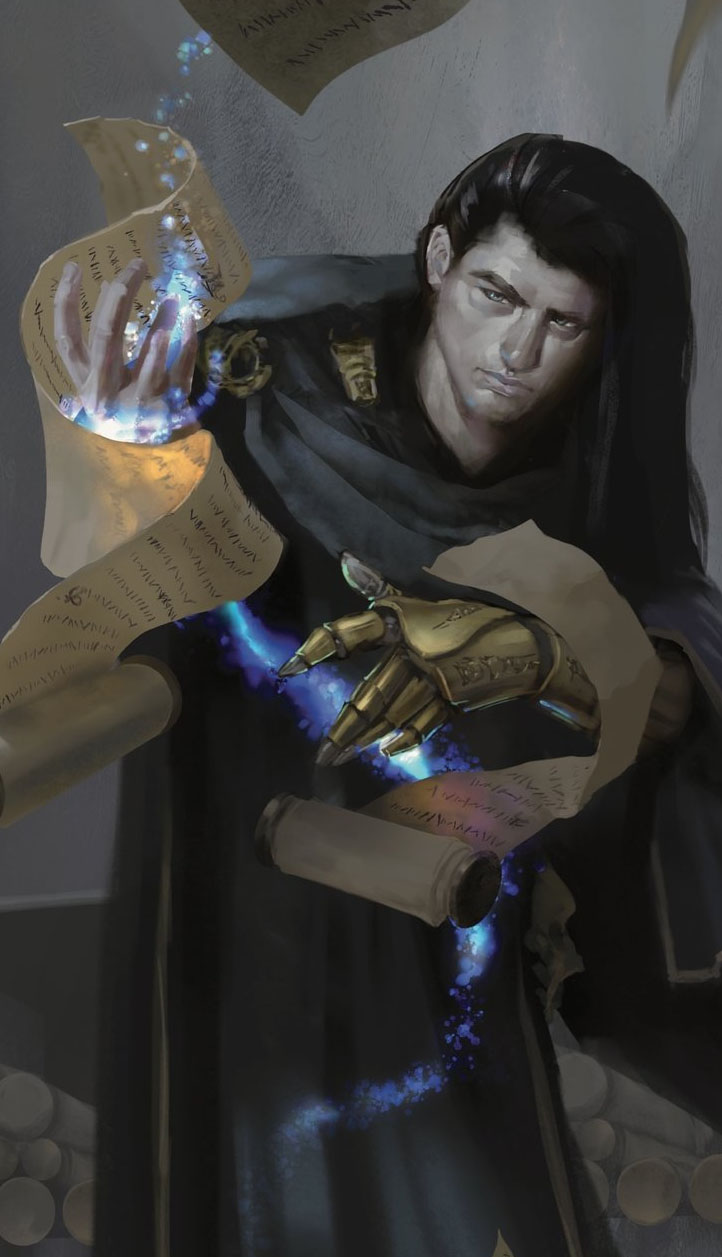
Dragon Heist - ManshoonHis method for doing so, however, is far less discrete than the Cassalanters: He takes a hostage.

Circumstance will determine whether it will work best to find someone in a PC’s backstory or to target someone they’ve built a relationship with during the campaign, but either way the kidnapping takes place offscreen. Perhaps the PC becomes aware of it when they find their loved ones’ ransacked quarters, but more likely it takes the form of a simple letter arriving at Trollskull Manor.

The letter explains the situation simply: They have something he wants. And now he has something they want. A meeting will be arranged (to which Manshoon will send his simulacrum rather than appearing himself), and the following proposal will be made:

  • Their loved one will not be harmed. Quite the contrary. They are enjoying luxurious accommodations (If only the PCs could be so lucky.) Manshoon is personally seeing to it that their every need (except freedom) is being met.
  • The PCs will seek to restore the Stone of Golorr and use it to claim Neverember’s Enigma – the 500,000 golden dragons he embezzled from the city.
  • Manshoon is not an unreasonable man, of course, and if the PCs fulfill their end of the bargain, not only will he free their loved one, they will also be free to keep fully 20% of the treasure.
  • The Zhentarim will also make available to the PCs the full resources of their intelligence-gathering and mercenary networks.

IF THE PCs JOIN MANSHOON: The Zhentarim response teams and safe houses are put at their disposal, with more and more resources being made available as they prove themselves more trustworthy. All of Manshoon’s lieutenants can be played as allies, and this extra muscle will certainly free the PCs up to try more daring (or, at least, direct) heists to obtain the missing eyes.

IF THE PCs REFUSE: Manshoon shakes his head sadly. Then he leaves, has their loved one murdered, and dumps the corpse on the front step of Trollskull Manor.

IF THE PCs SEEK TO RESCUE THE HOSTAGE: A heist! I love heists. The hostage is being held in Area E11 of Manshoon’s Extradimensional Sanctum. The Zhents who made their quarters there have been turned out for the moment; consider spreading them out between Kolat Towers and the Zhentarim faction outposts.

JARLAXLE’S ALLIANCE
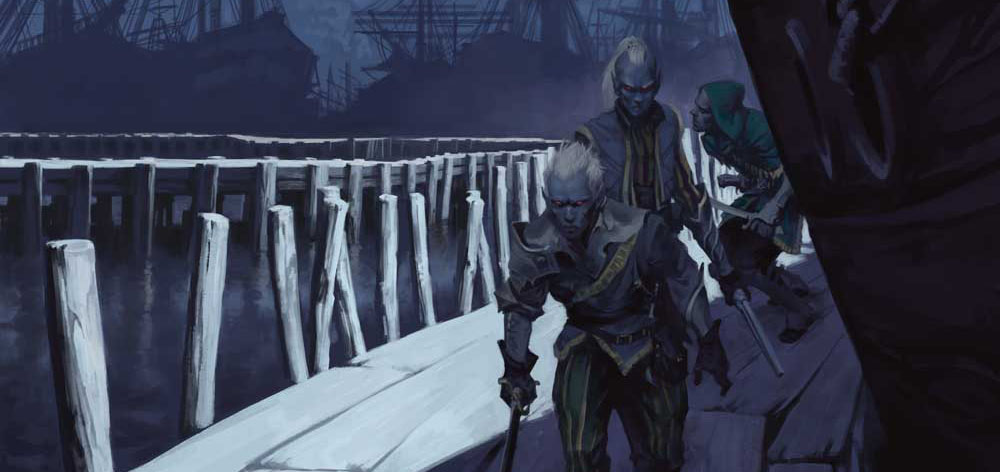
Dragon Heist - Bregan D'Aerthe

For Jarlaxle, we’ll move in the opposite direction: When running the opening scene of the campaign at the Yawning Portal, instead of using Step 2: Friendly Faces (in which the PCs pick one of the NPCs on p. 221 of Dragon Heist to be the contact they’ve come to meet), the contact they’re meeting with is, in fact, Jarlaxle.

Depending on the approach you want to take, they might think they’re meeting with “Captain Zord” or they might know the true identity of who they’re meeting. Either way, Jarlaxle does, in fact, connect them with Volo.

This means, of course, that the PCs are members of Bregan D’Aerthe from the very beginning. Refer to the general information on p. 14-15 of Dragon Heist and the faction missions on p. 34-35.

INVERTED NIMBLEWRIGHT INVESTIGATION: If you want to radically shift Chapter 2 of the campaign, then have one of the PCs’ jobs be to sell the nimblewrights for Jarlaxle. One of the reasons Jarlaxle wanted to get on Volo’s good side was so that Volo could help make introductions to various guilds, nobles, and other highly-placed and influential people. Refer to the list of owners in Part 5C: The Nimblewright Investigation as a resource for the prospective clients Volo refers them to.

Whether the PCs are selling nimblewrights or not, they still have Trollskull Manor as a reward from Volo. Jarlaxle will help bankroll the renovation costs and is eager to develop it as a safehouse for Bregan D’Aerthe operatives.

The fireball explosion also still happens on schedule: When the PCs discover that a nimblewright is involved, they can either go to Jarlaxle and clue their whole organization into the Grand Game. Or it’s possible that they were literally the ones who sold the nimblewright to the Gralhunds. (Small world, eh?)

THE GRAND GAME: Tracking forward, slot in the PCs everywhere that the campaign refers to Jarlaxle’s agents.

At Gralhund Villa they’re able to review nimblewright footage in Jarlaxle’s crystal ball and are then ordered to set up a surveillance post. (Maybe they even end up in Artheyn Manor, just like Fel’Rekt would in a ‘normal’ campaign.)

I recommend not having Jarlaxle accompany them on the other heists (he has a lot of other projects and a busy social calendar to attend to), but they can certainly tap Bregan D’Aerthe resources (in the form of a response team). And Jarlaxle may be able to directly feed them information (and access) to Xanathar’s Lair.

XANATHAR’S GANGSTERS
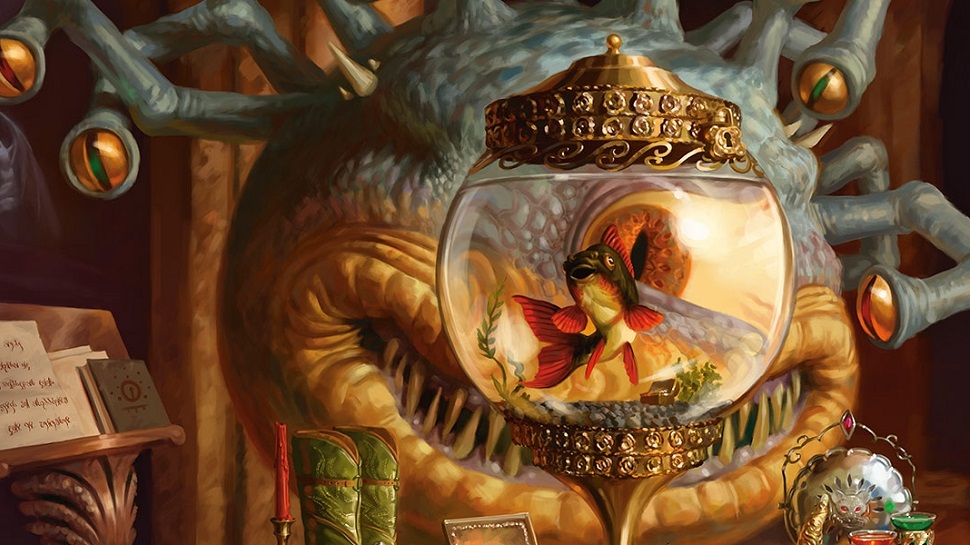
Dragon Heist - Xanathar

For this final collaboration we’re going to radically invert the campaign: Rather than starting the campaign at the Yawning Portal, the PCs will be gangsters working for Xanathar. Their first job? Raiding a warehouse where the Zhentarim are holding Renaer Neverember, capture Renaer themselves, and bring him to a sewer hideout where they’ll be met by Nihiloor.

Of course, they discover too late that they’ve kidnapped some fuckin’ mook named Floon Blagmaar. A total disaster. Maybe they try to double back to the warehouse, but by the time they get there, Renaer is gone and the place is swarming with watchmen. (Their first inklings that a Grand Game is happening will come from the questions Nihiloor asks ‘Renaer.’)

CHAPTER 2 – WORKING FOR THE BOSS: You need some time to pass here and, in this scenario, the PCs don’t get Trollskull Manor. Run a few faction missions that introduce them to the Xanatharian faction outposts (they get outfitted by Grinda Garloth; they struggle to figure out how to get the mechanical flying beholder working before the Twin Parades; they’re charged with running security at Terasse Estate and escorting gamblers through the dangerous tunnels to the gladiator tournaments).

Their contact person for these faction missions? Dalakhar.

CHAPTER 3 – THE TRAITOR: Then comes the day when Dalakhar vanishes. Turns out he’s betrayed the Boss and stolen something. Boss won’t say what, but it’s clearly important. The PCs need to find him.

They track him to the Inn of the Dripping Dagger. The timeline is slightly different in this version of reality, and they end up finding the letter from Kalain. They track Dalakhar to Kalain’s place, and she tells them he’s headed to some place called Trollskull Manor. (You’ll want to buff this up a bit to fully satisfy the Three Clue Rule.)

The PCs head over to Trollskull Manor. As they’re heading through the alley, a huge explosion goes off just around the corner up ahead: Rushing forward, they discover Dalakhar and a bunch of other people dead!

THE TROLLSKULL MANOR TEAM: From this point forward, the campaign more-or-less follows the normal track. Investigations will lead the PCs to Gralhund Villa; they’ll find the Zhentarim and Jarlaxle’s team watching the place.

But here’s the twist: There is a group of heroes who rescued Renaer Neverember and moved into the Trollskull Manor. And they’re doing what the PCs in a ‘normal’ Dragon Heist campaign would have been doing: The PCs likely first spot the Trollskull Manor Team at Gralhund Villa, but they’ll keep turning up:

  • They raid one of Xanathar’s sewer hideouts.
  • They perform a heist at Xanathar’s Lair. (Maybe the PCs can foil it. Or maybe the PCs foil their attempt, only to have Jarlaxle simultaneously steal the Eye. Guess it’s time to pursue them back to the Eyecatcher for a heist-in-kind.)
  • While the PCs are trying to perform a heist at Kolat Tower, the Trollskull Manor Team is simultaneously active onsite.

And so forth. Play the heroes actively, and figure out what faction(s) they belong to and bring those into play, too.

CONCLUDING THOUGHTS

The cool thing here is that, once you’ve restructured the campaign components into scenarios instead of plots, you can use those components in myriad ways. These examples push that to an extreme, but it demonstrates how much flexibility this approach has and how easy it is to take material prepped in this way and actively play it in order to respond to player choice.

Compare this to the approach taken by the published campaign, which attempts to give you flexibility and ‘reusability’ by, for example, giving you three different versions of an Old Tower. But the truth is that you don’t need multiple versions of a tower in order to get different utility out of it during actual play.

The other thing I’ll point out is that in all of these collaborator scenarios – including the original remixed version with the Cassalanters – we have no idea what’s going to happen. Do they take the Cassalanters offers or refuse it? Do the Xanatharian gangsters take the money and use it to take over the organization, launching a bloody gang war in and below the streets of Waterdeep? When Jarlaxle’s agents tweak to his true identity, do they remain loyal or turn on him?

Just as the flexibility of the material allows us to reframe the presentation of the campaign, it also provides infinite variability in the actual running of the campaign, providing you (and your players) with a constant stream of surprise and wonder.


 

Archives

Recent Posts

Recent Comments

Copyright © The Alexandrian. All rights reserved.