
The Alexandrian

Posts tagged ‘d&d’

Ptolus - In the Shadow of the Spire
IN THE SHADOW OF THE SPIRE

SESSION 22C: WORKINGS OF THE CHAOS CULTS

May 18th, 2008
The 10th Day of Kadal in the 790th Year of the Seyrunian Dynasty

The walls, floor, and ceiling of the room were covered in a haphazard array of magical circles, symbols, and strange characters. The sight was almost dizzying. After little more than a glance, Tee called out for Ranthir to join her.

Ranthir quickly identified the symbols as belonging to a variety of rites, although none were immediately known to him. He did note that many of them bore a more than superficial resemblance to the rites performed by the Seyrunian demon-binding cults of the previous century. And others seemed to have something to do with the creation and binding of energy. Some simply seemed to be mad scribblings to which Ranthir could not ascribe any immediate sense. One particular section of the wall had been completely covered in charcoal, and then written upon in chalk:

Tee, meanwhile, had discovered that one of the wood panels on the floor was loose. Prying it up revealed a small cache containing two books and a gold ring bearing the device of a broken square:

Ranthir was immediately distracted by the books. Eagerly taking them from Tee’s hands he began flipping through them.

TRUTH OF THE HIDDEN GOD

What appears, at first, to be a copy of the Book of Athor is nothing of the sort: The pages inside are covered with scrawled diagrams and heretical desecrations of the Nine Gods.

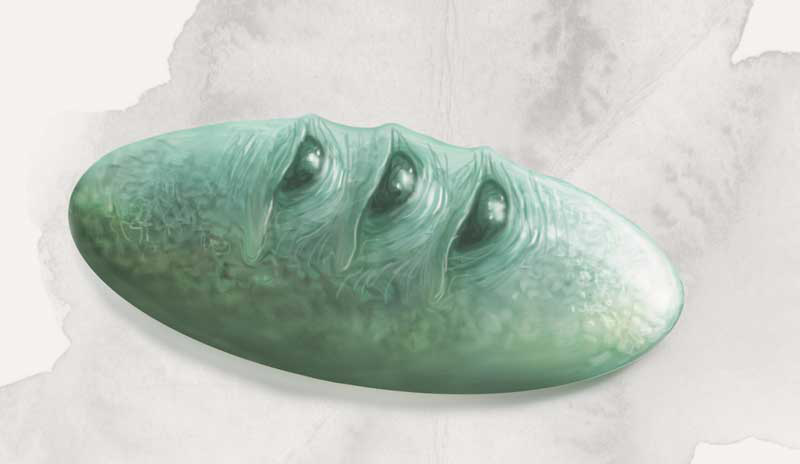
A closer reading reveals this to be a cult manual for the “Brotherhood of the Blooded Knife”. The cult venerates chaos in all its forms, focusing their blasphemous rituals around the practice of human sacrifice. These sacrifices are given to a Galchutt named Abhoth, who they venerate as the “Source of All Filth” and the “Lord of the Zaug”.

Disturbingly, much of the book is given over to material designed to mock the holy rituals of the Church. It appears that the cult establishes itself secretly in society by posing as other religious orders. Actual followers of the deity may choose to join them, usually to their dismay – either they come to join the cult itself or they die beneath the cult’s “blooded knife”.

In other cases, a few cultists will infiltrate another religion and use force, blackmail, magic, or simple persuasion to sway its members into secretly worshipping chaos. This process can take years, but eventually the cult eats the other religion from the inside out, consuming it until the temple is entirely a front for the altars of the Brotherhood hidden in their subterranean complexes.

The last few pages of the book appear to be a prophetic rambling of sorts, beginning with the words: “In the days before the Night of Dissolution shall come, our pretenses shall drop like rotted flies. In those days the Church shall be broken, and we shall call our true god by an open name.” The remainder of this section is a description of the faux religious practices for a fanciful “Rat God”, with the apparent intention being that a church could be openly established for this “god”. Eventually, the prophecies, say even this “last pretense” will be abolished and “Abhoth shall be worshipped by all who are not blooded by the knife”.

TOUCH OF THE EBON HAND

The pages of this volume are filled with disturbing and highly detailed diagrams of the most horrible physical deformities and mutations. A closer reading quickly reveals that these deformities – referred to as “the touch of the ebon hand” – are venerated by the writers as the living personification of chaos incarnate. Particularly prized are those functional mutations – an extra eye or oversized arms, for example.

The rest of the book describes horrid rites which make it clear that the Brotherhood of the Ebon Hand not only idolizes deformity and mutation, but seek to inflict it and spread it as well: Ritual scarring. Magical alteration. Alchemical experimentation. Chaositech-induced mutation.

Members of the cult have no distinctive garb, but they usually bear the symbol of a black hand in some form: A tattoo. A charm. A small embroidery on their clothes. Or so forth. Of course, most of them are also marked by their mutations.

THE COBBLED MAN

As Tee continued searching, Elestra also came into the room. Looking over Ranthir’s shoulder she pointed at the charcoal wall: “We’ve seen three of these symbols now. The hand, the knife, and the broken square.”

“I wonder what the others could mean.”

“Something to do with the cults, I guess.”

They continued chatting quietly as Tee probed at the walls and the floor.

Dominic, in the tower outside, stood looking in at them. And then pain rushed through his body as a heavy blow landed across the back of his skull.

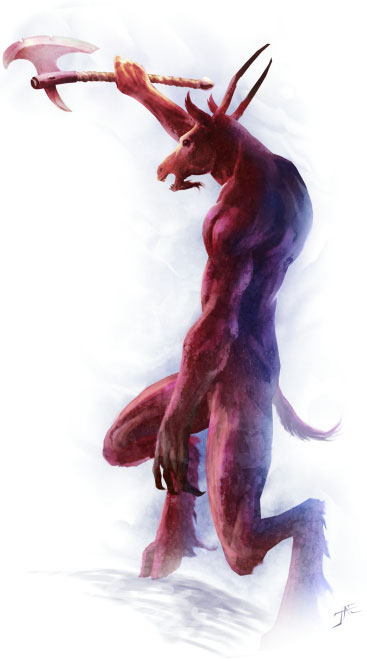
Stumbling forward he felt a horrible wave of nausea rip through his body. Turning he saw a horrific, monstrous man: A second head had been awkwardly attached to its shoulder, and the muscles of its arms and legs were grotesquely over-developed. The hair on both of its heads was greasy, lanky, and sparse. The eyes on one of the heads was shut, but the eyes of the other were filled with rage. In its right hand it clenched a silvery rod.

“WHY ARE YOU IN WUNTAD’S ROOM?”

Its voice was a dull boom. Its words sullen.

Tor, reacting almost instantly, rushed up the stairs from below. Emerging into the cramped base of the tower, he was clipped nastily along the side of his head. Like Dominic, he felt a nauseous wave pass over him. Shaking it off, he swung his sword – opening a vicious gash in the creature’s arm.

Ranthir rushed out, as well. “Can’t we just work this out?” But his voice was drowned out in the sudden chaos of the melee.

But then Tee shoved her way past him and her voice carried a greater authority: “Stop it! Wuntad sent us! Stop it now!”

The creature froze, its massive hand hovering to deliver a devastating blow on Tor. “Wuntad sent you?”

“Yes,” Tee lied, putting as much earnestness into her voice as she could. “He sent us.”

“He’s been gone so long. I’ve been alone for so long…” The dimwitted voice was filled with painful sorrow.

Tee softened. “Are you the Cobbledman?”

“… someone called me that. Once. They left too. A long time ago.” The Cobbledman clutched absently at the rags on his chest. “They left me all alone… Do you have any food?”

Ranthir fumbled at one of his pouches and then held out an iron ration. “Why didn’t you leave?”

“Can’t leave.”

“Why can’t you leave?”

“Wuntad put something in my brain. Make me loyal. Make it hurt to leave. Can’t leave until Wuntad say I can leave.”

Ranthir had a sickly certainty that this was a betrayal of the flesh. He could see telltale lumps beneath the Cobbledman’s skin – tubes and… other things.

“What happened to Wuntad?” Tee asked.

“Don’t know. The angry men in the metal suits came. There was lots of angry noise. I hid in my tower. And then everyone left… You’ll leave me, too, won’t you?”

No one had an answer for that.

“Cobbledman,” Tee said carefully. “Do you have a piece of metal that looks like a spiral?”

A look of something very like panic entered the Cobbledman’s eyes. “Yes.”

“Could we have it?”

“No! No! My friend gave it to me! I have to keep it safe! She said so!” His hand groped against the rags on his chest, clutching something beneath them.

“I understand,” Tee said gently. “But if we promised to bring it back, do you think we could borrow it? You could even come with us.”

“Maybe…” The Cobbledman seemed to be losing focus. “Do you have any more food?”

Ranthir gave him some more and the Cobbledman chewed it absentmindedly. “I’m going to go to sleep now. So very hungry…”

He began shambling back across the bridge and disappeared into this tower. They watched him go, sadness and pity filling their hearts.

“Well,” Tee said. “At least we know where one part of the spiral key is. Now we just need to find out where Radanna hid hers.”

NEXT CAMPAIGN JOURNAL

Avernus

Go to Table of Contents

ZARIEL’S CRUSADE

  • Zariel’s experiences at Idyllglen refocused her. Although she had served in Heaven’s armies, the conflict had always been somewhat abstract to her; or, at least, an affair of the Outer Planes where the conflict had long been relegated in most realms to a Cold War where the borders between realms had been long-settled. Now she had seen firsthand how the evils of the Abyss seeped out into the wider planes, inflicting untold horrors upon the multiverse.
  • Zariel began advocating for a more belligerent military policy. Some called her a warmonger, but Zariel disagreed: The war already existed, whether the angelic legions chose to fight in it or not.
  • Others said that it should be left to the Blood War: Let Evil annihilate itself. There was no need for Heaven to spend itself in the conflict. But this, Zariel argued, made Heaven complicit in the system that corrupted mortal souls to fight in that war; and turned a blind eye to the demonic miseries suffered by untold millions. The stalemate of the Blood War did not keep Evil in check; it perpetuated it. And it was Heaven’s duty to end it.

THE SECOND VISIT TO IDYLLGLEN

  • Following Zariel’s intercession against Yeenoghu, Idyllglen had erected a shrine honoring the angel who had saved their village. In the early 10th century DR, Idyllglen’s existence was once again threatened, this time by a marauding band of ogres led by a warlord named Irontusk.
  • Zariel answered the prayers of the villagers, journeying to the Material Plane with Lulu to aid them.
  • When they arrived, they met a young woman named Yael who had managed to organize the younger villagers into a defensive militia of sorts. Yael gladly yielded command of the militia to Zariel, who taught them much of the arts of war and forged them into a band of steadfast companions. The three of them – Zariel, Lulu, and Yael – became fast friends. With each new challenge they faced, Yael would smile and say, “We just need to dream a little bigger.” Soon Zariel and Lulu were saying it, too.
  • In a campaign that lasted for several months – during which the ranks of the militia swelled as it attracted recruits from other nearby settlements south of the Winding Water – Zariel defeated Irontusk’s warbands. Yael herself killed Irontusk in the climactic battle, and the remnants of the warband fled back across the Sunset Mountains and into the Goblin Marches to the east.

DAWN OF THE HELLRIDERS

  • Zariel returned to Mount Celestia, but the lust of battle still smoldered in her blood. Having tasted the fleeting, fast-paced passion of the mortals, she became even more frustrated with the glacial pace of change in the celestial realms. Her thoughts turned again and again to Yael and her other comrades in arms. Dream a little bigger.
  • One night on the silver, starlit beaches of Mercuria, Zariel and Lulu hatched their plan: They would return to the Material Plane and raise a mortal army. The army would invade the Abyss, creating a second front in the Blood War. Zariel believed that, if she could establish a flanking beachhead, other disaffected angelic warriors from Mount Celestia would rally to their cause. They didn’t have to win. They just had to upset the balance of the Blood War so that it would no longer be a stalemate.
  • Yael’s Zarielites: When they returned to the Material Plane, Zariel and Lulu discovered that Yael had turned their militia into a regional peacekeeping force. (The ogres had not returned, but there’d been a spot of trouble with trolls out of the Trollclaws. Mostly they secured travel between the Winding Water settlements.) Known as the Zarielites, they wore a badge with twin suns, representing Zariel and Lulu as their angelic saviors.

Note: This informal heraldry would be forgotten by the later Hellriders, but not by Zariel, who took a grim satisfaction in the irony of having her followers revive it as the heraldry of the Order of the Companion centuries later.

  • Yael’s response when she heard Zariel’s plan? Let’s dream a little bigger.
  • Olanthius, Lord of Elturel: Word of Zariel’s return spread and recruitment swelled. Yael became an ambassador of sorts, spreading the good word of Zariel’s Crusade. Lulu often accompanied her on these journeys, including arguably the most important of them all, when Yael went south to Elturel. Olanthius was impressed with Yael’s courage and righteousness, and pledged his service to the Crusade. (Olanthius and Yael would later fall in love.)
  • The Elturian Crusade: With Olanthius joining the cause, Zariel moved the headquarters of the Crusade south to Elturel.
  • Haruman, Lord Knight of the Far Hills: Another major recruit to the Crusade was the Lord Knight of the Far Hills. Haruman had once been known as the Boy Warlord, rising from obscurity as a slave in the Goblin Marches to conquer Farkeep (the citadel which would later become known as Darkhold) at the age of thirteen. Hearing of Zariel’s holy cause, he rode down to Elturel from the Sunset Mountains and pledged all of his knights to her service.
  • The Three Generals: Yael, Olanthius, and Haruman became known as the Three Generals, swearing fealty to the holy cause of the Crusade — to crush the evil of the Abyss under the guidance of Zariel.

Note: Jander Sunstar was a knight-banneret in Haruman’s service. He was the one who first learned of the Crusade and converted Haruman to the cause. If you’re looking to place these events in Jander’s personal timeline – as related in Christie Golden’s Vampire of the Mists and various short stories – they occur between the time that Jander leaves the Dalelands and arrives in Waterdeep.

THE CHARGE OF THE HELLRIDERS

While preparations continued to be made for their invasion of the Abyss, the crusaders were not quiescent. They secured the lands around Elturel and undertook a number of goodwill actions. They also went on a number of quests to secure the supplies necessary for waging war against demonic hordes.

YEENOGHU’S GAMBIT

  • Yeenoghu learned that Zariel was raising a huge mortal army and planned to invade the Abyss with it.
  • In response, Yeenoghu returned to the Material Plane at the head of a small demonic force. Once again recruiting an army of gnolls, he began razing the Winding Water settlements. Zariel responded, as Yeenoghu had known she would, by leading the Three Armies north.

Yeenoghu

THE THIRD VISIT TO IDYLLGLEN

  • The two forces met at Idyllglen. It seemed fated to the crusaders, but was actually according to Yeenoghu’s design: He wanted to manipulate the emotional connection Yael and Zariel had to the village.
  • During the battle, Yeenoghu detached a portion of his force and personally led a raid towards the village. General Yael responded almost immediately, moving her army out of position in pursuit.
  • While Zariel, Olanthius, and Haruman sought to rearrange their own lines of battle to account for the chaos that ensued, Yeenoghu’s force abruptly shifted direction. Casting off the illusions that had made them appear to be ordinary gnolls, the demons sliced their way through Yael’s command.
  • Neither Yael nor her knights were to be underestimated, however. This was, after all, the fight they had been preparing for. She stymied Yeenoghu’s counterattack.
  • Meanwhile, the bulk of the gnoll army – having lost their demonic commanders when Yeenoghu peeled them off – were routed by Zariel, Olanthius, and Haruman.
  • As the rest of the crusader army rounded on his flank, Yeenoghu abruptly abandoned pretense and led an assault directly on General Yael’s position. Slicing through her troops and cutting down her banner, Yeenoghu seized Yael, opened a portal, and leapt through it.

THE AVERNIAN AMBUSH

  • Zariel, leading her own charge atop Lulu, was only a couple dozen feet away as Yeenoghu vanished. “The demon lord flees before our wrath!” she cried. “And he has taken one of our own! To rescue and to salvation! Charge!”
  • The Three Armies plunged through the portal. But rather than emerging in the Abyss as they had expected, the portal led to the fire-blasted plains of Avernus. Worse yet, Yeenoghu had a small demonic army — which had crossed the Styx and penetrated deep into Hell itself — waiting on the other side.
  • Zariel arrayed her crusaders for battle, but her rear echelons were still passing through the portal when Yeenoghu’s army moved rapidly to engage.

THE BATTLE OF AVERNUS

  • There were a number of glorious deeds that day, among them Yael freeing herself from captivity and fighting her way to Olanthius’ side. Yeenoghu’s army had made retreat impossible, but the crusaders had withstood the initial assault and now the second and third armies had passed through the portal and were marshalling their strength. They vastly outnumbered Yeenoghu’s force, and there was a real chance that the demon lord would be destroyed, dealing the crusade’s first blow against the Abyss.
  • That’s when an army of devils, under the command of Terza’reg of the Dark Eight and lured to the area by Yeenoghu’s army, marched over the horizon.
  • Jander Sunstar panicked. (“We can’t fight both Hell and the Abyss!”) Under his leadership, a large chunk of the army routed back through the portal… which then slammed shut. (The crusaders who remained in Avernus believed the deserters had sealed it behind them. It’s possible Yeenoghu seized the moment to shut down the portal he had opened. Or perhaps arcanists in the advancing devil army were responsible for closing it.)

Note: Jander’s fate is somewhat beyond the scope of this reference, but worth establishing. He was the highest ranking officer among the crusaders who fled Avernus. The deserters became known as the Hellriders, their acts of infamy instead being told as deeds of glory, and Jander became the first High Rider of Elturel. He changed the Riders’ heraldry from the twin stars of the Zarielite Crusade to a horse rampant in flames. Eventually, sickened by his betrayal of both Zariel and Haruman, he left Elturel and headed to Waterdeep.

BATTLE’S END

  • The three-way battle that ensued was pure chaos. The best we can do here is to highlight a few moments.
  • Olanthius and Haruman were able to pincer the remnants of Yeenoghu’s army and finish them off, while Zariel and Yael wheeled her command about to meet Terza’reg’s army.
  • Yeenoghu escaped triumphant, having tricked Zariel into spending her glorious army fighting devils instead of demons and turning what could have been a Descent Into Avernus - Battle Standarddisaster for the Abyss into a huge advantage instead.
  • Zariel led the flying cavalry squadron (featuring primarily pegasi) into the air to meet the flying devils that swarmed over the battlefield.
  • Zariel and Lulu engaged in an aerial duel with Terza’reg, which ended when Terza’reg cut off Zariel’s right hand (still clutching her sword). Zariel leapt off of Lulu and dove after sword and hand, with Terza’reg in hot pursuit. At the last possible moment, Zariel snatched her sword from the air, reversed her flight, and plunged it through Terza’reg’s breast. A huge explosion rocked the battlefield as the devil general died, clouding the affair in a haze of red dust.
  • Despite her dreadful injury and the ensuing chaos, after Terza’reg’s death it was possible that Zariel and her generals might have been able to rally. But then a second army under the command of Baalzephon arrived.
  • To their credit, the remaining crusaders fought to the last warrior. (Although some, including Olanthius and Haruman, were captured after being struck down in battle.)
  • Yael had joined Zariel and Lulu. As Baalzephon tightened the noose around their necks, the three old friends fought side by side. As the devils closed in, Zariel knew what would come and feared her own weakness. She took a shard of her angelic essence – a spark of goodness – and placed it within her sword. She asked Yael to take the sword and make certain it was not captured by the forces of Hell. Yael refused. Zariel smiled sadly. “Look beyond this forsaken day. One last time, I need you to dream a little bigger.”
  • With tears in her eyes, Yael accepted.
  • Zariel then turned to Lulu, said goodbye to her old friend, and asked her to go with Yael and keep her safe.
  • The devils’ aerial forces had been decimated, and so Yael – having concealed the sword within her cloak – was able to escape through their depleted ranks upon Lulu’s back.

Go to Part 6D-C: Lulu’s Memories (Zariel in Hell)

Go to Table of Contents

We’ve previously discussed:

  • The continuity errors in Lulu’s backstory.
  • The continuity errors in Zariel’s backstory (including seeking vengeance against a Demon Lord of the Abyss by attacking the Nine Hells).
  • The failure to pay off the rediscovery of Lulu’s memories after positioning them as THE central mystery of the second half of the campaign.
  • That many of the tools given to the DM for managing Lulu’s memories are conceptually great (like a list of memory triggers and a definitive reference for her backstory), but unfortunately flawed and incomplete (i.e., giving a “definitive” reference that has both continuity errors and glaring omissions).

I’ve also briefly talked about my dissatisfaction with placing the Charge of the Hellriders in 1354 DR despite the fact that it was already legendary and of uncertain truth in 1358 DR. (This is definitely a non-essential fix. But, yes, I’ll be fixing it.)

In this installment of the Remix, we’re also going to be looking at Lulu’s dream quest and the other “memory dives” in the campaign.

One of the potential problems with Descent Into Avernus is that the PCs lack any sort of personal relationship with Zariel. She is, at best, a distant antagonist. Despite this, at the end of the campaign, the PCs are assumed to come face-to-face with her for the first time and immediately help her redeem her soul. This makes it really difficult to get the players emotionally invested in Zariel’s ultimate fate.

This is what makes the idea of Lulu’s dream quest so awesome! The PCs can actually experience the Charge of the Hellriders, the fall of Zariel, and all this other cool history the campaign is built around. They may not actually meet Zariel, but they’ll nonetheless get a chance to know her and, therefore, care about her.

… except the dream quest doesn’t actually do that. The dive into Lulu’s “memories” are structured around five “dreams”:

  • Dream 1: Explicitly something that didn’t actually happen.
  • Dream 2: Didn’t happen and isn’t a memory.
  • Dream 3: Actually just part of Dream 2.
  • Dream 4: Not a memory.
  • Dream 5: Lulu looks through a telescope and sees where the Sword is (except she doesn’t, actually).

This is a huge missed opportunity!

Dream sequences often all flat because they aren’t real and don’t mean anything. But they can be really amazing if they ARE meaningful and have real stakes. Which is absolutely the case with Lulu’s dream quest: Her memories are the central mystery of the campaign, right? And at stake is the location of the Sword of Zariel, which is the key to saving an entire city. Insofar as the players give a crap about this campaign, they will give a crap about what is revealed here.

Which is why it’s so frustrating that literally nothing is revealed.

So we’ll also be looking at how to structure these memory dives to provide a compelling “memory mystery” that delivers meaning and memorable pay-offs (pun intended). In fact, we’ll be adding a couple new memory dives to further enhance this portion of the campaign.

DEFINITIVE HISTORY OF ZARIEL & LULU

This is designed to be a broad, authoritative overview of the back story for Zariel and Lulu. You can assume that any place this reference contradicts the book-as-published that the change is deliberate.

THE AVERNIAD

  • Aeons ago, when the cosmos was still young and the Great Wheel had not been fully turned from the primordial planar chaos, Zariel fought in the Legions of Heaven. She served under the command of Ashmedai, a Celestial Marshal who rode a golden, winged lion.
  • Ashmedai and his legions were sent to Avernus. At this time, Avernus was a paradisical plane. Elysium and the Seven Heavens both desired to add it to their realms, and so their armies clashed upon its emerald plains.
  • The full tale of the Averniad is beyond the scope of our discussion today. (There are some who claim the full complexities of the celestial epic cannot be told in the course of a single mortal lifetime.) The important bit comes at the end: In the Great Betrayal, Ashmedai wrenched Avernus from the grasp of both Mt. Celestia and Elysium, instead claiming it for himself and aligning it with the Eight Hells. Thus Avernus became the Ninth Hell.
  • Ashmedai’s legions schismed between those who remained loyal to him and those who remained loyal to Mount Celestia. Ashmedai himself became Asmodeus, and his legion of fallen angels, using Avernus as a staging base, conquered Hell, wresting its crown from the brow of the dark lord Ahriman.
  • Zariel’s Long March: During the Fall of Avernus, Zariel’s commander – an angel named Chazaqiel – followed Asmodeus. Zariel and a small band of angels loyal to Heaven broke away and began a long march across Avernus before finally escaping down the River Styx (which in those days followed a very different course).

MEETING LULU: Her experiences during the Fall of Avernus had tainted Zariel’s mind with bitterness and anger. While recuperating within the starry groves of Lunia, Zariel met and befriended Lulu, a hollyphant who called the silvered forests of that plane home. When Zariel’s soul found peace and returned to Heaven’s legions, Lulu accompanied her as both friend and warmount.

THE TRIAL OF ASMODEUS

  • Long after the events related in the Averniad, a heavenly strike force penetrated Hell and captured Asmodeus, bringing him back to Mount Celestia to answer for his crimes. (There are some who believe that Asmodeus allowed himself to be captured, knowing what would happen next.)
  • Asmodeus claimed rights under the Pact Primeval. Also known as the First Law and quite possibly the first legal code to ever exist, it had been a founding agreement among the first Planes of Law that had emerged out of primordial chaos (and later became the Seven Heavens and Mechanus). Other pacts, such as those between Celestia, Elysium, and Olympus, had been based upon the authority of the Pact Primeval. By the time Asmodeus made his appeal, the Pact had been supplanted by other codes, but most of those codes ultimately still derived their legal standing from the Pact itself. Therefore, Asmodeus’ appeal to the Pact could not be ignored.
  • AsmodeusThus began the Trial of Asmodeus. Primus of the modrons was appointed as a neutral arbiter and judge.
  • The alleged crimes of Asmodeus, spanning aeons, were limitless. Even the testimony to their effect was seemingly without end, as an angelic horde bore witness, one after another. At last Primus, having grown weary of the proceedings, called a halt to the testimony: The scope of Asmodeus’ illimitable acts had been well-established and their sheer quantity was irrelevant.
  • Zariel, who had not yet had the opportunity to testify to the atrocities she had personally witnessed, was outraged. She violently demanded that she be allowed to speak, and when Primus ordered her to be silenced, the altercation sprawled into a brawl which completely disrupted the proceedings. (Was this the moment that Zariel first came to Asmodeus’ attention? Or had he had his eye upon her from the beginning?)
  • Asmodeus’ defense was simple: Although his former comrades interpreted his actions as a betrayal, they had not actually violated the principle of the Law. Indeed, they had upheld the Law by preventing an alliance between Hell and the Abyss which might have swept away all other planar powers. The Blood War fought by his devils now safeguarded Law from the Chaos of the Abyss.
  • In the end, Asmodeus prevailed. His acts may have been Evil, but Primus ruled that they were ultimately in accord with the Law, and were thus in accord with the Pact Primeval. The law which had once been the bedrock of Heaven now became Asmodeus’ holy right to test the merit of mortal souls (i.e., tempt them to evil) and claim those souls which were Hell’s due. (However, as part of Primus’ ruling, Asmodeus was also bound to always carry the Ruby Rod of Asmodeus, an artifact that both signified Asmodeus’ divine rights, but also bound him – and, through him, the other devils of Hell – to uphold the bargains they made with mortals.)

THE PURSUIT OF YEENOGHU

An almost incalculable amount of time then passed, during which Zariel and Lulu were living an eternal, angelic existence. Zariel remained of a martial temperament, waging war upon the forces of evil.

THE FIRST VISIT TO IDYLLGLEN

  • Several centuries ago (we could perhaps say the 8th or 9th century in Dale Reckoning, during the internecine conflicts which resulted in the Fields of the Dead becoming the Fields of the Dead), Zariel became aware that the demonic lord Yeenoghu had invaded the Material Plane and was personally leading a gnoll army that was sacking settlements north of the River Chionthar.
  • Zariel and a band of angels journeyed to the Material Plane to put an end to Yeenoghu’s depredations. They caught up with the demon lord in the village of Idyllglen.

THE DAUGHTER OF ASMODEUS

  • Zariel’s task force weren’t the only ones hunting Yeenoghu, however. A strike team from Avernus lead by Glasya, daughter of Asmodeus, had also been tracking Yeenoghu. They arrived during the battle and helped rout the demon lord.
  • Yeenoghu escaped, but his army was decimated and scattered to the winds. After the battle, there was tension between the celestial and infernal hosts, but Zariel and Glasya spoke for a short while and – having briefly been strange allies in the Blood War against the Abyss – agreed to go their separate ways.

Go to Part 6D-B: Lulu’s Memories (Zariel’s Crusade)

Go to Part 1

KORA MARWOOD

(Created by Chris Malone)

Kora Marwood was born the youngest to an impoverished family living in Waterdeep. Her father, Hogar, was a member of the guard and occasional longshoreman, and her mother cared for her four siblings and kept house in a shabby apartment in the Dock Ward. In the autumn of 1471, Kora’s mother, Samira, took a short-term field job with the Snobeedle Orchard and Meadery. In the Kora Marwood (by @BroadfootLenny)midst of a work day, she unexpectedly gave birth to Kora in the middle of the field.

Life continued to be difficult for the Marwoods, and things finally fell apart for the family when Hogar died while working on a job on the docks, killed by a faulty bit of cargo netting and crushed to death by lumber imports from Chult. Samira, fearing for her inability to care for Kora and her siblings, brought them to the Temples for adoption.

Kora, only three years old at the time, remembers little of her mother and her family. While her siblings went to temples of Lathander and Ilmater, Kora was taken by the acolytes of Mystra. She was raised in the mysteries and teachings of Mystra, learning the histories of civilization, magic, and religion.  While life was safe and predictable, it was also boring. Kora began sneaking out at night to spend time in the city, and soon found herself enamored with a young man named Aseir Kalid, from Calimshan.

Aseir was an artist, working during the day in his father’s shop weaving and dyeing, and then working on his own projects when he had time. When he presented her with a small wooden painting of her one night, she decided that she was done with life in the temple and left shortly thereafter. She lived with him for six months, exploring the city with new eyes. It was in the Spring of 1486 that Aseir fell ill with the Weeping Plague, an illness that began with sores around the eyes and nose that wept a clear fluid, then quickly spread throughout the body, followed by a fever and, for many, death. Brought to Waterdeep from ports far away, the city respond quickly with quarantine. It was then that Kora was reunited with her brother Randal, who had become a priest of Ilmater. Despite his training and magical prowess, he was unable to save Aseir, and left Kora in quarantine to care for him until he passed.

Heartbroken, Kora returned to the temple, throwing herself at the feet of the Head Priest. She begged him to take her back, so that she could serve the temple as a lay healer. While Mystra is not inclined towards life and healing, magic serves all, and they taught her the healing arts. She took to it quickly, showing prowess and aptitude.

She was asked to accompany a pilgrimage to Myth Drannor as a healer and acolyte, and she attended to this. Along the way, she made the acquaintance of a dwarven ranger named Dain Balderk. Dain was initially standoffish with Kora, but after she had several opportunities to demonstrate her knowledge, diplomacy, and skill, he showed a grudging respect. Unfortunately, the arrival of the pilgrimage was preceded by destruction, as the city of the Netherese fell upon Myth Drannor, destroying it. Again.

The pilgrimage stayed at the Ruins of Myth Drannor for several months, caring for the wounded and exploring the wild magic of the disaster. It was during this time that Kora discovered that Balasha Asorio, one of the guides and foragers with the party, was actually an agent of the Zhentarim. Exposing the traitor forced a hasty ambush that had been in the making for some time. The Zhent were repelled, but Balasha escaped and Dain received a grievous wound to his back that would never heal completely. On the return trip to Waterdeep, Dain revealed himself as a Harper, and indoctrinated Kora into the faction.

When the pilgrimage at last returned to the city, Kora swore herself to the service of Mystra and began her life as a cleric in full. She now lives at the House of Wonder as a healer, acolyte, and doing odd jobs when asked. She serves mostly as an informational asset for the Harpers, looking to find those who look to destroy personal freedom and otherwise act out of evil. She still meets with Dain regularly, who acts as a mentor (and handler).

DESCRIPTION: Kora stands about 5’6”, tending towards a leaner frame; not scrawny, but more svelte. She has darker skin, that of a deep tan or of a more Mediterranean ethnicity, not quite brown, but not pale. Her hair is dark brown, to the point of appearing black unless under direct sunlight. Her face is more narrow than broad, with a rounded chin, high cheekbones, and green eyes.

When at home and not expecting trouble or a call to action, she wears a robe or a tunic with a simple shirt underneath and blue or black leggings. When out and about, she wears her armor with a tabbard or tunic over it, leather leggings/britches, a cloak, and her shield, mace, pack, and healer’s kit at her side. She dresses in white, silver, and blue, with red elements in linings and trim to reflect Mystra’s holy colors. Mystra’s holy symbol is emblazoned on her shield.

WHAT KORA KNOWS – THE ZHENTARIM:

  • Zhentarim is a shadow organization of thieves, spies, assassins, and wizards that trades mercenaries and goods (including weapons) for profit.
  • Their original base of power was among the Zhent people in the Moonsea region, primarily a place called Zhentil Keep.
  • Long sought to gain political influence in Waterdeep, but the strength of the city’s Masked Lords, nobility, and professional guilds makes that difficult.
  • In the late 14th century (about 100 years ago), the founder of the Zhentarim (Manshoon) was killed and Zhentil Keep was razed. Zhentarim power was shattered, with the organization breaking down into many internecine factions.
  • You’ve been trying to figure out details about the local Zhentarim for awhile, as their power and influence seems to be growing. Recently, however, there appears to have been a schism within the group.
  • This schism is not widely known, because the Zhentarim are simultaneously fighting a gang war with the Xanathar Crime League, and that violence is capturing everyone’s attention. You know that that this gang war is the result of some provocative action taken by the new splinter group of the Zhentarim.

CREATING KORA

I’ve run games for and played games with Chris for a number of years now. His approach to character creation tends to be a quiet one: He likes to thoughtfully develop them in great detail, often working ahead of the group even in unfamiliar systems. In this case he was quite familiar with 5th Edition and the Forgotten Realms, and so by the time we were getting some of the new players up on their feet, Kora was already a fully fledged character rich with details. In fact, virtually everything you see above was already basically in place by the time I tuned in on Kora for the first time.

PUBLIC INTEGRATION: There’s an anecdote that’s somewhere between gospel truth and urban legend that goes around both the movie and video game production circles. You have either a developer or a writer or a director or maybe an SFX house who’s giving a presentation to their producer or editor or investor. And so they very deliberately add one element to their presentation or edit or final render that they know is dumb: Like, maybe it’s a noir drama but there’s a shot of a guy holding a goose for no reason.

So their boss says, “Looks great, but I think you should lose the shot with the goose.” And our creator-hero takes the note and deletes the goose… because, of course, they never actually wanted the goose in the first place. The point of the story is that everybody in a decision process feels a need to give notes; either because they psychologically want to feel that they’ve “contributed” to the final product or because they need to justify their paycheck. If they just say “that’s good,” it’s not like they’ve actually done anything, right? The point of the dumb goose was to provide a lighting rod for the irrelevant-but-necessary comment they pathologically need to provide.

This is my long-winded way of saying: As a GM, don’t be the executive in this story.

If you’ve got a value-add, go for it! That’s the whole point of the “public integration” phase. In this case, Chris’ expertise and clear vision meant that Kora was already fully integrated into the setting.

No need to look the gift horse in the mouth. Ride on.

PRIVATE INTEGRATION: Chris had chosen for Kora to be a fledgling Harper and had also set up a violent history with the Zhentarim, so that bit of integration with two of the major factions of the campaign was also more-or-less automatically done for me. I simply swapped out the scripted Harper contact (Mirt) for the character that Chris had created (although I eventually brought Mirt back in as Dain’s boss; thus Kora’s background gave additional depth to the Harpers rather than vice versa).

(I guess maybe it is worth pointing out that swapping out elements you had planned and replacing them with what the players created is not only just as valid as adding relevant stuff to the PCs’ background, it’s probably MORE valid.)

You’ll note that, like Sarah, Chris got a “What You Know” handout for the Zhentarim. Some of the bullet points are duplicated (there’s no reason to rewrite or reword stuff you don’t have to), but others have unique information, slightly different information, or information with a different interpretation. The goal, of course, is for the two players to be able to actually swap information in-character. (If their handouts were perfect duplicates, the interaction is more likely to be one of them regurgitating everything know and the other player not getting any pay-off from their character’s knowledge. The unique information solves that problem. The information that slightly overlaps – or even contradicts! – provokes actual discussion between the players.)

The Snobeedle Orchard appears on the map of Waterdeep:

Waterdeep: Undercliff - Snobeedle Orchard (Map)

I had a huge version of this map hanging on the wall and Chris simply grabbed it off the map when fleshing out the story of Kora’s mother. This was a really cool opportunity, but I blew it: I completely missed the fact that Dasher Snobeedle, a member of the Snobeedle family, had become one of the wererats sent to harass the new owners of Trollskull Manor (i.e., the PCs).  I eventually noticed my oversight towards the end of the campaign when I started doing some meaningful development on Kora’s missing mother and was able to work it in. (You can read about that in more detail over here.)

BRINGING THE PARTY TOGETHER: As I mentioned in Part 1, Edana’s position as a fixer made her a natural fit for being the character who would connect the rest of the party with their contact at the Yawning Portal. Kora’s role as a Harper agent, however, also made sense for this role.

There were a few options we collectively considered, including:

  • Kora somehow being undercover and investigating Edana. (Chris wasn’t really interested in playing Kora with a false identity, and this also suggested that Edana was currently involved in criminality, whereas Sarah was more interested in having her at the tail end of one of her respites.)
  • Edana introducing half of the party to their contact and Kora introducing the other half. (The problem was that Kitti, Pashar, and Theren were already grouped up, so there was no “other half” for Kora to introduce.)

The final solution ended up being a somewhat convoluted web of connections: Upon arriving in Waterdeep, Kitti decided the best way she could help Pashar raise money was by joining the underground fight circuit. (I made a note to connect this to the underground fights that figure later in the campaign.) Asking around, they got pointed in the direction of Edana. When Edana realized how much money they really needed, told them to skip the fights and decided to take them to Kora, who had been putting the word around that she needed a crew.

“Mystra’s got money,” was Edana’s rationale. But it turned out the job wasn’t for the Temple of Mystra. Kora was freelancing. But the offer was better than nothing, so Kitti, Theren, and Pashar accepted. Edana decided to tag along for a little bit just to make sure everything was copacetic. (It seemed to her that young Kora was flying by the seat of her pants… She wasn’t wrong.)

And that’s when Kora took them all to the Yawning Portal to meet her contact.

Go to Part 1

THEREN

(Created by Erik Malm)

I spent my youth exploring the forests of Evermeet and learning to hunt from my father.

Theren (by @BroadfootLenny)Shortly after coming of age, word reached the wood elves of Evermeet that not only had the ruins of our old home in the Ardeep Forest been overrun by kobolds and other monsters, but a group of humans, led by Lord Nandar of Waterdeep, had begun invading and trying to lay claim to the forest.

When Rond Arrowhome set sail with an army of wood elves to take back and protect the forest, I volunteered to join them. I was trained as a ranger and soon became an expert at hunting both humans and kobolds.

Now that the forest is once again safe, I prefer to spend my days alone with nature – exploring, observing, and experiencing the constant change and unpredictable events of the natural world. I especially love the power, beauty, and unpredictability of thunderstorms and have developed a connection to Aerdrie Faenya, though I am one of the few non-avariel who worship her.

I am always happy to help out lost travelers (who mean the forest no harm) or anyone else in need, though I remain distrustful of the wealthy elite like the Nandars of Waterdeep.

DESCRIPTION: Theren has copper-colored skin with a dark-brown/copper-colored hair (like dark, tarnished copper).

His clothes palette is standard dark forest colors; the sort of thing that would help with camouflage in Ardeep – deep greens, browns, dark grey/black. Theren’s original clothing would be elvish and probably trend more towards just greens and browns, emphasizing dark versions of those colors instead of a true black. (That said, the longer he’s in the city, the more likely he is to start wearing some greys that woud match stonework, etc. Maybe fewer greens as well, or even normal Waterdhavian clothing of a fashionable sort, but with subdued colors.) It’s ultimately all about camouflage; to blend into his environment.

Theren is 5’10”. Green eyes.

Hair is straight and shoulder length. Normally he just keeps it tucked behind his ears, which tends to keep it in place fairly well due to elvish ears being tall and pointy. But if it’s particularly windy (or similar conditions where his hair might obscure his vision), he’ll either wear a headband or tie his hair back.

There’s nothing particularly remarkable about Theren’s facial features – typical elvish face with thinner and more angular features than the average human. Rather, what is remarkable is the way that his life and outlook affect his skin, underlying musculature, and how he carries himself:

Theren has spent much of his life outdoors – baking in the sun, holding night-long vigils in the deep of the forest, and facing unafraid the heavy winds and storms which he is particularly fond of as a ceraunophile and worshiper of Aerdrie Faenya. Consequently, I think of Theren as looking a little weatherworn (or, at least, weatherworn for a young elf). It’s not that he necessarily looks particularly aged or beaten down by the elements, more like that subtle difference between how high quality furniture kept on a patio looks ever so slightly different than the exact same furniture kept in a three-season porch at the end of summer. He looks just a little out of place indoors and looks like he’s where he belongs when outdoors.

Similarly, his musculature looks just a little different than the average elf. He’s not particularly muscular or anything, though he still has an athletic build, but his muscles are all incredibly dense – like a rock climber’s, a farmer’s, or anyone else who’s primary form of exercise is one of intense and continuous use of their entire body. This also applies to the underlying musculature of his face, making him look a little extra solid/rugged/durable. I suppose it may look a little formidable in some cases, but Theren isn’t really threatening, scary, or even particularly imposing, he just looks like someone you’d rather not pick a fight with or try to rob.

His demeanor, posture, and manners have also been affected by his relative solitude and preference for the wilds. Having spent much of his time alone when he doesn’t need to worry about what others think about him, he displays his emotions a little more readily, he is a little more likely to speak his mind, his manners are a little more unchecked, and his posture and physical mannerism are a little more informal than a typical elf. To be clear, he’s still an elf raised on Evermeet, and a non-elf probably wouldn’t even notice anything at all, but to other elves he seems a little… wild/feral.

Finally, although his regular demeanor might be a bit more wild and relaxed, he also has a hunter mode that he shifts into when stalking prey or facing enemies. When he’s in this mood, he appears more cold, calculating, and emotionless. Unlike the differences described above, which might not be noticed by a non-elf, this shift is significant enough that everyone except the most unobservant can tell he’s hunting something or someone.

CREATING THEREN

The thing I always marvel at when revisiting Theren’s background is the intense depth of the physical description. I’ve had other players create similarly detailed descriptions, but usually it’s because EVERYTHING is lavishly detailed. The ratio between Theren’s physical description and everything else in Theren’s character background seems crazy at first glance.

But it works. And it’s a valuable reminder that everyone will have different touchstones that are most effective for them. (This will often depend not only on the player, but also the specific character.)

Look at how much amazing, actionable detail Erik works into Theren’s physical description! It’s all about blending into his environment? He’s a little bit uncomfortable inside? That’s gold. Even simple, specific physical actions like when/how he tucks back his hair.

PUBLIC INTEGRATION: Erik was the least versed in the Forgotten Realms at the table. Ironically, we ended up doing the most digging into the weird, esoteric corners of Realms Lore with his character.

The origin point was a simple question: Where would an elf ranger be from?

Evermeet was an easy answer: Big elven kingdom. Just across the ocean from Waterdeep. (Maybe he could be somehow tied into the maritime adventures of Kitti and Pashar?)

On the other hand, where might a wood elf live near Waterdeep? That led us to Ardeep Forest. And that’s where we really started digging in. I forget the exact path we followed, but I ended up not only pulling information from Lost Empires of Faerûn, but also tracking down an obscure article about the forest that was written by Ed Greenwood and published in Dragon Magazine #270.

There was also more recent lore, revolving around a conflict between Lord Nandar of Waterdeep and the elves of Ardeep in the 1470s. (The Waterdeep connection, however tenuous, made this appealing.) I was not particularly familiar with this era (and not at all familiar with these events), but they were intriguing.

PRIVATE INTEGRATION: The only thing of note here that I recall is that Volo was the “author” of the Dragon Magazine article. This didn’t really have anything to do with integrating the character into the campaign, but giving Erik a copy of the article was a nice way to subtly establish Volo’s existence for a player who otherwise wouldn’t be familiar with the name when it was dropped in the first session.

BRINGING THE PARTY TOGETHER: The key question which remained was how Theren would be pulled into Waterdeep. (Remember that every player needed to explain how their character ended up walking through the doors of the Yawning Portal at the beginning of the campaign.)

We looked at a few options, but what stuck was just aiming the Pashar-Kitti vector in the direction of Ardeep Forest: While passing through the forest on the way to Waterdeep, they would have met Theren. After helping him with some local trouble (or possibly being saved by him from local trouble, their mutual versions of the story had very different interpretations of those events), Theren was swayed by Pashar’s sob story and agreed to help him (them, really) raise the ransom money.

It was only six hundred gold pieces, right?

(He was in Waterdeep with them before he discovered that the actual ransom price was… uh… considerably more money than that. He hadn’t sworn an oath or anything… but good gods.)

Go to Part 5: Kora Marwood

Archives

Recent Posts

Recent Comments

Copyright © The Alexandrian. All rights reserved.