The Alexandrian

Archive for the ‘Roleplaying Games’ category

The Map of Anyoc

October 22nd, 2008

City Supplement 3: Anyoc was essentially a completed product when Dream Machine Productions went on hiatus. The only thing we were waiting for was the map. In fact, it was my intention to release it as our last product before the hiatus. But, unfortunately, the cartographer we had working on the project never completed it. Since we were shifting into a hiatus state in any case, I shelved the project.

As we started gearing up to come out of hiatus, however, I started working on the map myself. Here’s what the original sketch map that I drew way back in 2001 looked like:

Map of Anyoc - Original Sketch Map

Basically, there was little laid out except for the gross geography and spatial relationships of the city. However, I know that one of the things I love about a good city supplement is the map: As a handout, there are few things more satisfying than being able to slap down a really slick-looking map for the players to look at. And I’ve found that there are few things that can get my creative juices flowing like a good map: Imagine yourself standing on those streets and looking at those buildings. What does that colorful roof really look like? What lies beyond that door or hidden around that corner?

I knew that executing a city map to the standards that I would demand out of a product would be tough. I had previously designed the map for Aerie (City Supplement 2), but that was a very different type of project: Aerie had been carved out of solid rock according to a relatively rigid plan. For Anyoc, I felt it was important to capture the more natural and organic curves of a living city.

So I started researching.

SURVEYING THE FIELD

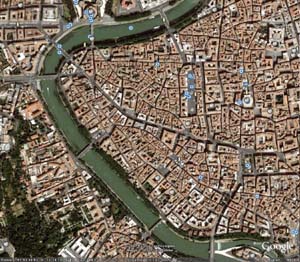
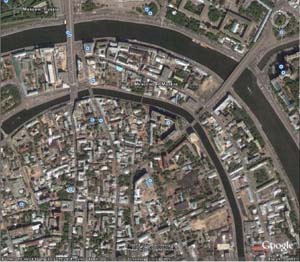
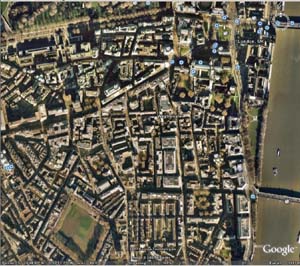
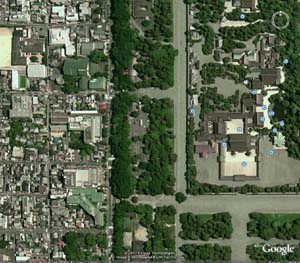
The first part of this research was a matter of “surveying the field”. I went to my shelves and pulled down a wide representative sampling of city maps from other roleplaying supplements. Notable examples include:

As you can see, there have been many different ways of handling the cartography for fantasy cities. Based on my recent experience with Ptolus, among other things, I knew how incredibly useful it could be to have every street and every building detailed on the map. As a player, I love the ability to say “I’m going to X by heading down this street right here”. And as a DM I love being able to say, “Okay, the House of Violet Gold is this building right here.”

With those goals in mind, I pushed aside the very generic style of maps like the one seen in the Freeport sample above. These types of maps are a bit more graphically detailed than my sketch on graph paper, but the detail is largely illusory — none of those blobs actually represent anything meaningfully concrete.

I also stepped away from the style of map seen in the Minas Tirith sample above: These maps resemble the kind of cartographical lot maps created by city surveyors and the like.

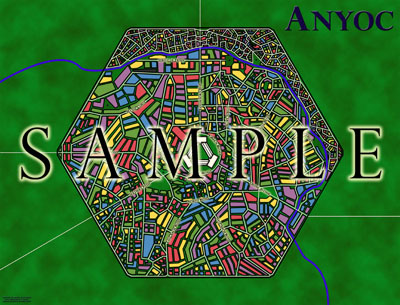
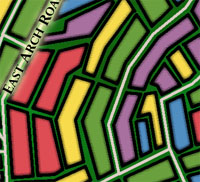
While I couldn’t create the type of detailed, individual buildings created by Ed Bourelle for Ptolus (unless I wanted to charge a lot more for the finished product than I was planning to), I felt that a “roof outline” style (such as those used in the Raven’s Bluff and Sharn examples above) represented the best compromise. Here’s the style I ended up with:

Map of Anyoc - Sample Style

With a style in hand, it was time to start laying out the streets. But before I could do that, I had to finish my research.

Continued…

City Supplement 3: Anyoc

October 20th, 2008

City Supplement 3: Anyoc

WALLS OF FAIRY STONE AND BLOOD…

Built of the seven fairy stones, the city of Anyoc stands proudly upon its hill. Pale purples mix with soft blues and faded greens; pinkish reds stand in contrast to burnished gold. And its white walls of essabas – the star stone – gleam in the bright light of the sun.

But long ago, in days dimmed by the thick mists of time, the site where Anyoc now stands was home to another great city: A black city which served dark and evil powers. It was said that the walls of that nameless city towered above its streets to a height of five hundred feet, and every inch of them was stained black with blood.

And beneath the streets of Anyoc, that ancient evil still waits for the time of its return…

City Supplement 3: Anyoc features full-color, black-and-white, and poster-size (21″ x 16″) maps of the city, a complete gazetteer featuring more than 30 unique locations, and bonus maps of the Westgate military complex and the Street of Trade!

Full-color maps only available in the Deluxe Color and PDF editions.

Each City Supplement provides a complete fantasy city. In addition to a full-page map of the city, each supplement includes a description of the city’s full history, an overview of the major characters and organizations, adventure seeds, and a complete gazetteer.

B&W Print EditionDeluxe Color Edition
RPGNow PDFLulu PDF – Paizo PDF
36 pages – Sample City Map

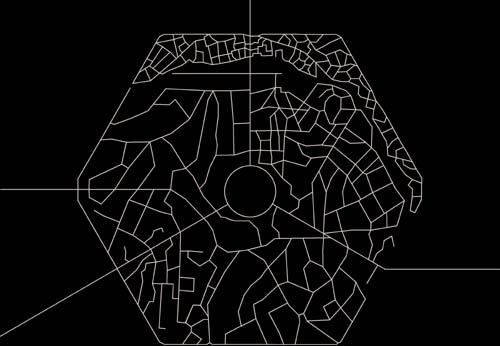
Anyoc Sample Map

Two Spells of Darkness

October 16th, 2008

Spells of Light and DarknessSpells of Light and Darkness: The Art of the Flame and Void was released last week. If you’ve been thinking to yourself, “Light and darkness spells? Sounds pretty lame.” here are two spells of darkness that might change your mind:

Eclipse
Evocation [Darkness]
Level: Cleric 7, Sorcerer/Wizard 7
Components: V, S, M/DF
Casting Time: 10 minutes
Range: 2 miles
Area: 2-mile-radius sphere
Duration: 4d12 hours
Saving Throw: None
Spell Resistance: No

This spell creates an area of magical darkness in a 2-mile radius centered on a point chosen by the caster. Within the area of the spell the sun is blotted out, creating an area of magical darkness that suppresses natural light sources, resulting in an area of shadowy illumination. Creatures within an area of shadowy illumination gain concealment (20% miss chance). Even creatures that can normally see in such conditions (such as with darkvision or low-light vision) have the miss chance in an area shrouded in magical darkness.

A darkness spell (one with the darkness descriptor) counters and dispels a light spell (one with the light descriptor) of an equal or lower level. A darkness spell brought into the area of a light spell of equal or higher level is temporarily negated (and vice versa). If both the darkness and light spells are simultaneously negated, the otherwise prevailing light conditions exist in the overlapping areas of effect.

Arcane Material Component: A small diamond dipped in black oil.

Shadow Spy
Divination [Darkness, Scrying]
Level: Assassin 3, Cleric 4, Sorcerer/Wizard 3
Components: V, S, M/DF
Casting Time: 1 minute
Range: Personal
Target: Your shadow
Duration: 1 min./level
Saving Throw: None
Spell Resistance: No

This spell animates your shadow, allowing you to independently move it up to your speed as a move action. In addition, the shadow spy acts as a scrying sensor, allowing you to see (but not hear) the immediate surroundings of your shadow as per a scrying spell.
A shadow spy can be difficult detect, making Hide checks using your skill modifier with a +10 circumstance bonus. In areas of dim light or shadowy illumination, this circumstance bonus doubles to +20. The shadow spy cannot be physically harmed.

While the spell remains in effect, you possess no natural shadow.

A darkness spell (one with the darkness descriptor) counters and dispels a light spell (one with the light descriptor) of an equal or lower level. A darkness spell brought into the area of a light spell of equal or higher level is temporarily negated (and vice versa). If both the darkness and light spells are simultaneously negated, the otherwise prevailing light conditions exist in the overlapping areas of effect.

Arcane Material Component: A shard of obsidian.

The eclipse spell is the type of thing that high-level necromancers use to keep their undead happy and Dark Lords crafts into sunslayer spheres to keep the yokels properly cowed with fear.

But shadow spy is the type of all-purpose utility spell that just about any self-respecting spellcaster will find useful. It’s less powerful than scrying, but also a slightly lower level and very flavorful.

Ptolus - In the Shadow of the Spire

IN THE SHADOW OF THE SPIRE

CHARACTER BACKGROUND: RANTHIR

(more…)

IN THE SHADOW OF THE SPIRE

Character Background: Ranthir

Many of you are reading this website because of D&D: Calibrating Your Expectations, the essay I wrote in March of last year. One of the points I made in that essay is that low level characters are actually more than capable of being experienced experts in their fields. Even at 1st-level, while they don’t have to be, they certainly can be.

Which brings us to the character of Ranthir, the last of our main characters: This guy isn’t your typical 1st-level apprentice. Instead, he’s an accomplished Acolyte of the legendary Academy in Isiltur, the Spired City. Although his esoteric theories are not fashionable or popular, he is nevertheless an accomplished scholar.

In our world he would be a gifted graduate student. In the world of D&D, there is a much higher ladder for him yet to climb. But I think it’s important not to denigrate the accomplishments of those who would be considered gifted and extraordinary in our world merely because they happen to live in a world where the superhuman is possible.

Which is not to say I don’t like my share of neophyte characters, too. Take a peek at Tee and Elestra, for example.

All I’m saying is that it can also be fun to shake things up a bit and roll up a starting character who hasn’t just fallen off the turnip truck: The guy who was already honored among his tribesmen, served a long and glorious tour of duty in the military, or distinguished himself in a scholastic career.

And I’m pointing out that you don’t need to start the character any higher than 1st-level to make that happen.

Archives

Recent Posts

Recent Comments

Copyright © The Alexandrian. All rights reserved.