The Alexandrian

Archive for the ‘Roleplaying Games’ category

Elemental Terror

January 15th, 2010

Elemental Terror

From “The Tale of Satampra Zeiros” by Clark Ashton Smith:

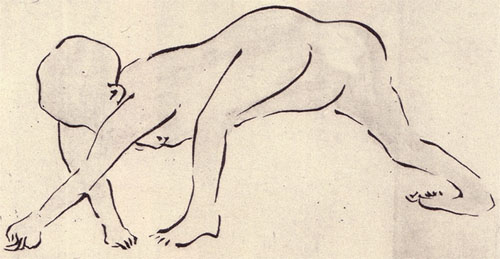
The basin, I have said, was very large; indeed, it was no less than six feet in diameter from the floor. The three legs that bore it were curved and massive and terminated in feline paws displaying their talons. When we approached and peered over the brim, we saw that the bowl was filled with a sort of viscous and semi-liquescent substance, quite opaque and of a sooty color. It was from this that the odor came — an odor which, though unsurpassably foul, was nevertheless not an odor of putrefaction, but resembled rather the smell of some vile and unclean creature of the marshes. The odor was almost beyond endurance, and we were about to turn away when we perceived a slight ebullition of the surface, as if the sooty liquid were being agitated from within by some submerged animal or other entity. This ebullition increased rapidly, the center swelled as if with the action of some powerful yeast, and we watched in utter horror while an uncouth amorphous head and dull and bulging eyes arose gradually on an ever-lengthening neck, and stared us in the face with primordial malignity. Then two arms — if one could call them arms — likewise arose inch by inch, and we saw the thing was not, as we had thought, a creature immersed in the liquid, but that the liquid itself had put forth this hideous neck and head, and was now forming these damnable arms, that groped toward us with tentacle-like appendages in lieu of claws or hands!

I’m going to have to start using more water elementals!

If you wanted to get fancy, you could certainly pimp out the stats of a large water elemental to represent some of the creature’s other abilities from the story (knicking the stench ability from the troglodyte as we go):

Speed: 40 ft., swim 90 ft.

Frightful Presence (Ex): Characters with less than 8 HD who perceive the malignant shape-shifting of the elemental water terror must succeed at a Will save (DC 14) or become either panicked (50%) or paralyzed with fear (50% chance) for 2d4 rounds. Even characters who succeed on the saving throw are shaken, but those who succeed on their saving throw are immune to the creature’s frightful presence for the next 24 hours.

Stench (Ex): The sooty admixture of the elemental water terror’s primordial form exudes an unsurpassably foul odor. All living creatures within 30 feet of the elemental water terror’s must succeed on a Fortitude save (DC 18) or be sickened for 10 rounds. Creatures that successfully save cannot be affected by the same elemental water terror’s stench for 24 hours. A delay poison or neutralize poison spell removes the effect from the sickened creature. Creatures with immunity to poison are unaffected, and creatures resistant to poison receive their normal bonus on their saving throws.

But even this isn’t really necessary: All you need is a water elemental’s stat-block and that beautifully lurid description and you’ll have an encounter far more terrifying than that provided by any ordinary water elemental..

(Tip for adapting the description: Insisting that the characters stand stock still for more than 6 seconds watching the slow, inexorable emergence of their doom is, quite rightfully, frustrating to the players. You’re taking control of their characters away. But if you simply prelude with “time seems to slow for a long moment as” then you can achieve the same effect without taking control of the PCs away from the players.)

I also recommend “The Tale of Satampra Zeiros” quite highly. It reads like a prototypical D&D adventure with a couple of thieves for the main characters and is a little like reading a mash-up of Lord Dunsany’s lyricism and Robert E. Howard’s primitive adventurism. It can be found in The End of the Story, which is Volume 1 of The Collected Fantasies of Clark Ashton Smith. Smith deserves a place alongside Lovecraft and Howard, but is oft forgotten. Although he is not listed in AD&D’s Appendix N of recommened reading, Smith’s influence feels immense.

Size Does Matter?

January 14th, 2010

Many moons ago, James Maliszewski of Grognardia put up a short post summarizing the total page count of various editions of D&D:

OD&D (LBBs only): 56 full pages (112 half-sheets)
OD&D (LBBs + 4 supplements): 183 full pages (366 half-sheets)
Holmes Basic: 48 pages
AD&D 1e (PHB, DMG, MM): 470 pages

To this post, I responded by saying:

It would be interesting to do a page comparison between editions without taking into account:

(1) Monsters
(2) Spells
(3) Classes
(4) Races

The theory being that adding more options within these categories is not necessarily adding bulk to the actual rules of the game.

(To that list I would also like to add “magic items”, “sample scenarios”, and “indices”.)

Basically, my thought was that you could take AD&D and strip out all the monsters, spells, magic items, classes, and races that weren’t found in the original OD&D and you would still have a completely playable game. In fact, someone observing you playing that game would have no way of knowing that you were doing anything other than playing 100%-by-the-book AD&D. (Unless, of course, you told them that you had limited the size of the menu.)

In other words, having those extra options doesn’t meaningfully increase the complexity of the actual rules of the game.

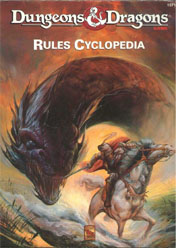
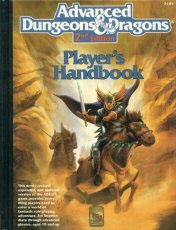
D&D Rules Cyclopedia (1991) AD&D Player's Handbook (2nd Edition)

I intended at the time to eventually put together such a post, but got distracted by other concerns… until now. So, without further adieu, and for whatever use it may be, the total “rules only” page count for various editions of (A)D&D:

OD&D (LBBs only): 29 full pages (58 half-sheets)
OD&D (LBBs + 4 supplements): 64 full pages (128 half-sheets)
OD&D (including Chainmail): 86 full pages (148 half-sheets)
Holmes Edition: 19 full pages
Moldvay Edition (Basic + Expert): 64 full pages
BECM: 163 full pages
BECMI: 221 full pages
Rules Cyclopedia: 142 full pages
AD&D 1e (PHB, DMG, MM): 192 full pages
AD&D 2e (PHB, DMG, MM): 223 full pages
D&D 3e (PHB, DMG, MM): 257 full pages
D&D 3.5 (PHB, DMG, MM): 294 full pages

NOTES

For more information on the different editions of the game you can check out my Nomenclature of D&D Editions.

The BECM entry total include only the Basic, Expert, Companion, and Master Rules. The BECMI entry includes the Immortals boxed set.

The 2nd Edition entry is based on the original 1989 rulebooks.

I’m not including either the Unearthed Arcana variant of 1st Edition, nor the Players’ Option variant of 2nd Edition.

First Impression: It’s interesting watch the slow, inexorable expansion of the game.

Second Impression: The relative pointlessness of the entire exercise is indicated in the comparison between the BECM and Rules Cyclopedia page counts (which are the same rules, except the former is bloated somewhat by the need to repeat and reintroduce information four times over). It’s also indicated in the comparison between 3.0 and 3.5 (where the expansion was largely due to the WotC’s ever-increasing font sizes).

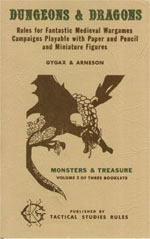
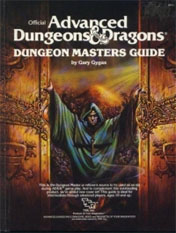
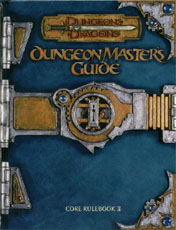
OD&D White Box - Volume 2: Monsters & Treasure AD&D Dungeon Master's Guide - 1st Edition D&D Dungeon Master's Guide - 3rd Edition

Roper Skull-Throwers

January 13th, 2010

RoperThe roper has a phenomenal reach (50 ft. with its tendrils), but remains excessively vulnerable to the “back off and plink it to death with ranged attacks” tactic. This isn’t really a huge problem, but I have had a couple of roper encounters that landed with dull, wet thuds.

So when I was taking a peek at the artwork from the 4th Edition Dungeon Master’s Screen and spotted this particular roper hanging out evocatively perched next to a fiery lava pit, I suddenly realized what ropers need: Big piles of skulls from their previous victims.

That they can throw.

In 3rd Edition this easy enough: A +11 ranged attack (1d6+4 points of damage) that can be used interchangeably with their normal strand attacks. A typical roper has 4d6 pieces of skeletal ammunition at hand, although particularly successful ropers may have accumulated larger bone piles while younger ropers or one new to a hunting location may have far fewer.

The Faceless Rage

January 12th, 2010

Faceless rage is a magical disease of evil and chaos that affects only humanoids. It transforms its victims by erasing their face and turning them into murderous savages.

TRANSFORMATION: Whenever a victim of the faceless rage suffers ability score damage from the disease, they must succeed at an additional Fortitude save (DC 18) or be transformed according to the faceless rager template.

Fortitude save (DC18); Infection contact/injury; Incubation 1 day; 1d6 Int/1d6 Wis, plus transformation (see above).

TEMPLATE: FACELESS RAGE

Noppera-b? (??????, faceless ghost) from the Buson Youkai Emaki (??????)

Noppera-b? (??????, faceless ghost) from the Buson Youkai Emaki (??????)

“Faceless rager” is a template that can be added to any humanoid or giant (referred hereafter as the base creature).

Size and Type: The base creature’s type does not change, but the creature gains the shapechanger subtype.

Hit Points and Hit Dice: Same as the base creature. To calculate total hit points, apply the faceless rager’s bonus to Constitution.

Attacks: A faceless rager loses the bite attack of the base creature (if any), but retains all other attacks of the base creature and and gains a slam attack (1d6 damage for Medium-size faceless ragers).

Special Attacks: A faceless rager loses the gaze attack of the base creature (if any), but retains all other special attacks of the base creature and also gains the special attacks described below.

Disease (Ex): Any creature struck by the natural attack of a faceless rager (including its slam attack and steal visage abilities) is exposed to faceless rage. The save DC is Constitution-based.

Improved Grab (Ex): To use this ability, the faceless rager must hit a natural attack (including its slam attack).

Steal Visage (Su): If a faceless rager succeeds at a grapple check against any humanoid, its victim must make a Fortitude save or have its face removed. The victim is left blinded, deafened, and mute. As the victim has no mouth, it will risk starvation if its face is not restored. Restoring a victim’s face requires a regeneration spell, just as if it were a severed limb. The save DC is Constitution-based.

Special Qualities: A faceless rager retains all special qualities of the base creature, and also gains those described below.

Blindsight (Ex): A faceless rager has blindsight 60 feet.

Incurable Disease (Ex): A faceless rager can no longer recover naturally from the faceless rage disease that afflicts them. Only magical treatment can restore the victim, specifically a remove disease spell followed by a greater restoration. Once cured, the faceless rager loses this template. A faceless rager’s face can only be restored after the disease has been magically cured, and requires a regeneration spell, just as if it were a severed limb.

Mindless Rage (Ex): A faceless rager must seek out and attack the nearest humanoid. If no humanoids are present, it will attack the nearest creature. If no creatures are present, it will wander randomly until it finds one. In this mindless rage, a faceless rager gains a +2 morale bonus on Will saves, but suffers a -2 penalty to Armor Class. They cannot use any Charisma-, Dexterity-, or Intelligence-based skills (except for Balance, Escape Artist, Intimidate, and Ride), the Concentration skill, or any abilities that require patience or concentration, nor can they cast spells or activate magic items that require a command word, a spell trigger (such as a wand), or spell completion (such as a scroll) to function. They can use any feat they have except Combat Expertise, item creation feats, and metamagic feats.

Abilities: Faceless ragers gain +4 to Strength and +4 to Constitution.

Challenge Rating: Same as base creature + 1. However, levels in a spellcasting class count only one-quarter towards their challenge rating (since the faceless rager cannot use spells). (For example, a faceless rager based on a 4th-level wizard would be a CR 2 challenge.)

Alignment: Always chaotic evil.

SAMPLE FACELESS RAGERS

DISEASED CARPENTER (CR 3) – Expert 3 – CE Humanoid (human shapechanger)
DETECTION – blindsight 60 ft., Listen +3, Spot +3; Init +1
DEFENSESAC 9 (+1 Dex, -2 mindless rage), touch 9, flat-footed 8; hp 23 (3d6+12)
ACTIONSSpd 30 ft.; Melee slam +4 (1d6+2 and disease); Ranged +3; Space 5 ft.; Reach 5 ft.; Base Atk +2; Grapple +2; SA improved grab, steal visage (DC 13)
SQ blindsight 60 ft., incurable disease, mindless rage
STR 14, DEX 12, CON 14, INT 12, WIS 10, CHA 10
FORT +3, REF +2, WILL +5
FEATS: Skill Focus (Craft (carpentry)), Skill Focus (Craft (carving)), Skill Focus (Knowledge (wood))
SKILLS: Balance +1, Craft (carpentry) +8, Craft (carving) +8, Diplomacy +8, Escape Artist +1, Hide +1, Knowledge (architecture/engineering) +6, Knowledge (wood) +8, Move Silently +1, Ride +1, Search +6, Sense Motive +6, Use Rope +1

DISEASED SOLDIER (CR 5) – Warrior 5 – CE Humanoid (human shapechanger)
DETECTION – blindsight 60 ft., Listen +3, Spot +3; Init +0
DEFENSESAC 8 (-2 mindless rage), touch 8, flat-footed 8; hp 33 (5d8+10)
ACTIONSSpd 30 ft.; Melee slam +8 (1d6+3 and disease); Ranged +5; Base Atk +5; Grapple +5; SA improved grab, steal visage (DC 14)
SQ blindsight 60 ft., incurable disease, mindless rage
STR 16, DEX 10, CON 14, INT 12, WIS 10, CHA 10
FORT +6, REF +1, WILL +3
FEATS: Alertness, Improved Unarmed Strike, Run
SKILLS: Appraise +1, Bluff +1, Climb +3, Craft (wittling) +1, Forgery +1, Gather Information +3, Innuendo +1, Intimidate +8, Jump +3, Listen +3, Search +1, Sense Motive +2, Spot +3, Swim +1

D20 Rules by Justin Alexander
This material is covered by the Open Gaming License.

Esoterrorists - Robin D. LawsI’ve recently been reviewing The Esoterrorists by Robin D. Laws with an eye towards how the core design ethos of the system — that the PCs always find every clue that can be found (as discussed in more length as part of my essay on the Three Clue Rule) — could be adapted to more generic purposes. (And quickly coming to the conclusion that is, in fact, so completely antithetical to the reasons that I play roleplaying games that it won’t work for me in any form.)

HARD AND SOFT LIMITS

But the game has prompted me to give some fresh thought to hard limits in system design, and the effect they have on scenario design for and the utility of a roleplaying game.

For example, let’s consider hit points: Imagine a hypothetical system in which the PCs have 20 hit points each. If each PC loses an average of 4 hit points each time they get involved in combat, then after four combat encounters the system is essentially mandating that the PCs stop fighting things (because the fifth encounter will kill them).

For simplicity’s sake, let’s assume that in this hypothetical system there’s no way for a PC to heal or restore their hit points except to rest for 1 week without stressful activity. That becomes a hard limit for scenario design: If you design a scenario that requires the PCs to fight more than four times in a single week, then your scenario is most likely going to end in failure (as the injured PCs either retreat or die).

This is, basically, how D&D 4th Edition is designed. The math is more complicated due to healing and variable encounter difficulty, but when the party’s healing surges run out (or, more accurately, when the healing surges for a single PC run out), the adventuring for the day is over. It has a hard system limit on how many combat encounters you can have per day, and you cannot design encounters with more combat encounters (or more difficult combat encounters) without house ruling the system.

By contrast, previous editions of D&D used hit points as a soft limit because there’s no limit placed on how much magical healing a single character can receive in a day. Of course, there are practical limits to the amount of healing any given adventuring party will have available to it in a single day, so you can’t simply ignore the issue of depleting the party’s hit points across multiple encounters. But it’s a soft limit precisely because there are ways (within the rules of the system itself) for overcoming that limitation.

For example, imagine that you wanted to design a scenario in which the PCs were in control of a fortress and needed to defend it from an army of the undead. In 4th Edition the scope of this scenario is dictated by the system: You can’t have more than X encounters of Y strength because the PCs will run out of healing surges. In 3rd Edition, on the other hand, you can make the siege last for any number of encounters, as long as you’re willing to provide the PCs with the necessary resources (like wands of cure light wounds, for example).

The reason I bring this up is that in most traditional roleplaying games there aren’t actually many hard limits to be found. I’ve found them to be quite a bit more prevalent in indie games, but in most cases they’re also fairly obvious in such games.

For example, 3:16 Carnage Amongst the Stars features a core mechanic for each mission in which the GM is given a budget of threat tokens equal to 5 x the number of PCs. The GM constructs encounters by spending threat tokens, and when he runs out of tokens the mission is over. This limit isn’t hidden in any way. Knowing it is recognized as being an integral part of running and playing the game. (Which, when you get right down to it, is true for all hard system limits. It’s just that 3:16 acknowledges it.)

HARD LIMITS IN GUMSHOE

The GUMSHOE system used in The Esoterrorists, on the other hand, looks like a traditional RPG… but its design is riddled with hidden hard limits.

Allow me to explain the two core mechanics of the game:

(1) For any investigative task, the PC uses the appropriate skill and automatically succeeds at finding any of the appropriate basic clues in the scene. In addition, a PC’s ranking in an investigative skill gives them a pool of points which they can spend to buy additional clues using that investigative skill that are non-essential to the adventure, but interesting in one way or another.

(2) For any non-investigative task, a difficulty number from 2 to 8 is secretly assigned and 1d6 is rolled. If the roll is higher than the difficulty number, the PC succeeds. A PC’s ranking in non-investigative skills also give them a pool of points which they can spend on checks using that skill to give them a +1 bonus to their die roll.

Pools for physical skills are replenished every 24 hours. Pools for non-physical skills are only replenished when a scenario ends.

And there’s your hard limit. Or, rather, your many hard limits: Each and every skill is turned into a 4E-style hard limit. For investigative skills this is relatively muted by the “mandatory success” mechanics of the system, but this same mandatory success results in a very flat playing experience if it’s not being periodically spiced by pool buys.

In practice, these hard limits severely restrict the length of an Esoterrorist scenario.

These limits, of course, aren’t entirely without their benefits. For example, once you recognize the hard limit, you’ll also realize that the system is silently mandating a diversity in the design of a scenario (so that you don’t rapidly tap out a single pool) — which, on the balance, is likely to be a positive more often than a negative.

But the negatives seem quite significant to me.

For example, in designing the investigative portions of a scenario you have two ways of dealing with the GUMSHOE hard limit:

(1) You can budget the number of “bonus clues” available in the scenario to make sure that the PCs will always have the points required to buy them. This avoids the problem of running out of points early in the game and then being forced to only engage the scenario at the most passive level available, but it raises the question of why the pools exist at all: It’s like sending you to a typical garage sale and then enforing a strict budget of spending no more than $1,000,000. Theoretically that’s meaningful, but in practice you’ve got all the money you need to buy everything on sale so it’s not a limitation at all.

(2) On the other hand, you can include more “bonus clues” over the course of the scenario than the PCs can afford. This means that the PCs will have to budget their points and only spend them selectively.

But here’s the problem: The players don’t know which of these approaches is true in any given scenario. (Particularly since most GMs aren’t going to read this essay and, therefore, aren’t going to make a deliberate decision in either direction. In practice, it’ll be a crapshoot from one scenario to the next which of these true. And which is true for which pool of points.)

And, furthermore, the design of the system is such that you often don’t know what you’re buying.

So either I’m giving you a million bucks and saying “buy everything at the garage sale”; or I’m giving you $5 and telling you to buy a random grab bag of stuff. It’s a feast or a famine and you don’t know which it is until it’s too late.

The problem becomes more severe for non-investigative tasks. Here the players need to spend the pool points in an effort to boost a random die roll above a target number that they don’t know. And they have to make that decision without any real knowledge of how many more die rolls of the same type they might be called upon to make.

So you’re bidding in a (frequently life-or-death) silent auction in what may (or may not) be a long series of silent auctions, the exact number of which you have no way of guessing.

CONCLUDING THOUGHTS

Of course, the argument can be made that I’m being relatively harsh on a game system which was probably designed to provide nothing more than a semi-useful scaffolding on which to hang some group improv.

But I belong to that school of thought that believes that system matters. And I don’t come to that belief merely from a background in game design. It’s also derived from my experience as an improv actor: The improv structures you use have an impact on the creativity that happens. Being aware of the strengths and weaknesses of an improv structure is the first step towards (a) choosing the right improv structure and (b) mastering the improv structure you choose.

In any case, hard limits are something to watch out for in a game system. They’re the points beyond which the game either Fails Completely or, at best, Stops Being Fun. That needs to be taken into account: Generally to be steered clear of, but sometimes to be taken advantage of.


Archives

Recent Posts

Recent Comments

Copyright © The Alexandrian. All rights reserved.