The Alexandrian

Archive for the ‘Roleplaying Games’ category

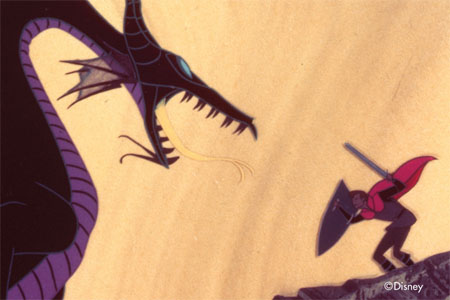
Sleeping Beauty - Sword and BoardingInspired by the “Shields Shall Be Splintered!” houserule at Trollsmyth, I’ve been thinking about how such a mechanic could be used to make sword-and-boarding a more interesting and flavorful mechanical choice. And maybe address some of the balance issues that make them so much less appealing than wielding a two-handed weapon.

SHIELDS: Once per round a character can use their shield to block (or partially block) an incoming attack. Both the shield and the shield’s wielder suffer the full damage of the attack, but the shield’s wielder can subtract a number of points of damage equal to their Base Attack Bonus. A shield cannot be used to block a touch attacks or attacks that bypass armor in any way.

A shield can be used to block damage from any effect which requires an attack roll (such as a scorching ray).

A shield can also be used to block damage from any effect which allows a Reflex save (such as a fireball). If the character makes a Reflex save for half damage, the damage blocked by the shield is subtracted before being halved.

A character who is flat-footed or unaware of an attack cannot use a shield block.

THOUGHTS AND QUESTIONS

(1) There are quite a few possibilities here for feats to extend this basic capability: For example, allowing characters to block up to twice their BAB in damage. Or a feat similar to Combat Reflexes that would allow a character to make a number of shield blocks equal to their Dexterity bonus. Should the “blocking spells and other effects” be relegated to a feat, as well? Is it too useful straight out of the box?

(2) Instead of making this a 1/round ability, should it be an immediate action?

(3) Is this useful enough that the normal AC bonus from a shield should be eliminated?

And, of course, the big question is: Does it work? Is it balanced? As the title of the post suggests, I’ve given this zero playtesting. It’s just a nifty idea that tickled the hind-quarters of my brain. It undoubtedly needs some tweaking at the very least.

Flame of the Phoenix

April 29th, 2010

My brother, who plays the mage Ranthir in the In the Shadow of the Spire campaign, requested a D20-statting of the spell seen in this video from Guild Wars 2:

FLAME OF THE PHOENIX
Evocation [Fire]
Level: Drd 2, Sor/Wiz 2
Components: V, S, M/DF
Casting Time: 1 standard action
Range: Medium (100 feet + 10 feet/level)
Effect: Medium size phoenix of flame
Duration: 1 round (see text)
Saving Throw: Reflex half or negates (see text)
Spell Resistance: Yes

A bright flame in the shape of a winged phoenix appears before you. With a screeching caw you can command it to attack any creature within range. The flame phoenix will fly in a straight line to that target. If it passes through the space of any other creature in its flight, that creature must make a Reflex saving throw or suffer 1d4 points of fire damage per every two caster levels (maximum 5d4).

Once the flame phoenix reaches its target, it stops moving for the round. In a burst of flaming feathers, the flame phoenix deals 1d6/level points of fire damage to the target (Reflex save for half damage, maximum of 10d6). If the target creature moves, the flame phoenix will follow it up to the limit of the spell’s range.

At the end of your next turn, the flame phoenix flies back to you in a straight line. If it passes through the space of any other creature in its flight, that creature must make a Reflex saving throw or suffer 1d4 points of fire damage per every two caster levels (maximum 5d4).

This material is covered by the Open Gaming License.

Urban Planning in Fantasyland

January 29th, 2010

So… what other small touches of garlic-planter proportions might you find in the urban planning of a fantasy setting?

I’ve often held, for example, that it seems as if cremation would be a natural solution for fantasy lands crawling with the undead. (On the other hand, if you can provide a reason why people believe their loved ones should be buried with whole and undisturbed bodies you will probably simultaneously explain why they find the creation of undead abhorrent.)

On a similar note, what does the well-stocked arensal of a city guard look like? Silver bullets for werewolves seem like a nobrainer. What else?

You Can’t Do That Here

January 25th, 2010

The Esoterrorists - Robin D. LawsOne of the things I look for in a roleplaying system is the “You Can’t Do That Here” failure point.

Obviously, there are things that a character logically shouldn’t be able to do. (Barring magical or technological aid, for example, a normal human being shouldn’t be able to flap their wings and fly like an eagle.) But that’s not what the You Can’t Do That Here glitch is about. You Can’t Do That Here happens when the structural or statistical quirks of a particular system make it impossible for a likely, probable, or desirable outcome to happen.

Imagine your favorite scene from a movie, book, or television sceries. Could that scene happen in your favorite roleplaying system? If not, why not? And can it be fixed?

These thoughts recently percolated to the surface for me during my read-thru and analysis of The Esoterrorists (which I also discussed here).

Scene 1: The detectives have a hit a dead-end in their investigation. Or perhaps their investigation has raised new questions. In any case, they return to the scene of the crime to look for new clues. Is there anything they might have overlooked? Is there evidence their later investigations suggest should exist that can now be found?

Scene 2: The teenage heroine is spending her summer vacation in the spooky, haunted house owned by her aunt and uncle. After spending seeral weeks in the house (enduring events of escalating strangeness), she passes down the hall and happens to notice for the first time a strange seam in the plaster. Investigating it more closely, she discovers a secret door and a staircase leading down to a hidden basement…

Scenes like these are a dime a dozen. They are also completely impossible if you’re playing The Esoterrorists: The system mandates that any clues which are to be found at a given location will be found by the PCs. That means you will never gain anything new by returning to a crime scene (unless new evidence has been deposited there since the last time you looked for some reason). Nor can you ever notice something that you previously overlooked.

And since this failure point in the system is a direct result of the system’s core design principle, there’s really no easy way to fix it: There’s an entire category of scenario that The Esoterrorists will never allow to be played out.

By contrast, these same scenarios can be absolutely trivial in other RPGs. For example, in the D20 system the former scene is modeled by either returning to the crime scene and Taking 20 for a more exhaustive search; or performing a new search with a circumstance bonus to model the additional insight gleaned from later investigations. And the second scene is nothing more than a series of failed Spot checks followed by a successful Spot check.

IN THE LENGTH OF A ROUND

On the other hand, I often see You Can’t Do That Here failure points being misdiagnosed by people who become trapped within the paradigms of the system. Perhaps the most notable example of this is the erroneous believe that, if it can’t be done in the length of a single round, then it can’t be done.

For example, in many discussions surrounding my essay “D&D: Calibrating Your Expectations” people would attempt to demonstrate the “ridiculous” number of feats which real world people require to be modeled “accurately” in the game system. A prime example was the Ride-By Attack feat:

When you are mounted and use the charge action, you may move and attack as if with a standard charge and then move again (continuing the straight line of the charge). Your total movement for the round can’t exceed double your mounted speed. You and your mount do not provoke an attack of opportunity from the opponent that you attack.

People would readily point to the example of any jousting tourney and say, “Anyone who jousts is capable of making an attack and then continuing to ride in a straight line.”

This is true. And, in fact, anyone in D20 can (a) ride up to someone; (b) hit them; and (c) continue riding past them. They just can’t do all of that in a single round.

This is about more than just defending the D20 system from an invalid critique, however. It’s about establishing a mindset in which you maximize the power and flexibility of your system of choice. Because the flip-side of You Can’t Do That Here is You Can Do That here, and that’s a lot more interesting.

Thinking back to the exercise we used to detect You Can’t Do That Here failure points, let’s turn it around now to a more positive use: Imagine your favorite scene from a movie, book, or television series. Can your system do that out of the box? If it can’t, what mechanics do you need to design to make it happen? And how can you design a scenario in which a scene like that becomes possible, plausible, or even probable? Can you generalize the case and figure out how to encourage scenes like that during a gaming session?

For example, imagine a scene where a kung-fu hero throws the bad guy through an aquarium full of piranhas. How can you enable and encourage that kind of scenery-interaction in your fight scenes? What mechanical structure can you use that will be (a) simple enough that the PCs won’t shy away from using it (as opposed to the default 3rd Edition grappling rules, for example); and (b) make the option as attractive (or more attractive) than simply hacking at the guy with their magic sword or throwing a punch at his jaw?

As a real world example, a couple of years ago I designed some simple counter-intelligence guidelines for the Gather Information skill. This took about 5 minutes. But having these guidelines made possible game content that would otherwise never have arisen: Previously “knowing that someone is asking questions about you” was a You Can’t Do That Here problem with the D20 system. Fortunately, it was a trivial one for me to solve — and now my PCs have to be cautious when asking questions about people; and occasionally they’ll be surprised to discover who has been asking questions about them.

Honeytrap

January 17th, 2010

More startling even than that diabolic chuckle was the scream that rose at my very elbow from the salt-compounded sand – the scream of a woman possessed by some atrocious agony, or helpless in the grip of devils. Turning, I beheld a veritable Venus, naked in a white perfection that could fear no scrutiny, but immersed to her navel in the sand. Her terror-widened eyes implored me and her lotus hands reached out with beseeching gesture.

The Abominations of Yondo, Clark Ashton Smith
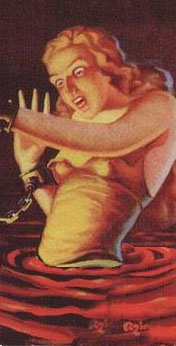
HoneytrapThe honeytrap is a roper-like creature which relies on deceit and camouflage to trap its prey. The upper half of its body bears the appearance of a beautiful young maiden, but this beauty is wrapped around a mass of tentacular horror. The honeytrap’s favored tactic is to secrete a corrosive chemical capable of rendering even solid rock into a quicksand-like liquiesence.  When its prey draws near, the honeytrap will cry in terror and plead for their aid. It will wait until they are at their most vulnerable before striking: Its sternum will part into a ravenous maw, exuding a half dozen coiled tentacles which will burst forth and wrap themselves lethally around the honeytrap’s would-be saviors.

The honeytrap prefers to lure its victims into a danerous mixture of complacency and chivalry before striking, but those seeking to flee a ravenous honeytrap may be shocked as it wrenches itself free from its muck-ridden hunting grounds and pursues them with great speed upon a second tumultuous mass of tentacles extruding from its “maiden” waist.

HONEYTRAP                                                     CR 8
CE Large Magical Beast
Senses: darkvision 60 ft., low-light vision, Listen +13, Spot +13
Init: +5 (+1 Dex, +4 Improved Initiative)
Languages: Common, Elven

AC: 24, touch 10, flat-footed 23 (-1 size, +1 Dex, +14 natural)
Hit Points: 85        HD: 10d10+30
Fort +10, Ref +8, Will +8

Speed: 40 ft.
Melee: bite +13 (1d6+6)
Ranged: 6 strands +11 ranged touch (drag and weakness)
Space: 5 ft.            Reach: 5 ft. (30 ft. with strand)
Base Atk: +10      Grapple: +14
Special Actions: quicksand liquiesence
Metamagic Feats: (spontaneous casters only)

Str 19, Dex 13, Con 17, Int 12, Wis 11, Cha 17
Special Qualities: darkvision 60 ft., low-light vision
Feats: Alertness, Improved Initiative, Iron Will, Weapon Focus (strand)
Skills: Climb +12, Hide +10*, Listen +13, Spot +13
Treasure: Standard
Advancement: 11-15 HD (Medium); 16-30 (Large)
Level Adjustment: —

Drag (Ex): If a honeytrap hits with a strand attack, the strand latches onto the opponent’s body. This deals no damage, but drags the struck opponent 5 feet closer each subsequent round (provoking no attack of opportunity) unless that creature breaks free, which requires an Escape Artist check (DC 23) or a Strength check (DC 19). (The DCs are Strength-based, and the Escape Artist check includes a +4 racial bonus.)

Drag and Bite: A honeytrap can draw a creature within 5 feet of itself and bite with a +4 attack bonus in the same round. A strand has 10 hit points and can be attacked by making a successful sunder attempt. However, attacking a honeytrap’s strand does not provoke an attack of opportunity. If the strand is currently attached to a target, the roper takes a -4 penalty on its opposed attack roll to resist the sunder attempt. Severing a strand deals no damager to the honeytrap.

Drag and Drown: A honeytrap who has drawn a victim into its quicksand will often try to drown them. A honeytrap can draw a creature 5 feet and attempt to drown them by making an opposed grapple check. If the check succeeds, the victim is pushed below the surface of the quicksand.

Strands (Ex): A honeytrap can extrude up to six strands at once, and they can strike up to 30 feet away (no range increment). If a strand is severed, a honeytrap can extrude a new one on its next turn as a free action.

Quicksand Liquiesence (Ex): A honeytrap can turn a 10 ft. radius of earth, dirt, or stone into quicksand in 1d4 minutes by excreting a powerful, acidic chemical. If a honeytrap is slain, moves, or stops excreting the chemical, the ground will re-solidify within 1d4 hours.

Quicksand requires a Survival check (DC 8′) to spot. The momentum of a running or charging character will carry them 1d2x5 feet into the quicksand. Characters in quicksand must make a Swim check (DC 10) every round to simply tread water in place, or a DC 15 check to move 5 feet in whatever direction desired. If a trapped character fails this check by 5 or more, he sinks below the surface and begins to drown whenever he can no longer hold his breath (see Swim skill). Characters below the surface of a bog may swim back to the surface with a successful Swim check (DC 15, +1 per consecutive round of being under the surface).

Pulling a trapped character out of quicksand often requires a branch, spear haft, rope, or similar tool to reach the victim with one end of it. The character performing the rescue must make a Strength check (DC 15) to pull the victim out, while the victim must succeed at a Strength check (DC 10) to hold onto the branch, pole, or rope. If the victim fails to hold on, he must immediately make a Swim check (DC 15) to remain above the surface. If both checks succeed, the victim is pulled 5 feet closer to safety.

Weakness (Ex): A honeytrap’s strands sap an opponent’s strength. Anyone grabbed by a strand must succeed on a Fortitude save (DC 18) or take 1d8 points of Strength damage. The DC is Constitution-based.

Skills: *Honeytraps have a +8 racial bonus to Hide checks if they are submerged in quicksand or similarly concealed.

This material is covered by the Open Gaming License.

Archives

Recent Posts

Recent Comments

Copyright © The Alexandrian. All rights reserved.