The Alexandrian

Archive for the ‘Roleplaying Games’ category

One-Page Rip-Off

July 5th, 2010

I received an interesting e-mail this morning from Tabletop Adventures:

[W]e also have other news about the Dungeon Codex: you now have an opportunity to get this great product in print! Tabletop Adventures and Philippe-Antoine Ménard, the Chatty DM, have jointly set up a project on the website KickStarter. This is a site that assists people with creative projects to raise funds to make their plans a reality. We are using KickStarter to gather support for a small print run of the Dungeon Codex.

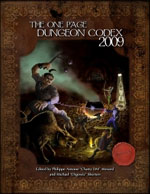
The One-Page Dungeon Codex 2009 contains the winning entries from the One-Page Duneon Contest, including my own Halls of the Mad Mage (Best Geometry). I wasn’t getting this e-mail because of my contributions to the book, however. I was getting it because I’d downloaded a copy of the PDF.

Following the link to KickStarter, I found a pledge system: For $3 you’d get an acknowledgment in the book. For $30 you get a printed copy. For $300 you get 10 copies.

What’s a little hazy, however, is exactly where this money is going. The project promises that the PDF will “become available as a special printed product”, but what does that mean, exactly?

Are they just talking about the copies being provided to pledgers? While they’re charging about $30, a quick investigation at Lulu reveals that you could print up a color copy of the book for about half that. That’s a pretty awesome profit margin for Tabletop Adventures.

(And if they’re not using Lulu, then they’re using a service like it. The minimum pledge threshold for this KickStarter project isn’t sufficient for anything larger than that.)

Are the pledges being used to fund a larger print run? Which they will then sell? If so, that’s an awfully one-sided business model they’re pitching to you. They’re basically asking you to provide the investment capital and then they’ll pocket all the profit.

Despite what you may be thinking, this post isn’t about freelancer rage. By submitting the Halls of the Mad Mage to the contest I released it under the Creative Commons license. They’re free to do whatever they want to with the module (along with everyone else in the world) and I’m not entitled to see a single penny of they money they make along the way. (Although the fact that they’ve turned a fun little community contest into a profit-generating enterprise will certainly influence my decision on participating in future versions of this contest.)

What I’m warning you about is a company trying to rip you off as a consumer.

So if you want a printed copy of the One-Page Dungeon Codex, here’s what you want to do:

(1) Download the free PDF.

(2) Go to Lulu.

(3) Set-up the PDF as a personal print job.

(4) Buy a copy for yourself.

This, it should be noted is perfectly legal: You have a copy of the work you are legally entitled to own (the PDF). Making additional copies of that work for your own personal use (even using third-party services like Kinko’s or Lulu) is legal. What you can’t do is distribute additional copies of that work to other people. (So don’t do that.)

And you’ll pay about half the price that Tabletop Adventures is looking for. Heck, you could even print up a hardcover edition of the book and still end up paying less.

Today’s lycanthropic template actually comes about because my first idea for sample werewolves could be summed up in two words: “Giant Werewolves”. But when I poked around at the idea for a bit, I realized that it was kind of unsatisfying for giant werewolf hybrids to shrink down into perfectly ordinary wolves. Clearly dire werewolves were called for.

Remember, these templates are designed to streamline and simplify the process of creating lycanthropes for 3.5:

(1) Create a stat block for the base creature.

(2) Apply the lycanthrope template in order to create the stat block for the humanoid form.

(3) Apply the hybrid template to the humanoid form in order to create the stat block for the hybrid form.

(4) Apply the animal form template to the humanoid form in order to create the stat block for the animal form

DIRE WEREWOLF TEMPLATES

DIRE WEREWOLF TEMPLATE
Apply this template to the base creature to create the werewolf’s humanoid form. This template can be added to any humanoid or giant.

Size and Type: Creature gains the “shapechanger” subtype.
Hit Dice and Hit Points: Add 6d8 hit die to the base creature.
Armor Class: +2 bonus to natural armor.
Base Attack: +4 BAB

Special Qualities: alternate form, low-light vision, lycanthropic empathy, scent

Base Save Bonuses: Fort +5, Ref +5, Will +5
Abilities: Wis +2, may gain an ability score increase due to additional hit dice
Skills: +2 racial bonus on Hide, Listen, Move Silently, and Spot checks. Gains (2 + Int modifier) x 6 skill points, treating Hide, Listen, Move Silently, Spot, and Survival as class skills.
Feats: Alertness, Run, Track, Weapon Focus (bite)

Challenge Rating: +4

DIRE WEREWOLF HYBRID TEMPLATE
Apply this template to the werewolf’s humanoid form to create the stat block for its hybrid form.

Size and Type: Large or the size of the base creature, whichever is larger.
Armor Class: +5 natural armor (if better than the humanoid form’s natural armor)
Attacks: Gains 2 claw attacks and 1 bite as a secondary attack (-5 penalty).

Hybrid Size
Claw
Bite
Small
1d3
1d4
Medium
1d4
1d6
Large
1d6
2d6
Huge
2d4
2d6

Special Attacks: curse of lycanthropy (Fort DC 15); cannot cast spells with verbal components
Special Qualities: DR 5/silver for afflicted lycanthropes; DR 10/silver for natural lycanthropes

Abilities: Str +14, Dex +4, Con +6

DIRE WEREWOLF ANIMAL FORM TEMPLATE
Apply this template to the werewolf’s humanoid form to create the stat block for its animal form.

Size and Type: Large
Speed: 50 ft.
Armor Class: +3 natural armor
Attacks: Replace all base attacks with a bite attack (1d8 and lycanthropy)

Special Attacks: curse of lycanthropy (Fort DC 15); cannot cast spells with verbal, somatic, or material components
Special Qualities: DR 5/silver for afflicted lycanthropes; DR 10/silver for natural lycanthropes

Abilities: Str +14, Dex +4, Con +6
Skills: +4 racial bonus on Survival checks when tracking by scent

TOTEM GIANTS

The clans of the totem giants can trace their blood back to Uru-Rukk, the Wolf Father. Their religious practices revolve around blood-bonding, ancestral offerings, and trance-rituals designed to evoke past life experiences passed through their bloodlines. The coming of age ritual for a wolf-giant involves the donning of their grandfather’s pelt (which may require the youngster to hunt and kill the old wolf… if they can).


HILL GIANT DIRE WEREWOLF – GIANT FORM (CR 11) – CE Large Giant (shapechanger)

DETECTION – low-light vision, Listen +8, Spot +11; Init -1; Languages Giant

DEFENSESAC 22 (-1 size, -1 Dex, +11 natural, +3 hide armor), touch 8, flat-footed 22; hp 153 (18d8+72); Special rock catching

ACTIONSSpd 30 ft. (base 40 ft.); Melee greatclub +20 (2d8+10) or 2 slams +19 (1d4+7); Ranged rock +12 (2d6+7); Space 10 ft.; Reach 10 ft.; Base Atk +13; Grapple +20; SA rock throwing; Combat Feats Cleave, Improved Bull Rush, Improved Sunder, Power Attack, Run, Weapon Focus (greatclub)

SQ alternate form, low-light vision, lycanthropic empathy, rock catching, scent

STR 25, DEX 8, CON 19, INT 6, WIS 12, CHA 7
FORT +17, REF +8, WILL +10

FEATS: Alertness, Cleave, Improved Bull Rush, Improved Sunder, Power Attack, Run, Track*, Weapon Focus (bite), Weapon Focus (greatclub)

SKILLS: Climb +7, Jump +7, Hide +3, Listen +8, Move Silently +4, Spot +11


HILL GIANT DIRE WEREWOLF – HYBRID FORM (CR 11) – CE Large Giant (shapechanger)

DETECTION – low-light vision, Listen +8, Spot +11; Init -1; Languages Giant

DEFENSESAC 23 (-1 size, +1 Dex, +11 natural, +3 hide armor), touch 9, flat-footed 22; hp 207 (18d8+126); DR 10/silver; Special rock catching

ACTIONSSpd 30 ft. (base 40 ft.); Melee 2 claws +26 (1d6+14) and bite +22 (2d6+14 and lycanthropy); Ranged rock +15 (2d6+14); Space 10 ft.; Reach 10 ft.; Base Atk +13; Grapple +27; SA curse of lycanthropy, rock throwing; Combat Feats Cleave, Improved Bull Rush, Improved Sunder, Power Attack, Run, Weapon Focus (greatclub)

SQ alternate form, low-light vision, lycanthropic empathy, rock catching, scent

STR 39, DEX 12, CON 25, INT 6, WIS 12, CHA 7
FORT +20, REF +10, WILL +10

FEATS: Alertness, Cleave, Improved Bull Rush, Improved Sunder, Power Attack, Run, Track*, Weapon Focus (bite), Weapon Focus (greatclub)

SKILLS: Climb +14, Jump +14, Hide +5, Listen +8, Move Silently +6, Spot +11


HILL GIANT DIRE WEREWOLF – DIRE WOLF FORM (CR 11) – CE Large Giant (shapechanger)

DETECTION – low-light vision, Listen +8, Spot +11; Init -1; Languages Giant

DEFENSESAC 13 (+1 size, -1 Dex, +3 natural), touch 10, flat-footed 12; hp 207 (18d8+126); DR 10/silver; Special rock catching

ACTIONSSpd 50 ft.; Melee bite +28 (1d8+14 and lycanthropy); Ranged +12; Space 10 ft.; Reach 10 ft.; Base Atk +13; Grapple +27; SA curse of lycanthropy, trip; Combat Feats Cleave, Improved Bull Rush, Improved Sunder, Power Attack, Run, Weapon Focus (greatclub)

SQ alternate form, low-light vision, lycanthropic empathy, rock catching, scent

STR 39, DEX 12, CON 25, INT 6, WIS 12, CHA 7
FORT +20, REF +9, WILL +10

FEATS: Alertness, Cleave, Improved Bull Rush, Improved Sunder, Power Attack, Run, Track*, Weapon Focus (bite), Weapon Focus (greatclub)

SKILLS: Climb +14, Jump +14, Hide +5, Listen +8, Move Silently +6, Spot +11


Alternate Form (Su): Switch forms as a standard action.
Curse of Lycanthropy (Su): Fort DC 15
Lycanthropic Empathy (Ex): Communicate with wolves and dire wolves; +4 bonus on Charisma-based checks against them.
Rock Catching (Ex): Reflex save as free action to catch Small (DC 15), Medium (DC 20), or Large (DC 25) rocks (or similar projectiles).
Rock Throwing (Ex): Up to 5 range increments of 120 ft. +1 racial bonus to throw rocks.
Scent (Ex): Detect presence within 30 feet (60 feet upwind, 15 feet downwind). Strong scents at double that range; overpowering at triple. Detect direction as move action. Pinpoint within 5 feet.
*Skills: In dire wolf form, gains +4 racial bonus on Survival checks when tracking by scent.

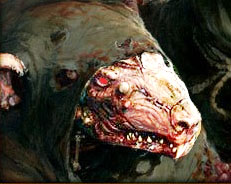
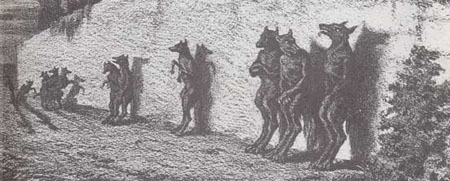
Lithographie de la Legende rustique de George Sand, 1858, Paris

Figthing with HTML code has chewed up some of the time I was planning to spend on lycanthropic templates, so I’m a day behind on my lycanthropes, but we’ll get to all of them before we’re done. Today we’re looking at the grand-daddy of them all: Werewolves.

As a reminder, these templates are designed to streamline and simplify the process of creating lycanthropes for 3.5:

(1) Create a stat block for the base creature.

(2) Apply the lycanthrope template in order to create the stat block for the humanoid form.

(3) Apply the hybrid template to the humanoid form in order to create the stat block for the hybrid form.

(4) Apply the animal form template to the humanoid form in order to create the stat block for the animal form.

WEREWOLF TEMPLATES

WEREWOLF TEMPLATE
Apply this template to the base creature to create the werewolf’s humanoid form. This template can be added to any humanoid or giant.

Size and Type: Creature gains the “shapechanger” subtype.
Hit Dice and Hit Points: Add 2d8 hit die to the base creature.
Armor Class: +2 bonus to natural armor.
Base Attack: +1 BAB

Special Qualities: alternate form, lycanthropic empathy, low-light vision, scent

Base Save Bonuses: Fort +3, Ref +3
Abilities: Wis +2, may gain an ability score increase due to additional hit dice
Skills: Gains (2 + Int modifier) skill points, treating Hide, Listen, Move Silently, Spot, and Survival as class skills.
Feats: Track, Weapon Focus (bite)

Challenge Rating: +2

WEREWOLF HYBRID TEMPLATE
Apply this template to the werewolf’s humanoid form to create the stat block for its hybrid form.

Size and Type: Medium or the size of the base creature, whichever is larger.
Armor Class: +4 natural armor (if better than the humanoid form’s natural armor)
Attacks: Gains 2 claw attacks and 1 bite as a secondary attack (-5 penalty).

Hybrid Size
Claw
Bite
Small
1d3
1d4
Medium
1d4
1d6
Large
1d6
2d6
Huge
2d4
2d6

Special Attacks: curse of lycanthropy (Fort DC 15); cannot cast spells with verbal components
Special Qualities: DR 5/silver for afflicted lycanthropes; DR 10/silver for natural lycanthropes

Abilities: Str +2, Dex +4, Con +4

WEREWOLF ANIMAL FORM TEMPLATE
Apply this template to the werewolf’s humanoid form to create the stat block for its animal form.

Size and Type: Medium
Speed: 50 ft.
Armor Class: +4 natural armor
Attacks: Replace all attacks with a bite attack (1d6 and lycanthropy)

Special Attacks: Replace base creature’s special attacks with trip and curse of lycanthropy (Fort DC 15); cannot cast spells with verbal, somatic, or material components
Special Qualities: DR 5/silver for afflicted lycanthropes; DR 10/silver for natural lycanthropes

Abilities: Str +2, Dex +4, Con +4
Skills: +4 racial bonus on Survival checks when tracking by scent.

THE SPIDER WEIRD OF HOLLOW’S DEEP

Werewolves are a dime a dozen, so I wanted to do something truly unusual to showcase the templates. In doing so I’ve technically broken the rules by applying a lycanthropic template to a magical beast. But if you don’t tell anybody, I won’t.

The Spider Weird is a horrific creature which haunts the dark woods around the village of Hollow’s Deep. It usually leaves the villagers alone, preferring to hunt the game animals of the forest. But upon occasion — when the villagers rile its anger or perhaps when the blood moon rises — the Spider Weird will inflict a reign of terror.

The Spider Weird is an aranea which was infected with lycanthropy while in its spider-humanoid form. The mixture of its natural shapechanging abilities and the lycanthropic curse allow it to assume four shapes: A monstrous spider, a black-eyed elf, a spider-wolf hybrid, and a wolf.


SPIDER WEIRD – MONSTROUS SPIDER (CR 6) – N Medium Magical Beast (Shapechanger)

DETECTION – darkvision 60 ft., low-light vision, Listen +7, Spot +7; Init +7; Languages Common, Sylvan

DEFENSESAC 16 (+3 Dex, +3 natural), touch 13, flat-footed 13; hp 35 (3d10+2d8+10)

ACTIONSSpd 50 ft., climb 25 ft.; Melee bite +8 (1d6 and poison); Ranged web +7; Space 5 ft.; Reach 5 ft.; Base Atk +4; Grapple +4; SA poison, spells, web

SQ change shape, darkvision 60 ft., low-light vision, lycanthropic empathy, scent

STR 11, DEX 16, CON 14, INT 14, WIS 15, CHA 14
FORT +8, REF +9, WILL +5

FEATS: Improved Initiative, Iron Will*, Track, Weapon Finesse, Weapon Focus (bite)

SKILLS: Climb +14, Concentration +8, Escape Artist +5, Hide +11, Jump +13*, Listen +7*, Spot +7*


SPIDER WEIRD – ELF FORM (CR 6) – N Medium Magical Beast (Shapechanger)

DETECTION – darkvision 60 ft., low-light vision, Listen +7, Spot +7; Init +7; Languages Common, Sylvan

DEFENSESAC 20 (+3 Dex, +3 natural, +4 masterwork chain shirt), touch 13, flat-footed 17; hp 35 (3d10+2d8+10)

ACTIONSSpd 50 ft., climb 25 ft.; Melee +1 rapier +7 (1d6 and poison, 18-20/x2); Ranged +7; Space 5 ft.; Reach 5 ft.; Base Atk +4; Grapple +4; SA spells

SQ change shape, darkvision 60 ft., low-light vision, lycanthropic empathy, scent

STR 11, DEX 16, CON 14, INT 14, WIS 15, CHA 14
FORT +8, REF +9, WILL +5

FEATS: Improved Initiative, Iron Will*, Track, Weapon Finesse, Weapon Focus (bite)

SKILLS: Climb +13, Concentration +8, Escape Artist +4, Hide +11, Jump +12*, Listen +7*, Spot +7*

POSSESSIONS: +1 rapier, masterwork chain shirt


SPIDER WEIRD – SPIDER-WOLF HYBRID (CR 6) – N Medium Magical Beast (Shapechanger)

DETECTION – darkvision 60 ft., low-light vision, Listen +7, Spot +7; Init +9; Languages Common, Sylvan

DEFENSESAC 23 (+5 Dex, +4 natural, +4 masterwork chain shirt), touch 15, flat-footed 18; hp 45 (3d10+2d8+20); DR 5/silver

ACTIONSSpd 50 ft., climb 25 ft.; Melee 2 claws +9 (1d4+1) or +1 rapier +9 (1d6+1, 18-20/x2) and bite +10 (1d6+1 and lycanthropy, poison); Ranged web +9; Space 5 ft.; Reach 5 ft.; Base Atk +4; Grapple +5; SA curse of lycanthropy, poison, spells, web

SQ change shape, darkvision 60 ft., low-light vision, lycanthropic empathy, scent

STR 13, DEX 20, CON 18, INT 14, WIS 15, CHA 14

FORT +10, REF +11, WILL +5

FEATS: Improved Initiative, Iron Will*, Track, Weapon Finesse, Weapon Focus (bite)

SKILLS: Climb +14, Concentration +10, Escape Artist +6, Hide +12, Jump +13*, Listen +7*, Spot +7*

POSSESSIONS: +1 rapier, masterwork chain shirt


SPIDER WEIRD – WOLF FORM (CR 6) – N Medium Magical Beast (Shapechanger)

DETECTION – darkvision 60 ft., low-light vision, Listen +7, Spot +7; Init +9; Languages Common, Sylvan

DEFENSESAC 19 (+5 Dex, +4 natural), touch 15, flat-footed 14; hp 45 (3d10+2d8+20); DR 5/silver

ACTIONSSpd 50 ft; Melee bite +10 (1d6+1 and lycanthropy); Ranged +9; Space 5 ft.; Reach 5 ft.; Base Atk +4; Grapple +5; SA curse of lycanthropy, trip

SQ change shape, darkvision 60 ft., low-light vision, lycanthropic empathy, scent

STR 13, DEX 20, CON 18, INT 14, WIS 15, CHA 14
FORT +10, REF +11, WILL +5

FEATS: Improved Initiative, Iron Will*, Track, Weapon Finesse, Weapon Focus (bite)

SKILLS: Climb +15, Concentration +10, Escape Artist +7, Hide +13, Jump +14*, Listen +7*, Spot +7*

Sorcerer Spells Known (CL 3)
1st (6/day, DC 13)—mage armor, silent image, sleep
0th (6/day, DC 12)—daze, detect magic, ghost sound, light, resistance


Change Shape (Su): Switch forms as a standard action.
Curse of Lycanthropy (Su): Fort DC 15
Lycanthropic Empathy (Ex): Communicate with wolves and dire wolves; +4 bonus on Charisma-based checks against them.
Poison – Spider or Elf (Ex): Injury, Fort DC 14, 1d6 Str/2d6 Str
Poison – Hybrid (Ex): Injury, Fort DC 16, 1d6 Str/2d6 Str
Scent (Ex): Detect presence within 30 feet (60 feet upwind, 15 feet downwind). Strong scents at double that range; overpowering at triple. Detect direction as move action. Pinpoint within 5 feet.
Web (Ex): 6/day, range 50 ft., range increment 10 ft. cts like net, anchors target in place. Effective against Large or smaller creatures.
*Skills: Can always choose to take 10 on Climb checks. In wolf form, gain +4 bonus to Survival checks made while tracking with scent.


In order to create the stat blocks for these forms, I:

(1) Prepped stat blocks of a normal aranea’s monstrous spider and humanoid forms. (I added armor and weapons to the latter.)

(2) To create the Spider Weird’s monstrous spider form, I applied the base werewolf template to the aranea’s monstrous spider stat block.

(3) To create the Spider Weird’s elf form, I applied the base werewolf template to the aranea’s humanoid stat block.

(4) To create the Spider Weird’s spider-wolf hybrid form, I applied the werewolf hybrid template to the Spider Weird’s monstrous spider form and then added the weapons and armor from its humanoid stat block.

(5) Finally, to create the Spider Weird’s wolf form I applied the werewolf animal form template to the Spider Weird’s monstrous spider stat block.

Without these werewolf templates I honestly would have never even considered trying to create the Spider Weird. Way too complicated. With the templates it took about 30 minutes to put the four stat blocks together. (I spent more time fussing with the HTML and CSS to make this page look half-way decent.)

This material is covered by the Open Gaming License.

Albino Skaven

Last week I posted a rant about the difficulty of creating lycanthropic stat blocks in 3rd Edition. The short version is this: Creating lycanthropes require you to create three separate stat blocks simultaneously while pulling information from both the base creature and the animal form. You end up juggling five stat blocks and if you discover that you need (or want) to make an adjustment on any one of them during the creation process you have to backtrack the change through all the other stat blocks.

I concluded that the rules themselves weren’t necessarily bad, but the organization of the rules were unnecessarily convoluted. It would be easier if the rules presented a clear order of progression:

(1) Create a stat block for the base creature.

(2) Apply the lycanthrope template in order to create the stat block for the humanoid form.

(3) Apply the hybrid template to the humanoid form in order to create the stat block for the hybrid form.

(4) Apply the animal form template to the humanoid form in order to create the stat block for the animal form.

And to that end I created sample templates for the wererat, which turned the rant into something rather more useful. Noumenon liked the template enough that he asked me to turn it into a series. I was initially skeptical that just churning out templates would be particularly interesting blog material, but then I realized I could spice things up a little by providing some advanced lycanthrope characters as sample applications of the templates.

So, on that note: Welcome to Movies & Lycanthropes Week at the Alexandrian.

Today is a bit of a rehash as we return to the wererat templates (although the sample NPC is new), but tomorrow we’ll have completely new material.

Note: These templates are designed to create 100% rules-accurate stat blocks. In other words, applying these templates should give you the exact same stat blocks that you would get if you applied the template from the 3.5 core rulebooks. They’re just providing a cleaner, quicker way of getting there.

WERERAT TEMPLATES

WERERAT TEMPLATE
Apply this template to the base creature to create the wererat’s humanoid form. This template can be added to any humanoid or giant.

Size and Type: Creature gains the “shapechanger” subtype.
Hit Dice and Hit Points: Add 1d8 hit die to the base creature.
Armor Class: +2 bonus to natural armor.

Special Qualities: alternate form, lycanthropic empathy, low-light vision, scent

Base Save Bonuses: Fort +2, Ref +2, Will +2
Abilities: Wis +2, may gain an ability score increase due to additional hit dice
Skills: +8 racial bonus on Climb and Swim checks. Gains (2 + Int modifier) skill points, treating Climb, Hide, Listen, Move Silently, Spot and Swim as class skills.
Feats: Alertness, Iron Will, Weapon Finesse

Challenge Rating: +2

WERERAT HYBRID TEMPLATE
Apply this template to the wererat’s humanoid form to create the stat block for its hybrid form.

Size and Type: Small or the size of the base creature, whichever is larger.
Armor Class: +1 bonus to natural armor (if better than the base creature’s natural armor bonus)
Attacks: Gains 2 claw attacks and 1 bite as a secondary attack (-5 penalty).

Hybrid Size
Claw
Bite
Small
1d3
1d4
Medium
1d4
1d6
Large
1d6
2d6
Huge
2d4
2d6

Special Attacks: curse of lycanthropy (Fort DC 15); cannot cast spells with verbal components
Special Qualities: DR 5/silver for afflicted lycanthropes; DR 10/silver for natural lycanthropes

Abilities: Dex +6, Con +2

WERERAT ANIMAL FORM TEMPLATE
Apply this template to the wererat’s humanoid form to create the stat block for its animal form.

Size and Type: Small
Speed: 40 ft., climb 20 ft.
Armor Class: +1 natural armor (if better than the base creature’s natural armor)
Attacks: Replace all attacks with a bite attack (1d4 plus disease).

Special Attacks: curse of lycanthropy (Fort DC 15); cannot cast spells with verbal, somatic, or material components
Special Qualities: DR 5/silver for afflicted lycanthropes; DR 10/silver for natural lycanthropes

Abilities: Dex +6, Con +2
Skills: Can choose to take 10 on Climb checks even if rushed or threatened. Can use their Dex modifier for Climb and Swim checks.

BRADOCH THE WERERAT

Bradoch is an elderly, orcish wererat. He has been isolated from his tribe and his kind of decades now. His only companions are his faithful rats, who surround him in great hordes throughout the forest. Bradoch is intensely protective of the rats, and he hates the goblin tribes (who hunt them for food).

Note: Bradoch is currently unschooled in the common tongue. But if he is brought into frequent interaction with local human populations, he will make it a point to learn it as quickly as possible — either relying on his own interaction or falling back onto using his rats as spies.


BRADOCH – ORC FORM (CR 6) – Barbarian 4 – NE Medium Humanoid (Orc, Shapechanger)

DETECTION – darkvision 60 ft., low-light vision, scent, Listen +11, Spot +11; Init +2; Languages Orcish

DEFENSESAC 19 (+1 Dex, +2 natural, +6 +1 mithril chainmail), touch 11, flat-footed 18; hp 26 (4d12+1d8-5); Weakness light sensitivity

ACTIONSSpd 40 ft.; Melee quarterstaff +7 (1d6+2); Ranged dart +5 (1d4+2 and poison); Space 5 ft.; Reach 5 ft.; Base Atk +4; Grapple +6; Atk Options rage 2/day; Combat Gear third eye of the rat

SQ alternate form, darkvision 60 ft., fast movement, illiteracy, light sensitivity, low-light vision, lycanthropic empathy, rage 2/day, scent, trap sense +1, uncanny dodge

STR 14, DEX 12, CON 8, INT 14, WIS 17, CHA 13
FORT +5, REF +4, WILL +8

FEATS: Alertness, Iron Will, Stealthy, Weapon Finesse

SKILLS: Climb +11, Handle Animal +7, Hide +10, Intimidate +4, Jump +8, Listen +11, Move Silently +10, Spot +11, Swim +10

POSSESSIONS: +1 mithril chainmail, masterwork quarterstaff, 6 poisoned darts, third eye of the rat, ruby (240 gp, worn on cord around his neck)


BRADOCH – HYBRID FORM (CR 6) – Barbarian 4 – NE Medium Humanoid (Orc, Shapechanger)

DETECTION – darkvision 60 ft., low-light vision, scent, Listen +11, Spot +11; Init +2; Languages Orcish

DEFENSESAC 23 (+4 Dex, +3 natural, +6 +1 mithril chainmail), touch 14, flat-footed 19; hp 31 (4d12+1d8); DR 10/silver; Weakness light sensitivity

ACTIONSSpd 40 ft.; Melee quarterstaff +6 (1d6+2) or 2 claws +8 (1d4+2) and 1 bite +3 (1d6+1 and lycanthropy); Ranged dart +8 (1d4+2 and poison); Space 5 ft.; Reach 5 ft.; Base Atk +4; Grapple +6; Atk Options rage 2/day; SA curse of lycanthropy; Combat Gear third eye of the rat

SQ alternate form, darkvision 60 ft., fast movement, illiteracy, light sensitivity, low-light vision, lycanthropic empathy, rage 2/day, scent, trap sense +1, uncanny dodge

STR 14, DEX 18, CON 10, INT 14, WIS 17, CHA 13
FORT +5, REF +7, WILL +8

FEATS: Alertness, Iron Will, Stealthy, Weapon Finesse

SKILLS: Climb +11, Handle Animal +7, Hide +14, Intimidate +4, Jump +8, Listen +11, Move Silently +14, Spot +11, Swim +10

POSSESSIONS: +1 mithril chainmail, masterwork quarterstaff, 6 poisoned darts, third eye of the rat, ruby (240 gp, worn on cord around his neck)


BRADOCH – DIRE RAT FORM (CR 6) – Barbarian 4 – NE Small Humanoid (Orc, Shapechanger)

DETECTION – darkvision 60 ft., low-light vision, scent, Listen +11, Spot +11; Init +2; Languages Orcish

DEFENSESAC 24 (+4 Dex, +1 size, +3 natural, +6 +1 mithril chainmail), touch 15, flat-footed 20; hp 31 (4d12+1d8); DR 10/silver; Weakness light sensitivity

ACTIONSSpd 50 ft., climb 20 ft.; Melee bite +8 (1d4, disease, lycanthropy); Space 5 ft.; Reach 5 ft.; Base Atk +4; Grapple +2; Atk Options rage 2/day; SA curse of lycanthropy, disease; Combat Gear third eye of the rat

SQ alternate form, darkvision 60 ft., fast movement, illiteracy, light sensitivity, low-light vision, lycanthropic empathy, rage 2/day, scent, trap sense +1, uncanny dodge

STR 14, DEX 18, CON 10, INT 14, WIS 17, CHA 13
FORT +5, REF +7, WILL +8

FEATS: Alertness, Iron Will, Stealthy, Weapon Finesse

SKILLS: Climb +13*, Handle Animal +7, Hide +18, Intimidate +4, Jump +8, Listen +11, Move Silently +14, Spot +11, Swim +12*

POSSESSIONS: +1 mithril chainmail, masterwork quarterstaff, 6 poisoned darts, third eye of the rat, ruby (240 gp, worn on cord around his neck)


Alternate Form (Su): Switch forms as standard action.
Curse of Lycanthropy (Su): Fort DC 15
Disease: Filth Fever (Fort DC 10, incubation 1d3 days, damage 1d3 Dex + 1d3 Con)
Light Sensitivity (Ex): Dazzled in bright sunlight or daylight spell.
Lycanthropic Empathy (Ex): Communicate with rats and dire rats; +4 bonus on Charisma-based checks against them.
Poison (Ex): Medium spider venom (injury DC 14, 1d4 Str/1d4 Str)
Rage (Ex): 5 rounds: +4 Str, +4 Con, +2 Will saves, -2 AC. Cannot use Concentration; Cha, Dex, or Int skills. Fatigued when rage ends (-2 Str, -2 Dex, can’t charge or run).
Scent (Ex): Detect presence within 30 feet (60 feet upwind, 15 feet downwind). Strong scents at double that range; overpowering at triple. Detect direction as move action. Pinpoint within 5 feet.
Trap Sense (Ex): +1 on AC and Reflex saves vs. traps.
Uncanny Dodge (Ex): Retains Dex bonus to AC when flat-footed.
*Skills: Can choose to take 10 on Climb checks even if rushed or threatened.


THIRD EYE OF THE RAT
Price (Item Level): 18,000 gp (6th)
Body Slot: Head
Caster Level: 6th
Aura: Moderate
Activation: —
Weight: —

This rat’s eye suspended in amber can be placed upon the forehead, where it will automatically attach itself as a third eye. A character using the eye can automatically detect the presence of any rat within 300 feet. In addition, they can attune themselves to a rat of their choice within that range as a standard action and see through the eyes of the rat.

The third eye of the rat does not grant the wearer the ability to control the rats in any way, but if the wearer looks through the eyes of a rat that they control which is currently sharing their space then they cannot be flanked.

Prerequisites: Craft Wondrous Item, clairvoyance, detect animals or plants
Cost to Create: 9,000 gp + 720 XP

CONCLUSION

Bradoch is fairly straight-forward: I created a 4th-level Barbarian with elite stats, applied the old age template, and then applied the wererat template. I’m showcasing him here because my struggles with Bradoch led directly to the creation of these lycanthropic templates (so it seemed appropriate).

Bradoch is also a secret sneak peek at a super secret project that I’m currently developing. The project is still so far under wraps the only thing I can tell you about it is a hint wrapped inside an enigma:

There is now a hidden way to access the homepage of the Alexandrian. But that is not its ultimate goal.

Have fun speculating! More were-creatures tomorrow!

This material is covered by the Open Gaming License.
UPDATE: This page is out of date and no longer maintained. I’m leaving it up to keep the comments archived, but for a complete index of all articles related to node-based scenario design, check Part 1 of the series.

Node-Based Scenario Design

Here’s a convenient index of Node-Based Scenario Design for easy access, easy reading, and easy linking.

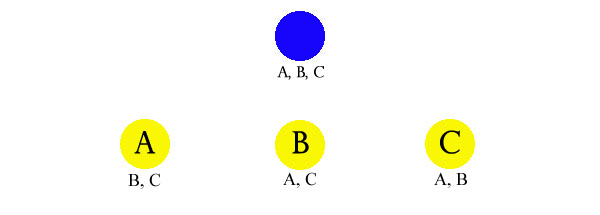
Part 1: The Plotted Approach
Part 2: Choose Your Own Adventure
Part 3: Inverting the Three Clue Rule
Part 4: Sample Scenario – Las Vegas CTU
Part 5: Plot vs. Node
Part 6: Alternative Node Design
Part 7: More Alternative Node Designs
Part 8: Freeform Design in the Cloud
Part 9: Types of Nodes

The essays on the Three Clue Rule and scenario-based design make for good supplementary reading if you haven’t seen them already.

UPDATE: A a sequel or supplement for Node-Based Scenario Design has been written under the mind-numbingly clever title Advanced Node-Based Design.

Archives

Recent Posts

Recent Comments

Copyright © The Alexandrian. All rights reserved.