The Alexandrian

Archive for the ‘Roleplaying Games’ category

How much should a single character be allowed to accomplish in 1 turn?

What you’re looking for is a sweet spot.

On one end of the spectrum, you have: “That guy is able to do way too much before I get another turn.” (Munchkin Quest suffers from this, as described and fixed in my house rules.)

On the other end of the spectrum, you have: “I’m not able to do anything interesting this turn.” (Imagine a game of Monopoly in which you could either roll the dice to move or buy the property you landed on, but not both. The balance would not be appreciably altered, but I suspect the game would suffer nontheless.)

The reason games use interrupt actions — such as attacks of opportunity — is to widen the tolerance of the sweet spot: It allows you to design turns that are long/large enough to maximize the potential for “I can do something fun with my turn” while simultaneously preventing the “why can’t I do anything to stop him from that long sequence of actions?” problem.

The disadvantage of interrupt actions, however, is the complexity which arises from tracking the triggers which allow those interrupts to be used. (Attacks of Opportunity in 3rd Edition gave you a single interrupt action, but had a very lengthy list of possible triggers. Swift actions were later added to the game, giving you a plethora of interrupt actions to choose from; but these almost universally had the trigger of “whenever you want to do it”, which is very easy to keep track of. 4th Edition simplified the list of triggers for Attacks of Opportunity, but drastically increased the number of different interrupt actions in the game and gave most of them different triggering conditions — thus radically increasing the complexity of the game.)

THOUGHT EXPERIMENT: Imagine a 3E-style combat system in which every character gets a single standard action each turn. In addition, they have a single interrupt action which they can use at any time. (For example, to hit someone running past them or trying to run away from them.)

(If you wanted to keep full actions, you could allow them to be taken by any character using their interrupt action on their turn.)

The point is that you don’t define any trigger conditions for those interrupts: You don’t need to keep track of them (or try to avoid doing them). You simply use them whenever you want to and can do whatever you want with them. Theoretically, this would give you the flexibility to respond to actions on the battlefield as you choose, without the difficulty of trying to keep in mind all the possible trigger actions.

Certain effects could vary the number of interrupt actions a character has. For example, a haste spell might simply grant a character an extra interrupt action. (Although on a similar note, you’d probably want to prohibit spellcasting with an interrupt action. An added layer of complexity, but probably necessary for balance. There are almost certainly some other wrinkles to work through if you wanted to use a system like this.)

Treasure Map

One of the key concepts of “(Re-)Running the Megadungeon” is that the goal of the adventure is not and cannot be to “clear the dungeon”. Such a goal would be as meaningless as a World War II game in which the goal was, “Kill all the Nazis.”

(I suppose, in a general sense, you actually could hold such a goal. It would be something like the ultimate instantiation of the hack ‘n slash campaign: There’s a dungeon over there. Go slash at it for awhile. The important thing, however, is that one cannot reasonably expect to achieve that goal. That’s just not going to hack it.)

The loss of this clear-cut goal is problematic because “clear the dungeon” has long since become the default tactical solution for virtually every scenario in D&D. Oh, it’s usually gussied up a bit. But you’d be surprised at how often everything boils down to “clear the dungeon”. For example:

  • “The forces of chaos are marshaling for an assault on the last bastion of civilization?” “How do we stop it?” “Go to the Caves of Chaos and… clear the dungeon.” (B2 Keep on the Borderlands)
  • “The corrupt mayor is planning to release the Yellow Sign and drive Freeport into madness!” “How do we stop it?” “Go to the Lighthouse and… clear the dungeon.” (Freeport Trilogy)
  • “Slavers are kidnapping people off the streets!” “How do we stop them?” “Go to the slave pits and… clear the dungeon.” (Scourge of the Slave Lords)
  • “The Giants are arming for war!” “How do we stop them?” “Go to their steading and… clear the dungeon.” (Against the Giants)
  • “Kalarel is trying to summon something terrible from the Shadowfell!” “How do we stop him?” “Go to the Keep and… clear the dungeon.” (Keep on the Shadowfell)

There’s nothing terribly wrong with this formula, of course. As you can see, it can be easily mapped to any number of potential crises. It has the virtue of being easy to set-up (Bad Guys X are trying to do Bad Thing Y and they can be found at Bad Place Z). And the players generally know exactly what they’re supposed to be doing (“Wipe them out, all of them”).

However, it does have the rather unfortunate side-effect of inherently funneling everything through the combat system, drastically narrowing the range of potential gameplay. And when you attempt to apply this default formula to the megadungeon it creates two major problems:

First, it’s a grind.  If your goal is to “wipe out all the bad guys” in a dungeon filled with bad guys, then the megadungeon boils down to a very simplistic dynamic: You go into the dungeon, empty as many rooms as possible, and then retreat. Then you go back and  you do it again. And again. And again. And again.

Second, the formula is inherently designed to use up material, whereas your goal with the megadungeon is recycle, reuse, and remix material. And the more you restock the dungeon while your players are trying to destock it, the more of a grind the whole thing becomes.

SETTING A DEFAULT

Having set aside the default mode of “clear the dungeon”, what are we to replace it with?

It’s not unusual at this juncture for someone to say, “Exploration.” Go poke around in the corners of the dungeon because you’re curious about what might be hanging out down there.

It’s not a bad suggestion, per se. But in my experience, exploration for the sake of exploration can be rather aimless. It lacks the necessary specificity to function as the driving force behind a campaign. I suspect this is because it doesn’t provide a strong enough criteria for decision-making: If you’re standing at an intersection in the dungeon and your goal is merely “to explore”, does it really matter which way you go? Not really. You’ll be exploring whichever way you go.

But “exploration” remains a compelling concept. Is there a way we can make it a more clearly defined goal?

Gold.

Here I once again find myself looking back to the earliest versions of the game, when the default method of play was not “kill the monsters”, but instead “find the treasure” — i.e., exploration geared towards a more specific end. And, notably, a specific end which — unlike “kill the monsters” — doesn’t pre-suppose the tactical and strategic means of success. (“Kill the monsters” implies blasting them with spells and poking them with pointy bits of metal. “Find the treasure” might mean killing monsters… but it could also mean sneaking past them, negotiating with them, distracting them, hiring them, tricking them, trading with them, or any number of other possibilities.)

TREASURE HUNTING

“Find the treasure”, in its most generic form, may not be terribly compelling. But it is sufficient for reliably getting the PCs to the entrance of the dungeon (and universal enough that it provides little meaningful constriction in terms of the types of characters that can be created; of course, there’s also no reason why a player couldn’t find a more unique goal for their PC).

Before one simply writes off “find the treasure” as bland pablum, however, consider that in its more specific forms “find the treasure” has served as the basis for some of the great stories of our time (or any time): Raiders of the Lost Ark, The Maltese Falcon, The Hobbit, The Illiad, The Golden Fleece. They’re all stories about treasure-hunting.

And OD&D builds a method for building towards that specificity right into its rules for procedural content generation: Treasure maps.

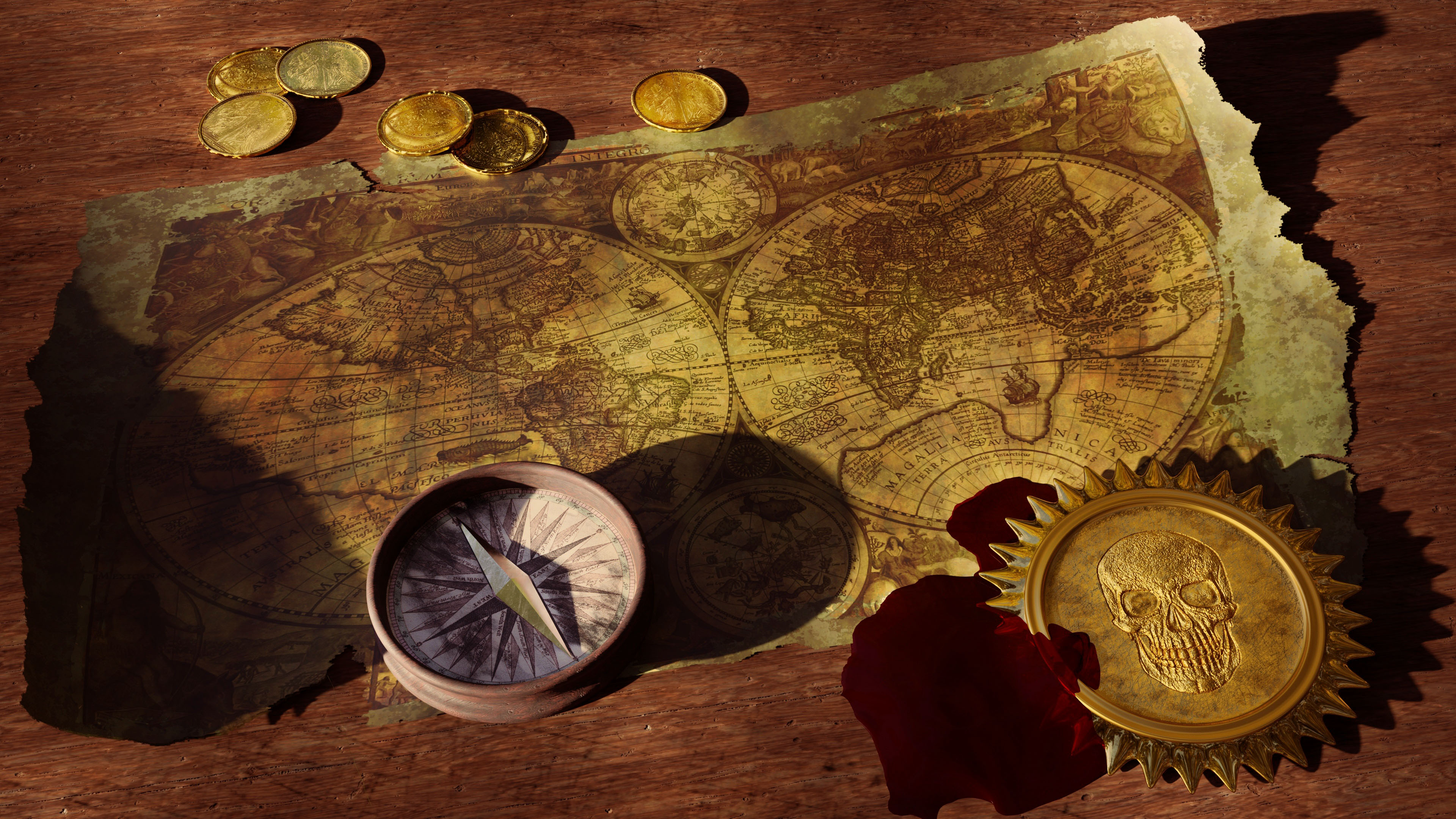
If you’re randomly generating treasure troves using the OD&D guidelines, then most intelligent foes will have a 10-15% chance of having one or more treasure maps. These can, of course, take many forms. (The Judges Guild Book of Treasure Maps supplements included everything from journal entries to scribbled notes to careful exemplars of cartography.) But the point is that a treasure map points you towards some specific treasure: You are no longer just poking around for gold in the general sense; you are specifically seeking for “the Tombe of Aerthering who is called DAMNED” (to take one example).

SPECIFIC DUNGEON GOALS

Moving beyond that, the point of setting a default goal (like “find the treasure”) is not to limit the game, but rather to provide a baseline to ensure that gaming happens. The point isn’t to say “you will go treasure-hunting”, but rather to say “if you can’t think of anything better to do, we’ll default to treasure-hunting”.

More generally, once you’ve used your default goal(s) to get the PCs into the dungeon complex, more specific goals will generally tend to accumulate on their own. In my Caverns of Thracia game, for example, a deep grudge quickly settled in against the minotaur who kept cropping up on an irregular basis. (He had killed or maimed more than a dozen PCs, so the grudge is probably understandable.) There were cheers at the table when he was finally cornered and killed in a recent session.

Have we arrived back at “killing the bad guy” as a viable megadungeon goal? Sure. (You didn’t think I was advocating for combat to be taken out of D&D, did you?) It’s not necessary to completely abandon the “there are bad guys, go get ’em” formula. But it may require a little more subtlety than that mail-order course on strategy from Palpatine University might suggest. “Wipe them out, all of them” might cut it if they’re the only guys in the neighborhood, but picking a fight with every humanoid tribe in the region because you want to put the cultists on level 4 out of commission probably isn’t a great idea.

Which begins to move us in the general direction of a more general precept: While it is necessary to maintain some sense of mystery regarding the depths of the megadungeon (as drawing back that veil of ignorance is one of the rewards for playing in a properly compelling megadungeon), it’s also important to foreshadow those depths by revealing certain details. These details, in turn, become goals for the PCs to achieve.

(The methods by which this foreshadowing can occur are essentially limitless: For example, the PCs may know that Black Donagal fled into the depths because they saw him do it. They may learn about the minotaur court by questioning a prisoner. They may find a map indicating the location of the Hall of Golden Maidens (if only they could identify one of the landmarks on their map). And so forth, not to mention divinations and magical visions.)

At this point, we can successfully return to the idea of “exploration” as a meaningful goal. Because while “exploring for the sake of exploring” is unfocused, exploring because you want to find the Tunnel of Black Rainbows is more than specific enough.

But we don’t have to stop there: The features of a megadungeon are people, places, and things. And all of these features can be foreshadowed and, thus, become goals. And out of people, places, and things every story in the history of the world has been told.

The default gets them playing. But once they start playing, there’s no limit to the things they can find or the goals they can discover.

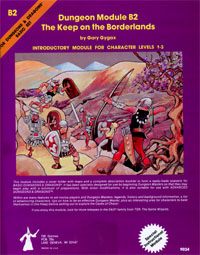
B2 Keep on the BorderlandsIn “(Re)-Running the Megadungeon” I talked about how to keep a dungeon complex fresh by restocking the room key and using wandering monster tables as a form of low-tech procedural content generation. In “Wandering Adventures” I talked about how the OD&D wandering monster tables could be used to generate entire adventures. Now I want to build on those ideas by touching on the basic concept of factions in the dungeon.

To immediately boil the idea down to its core: If your dungeon has a life beyond the activities of the PCs, it is much easier to revitalize the dungeon between delves. The life of the dungeon will naturally generate the ideas necessary to restock the dungeon (and, thus, carry a lot of the weight for you). This becomes even easier if the dungeon contains multiple, independent factions. (And even moreso if these factions are openly hostile to each other.)

Nor does this have to be something that you need heavily pre-plan. It can largely just be a matter of keeping one eye on it during your restocking process: “Okay, the PCs killed 70% of the orc population on Level 3. Who can take advantage of that? What will the Orc King’s response be? Actually, wait, they killed the Orc King. Have the orcs broken into factions? Could the Red Prince (I just made that name up) have allied with the goblins on Level 2 to push his claims? How will the other orcs feel about being asked to co-exist with lowly goblins? Will they turn to the Voodoo Necromancer (just made that up, too) who was once the Orc King’s advisor?” That’s about 15 seconds of brain-storming. Follow it up with a couple minutes of actual prep and you’ve got orc-and-goblin warbands with faces painted bright crimson squaring off against orc warriors ‘roided out on alchemical strength-boosters wearing the bone fetishes of the Voodoo Necromancer. It doesn’t even really matter if the PCs get involved in the actual politics of the situation: Even if they just hack their way through these orcish factions, they’ll (a) recognize that the dungeon has changed in their absence and (b) get some unique and interesting hacking out of it.

(You can see a similar real-play example of this in Delve Seven of “(Re-)Running the Megadungeon” when the elementalist gets killed.)

So, obviously, there’s nothing wrong with winging it. In the process of winging it, however, I’ve found it generally useful to prep two key pieces of information:

  1. Identify each faction.
  2. Identify the territory controlled by each faction.

Most of the time, it’s not necessary to get really obsessive with this. For example, in the Caverns of Thracia I don’t really have much more than a general sense that “the cultists control this chunk of the map”, “the lizardmen control these rooms”, “the anubians are based out of this complex”, and the like.

My understanding of the complex is fairly amorphous, and putting more detail into it is probably counter-productive: It’s unlikely to ever be noticed by players, it’ll bog down your prep, and it’s rarely representative of the fairly amorphous nature of contested territory. Precision will also tend to bog down your ability to flexibly interpret the results from your random encounter tables.

(Of course, if you’re designing a scenario in which particular focus or importance is placed on factional play, more detail may be merited.)

RANDOM FACTION INTERACTION TABLES

With that being said, it might be valuable to build some quick, light tools that will allow you to procedurally generate the ebbing shifts of factional fortunes in the dungeon. For this purpose, let’s turn to the Caves of Chaos from the classic B2 Keep on the Borderlands.

For those unfamiliar with this module, the Caves of Chaos are particularly useful for this purpose because they’ve already been conveniently split into factions: Essentially you’ve got a small valley full of caves, with each cave leading to an interconnected system of caverns and serving as the lair for one of several chaotic factions. The factions are:

Die Roll (d12)
Faction
1
Kobolds (A)
2
Orcs of the Bloody Fist (B)
3
Fang-Fingered Orcs (C)
4
Goblins (D)
5
Ogre (E)
6
Hobgoblins (F)
7
Owlbear (G)
8
Bugbears (H)
9
Minotaur (I)
10
Gnolls (J)
11
Evil Priests (K)
12
Wandering Adventurers

(“Wandering Adventurers” refers to an NPC party entering the Caves of Chaos.)

FACTION CONFLICT CHECK: After each visit to the caves by a party of PCs, make a faction conflict check. Roll 1d6. On a roll of 6, conflict has broken out between the factions. Roll twice on the faction table to determine which two factions have come into conflict. (If you roll the same number twice, either re-roll or assume some sort of civil strife.) Then roll on the Conflict Resolution Table:

Die Roll (1d8)
Outcome
1
Stalemate Skirmish
2
1 Faction Damaged
3
1 Faction Crippled
4
1 Faction Destroyed
5
Both Factions Damaged
6
Both Factions Crippled
7
Both Factions Destroyed
8
Factions Unite

Stalemate Skirmish: The factions are largely unaffected by the conflict. Their forces may have been reinforced, or you may wish to subtract 1 or 2 members from one of their encounters. (The conflict may leave them ripe for alliances against their recent foes; or leave a chamber showing recent signs of conflict; or a couple of corpses tossed onto the valley floor to be feasted on by the owlbear.)

Faction Damaged: A damaged faction has suffered losses equal to roughly 25% of their strength. Subtract 1d4 members from each encounter (keyed or random) with that faction.

Faction Crippled: A crippled faction has suffered loses equal to roughly 50% of their strength. Eliminate entire encounters or subtract 1d12 members from each encounter (keyed or random) with that faction.

Faction Destroyed: A destroyed faction has been eliminated. Their lair may lie empty, be occupied by the other faction involved in the conflict, or restocked randomly. Their population has been killed, driven off, or enslaved.

Factions Unite: The two factions have allied with each other. (One of the leaders may have been killed. The alliance may be for some short-term goal. Or the populations might be fully intermixed between the lairs.)

USING THE TABLES

Like a random encounter table, the output here is designed to be flexibly interpreted. Once again, the Caves of Chaos are great for this sort of thing because it already includes some short notes regarding the relationships between the factions. (For example, the owlbear is described as having recently munched on some gnolls. The two orc chieftains have a secret meeting room that only they know about. And so forth.)

Mostly for the fun of it, I’m going to roll up a couple actual examples using these tables. We’ll start by assuming that I’ve just rolled a “6” on my Faction Conflict Check and go from there:

1. DETERMINE FACTIONS: I roll 1d12 twice, generating 9 and 5. That’s the Minotaur and the Ogre.

2. DETERMINE OUTCOME: I roll 1d8 and get 8. That’s Factions Unite.

3. INTERPRET RESULT: The Minotaur and the Ogre are the two solo factions in the Caves. (There’s only one Ogre and one Minotaur.) Scanning their entries, I see that the ogre is willing to sell his services to the highest bidder and the minotaur has a lot of money. So let’s say that the minotaur has hired the ogre for some purpose. What could it be? Well, the minotaur is willing to help the bugbears if they pay him in slaves. What if the bugbears cheated the minotaur and now he wants a little help to get the payment he feels is his due? That sets up a scenario where the PCs could arrive in the valley to see bugbears fleeing from their caves; or find bugbears shackled in the minotaur caverns; or just the minotaur and ogre huddling up in the minotaur’s cavern while they plot the glories of their revenge.

Let’s do it again:

1. DETERMINE FACTIONS: I roll 4 and 12. That’s Goblins and Wandering Adventurers.

2. DETERMINE OUTCOME: I roll a 5 for Both Factions Damaged.

3. INTERPRET RESULT: This one is pretty easy to figure out. A group of adventurers entered the goblin caverns, wreaked some havoc, and then got driven off.

4. GOBLIN ENCOUNTERS: There are 36 goblins total in this lair. A 25% loss would represent 9 goblins. I can represent this loss pretty easily be eliminating the wandering patrol of 6 goblins (the surviving goblins have bunkered down) and the 4 goblins guarding the store room.

5. ADVENTURERS: Where’d they go? Well, let’s say it was a party of 4 adventurers. One of them is dead and his corpse can be seen on a spike outside the goblins’ lair. The rest are either (a) camping nearby and looking for allies; (b) sold to the hobgoblin slavers; or (c) both.

FINAL THOUGHTS

It should be pretty easy to see how this simple system can be used to add a little quick spice to the complex between PC visitations. Combined with the ability to simply use some generic wandering monster tables to rapidly determine the new inhabitants of any lair complex emptied out by the PCs, it’s pretty easy to see how the Caves of Chaos could be easily used pretty much endlessly for low-level adventuring.

The Keep on the Borderlands

FlawlessThis passage from Flawless by Scott Andrew Selby and Greg Campbell, which describes the largest diamond heist in history, particularly resonated with me because I read it hard on the heels of writing “Opening Your Gaming Table“:

Organizing a heist was a loose affair. A couple of guys would venture out to case a joint, often with at least one woman, someone’s wife or girlfriend, serving as a cover. Nicely dressed, they would go on what looked like a shopping expedition, but which was really a surveillance operation. Paying attention to the jewels gleaming at them from under the glass cases was only part of their focus. They would spread around the room pretending to admire just the wares, when actually they were sizing up the store’s security: How many video cameras are evident? What is the make and model of the motion detector near the door? Which drawer does the clerk open to take out the keys to the display case? They also took careful note of the jewelry; perhaps the most important question in evaluating a heist was whether or not it was worth the risk.

From there, the plot would evolve organically along lines of communication that were well established in the underworld, through code words and innuendo placed with the right bartender in the right part of town. The men would gather in the back room to play cards and drink a few glasses of beer, making sure to keep their conversation as vague as possible in case the place was bugged. When they needed to go over specifics, a few of them would go for a walk around the block that might last as long as half an hour.

It was then that they would go through the mental roster of who to involve. It was important that they worked with people they knew well or at least those who could be vouched for by already-trusted associates. It was a system of trust Notarbartolo would later discover in the legitimate diamond trade as well. The difference was that if the thieves picked the wrong people, they risked more than a deal going bad; they faced a long stretch in prison.

If the plan required a safecracker, they would compare notes on people they knew. They would debate the person’s skill and reptuation and try to remember whether he was in the city or in a jail at the moment. It wasn’t unusual that the first pick for the job was unavailable. Maybe he wasn’t interested because he didn’t like the risk, or maybe he was on vacation. Maybe he was involved in some other job at the moment. Sometimes a plan wouldn’t come together because the right people couldn’t be found to pull it off. Other times, a plot could be hatched in just weeks. And on occasion, they might formulate the perfect crime, but not commit it, preferring instead to sell the idea to someone else for a cut of the action.

After a job, that particular group might never work together again. Other times, the men might become fast friends who plotted their heists with each other in mind. Regardless, every job they pulled off added to each participant’s reputation, and over time, Turin’s thieving industry became well known even outside the realm of law enforcement. Gangsters from all parts of Italy paid a visit to its smoky cafes when they were in need of a skilled computer expert, alarm specialist, or jewelry fence.

Locked inside that description of the School of Turin — the name applied by the police to this loosely organized community of highly-skilled thieves — is the roots of an effective open gaming table. About the only thing you need to make it work is to figure out (a) how to keep the basic heist structure varied and interesting while also being based on easily (re-)generative material; and (b) how to create a heist structure which can be engaged, disengaged, and re-engaged by a disparate group of players.

(For the latter point, there may be something lurking in the concept of “sell[ing] the idea to someone else for a cut of the action.)

But this basic idea of a “community of experts” that organizes itself into ad hoc, short-term teams is the root of any open gaming table.

Blood Shield Bandits

February 8th, 2011

A few interesting factoids about the Blood Shield Bandits:

1. Several of the bandits worship a giant demi-goddess named Herathka. Their cult for this near-forgotten deity stems from the ancient shrine they discovered within a secret chamber hidden in the cave complex at one of their hideouts.

2. Before riding on a raid, Blood Shield bandits will pour a little alcohol on the ground in order to appease the godlings of mischief and mischance.

3. One of the 4th level fighters wears the mummified hand of his dead brother on a strap around his neck. The bandits believe it brings them good luck on their raids.

4. The bandits maintain small stashes of emergency supplies and gold scattered throughout the region. They’re marked by the symbol of a small raven that is carved into nearby tree trunks with small, coded symbols indicating the distance and direction of the stash.

5. Arik the Bold, a bandit lieutenant, has a fascination with all things arcane and magical. He particularly enoys collecting spellbooks, even though he can’t understand them at all.

6. On the night of a blue moon, the bandits burn a taper and watch for the winding sheet: On the morn they’ll ride on a great raid in the direction of the winding sheet’s bent. (The winding bent is an old folk belief. When a fragment of wax stands higher than the candle’s flame it’s known as a winding sheet. When it begins to bend under candle’s heat, the direction it bends is the winding bent.)

Back to Reactions to OD&D

Archives

Recent Posts

Recent Comments

Copyright © The Alexandrian. All rights reserved.