The Alexandrian

Archive for the ‘Roleplaying Games’ category

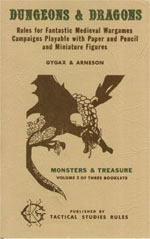
Volume 2 - Monsters & TreasureIn a recent comment exchange with jdh417 regarding (Re-)Running the Megadungeon, I spoke about wandering monster encounters in OD&D:

Practical experiment: OD&D says there’s a 1 in 6 chance of a wandering monster every 10 minutes in the dungeon. There’s only a 1 in 6 chance chance per day outside of the dungeon. Try following those rules strictly for a few sessions. You don’t even have to tell your players what you’re doing: They will find a way to get out of the dungeon.

(In practice, my OD&D game has dropped back to a 1 in 10 chance per turn. And, as I noted, this will drop even further if they’ve cleared a section of the dungeon. I’ll also reduce check rates if they’ve secured themselves or hidden themselves in some way, allowing for potential “camp in the dungeon overnight” scenarios. But I think the only way for a megadungeon to work is if the players can never feel completely safe while they’re inside it.)

But in quickly re-checking the OD&D rules for wandering monsters in the wilderness in order to make sure my memory was accurate for the details, I realized that I had been inadvertently glossing over a potentially fascinating distinction. From Volume 3: The Underworld & Wilderness Adventures, pg. 17-18:

At the end of day (turn) the referee will check to see if a monster has been encountered. The matrix below is for travel afoot or mounted. For travel afloat or in the air two die rolls are made — a 5 on the first one indicates an adventure in the mid-point of the day with waterbourne or aerial monsters; a 6 on the second die roll indicates that there is a normal adventure at the end of the day, and the table below is used.

What I want to call your particular attention to here is the phrase “the second die roll indicates that there is a normal adventure at the end of the day”.

See, the random charts which follow don’t include any information on the number of creatures encountered. They just determine type. Which presumably means that you should use the “Number Appearing” column from Volume 2: Monsters & Treasure. (Which is confirmed when you reference that volume and discover that this column is, in fact, marked with a footnote which reads, in part: “used primarily only for out-door encounters”.)

And that’s when the whole thing starts to make sense.

ROLLING A WANDERING MONSTER

Let me demonstrate by way of example. Allow me to roll up an actual wandering monster for a group of PCs traveling through a forest:

(1) I roll 1d8 and consult the “Woods” column to determine the type of encounter. I roll a 6, which is Men.

(2) I roll a 1d12 on the “Men” table. (This table includes four columns, one of which is “Desert (Mars)” and includes Red Martians, Tharks, Black Martians, Yellow Martians, and White Martians. Goddamn, that’s awesome. BID.) I use the “Typical” column, roll a 5, and get a result of “Bandits”.

(3) Now I flip over to Volume 2 and look up “Bandits”. There isn’t an individual listing on the Monster Type table, but “Men” appears generically. The Number Appearing for Men is 30-300, so I roll 1d10 x 30 and get 150.

(4) I flip to the description of Bandits on page 5:

BANDITS: Although Bandits are normal men, they will have leaders who are supernormal fighters, magical types, or clerical types. For every 30 bandits there will be one 4th level Fighting-Man; for every 50 bandits there will be in addition one 5th or 6th level fighter (die 1-3 = 5th level, die 4-6 = 6th level); for every 100 bandits there will be in addition one 8th or 9th level fighter (die 1-3 = 8th, die 4-6 = 9th). If there are over 200 bandits there will be a 50% chance for a Magic-User (die 1-4 = 10th level, die 5, 6 = 11th level) and a 25% chance for a Cleric of the 8th level. If there are exactly 300 bandits there will absolutely be a Magic-User, and the chance for a Cleric goes up to 50%. There is also a chance that there will be magical accouterments for the super-normal types […]

(5) So I have 150 bandits: That means I’ve got five 4th-level fighters. I also have three 5th- or 6th-level fighters, which turn out to be (roll) one 5th-level and two 6th-level fighters. And their leader will be an 8th-level fighter.

(6) The table for determining “magical accouterments” says that each fighter has a 5% chance per level to have a magical item, and I should check for armor, shield and sword. For the sake of this example, let’s just check for our 8th-level leader: 8 x 5 = 40% chance. Armor roll is 58, no armor. Shield roll is 33, so he has a magic shield. And sword roll is 44, so no sword.

(7) I flip to the Treasure tables. There isn’t a separate table for shields, but on pg. 24 there’s a table for Armor which includes shields. I roll three times on the table before generating a result (65) which includes a Shield +1.

(Weird note: There’s an example in the rulebook for how to generate bandits. It starts with, “Assume 183 bandits are encountered.” Which made me realize you could actually generate the number of bandits with 30d10. I did so just for kicks and generated… exactly 183 bandits.)

Total result? The Blood Shield Bandits, named after their fiery-haired leader who carries a shield of bright crimson into battle.

THE BANDIT ADVENTURE

My point with all this is that the OD&D rules for wandering monsters in the wilderness are not rules for generating random encounters in the sense commonly understood by later editions: These rules do not generate a single combat encounter. They are procedurally generating an entire adventure.

What does this adventure look like?

Probably something like this:

The Blood Shield Bandits

The Victorious Battle over the Bandits at Huanghua

In no small part because these rules are meant to gel with high-level play where the PCs are expected to be local baronial lords leading small feudal armies.

But even at lower levels, the encounter tables are telling you that you’re entering an area currently plagued by a large tribe of bandits. Does that mean getting waylaid on the road? Being forcibly deputized by the local lordling to deal with the problem? Being hired by a wealthy merchant whose daughter has been kidnapped? Being press-ganged by the bandits themselves and tasked with kidnapping the merchant’s wealthy daughter? All of the above? A dozen or so dice rolls have me pretty much brimming over with ideas.

In any case, the point is that you’re generating an adventure, just like the book says — something that the players can engage or ignore; bypass or be ambushed by; become embroiled with or skim past.

READING WITH FRESH EYES

Delving into the OD&D manuals continues to be a rewarding experience. I’m constantly amazed at how often I’ll realize that what I’m reading could actually mean something completely different and that I’m only defaulting to reading it in a particular way because of the conditioning imposed by thirty-plus years of RPGs which all went a different way.

In part, this gets back to my discussion of OD&D as the Ur-Game — a mirage that doesn’t actually exist because the rulebooks are open to so many different interpretations.

What fascinates me is the idea of the road that wasn’t traveled: All those passages whose enigmas were refined to read as “A” when they could have just as easily been read as “B”. (With “B” being potentially just as interesting.)

Since the OD&D PDFs are no longer legally available, people have occasionally asked me which OSR clone I recommend to take its place. The truth is that I don’t recommend any of them. OD&D is a severely flawed game, and all of the clones I’ve looked at have generally inherited its flaws while simultaneously (and probably necessarily) whitewashing out the ambiguities which I find rewarding to explore.

(UPDATE: The OD&D PDFs are once again legally available!)
Interesting Facts About the Blood Shield Bandits

Back to Reactions to OD&D

Obstacles in roleplaying games do not exist in order to prevent a PC from doing something. They exist in order to challenge the players to come up with an interesting way of doing it.

(This thought occurred to me as I was reading Flawless by Scott Andrew Selby and Greg Campbell in which they describe a diamond heist in ’76 in which the thieves tunneled into the vault from the sewer. They tested for the presence of a seismic alarm using an alarm clock and hauled away the excavated dirt in a Landrover they drove through the sewer tunnels. Then they welded the vault door shut from the inside and threw a Bastille Day looting party. That vault door didn’t exist to protect the jewels. It existed to make those thieves look cool.)

Keep on the ShadowfellMy work on converting the archives of the Alexandrian over the past few days have been something of a trip down memory lane as I go digging through material I wrote up to half a decade ago. And occasionally stumbling across comments that I don’t think I ever saw because of the broken and disjointed commenting system on the old site.

One discovery that particularly caught my eye came in response  to the Keep on the Shadowfell: Analyzing the Design series I wrote as a precursor to my remix of the module in 2008. A couple people mentioned that the specific traps I had been talking about in 2008 had been “fixed to a large extent” when WotC revised the module for its release as a freebie PDF.

I was curious enough to check it out.

And discovered that they’d fixed almost nothing. The only two improvements I can identify are:

1. They allowed Arcana and Thievery checks to stack for the purposes of disabling the dragon statues. (A suggestion I’d made in my original remix notes.)

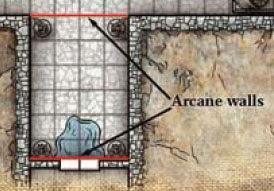
2. They made it clear when the arcane walls of the Whirlpool Trap would activate (“when a creature moves into the 4-square-by-4-square area between the statues”) and the location of the walls once they appear:

Revised Whirlpool Trap

But there are two problems with this “solution”:

First, as I discussed in my original essay on the matter, you’ve designed the trap so that it can’t be affected by anyone outside of the trap. (In order to disable the trap, you have to destroy the cherubs. And you can’t attack the cherubs if they’re on the other side of the wall.) They’ve removed the explicit references in the module itself to characters doing the impossible, but that doesn’t remove the larger design concerns:

(a) It’s not fun. In general, this means you will have one character inside the trap who needs to make several attacks against the cherub vases while everyone else sits around and watches.

(b) What happens if the character trapped inside the whirlpool is killed? As far as I can tell, the arcane walls just remain in place for the rest of eternity. (They can’t come down until the cherubs are destroyed; and the cherubs can’t be destroyed by anyone who isn’t caught in the trap.) Not only does this mean there’s no way to retrieve your fallen comrade’s battered body, it also means that the only path for reaching the Big Bad Boss of Keep on the Shadowfell is now blocked by two permanent walls of arcane energy.

Second, the trap breaks the rules. The Quick-Start Rules included in the original Keep on the Shadowfell included “Barriers” as one of the types of Area of Effect:

Barrier: A barrier runs along the edge of a specified number of squares. A barrier must cross at least one edge of the origin square.

This was problematic because the core rulebooks didn’t include “Barriers” and instead included rules for “Walls”:

Wall: A wall fills a specified number of contiguous squares within range, starting from an origin square. Each square of the wall must share a side — not just a corner — with at least one other square of the wall, but a square can share no more than two sides with other squares in the wall (this limitation does apply when stacking squares on top of each other). You can shape the wall however you like within those limitations. A solid wall, such as a wall of ice, cannot be created in occupied squares.

The original version of the trap was problematic in any case because it used the keyword “wall” to describe the arcane cage, and one just had to kind of assume that it meant “barrier” if you were using the Quick-Start Rules. You’ll note, however, that the revised version of the module is clearly using the rules for a “barrier” in its diagram.

So… no problem, right? The Quick-Start rules describe “barriers” and this trap, designed to be used with the Quick-Start Rules, now clearly follows those rules.

Except (and this is my favorite bit) somebody noticed that the rules for “barriers” were outdated and should never have been published in the first place, and so the revised Quick-Start Rules designed to be used with the revised version of Keep on the Shadowfell… don’t include the rules for barriers. The entire section was cut.

(Did they bother to replace these rules with the rules for walls which were supposed to be there in the first place? Don’t be silly. Of course they didn’t.)

So you have a trap which explicitly creates walls, but they don’t follow the rules for walls… and it doesn’t really matter anyway, because the Quick-Start Rules didn’t bother including rules for walls.

Epic Fail

My Favorite Character Sheet

January 24th, 2011

I’m re-posting a tale from the Caverns of Thracia which I’ve shared previously here on the site because it provides the context for my favorite character sheet of all time. (This was originally posted as part of OD&D in the Caverns of Thracia. You can just scroll down to the end for the new bit.)

What’s your favorite character sheet? Post it to your blog, link back to here, and throw a link up in my comments.

THE GRAND TOUR

As Thalmain led them into the Caverns of Thracia, he was able to act as a bit of a tour guide for the new players/characters. (“Here’s where the bridge almost burned down… Don’t open that door… Here’s the pit trap I heroically saved the party from… Here’s the place where I roasted lizardmen…”)

Eventually, however, they began pressing on into unexplored territory. A short while later, they found themselves descending broad stairs of stone…

And that’s when things got epic.

In the Caverns of Thracia, there is a room keyed thusly:

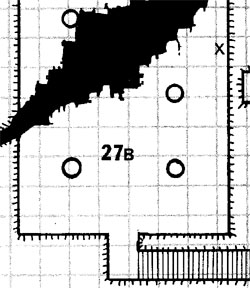
The Burial Crypt of the Cult of the Dark One: The reek of decaying flesh permeates the air here. Lying in ordered rows are rank upon rank of corpses. Most are long decayed and in skeletal form, but many are still fairly fresh, not having been dead for more than a few weeks (if you can call that fresh!). […] If the southernmost pair of columns is approached within 5′ or if the columns are passed between or to either side, 1-4 skeletons will animate and begin to attack intruders. Each additional melee round 1-4 more skeletons will animate as long as there are living intruders to fight, up to a total of 400 skeletons. Skeletons, AC: 7, Move: 12″, HD: 1, Damage 1-6, HP 3.

I decided that the Thanatos cultists that they had killed before would have been moved down here, so there were also about a dozen bodies laid out directly before the leading into this large chamber and covered with fresh linen. (This creeped them out because, of course, it implied that there had been somebody around to move the bodies.)

Caverns of Thracia - Area 27B

Inevitably, of course, the PCs moved far enough into the room to trigger the undead guardians. As the corpses began to stir and wrench themselves free from the cordwood-like stacks of the dead, the party fell back to the entrance.

The two halfings — skilled in ranged weaponry — picked off the first wave. (Aided by the occasional coin-toss from Howard.) But more and more of the dead were beginning to stir, and they realized it would only take a few unlucky die rolls for the skeletons to reach their defensive position.

(Actually, I don’t think I’ve discussed this previously: Halflings are described in OD&D as having “deadly accuracy with missiles as detailed in CHAINMAIL”. These sessions are being run with the conceit that I don’t “have” Chainmail, so we decided that halflings would simply get a +1 bonus to damage while using ranged weapons.)

Against the eminent risk, they quickly rearranged their lines. Brennan and Reeva took the front line. Greenwick switched from ranged attacks to a polearm in the second rank. And then Howard, Thalmain, and Bob lined up in back using their ranged attacks to thin the undead ranks before they reached the melee fighters.

But, more importantly, they also started spreading oil in front of their defensive position. And as soon as some of the undead got close enough, they lit the oil.

Based on my interpretation of the room key, the undead would just keep coming. Each undead had 1d6 hit points. Those that survived the ranged attacks would enter the oil, suffer 1d6 hit points, and frequently die before they even threatened the melee fighters.

After a couple of rounds, it was clear that the 1d4 skeletons per round were just never going to pose any kind of credible threat: The defensive position they’d created was too strong. And while the oil would only last for 1d6 rounds, they had stocked up on it (in large part due to Thalmain’s success with a similar tactic during the last session).

THE MASSACRE

I was in the process of trying to figure out how to make the encounter more interesting (since wittling through 400 undead 1d4 at a time wasn’t particularly exciting) when the PCs made it easy for me:  They decided to try proactively eliminating the undead before they could rise. They tossed a flask of oil onto one of the piles of corpses and then fired a flaming arrow into it.

I ruled that the resulting conflagration was successful in destroying a large number of potential undead… but it also had the effect of rousing them. I rolled 1d10, got a result of 8, and went from rolling 1d4 to rolling 8d4 for the number of undead animating each round.

As the undead rose en masse, the piles collapsed — sending the dead cascading across the floor of the chamber.

It’s a testament to the strength of their defensive position that they managed to hold out for several more rounds against the larger waves of undead without sustaining any injury. I was literally rolling fistfuls of d6’s to calculate the skeleton’s hit points while the players rolled a fistful of d6’s to calculate the damage wrought from the wide moat of fire they had laid down. They would read off the results and I would toss d6’s aside or lower their totals to reflect the current hit points of the skeletons.

Unfortunately, many of them were just 1st level characters. Eventually the law of averages worked against them and one of the skeletons emerged from the flaming oil and with a howl of undead rage managed to rip out Brennan’s throat.

Around this same time, my d4’s rolled high and a wave of 22 skeletons started heading towards them. At that point, they decided that discretion might be the better part of valor. But they weren’t done yet: Howard moved up to the melee line and they held the position for another couple of rounds.

As the wave of the 22 skeletons got close, however, they fell back.

But they weren’t done yet. See, Brennan had been the one carrying most of their (very large) supply of oil. So before they retreated, they rolled Brennan’s body into the flames.

1… 2… 3….

KA-BOOM!

Surprisingly, a couple of the skeletons managed to actually emerge from the far side of the inferno and pursue them a couple of steps up the stairs. (I say a couple of steps, because Thalmain and Bob put arrows through their skulls before they got any further.)

When it was all said and done, I tallied up the dead:

They had killed 76 skeletons.

Killed? It’s probably more accurate to say “slaughtered” or “massacred” on a scale that a bunch of 1st level characters (with the exception of the 3rd level Thalmain) should really not be capable of dealing out.

Of course, they weren’t 1st level any longer. Everybody not only leveled up, but also maxed out their XP for the next level, bumping into the “thou shalt not get enough XP for two levels” ceiling. (Well, except for Thalmain, who bumped into the “thou shalt not advance past 4th level” ceiling for halflings.)

76 skeletons.

It isn’t the largest single-battle slaughter I’ve ever seen in a D&D game, but it’s almost certainly the most impressive. The only battles that rival it in terms of sheer number involved groups fighting large hordes of significantly weaker opponents.

Smart play. Very smart play.

Admittedly, if the skeletons had been smarter they wouldn’t have continued marching into the flames. But, on the other hand, I’m not sure how much difference it would have made: The skeletons had no access to ranged weapons and any possibility of a retreat was cut off by the chasm to the north). Even if they had hung back, they would have simply been picked off by the party’s ranged attacks.

MY FAVORITE CHARACTER SHEET

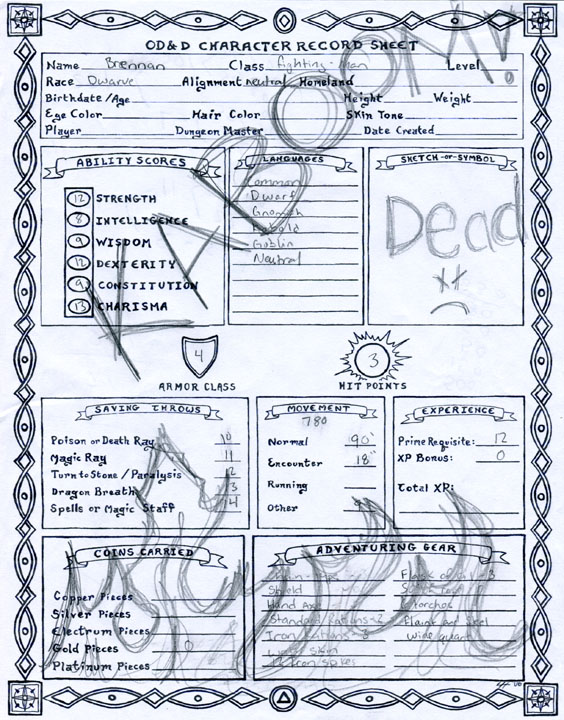
Which brings me to my favorite character sheet, which belongs / belonged to Brennan:

Character Sheet - Brennan

(click for larger image)

As decoated posthumously by Brennan’s player, Katlin.

Go to Part 1

DELVE FIVE

The first four passes through this section of the dungeon had completely cleared out the anubian outposts on Level 1 and heavily decimated their forces on Level 2. I made the decision to allow this section of the dungeon to be temporarily cleared and dropped the chance of random encounters to one check per three turns.

This allowed the next group to pass through relatively quickly through largely abandoned chambers. They were once again tempted by the plaster-chipped door, but decided to pass it by when one of their veteran party members explained what the inscription said. Passing down to area 42 they encountered an ochre jelly (random encounter) who had taken up residence in the rubble pile and grown to a rather impressive size as a result of feasting on the dead rat corpses left behind by the last expedition. (This encounter nearly resulted in intra-party homicide when a particularly dim-witted knight couldn’t figure out that he was not helping matters by constantly hitting the ochre jelly and splitting it into smaller-yet-equally-vicious portions.)

They then continued south of this area, had several other adventures beyond the scope of this section (including rescuing an amazon warrior who had been frozen in ice for a thousand years), and then left.

(Nothing too exciting about this. If there is a lesson to be learned, it’s that you don’t have to cram in fresh content all the time. The importance of negative space — the absence of something to contrast its presence elsewhere — can’t be dismissed as a design principle.)

DELVE SIX

There was then a lengthy break in the campaign, which was marked in the game world by the pollen monsoon. When the PCs were able to return to the Thracian ruins, I spontaneously decided that an elementalist had moved into this vacated upper level. Accompanying him would be a number of lesser elementals.

And then, when the PCs kicked down the door to area 5, I found myself saying, “… sheets of malevolent flame dance around hearts of molten magma.” When the elementals died, they left behind smoldering, blackened pyrites. If they were struck with cold-based spells, I decided there would be a percentile chance that their magma hearts would explode from the sudden contraction (killing the elementals, but peppering the room with shrapnel).

So, those were pretty cool.

I also knew at this point that the anubians had re-fortified the guardpost in area 43, but the PCs didn’t make it that far during this session.

(This is our first major re-population of a deserted section of the dungeon. Couple things to note: First, I didn’t consult any repopulation tables. Why? Because I was struck by a cool idea. Random tables are tools, but I feel that you shouldn’t feel enslaved by their results.

Second, I’m not spending any time outside of the game prepping this repopulation. At the beginning of a session, I’m jotting down a few notes on how the dungeon has changed during the same time that the players are rolling up new characters, shopping for supplies, and the like. Of course, nothing says you can’t spend some time doing detailed prep work between sessions. But preserving the “I can play this any time” nature of your megadungeon means that you never want to feel like you need to do that kind of prep work before you can play the next session.)

DELVE SEVEN

When the PCs next returned to this section of the dungeon, I decided that the elementalist had been killed. (They discovered his flame-scorched body jamming the door to area 5 shut.) The reasons for this aren’t really important (and would be spoilers for my players), but this meant this section of the dungeon (along with 3 others) were depopulated.

I decided arbitrarily to check repopulation for each section by making a single 1-in-10 wandering monster check for each “section”. (The determination of “section” was essentially arbitrary on my part.) The check in this section came up positive, and I rolled on the Level Two wandering monster table (on the theory that some group from deeper in the dungeon had moved up to occupy these chambers).

The result was “giant spider”. There’s a minor spoiler here that I’m going to put into black text. My players shouldn’t highlight it, but the rest of you can do so to read it:

(On the second level of the dungeon there is a Shelob-sized spider that is described as having an egg sack of young spiders that’s ready to hatch. I decided that the egg sack had hatched, and some of the young spiders had migrated to this upper level.)

In any case, I decided these giant spiders had moved into the bat chambers. They had strung their webs and were basically feasting on the bats (whose population had been significantly depleted).

The PCs’ first inkling that something was wrong came when they found the giant spiderweb draped across the staircase leading down to area 2. After they had cleared out the spiders, they found the elementalist’s scorched body, verified that the rest of this section was still deserted, and then moved down to the second level where they engaged in multiple, semi-futile skirmishes with the anubian guardpost (which I had repopulated before the previous session).

(Here we can see how random tables can provide the raw seeds that you can riff off of to develop the megadungeon in interesting ways. This kind of improvisational extrapolation from a simple table entry of “giant spiders” is what makes the campaign come alive.

The wandering monster table is like the audience members who yell out suggestions on an improv show: Simply yelling out “mime” and “airplane” doesn’t make for a comedy show; it requires the improv actors to create a sketch about a mime pilot making an announcement over the plane’s intercom system for that. Similarly, just having random “giant spiders” attack the PCs because the table says so doesn’t make for an adventure; what you need are giant spiders in a particular place for a particular reason and doing a particular thing.

Why use the table at all? For the same reason the improv actors use audience suggestions: It keeps you fresh. It forces you to think outside of your comfort zone. It can give you an idea where you’re drawing a blank. Perhaps most importantly, it’s fun.)

A FEW FINAL THOUGHTS

At several points during the writing of this essay I found myself thinking, “This is really boring. This is just me giving a litany of fairly simplistic events.”

But maybe that’s the point: There really isn’t any magic here. You keep the dungeon alive by using wandering monster encounters to simulate the activity of the complex. You partially repopulate the dungeon inbetween sessions to keep it fresh. The result is that you can take 10 encounter areas, a couple of tables, and get dozens of hours of play out of it.

With that being said, if these 10 areas were the only section of the dungeon available none of this would work. First, the PCs would be able to “clear” the dungeon and there would be no immediate motivation to return. I could, obviously, repopulate such a dungeon and remotivate them to come back (“the draconian scouts have established their advance base in the same abandoned mines used by the orcish raiders!”), but there would be a greatly reduced sense of building on past successes or contributing to a single, larger goal.

Second, in the megadungeon the PCs aren’t being forced to go back over the same ground. They’re choosing to come to this entrance of the dungeon instead of another. This is important for both tactical and psychological reasons.

But, laying those caveats aside, my biggest point here is the ability to effectively reuse and refresh the megadungeon. This material can be used and re-used many times over without becoming stale. And if it ever starts to become stale, it’s a relatively trivial matter to freshen it back up again: Lizardmen invade the complex from the nearby swamplands. In a mighty, magical earthquake a new ziggurat pushes its way out of the earth leading to an entirely new complex connected in yet unknown ways to the caverns beneath. The black-eyed cultists approach some of the heroes to form an alliance against the aggressive anubians. And so forth.

In many ways, I feel like a megadungeon becomes the DM’s character. And I play my megadungeon much like I would play a PC. Before play begins, I don’t really know what my megadungeon is going to do: But my random encounter tables generate 2d4 anubians just after the PCs raid the depths, and I know the anubians have sent a team of assassins to hunt them down. Black-eyed cultists are holding a ritual on Level 2 and I suddenly know the sin day they’re celebrating. Lizardmen show up in the anubian sections of the dungeon and I know tensions are erupting between their tribes. Then the minotaur shows up to determine why tribute is not being paid and… and… and…

And a story gets told.

Go to Part 3: The Players Take Charge

Archives

Recent Posts

Recent Comments

Copyright © The Alexandrian. All rights reserved.