
The Alexandrian

Archive for the ‘Roleplaying Games’ category

Dread: Pacing Problems

December 14th, 2011

Dread is a storytelling game of horror based around a core mechanic in which the players pull blocks from a Jenga tower whenever their characters attempt a meaningful action: If the tower doesn’t collapse, the action is successful. If it does, the character is eliminated from the story, the tower is rebuilt, and play continues.

The intent is that the tower’s steady descent into precariousness models the traditional horror pacing of “tension rises, something bloody happens, and then tension starts rising again”. And, in my experience, this fundamentally works: In a focused gaming environment, the physical act of pulling the block viscerally and collectively immerses the players into the emotional state of the narrative.

So, at a basic level, the mechanic is very, very effective.

Which makes it all the more unfortunate that the game inherently suffers from a systematic pacing failure that arises from the same mechanic.

Let’s assume that you want a collapse or near-collapse state at the end of the game (for a tension-filled conclusion).

Per the designers of the game in this thread, it takes about 30 pulls to reach a collapse-state on the tower. I haven’t done any rigorous testing, but that sounds pretty plausible based on my experience. Unfortunately, this means that Dread only reduces the time between collapse-states by 10% (by pulling 3 additional blocks per character knocked out when you rebuild the tower). That means that in a two-collapse game one of the players will be sitting out of the action for nearly half the game. In a three-collapse game, one of the players will be sitting out for 60% of the game.

(To put that in perspective, it means that in a two hour game featuring three collapses, one of the players will play for 45 minutes and then watch the other players for an hour and a quarter. Even doubling the rate of pulls after the first collapse only mitigates this problem.)

Obviously this isn’t a problem if you’ve got a pool of players who don’t mind being completely passive spectators for long periods of time, but the “no chatter” rule in Dread (prohibiting players from talking out of character) only exacerbates a problem which is widely recognized as being a bad idea in game design for a reason.

THE END GAME PROBLEM

The logical conclusion would seem to be pacing for games featuring a single collapse-state: People aren’t “supposed” to be eliminated except for possibly a single elimination during the final climactic struggle. This makes the game considerably narrower in its utility, but appears to be the only way to easily resolve the “bored player” syndrome.

Unfortunately, this solution only calls attention to the other problem the game has: Tension deflation following a tower collapse.

Theoretically, of course, this models the tension/release cycle of horror movie pacing (as described above). But the player elimination problem forces us to abandon that pacing. And even if we didn’t do that, the same problem exists at the end of the game: There’s no way to quickly ratchet the tension back up.

Bill is killed by the werewolf… and then the werewolf isn’t scary any more and the group mops him up.

For mid-game collapses, of course, the GM should make the werewolf run off and then come back later (once the tension has built again). That, after all, is how horror movies work.

But the problem is repetitive: Whenever the tension ratchets up to the point that you can trigger an effective conclusion, there’s a high-risk for a collapse. And since a collapse always indicates a failure, it means that the actual conclusion will happen AFTER the collapse. This means that the game tends to either (a) end on a whimper or (b) a sacrifice (in which one of the players sacrifices their character by knocking over the tower to achieve a Pyrrhic victory). The latter is effective… but only up to the point where it becomes predictable.

SOLUTIONS?

Unfortunately, I don’t have any.

And it is unfortunate, because, as I mentioned above, the core mechanic is very effective in practice: The Jenga tower not only mechanically creates tension which normally requires a great deal of GM skill to evoke, but also invests the table collectively in that tension as a shared experience.

The game is intensely good at a micro-level. But its inherent pacing problems create a consistently frustrating experience at the macro-level.

Last week I proposed space scurvy, but deficiency diseases can also be interesting to consider in the context of a fantasy setting.

Imagine for a moment that fantastical creatures like dragons, basilisks, or medusa depend on some vitamin (or a complex of vitamins) which allow them to process magical energy or a “supernatural essence”. For the most part this is no big deal: This “magimin” exists as part of the natural food chain in fantasyland and these creatures get plenty of it from their natural diet. (Some of them might produce it naturally under certain conditions, just like we do with vitamin E from sunlight.)

But when these creatures start suffering from a magimin deficiency — for example, if a dragon starts eating livestock who have been raised in a natural antimagic field — things can turn bad. Our dragon, for example, might find his wings withering and falling off while his heart enlarges in an effort to cope with pumping blood through his great bulk. A medusa’s snakes wilt and become lifeless. A basilisk might slowly grow blind as its own eyes turn to stone.

A little too much science in your fantasy? Maybe. But I like to give thought to this sort of thing because it opens up interesting possibilities.

For example, what if we make the magimin deficiencies a little more magical? Without their magimins, dragons slowly begin to shrink… eventually becoming nothing more than large snakes. But what happens if a mad wizard were to superdose an ordinary snake with magimins… would they become a dragon (or some other insanely mutated creature)? Now we have a mechanism for those “mad scientist” wizards to use when they’re creating owlbears. And that means they need a supply of magimin. And gaining that magimin (by harvesting fairies, for example, or simply having it shipped in) will have consequences that can serve as adventure hooks (and also give the PCs non-standard ways of fighting back).

On the other end of the scale, what if magical creatures went away because their magimins went away? But if magimins were to be reintroduced to the food chain, suddenly we’d have a lot of dragons that have been trapped as snakes for a couple hundred years re-appearing.

Gemini Beast

December 12th, 2011

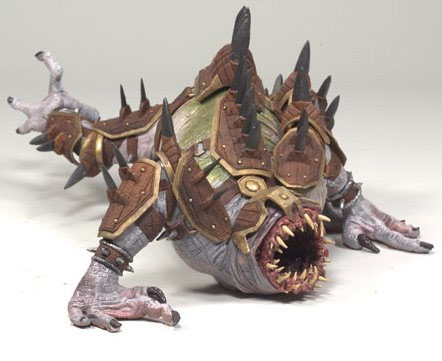
Ripped from the pages of my Ptolus campaign, this beasty was created by chaos cultists using an artifact known as the Idol of Ravvan. He was an early test of the monster creation system from Legends & Labyrinths and was specifically designed to take advantage of the Gemini figure from McFarlane’s Warriors of the Zodiac toy line (pictured below).

Gemini Beast - Warriors of the Zodiac - McFarlane Toys

GEMINI BEAST (CR 8+2*): 256 hp (HD 11d8+40), AC 20, claws +14/+14 (2d8+2d6+4), Save +11, Ability DC 18, Size Gargantuan, Speed 60 ft., Reach 20 ft.

Str 30, Dex 11, Con 18, Int 6, Wis 5, Cha 10
Skills: Climb +24, Intimidate +14, Listen +11, Spot +11
Blindsense 60 ft.

SPECIAL: The Gemini Beast is actually two creatures joined together (each possessing the stat block above). Like a mounted combatant, they take their actions simultaneously. If either moves (as a move action, full action, or 5-ft. step) they are both considered to have taken that action.

If one of the Gemini Beasts is slain, that half of the creature simply becomes inert and dead. The other half can continue taking actions normally, although it suffers a -30 ft. penalty to its speed (due to hauling the dead carcass of its twin behind it).

* Potentate.

Over on Lamentations of the Flame Princess, Mr. Raggi wrote a really good piece on Toybox Style Play.

Check it out.

Basically, he’s talking about a principle of design in which you include elements which (a) aren’t designed to be interacted with mechanically and (b) don’t actually have any pre-designed purpose (or, at least, no “meaningful” one).

In other words, make it a point to include randomly cool shit in your adventures.

I really couldn’t agree more strongly with this. My 101 Curious Items are  an example of this. Similarly, whenever I’m keying a room, I’ll try to make it a point to include at least one detail that is interesting-but-irrelevant. These aren’t always things that the PCs can interact with, but they frequently are. (For example, in one “empty” room I littered the floor with shards of shattered pottery… which could be reassembled with a mend spell to reveal several crude busts. In another case I put “age-old scratches” on a door. )

If you’ve been reading the Alexandrian for awhile, you know that I make it a very specific point to design scenarios in which I really have no idea what the outcome will be. I want to be surprised by the actions of my players and to be just as surprised by what happens in play as they are. Stuff like Don’t Prep Plots and Node-Based Scenario Design describe some of the ways I achieve that at a macro-level. But this “toybox” design is one of the ways I exercise the same principle on the micro-scale: If you include enough randomly cool shit, eventually the players are going to grab onto it and do something ridiculously cool with it.

Technoir - Jeremy KellerTechnoir uses a simple core mechanic in which verbs are used to push adjectives onto characters. (For example, you might use your character’s Hack verb to push the adjective “exploited” onto a gunrunner’s security system.) That may look a little gimmicky, but it actually seems like a really slick little system.

What I find particularly notable about this is that it mechanically articulates and reinforces a procedure that I use almost constantly when I’m refereeing in virtually any system: When a player proposes an action with an uncertain outcome, the action is mechanically resolved using the rules of the game. Then I consider how that outcome has shifted the status quo and carry that knowledge forward as additional actions are proposed and resolved. I’m intrigued to see how a system that feeds directly into this process will perform in play: Will it piggyback it? Reinforce it? Interfere with it? Enhance it?

I’ll probably have more to say about Technoir once I’ve had a chance to actually play it, but my read-thru of the rulebook actually got me thinking about something completely different that I want to touch on today: Skill challenges in 4th Edition.

Technoir structures its core mechanic into Sequences using a very simple system of turn-taking. The trick to resolving sequences is pretty simple: Because adjectives are meaningful, the GM can use his common sense to know when a sequence ends (because the adjectives that have been applied will either result in the players being successful or unsuccessful in achieving their goal). This works because you can’t just slap adjectives on willy-nilly; you need to establish the proper vector by which the adjective can be applied. (In other words, you need to explain what actions you’re taking to achieve the objective.)

The result is that adjectives both arise naturally from the game world and also strictly describe the game world. As a result, sequences build organically and logically to unforeseen conclusions.

The system is, as far as I can tell, incredibly flexible and can be applied to almost any conflict (or what Technoir refers to as a “contention”): Hacking, seduction, combat, interrogation, tracking, chases, etc.

In other words, Technoir‘s sequences have the same mechanical goal as 4th Edition’s skill challenges (resolving discrete chunks of action in a structured format). But skill challenges are the polar opposite of Technoir‘s sequences:

First, whereas Technoir trusts the creativity and common sense of the players at the table to determine when a goal has been achieved (or thwarted), 4th Edition’s skill challenges hard-code a success-or-failure condition which is completely dissociated from the game world. Or, as Technoir puts it:

After any turn is taken and an action is performed, everyone at the table should look at what’s happening in the fiction. As I said before, there’s no score. You have to decide for yourselves when this ends. Each player should respect the adjectives that have been applied and removed and decide what her protagonist wants now — no matter what hse came into the scene wanting. You should do the same for your antagonists. You might find that one side got what they cam for and is done. Or that the two sides are now willing to compromise. Or that there are no good vectors for attacks any more. Look for new ways out of the situation. Maybe it’s time to stop rolling dice and cut to a new scene.

But if there is still something to contend over, go on to the next turn and play out the next action.

Technoir cares intimately and enthusiastically about what your characters have done, why they’ve done it, and what they’ve accomplished by doing it. 4th Edition’s skill challenges, on the other hand, don’t give a crap about any of that: If you haven’t rolled four successes yet, then your characters haven’t succeeded (no matter what they’ve achieved with those checks). And if you have rolled four successes, then your characters have totally succeeded (even if their actions haven’t actually achieved that yet).

Second, Technoir‘s system inherently gives freedom of choice to the players. They set their goals, determine their actions, and even demand their outcomes. (Of course, those demands may not always be satisfied.) Despite several years of constant errata and house rules attempting to soften 4th Edition skill challenge’s away from the rigid railroad presented in the original Dungeon Master’s Guide, the system is still inherently antithetical to player choice. For example, here’s a key quote from the presentation of skill challenges in D&D Essentials Rules Compendium:

Each skill challenge has skills associated with it that adventurers can use during the challenge. (…) Whatever skills the DM chooses for a skill challenge, he or she designates them as primary or secondary. A typical skill challenge has a number of associated skills equal to the number of adventurers plus two.

Incredibly, skills that players want to use that the DM hasn’t pre-approved can never be considered primary skills and are automatically considered inferior (they can count for no more than one success and may not count for successes at all). By default, 4th Edition tells you that ideas originating from the players are not to be treated with the same respect as ideas originating from the DM. It’s hard-coded right into the rules.

The two approaches really are night and day: Technoir trusts the creativity of the players. 4th Edition shackles the creativity of the players.

Archives

Recent Posts

Recent Comments

Copyright © The Alexandrian. All rights reserved.