The Alexandrian

Archive for the ‘Roleplaying Games’ category

Golden Dice - Dice PalaceShould the Bluff skill be usable on PCs?

Hypothetical situation proposed on another forum: Billy doesn’t trust Sue. Billy’s player argues that, even if Sue succeeded on her Bluff check, Billy still wouldn’t believe her. It doesn’t matter how good a lie is if the person being lied to inherently doesn’t trust the speaker. Counterargument? If you inherently distrust someone, that’s what roll modifiers are for.

This is a common discussion. I had a couple of immediate reactions to this particular scenario that I thought might be of general interest.

Note that there are, in fact, two different issues here.

First: Whether or not social skills should compel PC behavior.

One group will argue that playing an RPG is fundamentally about making choices as if you were your character. Therefore, a mechanic which effectively “plays the game for you” is really problematic, particularly if it fundamentally disrupts a player’s conception of the character they’re playing. (The GM gets to create and control the entire universe; it might be best if the player gets to at least have undisputed control over his one character.)

The flip-side of this argument is that being forced to believe a lie against your will is not fundamentally different than being stabbed through your kidney with three feet of steel against your will. Both remove character agency and there’s really no reason to distinguish between the two.

What decides the issue for me, personally, is that I’ve never encountered a player in the latter group who has their enjoyment of the game negatively affected if compulsory social mechanics aren’t used: They’re OK with them, but they don’t need them. On the other hand, I’ve met lots of players in the first group who have their playing experience totally ruined by the presence of compulsory social mechanics.

So, for me, this is kind of a no-brainer: I’ve got an option that will make a lot of people happier and which will have no negative impact on anyone else. That’s the option I should go with.

Second: How the specific mechanic is being applied.

Is the mechanic sufficiently taking into account the level of distrust that Billy has for Sue? It looks like there are roll modifiers, but are those modifiers large enough to truly represent the amount of distrust he has?

Also, should the outcome of a successful Bluff check be “you believe the lie and you have to act as if you are completely gulled and have no doubts whatsoever” or should the outcome of a successful Bluff check be “she looks like she’s telling the truth / you don’t see anyone reason not to believe what she’s saying”?

This ties back into the question of whether or not the social mechanics should be compulsory or not.

To put this in perspective, imagine that this was a Poker game: Someone makes a Bluff check and succeeds against your Sense Motive check. Should the mechanics force the PC to call his bet (or go all in) without having any choice in the matter? Or should the mechanics simply report back “you think he’s got the better hand” and then let the player make the decision?

In general, I prefer social mechanics to either (a) provide information or (b) have a mechanical impact without compelling action.

If you make a Spot check to see someone hiding in a room, a successful check doesn’t compel you to attack them: The Spot check provides you with information (“there’s a dude hiding in there” or “the room appears to be empty”) and then you make a decision about what to do with that information. Similarly, a Sense Motive check should provide you with information (“you think he’s in love with Sarah” or “you don’t think she’s lying”) and it’s still up to you to make a decision about what to do with that information.

Similarly, a successful Intimidate check might apply a morale penalty to your action, but the ultimate decision of whether you drop your sword and run away screaming is up to you.

What about NPCs?

I’m perfectly OK with social mechanics being compulsory for NPCs. In fact, as a GM, I generally prefer it. The difference is that I don’t think of them as “compulsory” — instead those mechanics are the oracle that I consult to tell me what’s happening in the game world. (It’s very similar to a random encounter check: I don’t know what’s going to happen. Let’s consult the mechanics and find out.)

For similar reasons, I find it perhaps unsurprising that people have a lot less problem with compulsory social mechanics in STGs: They are playing a game of narrative control and the relationship they have to their character is very different than the relationship a player has to their character in an RPG. An oracular consultation of the mechanics to determine what their character is doing is more likely to fit into their mental landscape; it also just becomes one more mechanic for determining narrative control among a plethora of such mechanics.
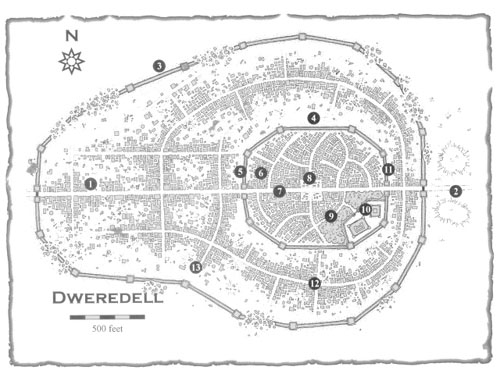
The map for Dweredell was originally created with large key entries. It looked like this:

Map of Dweredell (Keyed)

It’s a beautiful map, but I always wished that I had a version that had no map key numbers on it.

Then a fellow by the name of Andrew Shields contacted me: He’d done an absurdly awesome amount of Photoshop work and managed to rebuild the map sans numbers. Instead of posting it here, I’m going to point you over to Andrew’s website: Here.

It’s well worth checking out, particularly if you’re the proud owner of a copy of City Supplement 1: Dweredell. (And if you’re not a proud owner of that book, you should check it out. Hint, hint.).

City Supplement 1: Dweredell

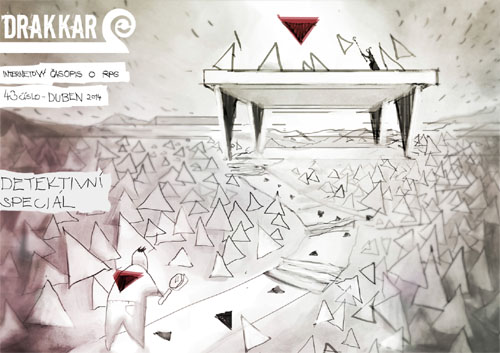
My original essay on the Three Clue Rule has been translated into Czech for an awesome-looking fanzine:

Drakkar 43

Direct Link (PDF) / Facebook Page

I’ll be honest: I can’t read a word of it, but I think it’s pretty cool nonetheless.

Dragon Fight - Daniel Gay (Edited)

… and by that, I mean that they should be inspiring good, old-fashioned awe with the things that they do.

This is something I first talked about in D&D: Calibrating Your Expectations and I developed the theme in E(X): The Many Games Inside the World’s Most Popular Roleplaying Game.

Recently I was speaking with someone who was unhappy with the “crazy scaling” of Perception checks he was seeing in the arms race of high level Pathfinder games: The players crank up their Perception modifiers. The GM responds by simply cranking up the DC necessary to accomplish previously much easier tasks. The result is “silly” and “ridiculous”.

This is what I said:

FIRST, CONTEXTUALIZE THE NUMBERS. Instead of just blindly cranking up the numbers, think about what those larger numbers really mean. If a DC 30 check reveals a “well-hidden secret door”, then what does a DC 40 check really mean? Well, it means something that no one in the real world without special tools would ever be able to detect. So maybe that means that the door has been phase-shifted onto the Ethereal Plane; or painted with the illusion-infused blood of a demon; or covered with the alchemically-treated hide of an animal that has evolved the ability to make people psychically ignore its presence.

In other words, embrace the fact that the PCs are doing awesome things and really emphasize how awesome it is.

SECOND, EMPHASIZE NOT CHANGING THE NUMBERS. Instead of trying to keep the same old tasks challenging, focus on the paradigm shift that’s occurred.

Yup. They’re really, really good at finding hidden things. Similarly, they’re really, really good at killing 1st level goblins. Instead of resisting that change by leveling up all the goblins in the universe to match their new abilities, focus instead on exploring how their interaction with the world shifts.

A mechanical option along these same lines would be to include guidelines for improving the quality or speed of a check by accepting a penalty on the check. For example, I have a generic set of guidelines for “quick checks” that drop the time required for the check by one category in exchange for accepting a -10 penalty to the check. (High level characters, for example, can make successful Gather Information checks in 1d4+1 minutes instead of 1d4+1 hours by accepting a -20 penalty on their check.) For Perception checks, you might apply a -10 penalty to allow characters to notice hidden doors/objects/etc. without actively searching for them. (They just walk into a room and spot the hidden door in the corner.)

An extreme example of this sort of thing is Doctor Who: The Doctor can open the door of the TARDIS, sniff the air, and instantly identify the atmospheric content, the planet he’s standing on, and the time period. (I like to imagine that this is based on complex spectrographic analysis compared to charts which Time Lords study in school much like we study multiplication tables.)

ALTERNATIVELY, PUT A CAP ON THE AWESOME. If you don’t want to embrace the awesome, on the other hand, you’ll be much happier simply stepping out of the arms race. Cap their advancement before they become “too awesome”, either drawing the campaign to a close or finding other ways of advancing their characters. (This is where E(X): The Many Games Inside the World’s Most Popular Roleplaying Game comes back into the picture.)

FURTHER READING
High-Level D&D Adventures
Soloing Smaug: The Struggle for D&D’s Soul

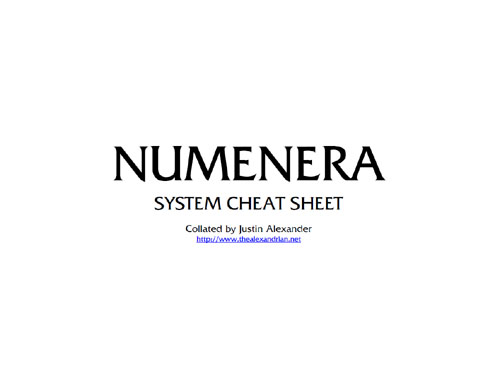
Numenera - System Cheat Sheet

(click for PDF)

A couple months ago I posted a draft version of my system cheat sheet for Numenera. At the time, I predicted that I would be running the game sooner rather than later. That turned out to be really, really true. I’m now running the game regularly for three groups:

  • The original playtest group I organized.
  • A second group which had gathered at my house for random gaming and asked me if I had a roleplaying game ready to roll.
  • A group composed entirely of players new to roleplaying games.

It’s been a rousing success with all three and I’ve now run a total of 12 sessions. At least one of these groups will be winding down once the original adventure is completed (Vortex), but one of the groups has already transitioned to a full campaign using The Devil’s Spine as a foundation and the group of newcomers also appear to be interested in the long haul (although I think they’ll end up going a different direction).

In any case, I’ve used my play experience to both expand and refine the cheat sheet, which I now consider to be in its final version. As before, this cheat sheet is designed to summarize all the rules for the game — from basic action resolution to advanced combat options. I’ve found that it’s a great way to get a grip on a new system and, of course, it’s also a valuable resource at the game table for both the GM and the players. (For more information on the methods I use for prepping these sheets, click here.)

IT’S STILL A GM SCREEN!

The cheat sheet still uses landscape formatting suitable for insertion into a modular, four-panel, landscape-oriented GM screen. (Just like the one backers of the Numenera kickstarter were able to buy as an add-on. And which you can buy here.) I’m not including graphics for the front of the screen, but if you buy the Numenera GM Screen PDF you’ll be totally golden.

You may notice, however, that the final version of the sheet has more than four pages. What I’ve been doing is printing the “Miscellaneous Rules” and “Numenera” pages using inverted duplex printing and then taping that sheet to the “Hazards & Combat Modifiers” page. Insert the “Hazards & Combat Modifiers” page into the screen and you’ll be able to fold the other sheet over so that it displays the “Miscellaneous Rules” page, but can be flipped up to show the other two pages.

(Alternatively, of course, you can just choose two pages not to include.)

WHAT’S NOT INCLUDED

These cheat sheets are not designed to be a quick start packet: They’re designed to be a comprehensive reference for someone who has read the rulebook and will probably prove woefully inadequate if you try to learn the game from them. (On the other hand, they can definitely assist experienced players who are teaching the game to new players.)

The cheat sheets also don’t include what I refer to as “character option chunks” (for reasons discussed here). So you won’t find types, descriptors, or focuses here.

You also won’t find most of the optional rules for the game. I may add those later, but not yet. (The exception are the rules for modifying abilities; I suspect they’re going to be too useful not to have handy.)

HOW I USE THEM

I generally keep a copy of my system cheat sheets behind my GM screen for quick reference and I also place a half dozen copies in the center of the table for the players to grab as needed. The information included is meant to be as comprehensive as possible; although rulebooks are also available, my goal is to minimize the amount of time people spend referencing the rulebook: Finding something in 6 pages of cheat sheet is a much faster process than paging through a 400 page rulebook. And, once you’ve found it, processing the streamlined information on the cheat sheet will (hopefully) also be quicker.

The organization of information onto each page of the cheat sheet should, hopefully, be fairly intuitive. The actual sequencing of pages is mostly arbitrary.

Page 1: For Numenera, the difficulty terrible is the heart of everything. Once you understand that, the special rolls, GM intrusion, and the concept of advantage/disadvantage 90% of the rest of the system actually becomes irrelevant. This page is likely to become superfluous quickly. You’ll note that I included examples of GM intrusion: This is unusual for my cheat sheets, but so much of Numenera is designed to empower strong, flexible rulings by the GM that providing this kind of idea fodder feels right to me and has proven useful during play.

Page 2: The core of the combat mechanics. If you’re teaching new players the game, you really only need to walk them through these first two pages. (I’ve been adding another column or so of additional material at the beginning of each subsequent section, slowly adding more tools to the players’ toolboxes.)

Page 3: The extended combat actions and options. The rules for “Trading Damage for Effect” are technically an optional rule, but I’ve found them too invaluable not to include here. (Compared to the draft version of the sheet, you may also notice that I’ve pulled out the guidelines for simplifying multiple enemies and the boss package you can use to buff NPCs. Very useful stuff for the GM that’s buried deep in the rulebook.)

Page 4: A collection of miscellanea. Optional rules are off on the right, but I haven’t used them yet in my own game. (You’ll also note a couple of house rules tucked down in the corner. These are still being playtested, but I think they’re useful.)

Page 5: Everything that you need to know about the numenera. This stuff is highly situational, but one concept I’ve found needs to be stressed to new players is the idea of scavenging for numenera. This process appears to be non-intuitive so you need to let them know it’s an expected part of the game world.

Page 6: Hazards & Combat modifiers. I expressed bafflement when I posted my draft version of the sheet for why all of these modifiers exist. In actual practice, I’ve found them more useful than I anticipated.

PLAY NUMENERA

As I mentioned before: Y’all should grab a copy of Numenera and start playing ASAP. It had my official “I Had a Ton of Fun Playing That” seal of approval and twelve more sessions has only served to add a “I Had a Ton of Fun Running That” merit badge.

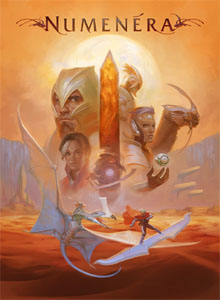
Numenera - Monte Cook Games

FURTHER READING

The Art of GM Intrusions
Numenera: Calibrating Your Expectations
Numenera: Last Precept of the Seventh Mask
Tales from the Table: Last Precept of the Seventh Mask
The Numenera Tavern
Numenera: The Wandering Walk
The Moon of Numenera
Numenera: NPC Allies
Numenera: Grappling
Numenera: Attacking Objects
Numenera: Identifying Numenera
Numenera: Into the Violet Vale – Prep Notes
Review: Weird Discoveries
The Aldeia Approach
Numenera: Welcome to the Ninth World

(Please note that the title page has been altered to remove the copyright logo graphic I originally used in the draft version. All Numenera content on this website is issued under the fair use doctrine and it should be explicitly understood that no content on this website is issued under the MCG fan use policy.)

Archives

Recent Posts

Recent Comments

Copyright © The Alexandrian. All rights reserved.