The Alexandrian

Archive for the ‘Roleplaying Games’ category

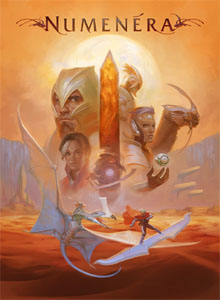
Numenera - Monte Cook GamesMany moons ago I wrote D&D: Calibrating Your Expectations: The point of the article was to re-orient your expectations regarding the level of power being modeled by mid- and high-level D&D characters. (If you think “Conan” when you think about a 15th level character, you’re doing it wrong. Think Hercules in his most powerful persona as a full-blooded demigod.) The article had a few unexpected consequences, but by and large it seems to have helped a lot of people avoid or resolve the dissonance they once experienced between the mechanics of the game and the fantasy they were creating or emulating. We all stopped fighting the system and started embracing all the awesome stuff it was capable of.

Brandon Perry shot me an e-mail recently asking me to give Numenera the same treatment. It sounded like a really fascinating idea for a blog post, so I’m going to take a crack at it. Before I do, though, I want to offer a little bit of a proviso: When I wrote D&D: Calibrating Your Expectations I had nearly 20 years of experience with the game and had played or run hundreds (possibly thousands) of sessions. Although I’ve been playing Numenera since it was released last August, my experience with the game is obviously extremely truncated by comparison (consisting of a couple dozen sessions). So there’s going to be a little more armchair theorizing this time around, with all the risks that sort of thing entails. Take what I have to say with a grain of salt and keep testing it against your actual experience at the gaming table, but hopefully you’ll find some value in what I have to say here.

STATS vs. EFFORT vs. EDGE

Let’s begin with the core attributes of your character in Numenera. These seem to be frequently misunderstood, in no small part because they defy the expectations formed by the norm of other roleplaying games.

For those unfamiliar with it, the basic mechanic of Numenera works like this: The GM sets a difficulty between 0 (Routine) and 10 (Impossible). This number is multiplied by 3 in order to arrive at a target number (between 0 and 30). The player rolls 1d20; if they roll equal to or higher than the target number, they succeed.

For example, if you wanted to climb a Difficult (4) cliff, you’d have to roll 12 or higher on 1d20 (because 4 x 3 = 12).

In practice, however, the difficulty will be modified before the dice are rolled: Each relevant asset or skill the character has will reduce the difficulty by 1. So if a character who was skilled at climbing (-1) and also had their climbing kit with them (-1 for the asset) was facing a Difficult cliff, the effective difficulty would only be 2 and they’d have to roll a 6 or higher on 1d20 to reach the top.

Each PC has three stats: Might, Speed, and Intellect. Your score in each stat forms a pool and you can spend points from your pool to activate special abilities and also exert effort. When you exert Effort, you spend 3 points from the relevant pool to decrease the difficulty of the task by 1.

So, looking at that Difficult cliff again: You start with difficulty 4, subtract 1 for being skilled in climbing, subtract 1 for having the asset of a climbing kit, and then you could exert effort (spending 3 Might points) to subtract 1 again. (Now the cliff has an effective difficulty of 1 and you only have to roll 3 or higher on 1d20.) As your character advances, you’ll be able to exert multiple levels of effort simultaneously (further reducing the difficulty of a task).

Now, this is the point where most people get confused: Say you’ve got one character with Might 9 and another character with Might 14. Which character is stronger?

Neither.

Primed by other roleplaying games you probably have a natural instinct to think the Might 14 character is stronger. But he’s not. He simply has more endurance when it comes to performing difficult Might-related tasks. (Think about it: If both characters have the same skills and assets, then they’re facing the same probability of success. They are both equally capable of applying effort to any given Might roll. The only difference is that one of them will be able to apply effort to more Might rolls: He’ll win in a competition of endurance, but it’s a 50-50 split for any individual feat of strength.)

So stat pools are not the same thing as a typical RPG ability score. To find something like those in Numenera, you need to look at Edge.

In addition to having a pool in each stat, characters in Numenera also have an edge in the stat. For example, a beginning glaive has Might Edge 1, Speed Edge 1, and Intellect Edge 0. You use edge to reduce the cost of any associated pool expenditures. (So, for example, if you had a Might Edge of 1, you would spend 2 points to apply Effort to a Might roll instead of 3 points.) What this mechanic means is that a character with a Might Edge of 1 is stronger than a character with Might Edge of 0.

If this distinction is confusing you, think of it like this: When you get a Might Edge of 3, you can now apply Effort for free. That means you are just automatically 15% more likely to succeed at anything you do that’s related to Might. (Which means that you’re stronger.)

It should be noted that the range of potential Edges in Numenera is fairly small: The theoretical maximum is 0 to 6, and 0 to 4 is probably more likely in actual practice. (And you’ll only see those ranges with higher tier characters.) So, at most, characters are going to vary 20-30% based on their “ability scores”.

EFFORT AS CALIBRATOR

 The difficulty table in Numenera does a pretty good job of calibrating your expectations for a normal person:

DIFFICULTY / NPC LEVEL
DESCRIPTION
TARGET #GUIDANCE
0
Routine
0
Anyone can do this basically every time
1
Simple
3
Most people can do this most of the time
2
Standard
6
Typical task requiring focus, but most people can usually do this
3
Demanding
9
Requires full attention, most people have a 50/50 chance to succeed
4
Difficult
12
Trained people have a 50/50 chance to succeed
5
Challenging
15
Even trained people often fail
6
Intimidating
18
Normal people almost never succeed
7
Formidable
21
Impossible without skills or great effort
8
Heroic
24
A task worthy of tales told for years afterward
9
Immortal
27
A task worthy of legends that last for lifetimes
10
Impossible
30
A task that normal humans couldn't consider (but doesn't break the laws of physics)

All the guidelines there pretty clearly flow from the underlying math (which is straightforward because the system is just 1d20 vs. the target number): Routine tasks can be achieved every time (unless adverse circumstances push the difficulty up) because you’ll always roll higher than 0 on a d20. Difficult tasks have a 50/50 chance for trained characters because the skill drops the difficultly level by 1 (and math does the rest).

The key breakpoint on the chart is between Intimidating tasks and Formidable tasks, because that’s the point where you need to be either skilled or spend effort to have any chance of success (and the chart says exactly that).

Where I quibble with the chart a little bit is the Heroic level: It claims that these are “tasks worthy of tales told for years afterward”. But a character with skill specialization (-2 difficulty) expending a couple levels of effort (-2 difficulty) would actually have a 45% chance of success. That’s definitely impressive and probably the sort of thing you’d tell your friends about for a couple of days if you saw somebody do it, but it’s probably not going to be talked about for years.

Long story short: I’d bump the descriptions of Heroic, Immortal, and Impossible actions all up a slot or two.

The point, though, is that if you’re looking for the upper limit of what a character is capable of, then the maximum level of effort they can expend (which is generally equal to their tier) is a good indicator.

In general, the absolute best an unskilled character can do is difficulty 6 + their effort. Skills top out at specialized (-2 difficulty), so highly skilled characters will top out at difficulty 8 + their effort. In proper conditions and with proper equipment (i.e., with a couple of assets under their belt), it actually ends up being 10 + their effort.

(That, coincidentally, means that even beginning characters can line things up to make difficulty 10 tasks achievable. Which is another reason why the concept of “Impossible” should probably be bumped up a level or two on that table.)

EDGE AS CALIBRATOR

What you also want to calibrate, however, is the other end of your scale: What do your characters consider routine? (In fact, I generally find this a lot more useful in terms of really conceptualizing what life is like for a particular character.)

For that, we want to look at edge.

In a purely theoretical sense, Edge 3 and Edge 5 are the magic numbers where the first and second levels of effort become completely free and the difficulty for any related task is usually going to automatically drop.

In actual practice, however, I’ve found that once effort only costs 1 pool point the threshold for ubiquitous “impulse purchasing” seems to be reached: Players will start liberally using effort on pretty much every die roll (and they can generally get away with it). That means that the real thresholds to look at are Edge 2 and Edge 4.

In other words, an untrained character will consider tasks with a difficulty equal to one-half their Edge routine. (Of course, you should also adjust this difficulty for their skills and assets.)

These numbers don’t hold up if your Edge radically outpaces your maximum Effort (it doesn’t matter how cheap it is to spend the points if you’re not allowed to spend the points). This is theoretically possible due to the flexible advancement mechanics, but incredibly unlikely in practice.

SKILLS AND TOUCHSTONES

One thing to get a feel for in Numenera is that most of the ratings in the system cover a fairly broad range. (This is deliberate. Phrases like “precision isn’t that important” and “precision isn’t necessary” are sprinkled liberally throughout the rulebook.) This is also true when it comes to skills, with the system only distinguishing between three levels of training – untrained, trained, and specialized. Each of those skill levels must be covering a lot of territory and, upon closer inspection, it’s also notable that “untrained” is something of a misnomer because even untrained characters can succeed on challenging and even intimidating tasks with a fair amount of regularity if they apply a little effort and preparation.

PCs will only get a handful of skills in Numenera, but this isn’t because they’re ignorant louts: The game is actually assuming that characters have a very broad and pervasive competency across the board and only highlights the stuff they’re really, really good at. (This also fits the other elements of the system: As characters increase in tier their Effort improves across the board, which means their maximum possible performance improves in everything. Edge focuses the regularity of their performance and skills refine that focus even further.)

In trying to really peg what skill performance means in Numenera, however, the generalized flexibility of the system occludes things a bit. Unlike D&D, Numenera doesn’t give a lot of difficulty guidelines outside of the primary difficulty table described above. In practical terms, we’re basically limited to crafting items, climbing, and remembering/understanding particular pieces of knowledge.

Limited although they may be, I will use these guidelines as touchstones in the calibration discussions. If you want to see the tabular breakdowns for these difficulties, you can find them on my Numenera system cheat sheet.
Go to Part 2: Comparing the Tiers

Better Angels - System Cheat Sheet

(click for PDF)

I’ve done several of these cheat sheets now, but for those who haven’t seen them before: I frequently prep cheat sheets for the RPGs I run. These summarize all the rules for the game — from basic action resolution to advanced combat options. It’s a great way to get a grip on a new system and, of course, it also provides a valuable resource at the table for both the GMs and the players. (For more information on the procedure I follow when prepping these cheat sheets, click here.)

This set of cheat sheets is for Better Angels, a One Roll Engine game from Greg Stolze and Arc Dream Publishing. The core concept of the game is that supeheroes and supervillains have their powers because they’re possessed by angels and demons, respectively.The conceit that makes this compelling, however, is that the supervillains are actually trying to mitigate the evil of the demon inside them: See, if a demon ends up inside of a goody two-shoes who refuses to do any evil in their name, the demon gets bored and leaves. That’s a problem, because every time a demon shifts to a new host there’s a chance they’ll end up inside of someone who is truly evil: A Jeffrey Dahmer or a Hannibal Lector with the powers of a demon is capable of truly despicable acts. So if you end up with a demon inside of you, the argument goes, the best course of action is to keep them entertained with evil acts that are big and splashy, but ultimately not all that harmful to the people around you.

In other words, you do all the wacky stuff that pulp era supervillains did: You kidnap the Statue of Liberty and hold her for ransom. You have whales swallow explosives. You burn down the mansion of Big Bank, Inc.

The problem, of course, is that demons are actually pretty good at that whole “corroding your soul” thing. So while you’re trying to do splashy-but-limited-damage evil, the demons are actively working to make you compromise just a little bit more; sacrifice morals you thought were sacrosanct; cross lines you promised to never cross.

And, mechanically speaking, what makes this concept really pop and turned the game into a must-play for me is that each player is responsible for both their Mortal character and for the Demon of the character to their right. This dual-role dynamic forces the conflict between Mortal and Demon into the open and the rules of the game expertly model the ethical battlefield / minefield that the characters are all trying to traverse on tightropes.

HOW I USE THEM

As I’ve described in the past, I keep a copy of the system cheat sheet behind my GM screen for quick reference and also provide copies for all of the players. Of course, I also keep at least one copy of the rulebook available, too. But my goal with the cheat sheets is to consolidate information and eliminate book look-ups: Finding something in a half dozen or so pages is a much faster process than paging through hundreds of pages in the rulebook.

The organization of information onto each page of the cheat sheet should, hopefully, be fairly intuitive. The actual sequencing of pages is mostly arbitrary.

Page 1: I’ve adopted the green/purple distinction between Strategies and Tactics from the Better Angels rulebook. Understanding the explicit sinister/virtuous antithesis between each Strategy and Tactic is the core of the system and that’s headlined here along with an overview of the incredibly simple ORE mechanic.

Page 2: And here you’ve got pretty much every other mechanic in the game. (New players mostly just need to understand the “Damage” column here; everything else is relatively nonessential for launching your first session.)

Page 3 / Page 4: Demonic Prerogative and Domain of the Human cover everything you need to know about playing each of your characters. For Better Angels to really work, the players all need to understand the full dynamic of the game’s central conflict. (It’s particularly important to grok the methods a Demon has for mechanically corrupting their host and the methods a Mortal has to maintain or regain their moral equilibrium. Being clear on each side’s “end game” is also important.)

Pages 5-7: As I’ve discussed in the past, I generally don’t put “character option chunks” in the cheat sheet. The superpowers in Better Angels, however, are generally pretty streamlined. As a GM I also found it easier to parse NPC stat blocks with a power cheat sheet. And, last but not least, players found it useful because the effect of each power in Better Angels varies based on your current stats (and those change frequently and rapidly); so it’s not like other games where you can really familiarize yourself with your current powers.

Page 8: The ability to construct devilish devices (a.k.a. supervillain death-rays) is something I saw new players overlooking, so the full procedure gets highlighted here. (This isn’t “first session critical”, but it’s something I’d consider reviewing at the start of the second session.)

Page 9: This page has all the mechanics the GM needs in order to run angelic NPCs / superheroes.

WHAT’S NOT INCLUDED

These cheat sheets are not designed to be a quick start packet: They’re really useful as a tool for an experienced player teaching the game to new players, but you’ll find it really difficult to learn the game from scratch by just reading through them. (They are an adjunct to the core rulebook, not a replacement.)

You also won’t find most of the optional rules for the game.

MAKING A GM SCREEN

These cheat sheets can also be used in conjunction with a modular, landscape-oriented GM screen (like the ones you can buy here or here).

Personally, I use a four-panel screen and use reverse-duplex printing in order to create sheets that I can tape together and “flip up” to reveal additional information behind them. For Better Angels my screen looks like this:

  • Page 1: Basic Mechanics (with Demonic Prerogative & Domain of the Human behind it)
  • Page 2: Other Mechanics (nothing behind it)
  • Demonic Aspects (with both pages of Demonic Powers behind it)
  • Angels (with Devilish Devices and the logo sheet behind it)

I hope you find these useful!

When discussing roleplaying games I’ve tried to eliminate the term “immersion” from my vocabulary: It’s terminology with a horribly fractured etymology and never fails to create confusion whenever it’s used.

The problem has its primary roots in the ’90s: In the tabletop community, the Usenet groups picked the term “immersion” to refer to people deeply immersing themselves in the playing of their character. “Deep immersion” became the state in which roleplaying flowed naturally and you were able to make decisions as your character and portray your character without having to engage in logical analysis.

Almost simultaneously, however, the video game community created the concept of “immersion vs. interactivity”. In this construct, loosely speaking, interactivity refers to the player making decisions and immersion refers to the player becoming drawn into or convinced by the faux reality of the game world. (You’ll notice that, in this construction, the concept of “immersion” is effectively set up as being in a state of antithesis with the tabletop community’s use of the word “immersion”.) This video game concept of “immersion” then “jumped the pond” and got picked up by various tabletop communities.

Then you can take all of that confusion and stir in a healthy dose of people using the word according to its general dictionary definition: “Deep mental involvement.” That meant any time somebody said “no, immersion is about deep mental involvement in X” (whether X was “playing your character” or “the presentation of the game world”), somebody else could respond by saying “no, I experience immersion by having a deep mental involvement with Y”.

My personal use of the term was shaped in those old Usenet discussions. So if you ever do see me using the word “immersion” in the context of tabletop roleplaying, it’s a virtual certainty that I’m talking about immersion in the process of roleplaying a character; the sort of one-to-one flow of thought to action and the empathetic flow of thought that often characterizes our conception of the very best Method actors. But I’ve generally found that when I need to discuss that sort of thing it’s almost always more rewarding to find a way of talking about it which doesn’t use the word “immersion”.

Whatever your personal conception of the word “immersion” is, I recommend you do the same.

Well, in this case, mostly untested. Here’s a mechanic I improvised while running Trail of Cthulhu last night:

Mitigation Test:When making a mitigation test, instead of setting a difficulty number the Keeper sets a “worst case quantity”. The Investigator then resolves the test normally (spending points, adding them to their roll, and so forth), but the result of the test is subtracted from the worst case quantity to determine the actual outcome. (In some situations, you might choose to use multiples of the test of the result.)

Example: One of the investigators has been bitten by a Mythos creature and the creature’s poison is turning their flesh to stone. The team’s doctor decides the only way to save their life is to cut away the “infection”. The Keeper calls for a mitigation test using Medicine to determine how much damage the doctor deals to the victim/patient and sets the “worst case quantity” to 12 points of damage. The doctor’s player spends two points, rolls a 4, and manages to perform the procedure while only inflicting 6 points of Health damage (12 – 4 – 2 = 6).

Example: An orphanage is beginning to collapse. An Investigator is trying to rescue as many kids as possible before the building comes down completely. The Keeper calls for an Athletics mitigation test to determine how many kids survive and sets the “worst case quantity” to 6 dead kids. The player asks if he can spend Architecture points to assist (by judging which sections of the building are in most jeopardy) and the Keeper agrees. He spends 3 points and rolls a 2… He’s just not able to find Timmy before it’s too late.

Example: The player is trying to carve a forged copy of a stone tablet, but is under something of a time crunch to get it done. The Keeper sets a “worst case quantity” of 48 hours and calls for a Craft test. The Investigator gets a result of 6, which the Keeper multiplies by 5: It’ll take 48 – 30 = 18 hours to complete the duplicate tablet.

Thanks to Colleen Riley, Phil Henry, Tess Keen, and Sarah Holmberg for being my guinea pigs.

Half a decade ago, a fellow named FireLance posted a really interesting breakdown of non-combat challenges over at ENWorld in a post that got, apparently, no attention whatsoever. Which is unfortunate, because I think it’s actually a really interesting way of looking at non-combat encounters.

Before delving into it, though, I should note that this is a lot like the “36 Dramatic Situations” or “7 Basic Plots” or “20 Master Plots” lists that periodically go floating through the meme-verse: These are useful as conceptual tools, but you shouldn’t get too wrapped up in believing the reductivist perception of the creative process they maintain. If you believe that The Terminator and Hamlet are both the same story because they can be boiled down to “Man vs. Man”, then you’re making the same categorical error as believing that the Grand Canyon and your garden are the same thing because they can both be categorized as “earth”.

Tossing that proviso aside, however, I’m going to briefly restructure and revisit FireLance’s basic work.

DISCOVERY CHALLENGES

Discovery challenges involve seeing, finding, or becoming aware of something that was previously lost or unknown.

TYPES OF DISCOVERY CHALLENGES

Knowledge: Determining whether or not a PC already knows a piece of information.

Invention: The creation or revelation of new knowledge. (This can also include the creation or repair of physical objects.)

Observation: Determining whether or not a PC notices something hidden (an object, a person, an intent, a clue, a pattern).

Research: Exploring existing sources of knowledge to discover the information (databases, libraries, warehouses).

Tracking: Discovering the location of a creature or object by following a trail of observations.

DISCOVERY CHALLENGE COMBINATIONS

Movement challenges contribute to Discovery challenges if being in a particular location makes its easier (or necessary) for the PCs to observe or discover something.

Persuasion challenges contribute to Discovery challenges if the knowledge sought by a PC is possessed by an NPC.

Survival challenges may contribute to a Discovery challenge if some information can only be found or pursued in a dangerous location.

MOVEMENT CHALLENGES

Movement challenges involve reaching a particular location. Such challenges can be broadened by including additional characters, creatures, or objects that must be moved along with the PC (e.g., clearing a pile of stones, guiding a group of pilgrims, helping someone climb a wall).

TYPES OF MOVEMENT CHALLENGES

Chase: The PC must arrive at a location before a certain time or before someone/something else does. (Or, alternatively, they must stay ahead of a pursuer.)

Obstacle Course: The PC must traverse some form of physical obstacle in order to reach their destination (e.g., climbing, jumping, swimming, balancing, opening locks, moving heavy boulders).

Sneak: The PC must evade discovery.

MOVEMENT CHALLENGE COMBINATIONS

Discovery challenges contribute to Movement challenges if the discovery makes the movement easier (e.g., providing a short cut, an easier method of travel, or the like).

Persuasion challenges contribute to Movement challenges if the journey requires the PCs to handle mounts, convince NPCs to allow them passage, or if they have to bring NPCs with them.

Survival challenges contribute to Movement challenges if the PCs have to travel through a dangerous area.

PERSUASION CHALLENGES

Persuasion challenges are focused on convincing another person (or group of people) to take a particular course of action.

TYPES OF PERSUADE CHALLENGES

The full gamut of potential social situations allows for a wide variety of potential goals for Persuasion challenges (literally anything a person could know or do for you) and also a wide variety of potential tactics (seducation, coercion, intimidation, flattery, bribery, etc.), but ultimately they are all challenges of the same type despite this vast panoply of possible variations.

PERSUADE CHALLENGE COMBINATIONS

Discovery challenges can contribute to Persuasion challenges by providing leverage over someone (or, perhaps, removing the leverage that someone else has over them).

Movement challenges contribute to Persuasion challenges by giving access to the person you need to persuade.

Survival challenges contribute to Persuasion challenges by keeping people alive until they can do what you want them to do.

Any challenge type can contribute to a Persuasion challenge if it’s being carried out in exchange for a person’s cooperation.

SURVIVAL CHALLENGES

Survival challenges involve characters escaping or enduring physical danger (or helping others escape or endure physical danger). They could also feature the prevention of potentially dangerous situations (like negating a ritual that would summon a demon).

TYPES OF SURVIVAL CHALLENGES

Environmental: Dangerous weather, natural disasters, extreme temperatures, poisonous gases, inimical energies, or any other pervasive hazard.

Health: Recovering from diseases, long-term poisons, curses, or other afflictions. Also enduring shortages in the essentials of life (food, water, oxygen, etc.).

Trap: Hidden hazards unleashed by specific triggering conditions. Traps can generally be disabled so that they no longer pose a threat. (They are usually contrivances created by an intelligent creature with the intention of snaring the unwary, but certain natural hazards may also possess some or all the characteristics of a trap.)

SURVIVAL CHALLENGE COMBINATIONS

Discovery challenges contribute to Survival challenges by giving advance warning of danger or methods of surviving or bypassing the danger.

Movement challenges contribute to Survival challenges by allowing a character to reach a safe area.

Persuasion challenges contribute to Survival challenges if someone is convinced to help the PC survive.

USING THE ABSTRACTION

As a GM, what I generally find these types of categorical analyses most useful for is self-diagnostics: Am I defaulting to a particular type of challenge too often? Is there a type of challenge that I’m usually not including in my scenarios? Are there ways that I could be combining multiple challenge types in interesting ways?

What I don’t recommend doing, however, is designing directly from the abstraction: Thinking something like “OK, I need a Survival challenge of the Trap variety here” is, ironically, a trap itself. As anything other than a creative exercise, that sort of thinking will throttle your creativity and is also likely to artificially restrict you into thinking there’s a “right” way to resolve a given challenge.

On the other hand, that’s a good self-diagnostic exercise to perform: Look at an obstacle you’ve created in your current scenario and think about all the way different ways that someone could overcome or avoid or subvert that obstacle.

For example: Duke Leonardo has ordered the arrest of the PCs for a murder they didn’t commit. The obvious solution is a Movement challenge with the PCs trying to evade the guards or escape the city. But the PCs could also resolve it as a Persuade challenge (bribing guards or even convincing the Duke of their innocence). Or as a Discovery challenge (where they discover the true identity of the killer).

(Which isn’t to say that every challenge needs to be designed with liberal solutions in mind. Sometimes a trap is just a trap… unless, of course, the PCs find the architect who built the dungeon and convince him to give them the construction blueprints.)

Archives

Recent Posts

Recent Comments

Copyright © The Alexandrian. All rights reserved.