The Alexandrian

Archive for the ‘Roleplaying Games’ category

Gencon 2014 - The Best Four Days in Gaming

I mentioned a couple days ago that I’d just returned from Gencon and a few people asked me to talk a little bit about my experiences there. As I mentioned, I ran 5 games and played in 4:

  • Numenera: Into the Violet Vale (ran 3 sessions)
  • The Strange: Eschatology Code (ran 2 sessions)
  • Cthulhu Masters Tournament (played in 2 rounds)
  • Eclipse Phase: Detente
  • Eclipse Phase: Overrun

This was more intense but considerably less varied than last year, when I played in 6 games (including Call of Cthulhu, Lady Blackbird, Eclipse Phase, Shabal-Hiri Roach, and Numenera).

The sessions of Numenera and The Strange I ran were actually the very first con games I’ve ever run. And I made a very conscious decision to jump in with both feet by signing up to run two sessions of each. What I wasn’t anticipating was that this would, in turn, lead to a very intense pre-con experience, too: I didn’t receive the scenarios I was running from Monte Cook Games until August 2nd, which meant I had less than two weeks to read them, prep them, and playtest them. (I ended up running two playtest sessions of The Strange: Eschatology Code and one session of Numenera: Into the Violet Vale with various assortments of my local players.) The core rulebook for The Strange was also just released and so I found myself having to run the game without actually having read the core rulebook yet. (I actually still haven’t finished the core rulebook.)
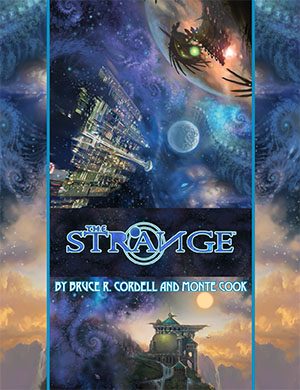
The Strange - Bruce Cordell and Monte CookTHURSDAY MORNING SURPRISE: I was supposed to launch my Gencon experience by playing in an 8 AM game of Numenera run by an independent GM unassociated with the official MCG events. I haven’t had much of a chance to actually play the game since last Gencon and I was looking forward to it. Unfortunately, the GM was a no-show. That meant that I was sitting at a table in the Marriott with four players who were all desperate to try out this awesome game. Meanwhile, right next door at the JW Marriott, I had all my supplies for running Into the Violet Vale.

Well… you can guess what happened next. We headed over to the JW Marriott’s bar, sat in comfy chairs, and I inaugurated my experience of GMing at con twelve hours earlier than I was anticipating. The session, albeit somewhat abbreviated on time, proceeded fabulously. (This was followed by a desperate scramble to print out new character sheets for the scenario so that I would have enough for my official games. Fortunately, the JW Marriott has a FedEx store on the second floor.)

THE STRANGE: Since Gencon last year, Numenera has rapidly dominated my roleplaying, displacing D&D 3.5 as my most played game. I am just as excited about The Strange. I talked more about it over here, but the short version is this: If you’ve dismissed this as just a simple “dimension hopping” game, take the time to give it a second look. It’s doing some really interesting and unqiue stuff within the genre.

I will also say that Eschatology Code, the scenario Bruce Cordell wrote for Gencon, is simply fantastic. It has certain limitations as a scenario for home play (although it would be a strong way to kick off a campaign), but it’s one of the tightest and most effective convention scenarios I’ve had the pleasure to see. No spoilers, but if you get a chance to play it, I recommend seizing the opportunity.

ECLIPSE PHASE: I’m a huge fan of Eclipse Phase and my experiences with their games this year were great. I had some confusion with my schedule (Google Calendars shifted the times of all my events when I switched time zones heading into Indianapolis) and I ended up being an hour late for the first scenario. After apologizing profusely for being an unintentional jackass, however, I settled into a really nifty scenario involving multiple factions fighting over control of one of the Pandora Gates. Midway through the scenario I had a Crowning Moment of Awesome(TM) and actually got a round of applause at the end of the session for it. Woot!

(During the convention I also got two rounds of applause while GMing, one after pulling a back-to-back doubleheader of Numenera and ThStrange that lasted until midnight on Friday.

CTHULHU MASTERS TOURNAMENT: This was my second year participating in the Cthulhu Masters Tournament and this year (after fleeing a Hound of Tindalos during the Fall of Saigon in a very memorable scenario where they actually built a helicopter for use to roleplay in) I advanced to the second round. This tournament is really fabulous and the caliber of players it attracts is simply marvelous.

THE LOOT: The two Gencon acquisitions I’m most excited about are Run, Fight, or Die and Level 7: Invasion. (The Strange would also be on the list, but I kickstarted it and received the rulebook a couple weeks earlier.)

Run, Fight, or Die - Richard Launius

Run, Fight, or Die was designed by Richard Launius (of Arkham Horror fame). I first glanced at it many moons ago when it was being kickstarted, but the pitch for the game was basically “King of Tokyo with zombies” and my response to that was, “Meh.” (As it is with pretty much all “it’s X plus zombies!” pitches.) But I slid into a demo game on the con floor and really, really enjoyed the game: The central keep-and-roll mechanic is similar to King of Tokyo, but that’s where the similarity ends: Run, Fight, or Die features immediate punishment for pushing your luck, which adds an extra dynamic of risk to the standard procedure or looking for the most favorable combination. The combinations themselves are actually progressive in interestingly discontinuous ways, which means that you can actually end up shooting past your desired result. Finally, the central conflict of the game — in which hordes of zombies move closer and closer towards you — creates a rich tactical environment in which you have to balance and choose between short-term and long-term consequences.

The whole package is just fabulous. I’ve played it a dozen times since getting home from Gencon and I’m pretty firmly convinced that it’s going to be a huge hit at my Game Night parties.
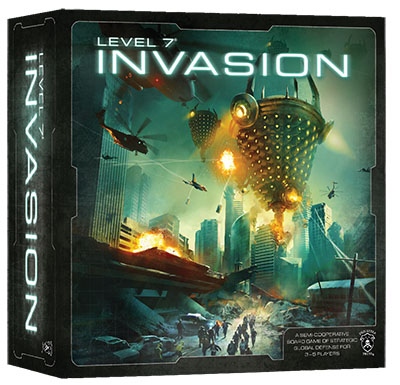
Level 7: Invasion - Privateer Press

I haven’t actually had a chance to play Level 7: Invasion yet, so I really can’t pass any kind of judgment or provide any kind of insight about it. But I’m a huge fan of Level 7: Escape and Level 7: Omega Protocol. The progressive storytelling in the series evolving through radically different types of games (Level 7: Escape is a co-op ‘crawler, Level 7: Omega Protocol is a players-vs-masters tactical combat game, and Level 7: Invasion is a geopolitical wargame) is really fascinating to me.

 

The Strange - System Cheat Sheet

(click for PDF)

The Strange is the new RPG from Monte Cook Games. The basic concept of the game looks something like this:

You may be familiar with the Fermi Paradox, the mysterious paradox which exists between the fact that conditions for intelligent life appear to be plentiful while intelligent life itself appears to be extremely rare. What we’ve discovered is that another scientific mystery — the existence and source of dark energy — is not so much a mystery as it is a smoking gun. We now know several key things about dark energy:

  • It forms a vast network which exists as a fractal substrate beneath the surface of reality as we understand it.
  • This network is, in fact, artificial. We don’t actually know why it was built, but we can tell that it’s the result of alien technology we can’t even begin to understand. This network is commonly referred to as the Strange.
  • The dark energy within this network is drawn to sentient life. When large populations of sentient life are present (like, say, a world with 7 billion people living on it) the concentration of dark energy rises precipitously.
  • Large concentrations of dark energy within the network cause the spontaneous creation of alternate realities based on the collective subconscious of the population. These realities are recursive instantiations of the “prime world” and have become referred to as “recursions”.
  • Unfortunately, large concentrations of dark energy also attract the attention of beings we refer to as “planetovores”. We refer to them by that name because the first time we encountered one, it attempted to eat the planet.

Other threats to humanity also exist in the Strange or emanate from recursions. For example, one of the many recursions in the shoals of Earth is the world of Ruk. It turns out, however, that Ruk is not a recursion of Earth: It was actually spawned from an alien world and then cast adrift through the Strange. Many people on Ruk, however, don’t like being stuck in Earth’s “gravitational pull” within the Strange and want to escape. Unfortunately, the only way they know of accomplishing that is to blow up the planet.

I’m still processing all the awesome material that’s been coming out for The Strange since the beginning of August, but I’ve also been running demo scenarios for Monte Cook Games. (I’ve run those scenarios for 20+ people now.) As a result, I’ve prepped one of my system cheat sheets for the game. This actually proved relatively simply, since the mechanics of The Strange are virtually identical to the mechanics in Numenera. (Somewhere on the order of 99.99% identical.) Where the system differentiates itself are the character creation mechanics (which use the same structure, but with a completely different set of content) and the incredibly clever mechanics by which you “translate” from one recursion to another. (The short version is that all characters in the system are summarized by their type, descriptor, and focus. For example, you might be a graceful paradox who solves mysteries. When you translate from one recursion to another, the core of your character — your type and your descriptor — remains the same. But as you are translated into the symbolic reality of the recursion, your focus changes. So the graceful paradox who solves mysteries on Earth becomes a graceful paradox who embraces Qephilim ancestry on Ardeyn and a graceful paradox who metamorphosizes on Ruk. It looks simple, but in actual play this simple mechanic — and the clever character sheet that makes implementing it a breeze — is addictively awesome.)

HOW I USE THE CHEAT SHEET

As with my other system cheat sheets, this one is designed to summarize all the rules of the game — from basic resolution to advanced combat options. I’ll make stapled copies of these sheets available to the players and also keep a copy behind my screen for quick reference: Serving as a comprehensive system reference, the sheets cut down on the amount of time required for rulebook references. The organization of information onto the cheat sheets should, hopefully, be intuitive. The actual sequencing of the pages is mostly arbitrary:

Page 1: For The Strange, the difficulty table is the heart of everything. Once you understand that, the special rolls, GM intrusion, and the concept of advantage/disadvantage 90% of the rest of the system actually becomes irrelevant. This page is likely to become superfluous quickly. You’ll note that I included examples of GM intrusion: This is unusual for my cheat sheets, but so much of the Cypher System is designed to empower strong, flexible rulings by the GM that providing this kind of idea fodder feels right to me and has proven useful during play.

Page 2: The core of the combat mechanics. If you’re teaching new players the game, you really only need to walk them through these first two pages. (I’ve been adding another column or so of additional material at the beginning of each subsequent section, slowly adding more tools to the players’ toolboxes.)

Page 3: The extended combat actions and options. The rules for “Trading Damage for Effect” are technically an optional rule, but I’ve found them too invaluable not to include here. (Compared to the draft version of the sheet, you may also notice that I’ve pulled out the guidelines for simplifying multiple enemies and the boss package you can use to buff NPCs. Very useful stuff for the GM that’s buried deep in the rulebook.)

Page 4: A collection of miscellanea. Optional rules are off on the right, but I haven’t used them yet in my own game. (You’ll also note a couple of house rules tucked down in the corner. These are still being playtested, but I think they’re useful.)

Page 5: Everything that you need to know about cyphers and the Strange. The big thing here are the translation mechanics, which you can use to really emphasize the important difference between translating through the recursions of the Strange and the kind of “teleportation” effect that players might be imagining from shows like Sliders or Stargate SG-1.

Page 6: Hazards & Combat modifiers. ‘Nuff said.

MAKING A GM SCREEN

These cheat sheets can also be used in conjunction with a modular, landscape-oriented GM screen (like the ones you can buy here or here).

Personally, I use a four-panel screen and use reverse-duplex printing in order to create sheets that I can tape together and “flip up” to reveal additional information behind them. For The Strange this is pretty straightforward. My screen looks like this:

  • Page 1: Basic Mechanics (nothing behind it)
  • Page 2: Combat (nothing behind it)
  • Page 3: Combat Actions (nothing behind it)
  • Page 4: Miscellaneous Rules, with The Strange printed on the opposite side and Hazards & Combat Modifiers behind it.

PLAY THE STRANGE

My only regret right now is that I’ve got enough gaming projects on my plate right now that I don’t know when I’ll be able to prep anything for The Strange beyond the introductory scenario and the demo scenario I’ve been running. But, like Numenera before it, this game already has my official “I Had a Ton of Fun Running That” seal of approval. So I recommend grabbing a copy ASAP and digging in.

The Strange - Monte Cook Games

FURTHER READING

The Art of GM Intrusions
The Strange: Fictional Linkage
The Strange: Violet Spiral Gambit
The Strange: Eschatology Code – Prep Notes
The Strange: Mastodon – Prep Notes

JDJarvis at Aeons & Augauries has the really interesting idea of randomly determining the source of your PC’s starting wealth. Click through for a full table that gives you everything from petty theft to rich uncles to grave robbing.

I’ve seen a lot of “random background tables”, but what caught my eye about this one is that it leverages a common mechanic and seeds the mechanic with interesting narrative hooks. Any of y’all have interesting answers to the, “Where did you get that money from?” question?

In other news, I’m back from Gencon! I ran 5 games and played in 4:

  • Numenera: Into the Violet Vale (ran 3 sessions)
  • The Strange: Eschatology Code (ran 2 sessions)
  • Cthulhu Masters Tournament (played in 2 rounds)
  • Eclipse Phase: Detente
  • Eclipse Phase: Overrun

This was more intense but considerably less varied than last year, when I played in 6 games (including Call of Cthulhu, Lady Blackbird, Eclipse Phase, Shabal-Hiri Roach, and Numenera). The lack of variety was not so much by design as accident: Reaching the second round of the Cthulhu Masters Tournament knocked out two other games that were originally on my schedule. (Although the decision to run 4 games for Monte Cook Games prevented me from participating in Games on Demand this year, which is a variety killer.)

Dungeons & Dragons - 5th Edition

UPDATE: Many moons ago I wrote a lengthy post discussing the 5E Consultant Witch Hunt, using it to discuss wider issues of outrage culture and the witch hunts it engenders.

At the time I described the accusations as being without evidence. That was true… at that time.

Subsequently, however, a great deal of evidence has emerged that the two people at the center of this controversy — RPGPundit and Zak Smith — are, in fact, giant scumbags. The former has repeatedly associated himself with white supremacists and advocated genocide. The latter has accumulated a lengthy track record of gaslighting, impersonating others, and truly horrific abusive behavior both online and offline.

This evidence also now includes a great deal which directly substantiates what was being said in 2014.

I don’t necessarily regret giving them the benefit of the doubt in 2014 when this evidence was not yet available, but, ultimately, mea culpa.

Many of the things I wrote in that original post remain true. But too many of the specifics have aged incredibly poorly. Thus, I’m pulling that post down.

Go to Part 1

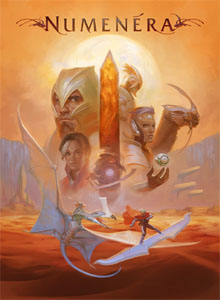
Numenera - Monte Cook GamesBefore we proceed, I want to talk a little about my assumptions here: By default, the process of advancing a tier means that you gain +4 stat points, +1 to an Edge of your choice, +1 Effort, and a skill. (You’ll also pick up extra abilities from your character’s Type, but we’re not going to worry about that for the moment.) For the purpose of these discussions, however, I’m not going to be looking at characters who have dumped all their advancements into becoming hyper-specialized at doing one thing.

For example, I’m going to assume that characters are spreading their Edge boosts around instead of concentrating them all in a single stat. (In practice, I’ll be assuming that your highest Edge will be 1 + ½ your Tier.)

For the purposes of analyzing what characters are really capable of, I’m also going to be bumping up the descriptions of tasks with difficulties of 8+ (for the reasons that I described in Part 1). In practice, we’ll be looking at something like this:

7Impossible without great skill or great effort
8Impossible without great skill or exceptional effort
9A task worthy of tales told for years to come
10A task performed by those who become legends in their own time
11A task worthy of legends that last for lifetimes
12A task that normal humans couldn't consider under any circumstances

(Difficulty 12 is the significant breakpoint here because a person with specialization, the best circumstances in the world, and willing to expend a single level of Effort still couldn’t possibly succeed.)

TIER 1 vs. TIER 3

Our general discussion has gone a long way towards establishing our baseline expectations for a Tier 1 character: They’ve got Edge 1 in one or two ability scores and they’ve got one level of Effort. If we imagined a “Tier 0” character who lacked any Edge or Effort, the Tier 1 guy can last a little longer and can also accomplish things that are a little bit tougher. We might think of him as being just a little bit better than a normal Joe, but the types of things he would consider “normal” or “routine” haven’t really shifted.

Now, let’s compare that starting character with a character who has achieved Tier 3: They’ve got Effort 3 and their high Edge is 3. They’ve probably also picked up at least one specialization.

The upper limit for this character in general has now become Difficulty 9: “A task worthy of tales told for years to come.” They don’t have to be skilled at it; they don’t need a great set of tools or perfect circumstances. They just focus their Effort on it and they’ll do stuff that people in the local aldeia will still be talking about a decade from now.

In their area of specialization, however, things are obviously even better: Without expending any effort at all, they can achieve things normal people would consider impossible (difficulty 8). Even under the worst conditions (+2 difficulty), they’re still capable of accomplishing stuff that average people would find intimidating under normal conditions.

And their absolute upper limit is even better: Specialization (-2), effort (-3), and a couple of assets (-2) means that they’re already capable of accomplishing difficulty 13 tasks… they’ve already blown the cap off our difficulty scale.

What type of stuff can they succeed at 50% of the time? Well, in general they can succeed at Intimidating tasks (stuff normal people almost never succeed at) 50% of the time by expending effort. If they’re specialized and have favorable conditions, they can achieve the impossible 50% of the time.

Notably, however, the stuff they consider routine doesn’t accelerate as quickly: Instead of just the stuff average people consider routine (difficulty 0 tasks), they also consider stuff people consider simple (difficulty 1 tasks) routine. Perhaps more telling, the “standard” difficulty of the game is now routine for them.

Okay, let’s use our touchstones: Even if these characters aren’t specifically trained at a task, they are capable of crafting any numenera item in the game; they can climb across smooth ceilings; and they are likely to possess knowledge very few people possess. If it’s their specialty, then they possess “completely lost knowledge” and they can do whatever the equivalent of climbing a wall of glass without any equipment is.

TIER 3 vs. TIER 6

So what we’ve rapidly established is that the small numbers of the Numenera system rapidly accumulate huge shifts in power and ability.

A Tier 3 character can generally perform the seemingly impossible and will, in their specialty, be capable of feats that will literally make them legends.

Because that top end already strains our ability to really comprehend what they’re capable of, the big conceptual shift between Tier 3 and Tier 6 is in the routine: With Edge 4 in their specialty, tasks of standard difficulty have become routine. More notably, that which normal people consider difficult they automatically consider simple.

(Pause and think about that for a moment: Think about the stuff that you find really difficult to do. The stuff that gives you a sense of satisfaction when you complete them successfully. Tier 6 characters consider that stuff trivial.)

The other end of the scale becomes simply staggering: Effort 6 expands their general range of ability (without skill or favorable circumstance) to difficulty 12 tasks; i.e., stuff that normal humans couldn’t even consider doing. Combine that with specialization (-2) and favorable circumstances (-2) and you’re up at difficulty 16… which is just completely off the human scale.

How far off the human scale? Well, the difference between “task worthy of legends that last for lifetimes” and what these characters are able to achieve in their specialization is the difference between a task the “most people can do most of the time” and “normal people almost never succeed”. (If there was a world where every high school basketball player had the skills of Michael Jordan, these guys would be the Michael Jordans of that world.)

Our touchstones have already been rendered largely useless, but consider this: Tier 6 characters who are not specifically skilled in climbing are nevertheless capable of expending a little effort and climbing featureless glass walls 45% of the time.

In an area of specialization (-2) they’ll have a 15% chance of knowing a piece of completely forgotten knowledge without spending any pool points. If they expend maximum effort, their chance of knowing something which (I must repeat) is completely forgotten rises to a mind-boggling 70%.

CONCLUSIONS

My big take-away from this is that by the point you reach Tier 6, Numenera is no longer a game about characters wandering through inexplicable technological ruins that they are incapable of understanding. The characters are capable of easily creating original pieces of numenera to rival even the most powerful technology of the Ancients and they almost certainly understand many of the deepest mysteries of the cosmos they inhabit.

(And if you’re still looking for a way to calibrate your understanding of the highest tiers, consider this: If a Tier 6 character was actually hyper-focused with Edge 6 (+3), a specialized skill (+2), proper tools (+1), and favorable circumstances (+1) they would consider even tasks that normal people consider “impossible without skill or great effort” to be routine.)

It looks to me like the turning point probably comes somewhere around Tier 4: Tier 1 you’re slightly better than the average person. Tier 2 you’re a highly talented expert (or Big Damn Hero depending on your perspective). Tier 3 is where you hit Legendary status. Tier 4 is where I think you have to start looking at a phase change in the types of stories your characters are getting involved with unless you want to suffer a dissonance with what the mechanics are telling you.

One notable thing to keep in mind, though: Although Numenera rapidly expands the high-end of potential, the low-end of surety doesn’t expand as quickly. The PCs may become incredibly potent demigods by the standards of their age; but they also remain distinctly mortal ones.

Archives

Recent Posts

Recent Comments

Copyright © The Alexandrian. All rights reserved.