The Alexandrian

Archive for the ‘Reviews’ category

To read a spoiler-free review of Cyteen, click here.

For some spoiler-filled thoughts about the book, go ahead and read more…

(more…)

Cyteen - C.J. CherryhCyteen is like a freight train. Half way down the first page the freight train hits you, and then you spend the rest of the book speeding along at eighty miles per hour, trying to figure out which is more exciting and terrifying: The pain from the impact, the rush of the air, or the beautiful scenery streaking by. Then, as the novel comes to an end, the train slams on its brakes and you’re thrown against a wall from sheer momentum. Stumbling away under the impact of so many disparate sensations, you come to the realization that this was one of the greatest experiences of your life. And like a madman on a rollercoaster, you’re wondering how long you have to wait before getting another ride like it.

I’d bounced off Cherryh twice before. When I was ten years old, I got Rimrunners from the SFBC. I bounced off that very hard, although I’m pretty sure now that it was a combination of being too young and entering a series at the wrong point. But it did leave a sour impression in my mind when it came to her, so I didn’t try her again until last year, when I picked up the omnibus edition of The Faded Sun trilogy. After getting about twenty pages into that book, it got left at home when I went to Las Vegas. While in Vegas I ended up getting involved in several other books, and, as a result, The Faded Sun ended up going back onto the shelf.

Then Cyteen came to my attention. And I’m glad it did.

THE BEGINNING
In media res, as a term, seems an insufficient description of the deep end into which Cherryh throws the reader at the beginning of Cyteen.

Here’s a little future history. Wham. Here are some characters. Wham. Here’s some political intrigue. Wham. Here’s some character drama. Wham.

For me, the experience was like dog-paddling wildly in a typhoon. If I had stopped paying attention and struggling, the novel would have overwhelmed me. If I had allowed myself to be distracted from the page, I think it would have become incomprehensible and – shortly thereafter – boring.

Or, to put it another way: Cherryh opens the book with a lot of sound and fury. If you don’t pay attention, then it will signify nothing – and the opening will simply read as an interminable barrage. But if you’re paying attention, you can see the clues being dropped: This does signify something. Something’s going on here. What is it? What does that mean? And if you’re in that mindset, then every little detail becomes crucial and intriguing.

THE STORY

Cyteen is a political thriller. It’s a murder mystery. It’s a generational epic. It’s a coming of age story. (Actually, it’s two coming of age stories. Possibly three.) It’s a psychological novel. It’s a future history.

Cyteen brings to mind thoughts of Dune, Ender’s Game, Use of Weapons, A Deepness in the Sky, and the Foundation Trilogy.

Cyteen demonstrates a remarkable breadth and depth. Cherryh has an equal willingness to tackle the big ideas and explore the small ones; to show her characters at the worst of times and at the best of times.

THE EXPERIENCE

Cyteen is not an easy book to read. And I mean that in a good way. This is a novel which is going to ask you to do your part as the reader: Its not going to hand you much of anything on a silver platter. Its going to force you read between the lines, draw your own conclusions, and interpret the narrative. If you don’t, the novel will simply read as a meaningless, turgid piece of self-indulgence.

But if you give it the careful reading it deserves, you will be rewarded with a richness which is hard to describe.

By way of example: I noticed at least five instances in which, if I had missed or glossed a single sentence, my entire reading of the work would have shifted profoundly. And as a result, of course, that means that the book demands a re-reading.

Cyteen is like a jewel: When you read it, you’re looking at it from a unique perspective. The smallest elements that stand out for you will shape the way the novel presents itself to you. Someone else reading the novel would notice a different set of details, and their reading experience will shift as a result. Cyteen presents itself as a truly multi-faceted work – a work whose appearance will change for the reader and the reading.

I simply cannot marvel at this enough: Reading Cyteen does not have the normal effect of starting at one point (page one) and traveling to another (the last page). Instead, you are immersed into a mental web in which your picture of the novel as a whole is constantly being revised: Something you see on page 10 will be reshaped by something you see on page 310.

Even as I sat down to write this review, I ended up glancing through the first few pages. I was immediately pulled right back into the book, and as I read just a handful of paragraphs I was amazed to discover that new details were revealing themselves and, once gain, my impressions of the entire novel were being transformed.

THE CHARACTERS

Cherryh also demonstrates an incredible gift for putting you inside the minds of her characters. The novel is incredibly enriched by the depth of her characterizations: Her POV characters are not there merely to narrate events, they are there to respond to them in both thought and deed.

The effect of all this becomes a master stroke in this story, which is largely about perception and personality. Reading Cyteen is like standing in an endless house of mirrors: You see nothing directly, but reality is limitlessly reflected all about you.

Perhaps even more remarkable is the fact that every character’s perceptions are completely legitimate – even when they’re completely inverted from one another. You’ll read Character #1 and think you’ve got everyone figured out. Then Cherryh will jump over to Character #2, and you’ll realize that not only did you not have Character #2 figured out… you need to seriously re-analyze your opinion of Character #1, too.

I’ve seen plenty of authors put me into the heads of multiple characters. But only Cherryh has left me absolutely convinced that every single point of view is legitimately the vision of a fully realized character.

CONCLUSIONS

Cyteen is a masterpiece. Its supreme mastery of form and character, matched to a plot of epic proportions and psychological complexity, is simply awe-inspiring.

Perhaps its strength can be left to a simple testament: As I finish writing these words, I am nearly overwhelmed with a desire to go back and devour it again.

GRADE: A+

For additional comments on Cyteen, which include SPOILERS, click here.

Sky Coyote - Kage BakerNOTE ABOUT SPOILERS

The following reaction will contain spoilers for The Garden of Iden, the first novel in Kage Baker’s Company series.

As a policy, I’m trying to keep the spoilers in these reactions to a bare minimum and limited to the first fifty pages of the book. If the spoilers exceed those guidelines, I’ll make a point to include a note up front. Spoilers for the two books discussed here are kept to the usual absolute minimum.

END NOTE ABOUT SPOILERS

I found a lot to really enjoy in Baker’s The Garden of Iden, as I described in my previous reaction.

The Garden of Iden walked a fine line between a light adventure story and a character drama, and succeeded admirably at delivering a powerful dose of the latter wrapped in the appealing package of the former.

Sky Coyote, the second novel in the series, walks the same line, but ends up coming down firmly on the other side of it: This is a fun, rip-roaring, no-holds-barred adventure story nicely spiced with moments of character drama which ring true and strike deep chords. The result is very effective: Because the same thematic elements are used and explored in both The Garden of Iden and Sky Coyote, the book clearly resonates as a sequel. But because the ratios are shifted, Sky Coyote exists as a stylistically distinct work.

Unlike The Garden of Iden, Sky Coyote does begin to show clear signs of a series-in-progress: Moments of conspiracy and mystery lurk throughout the novel, but their resolution is distinctly left for another day (and a different book). Intriguingly, however, the result is not that of a half-finished product: The very lack of resolution for the moments of conspiracy in terms of plot is, in fact, the resolution of the major character drama of the novel. In a similar fashion, Kage Baker brings Mendoza, the main character of the first novel, in as a supporting cast member in Sky Coyote. Mendoza’s role in the novel is absolutely essential, justified, and complete… but it also serves, at the same time, as a foundation for Mendoza in Hollywood.

Mendoza In Hollywood - Kage BakerThere’s a remarkable craft at work there. And a surprising depth in what appears, at first glance, to be a light read. And, in fact, the novel can be read as a light adventure story completely independent of the series as a whole.

Mendoza in Hollywood, by contrast, is the story of post-traumatic stress syndrome finally catching up with Mendoza. But its also a conspiracy story, and the twin threads wrap around each other in a delightful way as the books comes to a close.

The strength here, as it was in The Garden of Iden, is the depth with which Kage Baker draws the character of Mendoza. The emotional journey Mendoza endures through the novel is a gut-wrenching, heartbreakingly true experience.

The book doesn’t quite measure up to the first two, however, because it doesn’t find a plot for a long time. When it does, the whirlwind is intriguing and exciting, but ultimately short-lived. (And there are some suspension of disbelief issues with the deus ex machina which jump starts the plot once it arrives.) Two comments on this:

First, it creates a problem with the cover blurb. The blurb writer, clearly seeking exciting plot to write about, sums up the entire plot of the novel. Well, okay, he doesn’t describe the last 50 pages. But, nonetheless, if you read the cover blurb on this one your reading experience will drastically suffer. DO NOT READ THE COVER BLURB. I’m not kidding.

Second, I suspect that I would enjoy this novel on an entirely different level the second time through. Simply put, once the plot becomes clear near the end of the book, a plethora of small details – worked seamlessly into the character drama endured by Mendoza through the early part of the book – suddenly coalesce.

It’s a situation where, if you knew the plot of the book ahead of time, the thrust and direction of the story would be clear to you. I don’t think its coincidental that this is the same knowledge an author would have sitting down to write the book.

Which doesn’t mean that Mendoza in Hollywood is a waste of time the first time through. The character drama is intense. The development of the series’ meta-plot is intriguing. And the reading experience, for me, was very enjoyable.

It’s a good novel cursed by the fact that it followed two great novels, and it suffers somewhat in the comparison. But that doesn’t change the fact that it’s good.

At the moment, I am very much looking forward to reading the next book in this series. Unfortunately, The Graveyard Game appears to be entirely unavailable to me at the moment. Fortunately, it is going to be re-released in paperback sometime next year by Tor, shortly before they publish the fifth book in the series. So I’ll be looking forward to that.

GRADES:

SKY COYOTE: A-
MENDOZA IN HOLLYWOOD: B

Kage Baker
Published: 1999 / 2000
Publisher: Tor
Cover Price: $6.99
ISBNs: 0380731800 / 0380819007
Buy Now!

To keep things a little mixed up, today we’ve got the next five What I’m Reading reviews:

6. Sky Coyote / Mendoza in Hollywood – Kage Baker
7. Cyteen – C.J. Cherryh
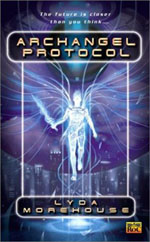
8. Archangel Protocol – Lyda Morehouse
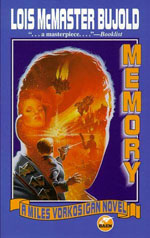
9. Memory – Lois McMaster Bujold
10. Digital Knight – Ryk Spoor

These reviews were originally written for the rec.arts.sf.written newsgroup. Although originally rather informal productions, their scope and purview quickly grew to become substantially more elaborate. I’ve often thought of reviewing as an attempt to communicate an essentially experiential phenomenon — in other words, I am more interested in describing what it was like to read a novel rather than describing the novel itself. In many ways, therefore, the writing of the WIRs was (and is) an essentially blog-like activity.

Once I’ve finished reposting the WIRs originally posted to rec.arts.sf.written, I’ll continue posting new WIRs as they’re written.

Stars My Destination - Alfred BesterAlfred Bester is one of those authors that I’ve been aware of for a long time, but who never quite made it onto my To Read List: His name would come up in a discussion or article, but my interest was never quite piqued enough, or a copy of the book never found its way in front of my eyes in a timely fashion, and he would sink back into the mental noise of my consciousness.

Then, a couple of weeks ago, the stars aligned themselves in the heavens, Bester again came to my attention, and – lo and behold – I discovered used copies of The Stars My Destination and The Demolished Man on the shelves of Uncle Hugo’s here in Minneapolis, MN.

Wow. I’ve been missing out.

Three things about Bester stand out to me:

First, his use of what I must call, for lack of a better term, casual detail. Bester will seamlessly drop a staggeringly original idea into a paragraph, casually passing it by as if it were no more remarkable than the mention of an automobile in a novel of today. The effect is that of a novel written in the far future, not merely taking place there. It’s a technique which was pioneered by Heinlein, but Bester presents it in a perfected form.

Second, the fact that these are – at their core – incredibly powerful character dramas. They have all the strength and pathos of a Greek or Shakespearean tragedy, while simultaneously being driven by a fast-paced, tautly-plotted action-adventure. The result is a reading experience which is not only compelling and addictive, but tremendously powerful. The depth with which the characters are drawn, and the sheer emotional extremity of their circumstance, leaves a lasting impression on your mind and soul.

Finally, the astonishing originality and scope of his ideas. Unlike this contemporaries, Bester is not content to simply choose one or two or ten different ideas with which to build his future. Instead, he uses dozens, spinning them out one after another in an incredibly dense, breath-taking vista. Nor is his cascade a random cornucopia of creativity: Each idea is a facet painstakingly set within an imagined epoch, carefully revealed not only to deepen the setting, but to further the story.

To see this depth and mastery in a piece of 1950s science fiction is astonishing. Bester was incredibly ahead of his time. It would take nearly a decade after the publication of The Stars My Destination before science fiction, as a field, began tentatively taking steps to explore in the directions Bester had already intuitively mapped out. It would take nearly thirty years before the genre showed serious signs of actually catching up to Bester, and even today – nearly fifty years after its publication – The Stars My Destination continues to exist on the cutting edge.

Demolished Man - Alfred BesterIn fact, if I didn’t already know who Alfred Bester was, I would have been terribly excited at discovering a new, cutting edge author after finishing The Stars My Destination. It is the only novel from the 1950’s that I feel could have been written yesterday: The setting reads like a post-cyberpunk novel, and the main character reads like a protagonist from Iain Banks or Stephen Donaldson.

That’s an incredible accomplishment. And the result are books which are exciting to read in any case, and shockingly revelatory when read within their historical context.

After reading these books, one is left to wonder what science fiction would have been like if Bester hadn’t left the field shortly after the publication of The Stars My Destination in 1956. I detect a definite pre-Bester vs. post-Bester watershed in the genre, and I think that if one were to carefully trace out the earliest whispers of the New Wave movement, one would find those whispers firmly rooted in the soil of Bester’s work. Would Bester’s continued work in the field, therefore, have quickened that development? Would Bester have served as a catalyst for a revolution? And, if so, how would that revolution have differed from the one Harlan Ellison catalyzed with Dangerous Visions?

Unfortunately, such ponderings are lost to history – just as Bester was lost to Holiday magazine for the better part of two decades. Perhaps it is an alternate history tale for Michael Burstein to tell.

I have it on Good Authority(TM) that the books Bester wrote upon returning to the SF field in the 1970’s do not compare with these early masterpieces. That’s unfortunate. I plan to give them a shot at some point, anyway, starting with The Computer Connection (since that turned up on the used shelf recently, too).

GRADES:

THE STARS MY DESTINATION: A+
HE DEMOLISHED MAN: A+

Alfred Bester
Published: 1956 / 1953
Publisher: Vintage Books
Cover Price: $12.00
ISBNs: 0679767800 / 0679767819
Buy Now!

Archives

Recent Posts

Recent Comments

Copyright © The Alexandrian. All rights reserved.