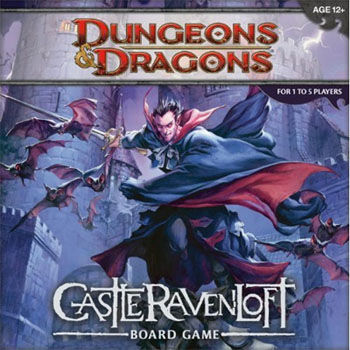
 As a roleplaying game, 4th Edition sure makes a great boardgame.
… Zing!
But in all seriousness, I’ve been looking forward to getting my grubby paws on a copy of the new Castle Ravenloft game for awhile now. For the better part of two decades now, I’ve been looking for a boardgame that could be played when you were in the mood for a little dungeon-crawling but didn’t have anyone to DM.
(Over the years I’ve dabbled with dungeon-crawling boardgames that require DMs, but I’ve pretty much sworn off them at this point. Descent is a decent game, for example, but I can’t imagine a scenario when I would ever play it: Since it requires a DM, I might as well just grab my copy of Dungeons & Dragons off the shelf. The full-fledged RPG is a richer and more rewarding experience in almost every way, and with the speed of OD&D character creation you can actually get the game set-up and start playing much quicker, too.)
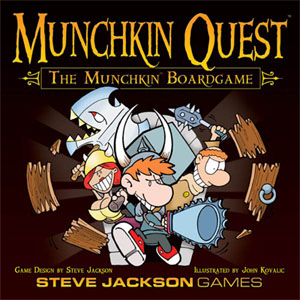
Most recently, Munchkin Quest looked like it might fill that slot for me. It had some pacing issues, but after fixing those problems the game saw a couple months of intense use. But after that, the game started collecitng dust: The competitive aspect meant it still wasn’t quite scratching that dungeon-crawling itch. And it was too long (3-5 hours) given the relative shallowness of its gameplay. Way too many sessions ended with all of us wishing that the game would just end already.
Castle Ravenloft is pretty much at the opposite end of that spectrum: The prepackaged adventure scenarios all feel lightning fast and can easily be completed in 60 minutes or less. I’ve played it more than a dozen times already (having gotten it only a week ago). The real test, of course, will be whether or not the game endures after the first flush of excitement. But for the moment I wanted to talk about some of my first impressions.
RANDOM DUNGEON, BUT SHALLOW EXPLORATION
The game features a random dungeon construction: Individual puzzle piece tiles are laid out as your heroes explore the dungeon. The result can be quite tense at times as you cross your fingers against drawing a black tile (which results in a debilitating encounter being drawn), but very few of the tiles have any kind of special effect or meaningful identity in a given scenario.
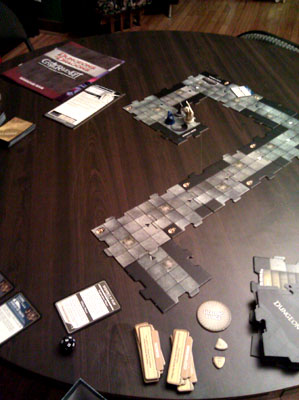 So while the game is more variable and interesting than dungeon-crawlers featuring pre-determined dungeon layouts, there’s also no sense of actually exploring the dungeon in most of the scenarios.
Similarly, because the dungeon layout is random it doesn’t really matter where you go: You virtually never hit a dead end, and at some point you will draw the location tile containing your goal for the given scenario.
Here’s a simple hack I may be trying in the near future: For scenarios involving the use of the special 1×2 Start Tile (which is most of them), start by forming a random 3×4 grid of face-down dungeon tiles with the Start Tile in the middle of them. Now take any scenario-specific tiles and shuffle them into a stack of random dungeon tiles to form a stack of 13 additional dungeon tiles. Deal these out randomly to form a face-down, 5×5 grid (including the original 3×4 grid). (For a longer game, form a 6×6 grid instead.)
TACTICS, BUT NOT AS WE KNOW THEM
Although Castle Ravenloft offers a setup superficially similar to 4th Edition, this can actually be quite deceptive. As a result, I’ve seen quite a few reviews complain that Castle Ravenloft doesn’t have any tactical depth.
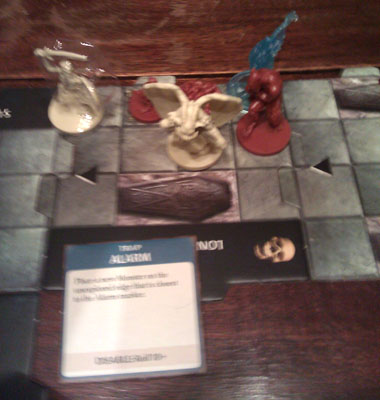 This is not, strictly speaking, true: Castle Ravenloft does have tactical depth; it’s just a tactical depth that looks absolutely nothing like 4th Edition’s tactics.
The primary tactical crux of Castle Ravenloft lies in the fact that heroes move by spaces but monsters by tile. (For example, a typical hero might move 5 spaces on their turn. A typical monster, on the other hand, will move 1 or 2 tiles.) Thus, the core tactics of the game revolve around managing the placement of monsters and heroes around the tile borders.
These basic tactics are complicated by the necessity to manage the monster’s control sequences; the panoply of variable hero abilities; and the random crises generated by a fair-sized chunk of the game’s encounter cards.
(The game may also suffer in the opinion of some because it’s very easy to brute-force your way through the early, introductory scenarios. It’s thus possible to completely ignore the tactics and strategy of the game and still pull out early victories, leading one to the false conclusion that the game has no strategy. In that respect it’s kind of the inverse of Settlers of Catan — a game which you think has a strategy when you first start playing it and then eventually realize is dominated completely by dumb luck.)
HORRIFIC RULEBOOK
The Castle Ravenloft rulebook is quite possibly the worst I’ve ever read. It’s poorly organized, fails to explain basic terminology, establishes other terminology which it then proceeds to use inconsistently, and then compounds all of these problems with an atrocious (lack of) organization. And given the relative simplicity of the rules, the experience of the designers, and the fact that the game is built on the back of a fairly well-established ruleset… well, it’s completely inexcusable.
It’s also disappointing that WotC failed to leverage their existing stock of high quality fantasy art to spice up the cards. The lack is particularly felt, in my opinion, when it comes to the treasure cards.
MONSTERS & SCENARIOS
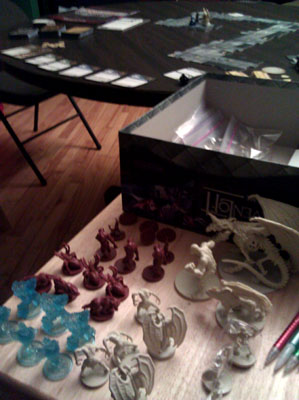 The argument could certainly be made that it’s worth buying the game just for the 42 miniatures that come with it. I don’t think I’d disagree: Amazon is selling the game for $50 right now, so the price per mini comes out to about $1.20. Since that includes a Huge Dracolich, I’m pretty happy with it. (And that’s ignoring the general utility of the interlocking dungeon tiles.)
Laying that aside, I do wish the game had a bit more variety when it came to monsters. There are basically ten varieties of “grunt” in the game (zombie, skeleton, blazing skeleton, wraith, ghoul, wolf, kobold, spider, rat swarm, gargoyle) and you’ll see a lot of them all. While the varied scenarios are keeping much of the game fresh for me right now, the monsters have all become rather hum-drum.
Fortunately, this is an aspect of the game which is surprisingly easy to customize. Although game balance probably requires that you keep 10 different types of creature for each adventure, swapping them out for equally challenging monsters isn’t a problem. There’s a ton of fan-created monsters already available, and there are cheap D&D mini singles available all over the place.
Speaking of scenarios, the game comes with 12 (including two solo scenarios) and 2 more have been released through Wizard’s website. The scenarios are varied (often completely changing your strategic approach to the game) and have been easily supporting multiple play-thrus for me. For example, in this scenario:
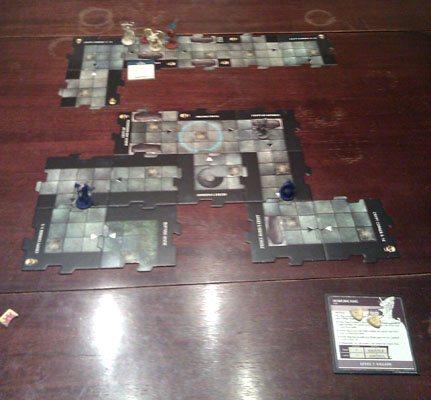
The heroes start play having been randomly teleported to different corners of the dungeon. You have to reunite with each other and shut down a demonic summoning while the villain of the piece continues to assault the heroes with teleportetic assaults.
(In the image above you can see where we’ve set off an Alarm trap — which summons additional monsters each round — in a section of the dungeon we were subsequently teleported out of. One of the (blue) heroes has been abandoned in a dead end corridor. And both of the heroes are dreading the possibility that the villain is going to teleport them back up to where all those monsters are waiting to devour them.)
But I do wish there were more of them. When I compare the relatively anemic number of scenarios offered by Castle Ravenloft to the dozens of scenarios offered by Betrayal at House on the Hill (another game I received this Christmas which features variable scenarios of roughly equivalent complexity), I do feel this was an opportunity missed by the designers.
FINAL WORD (FOR NOW)
Castle Ravenloft is fun.
I’m enjoying it a lot, and I keep roping in more and more people who all seem to agree.
It’s not perfect, but its only egregious flaw (the atrocious rulebook) is relatively easy to overcome.
Having just reviewed my early thoughts on Munchkin Quest, I realize that initial success may not translate into a permanent or even long-term success. But as I write this I’ve already gotten more than a dozen plays out of the game, and I’ve only touched half the scenarios it shipped with. A couple scenarios have already seen 4+ plays. Even if that’s where the game tops out, I’ll still get 40+ plays out of it. That’s pretty good compared to most of the games I own.