The Alexandrian

Collected Stories of Vernor VingeVernor Vinge’s output as an author can be described as almost tepid. Over the span of four decades (from 1965 through 2005), his total output consists of only 25 works: 19 short stories and 6 novels.

That’s a slim opus, indeed, but it’s an opus which has completely transformed the entire genre.

Usually when you say stuff like that you’re speaking hyperbolistically. But not in the case of Vinge: At least half of the significant science fiction authors of the last two decades owe Vinge either a direct or indirect debt of enormous proportions. And, as a result, pretty much everyone else in the field has been influenced by his ideas to one degree or another.

A lot of this importance can be credited to Vinge’s conceptualization of the Singularity, which I’ll discuss at more length as it comes up in his work. But he’s also responsible for the modern vision of cyberspace. That, combined with his anarcho-capitalistic social thought experiments, puts him solidly behind the nascent origins of the cyberpunk movement in the 1980s. He is also arguably responsible for the Neo Space Opera Renaissance of the past decade and his most recent work (represented by “Fast Times at Fairmont High”, “Synthetic Serendipity”, and the forthcoming Rainbows End) would seem tantalizingly poised to shape major genre trends for the decade to come in ways we can perhaps scarcely imagine.

But until recently, I, like many others, had read only Vinge’s two most recent, Hugo Award-winning novels: A Fire Upon the Deep and A Deepness in the Sky. I had been previously turned away from his earlier works partly because they were frustratingly unavailable and partly because I’d heard that his earlier novels just weren’t of the same quality as his more recent work.

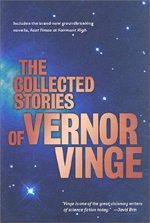
Then, a few weeks ago, I finally cracked open The Collected Stories of Vernor Vinge. Over the course of the following month I proceeded to devour (or re-devour) every word Vernor Vinge has ever published.

THE COLLECTED STORIES OF VERNOR VINGE

The Collected Stories of Vernor Vinge is a very strong testament to the quality and nature of Vinge’s career. At the time it was published in 2001, this was arguably a complete collection of Vinge’s short fiction. It contains less than two dozen stories spread thing across four decades of work, but almost every single story is a masterpiece. The collection contains every word of short fiction published by Vinge, but it reads like another author’s “Best of” collection.

I have to assume that Vinge is essentially a methodical craftsman: Each story painstakingly fashioned like a jewel, with each facet carefully cut to reveal its inner strength and beauty to the utmost. This can create seemingly agonizing waits between the appearance of each work, but it also means that the wait is always worthwhile.

The highlights of this collection include:

“Bookworm, Run!” – This is basically the story of someone who gets Google plugged straight into their brain. A version of Google fully stocked with the mainframes of the Department of Defense, the CIA, the NSA, and the FBI all rolled into one. The result is the ability to instantaneously access an essentially infinite library of networked information in a fashion almost, but not quite, as if it existed in your own memory.

Lots of science fiction authors have been known to let genies out of bottles: Ideas so powerful that they come to define their careers and create a shockwave which percolates throughout the field or transforms our understanding of the genre. Smith’s space opera. Asimov’s Three Laws of Robotics. Herbert’s Dune.

But most of these authors don’t reveal their genies until they’ve got a few dozen stories under their belt. By contrast, Vinge, in the very first story he ever sold, whips out his bottle, smashes it to smithereens, and starts interrogating the genie. The result is a revelation which has been haunting his work, and the entire genre, ever since.

What, exactly, are we talking about? The Singularity. In “Bookworm, Run!”, Vinge asks a very simple question: “What happens when human science creates the first truly superhuman intellect?” And Vinge’s answer is evocative, “You get something incomprehensible. You get a point beyond which the merely human is no longer capable of understanding.”

Vinge’s argument, essentially, is that as you begin to grow intelligence, you reach a point at which that growth becomes essentially exponential. For example, in “Bookworm, Run!”, when you reach the point that your natural memories can be supplemented by artificial databases, you don’t get a situation in which intellect gradually improves: You have an explosive, essentially infinite growth in personal knowledge. And that sudden expansion from knowing a few things to knowing everything creates a dynamic which is, essentially, unimaginable – it can only be thought of in the grossest and most imprecise of ways by those of us who have not yet undergone that change.

In “Bookworm, Run!” Vinge saddles his protagonist and his specific technology with some… unique limitations. In this way he sidesteps the essentially incomprehensible nature of his proto-Singularity (since he hadn’t fully developed the concept yet), and instead sidles up to it from the side. But he doesn’t simply ignore the implications, either, as the end of the story reveals.

This reveals the unique problem of dealing with the Singularity in fiction: How do you tell a story about something incomprehensible by its very nature? Trying to meet that unique challenge of storytelling can give rise to some fascinating solutions and some wondrous world-building. In many ways, his many varied solutions to this problem have come to define Vinge’s career.

“Bookworm, Run!” is also quintessentially Vingean, revealing the future contours of his career, for another reason: In addition to the central conceit of the story, Vinge also casually drops a few other bombshells into his world-building which fundamentally transform society even before the story begins. Not only is he not content in running just a single thought-experiment through his story, the entire setting is permeated with detailed extrapolation.

In this case, the most notable change after the proto-Singularity at the centerpoint of the story, is the availability of cheap fusion reactors. Vinge postulates that this prevalence of cheap energy will create an economic depression, requiring the government to impose a period of strict economic controls. His logic here makes no sense to me, but it’s particularly interesting to look at the story as a starting point for Vinge’s experimentation with the economic organization of a high-tech society, a theme he’ll return to time and again in his work.

(Although I find it interesting to note that if you replace the words “cheap fusion reactors” with “self-replicating nano-factories” I probably wouldn’t have had the reaction of, “How do you figure, exactly?” Is that indicative that self-replicating nano-factories are just the latest “utopia gizmo” of science fiction, or is it that science fiction has finally found the utopia gizmo it’s always been looking for?)

“The Ungoverned” – This question of the ways in which technology can restructure an entire economy and, by extension, society is central to Vinge’s world-building in “The Ungoverned”. Basically, Vinge seems to have quickly reached the conclusion that sufficiently advanced technology inevitably breaks down central authority.

“The Ungoverned” is a novella lying between two novels: The Peace War takes place before it; Marooned in Realtime takes place after it. In The Peace War we see the last desperate efforts of a central authority attempting to cling to power by artificially suppressing technology. In Marooned in Realtime, Vinge takes this question to its extreme: What use is a central authority when an individual is an entire economy unto themselves? “The Ungoverned” lies quite literally between; an anarcho-capitalist society in rapid transition.

But all that is just the world-building. It’s the groundwork and the thematic substance which opens up the door for the rip-roaring war story which is the actual meat of the story. It makes for a fascinating reading because, on the one hand, it’s a fast-paced, no-holds-barred action story; but, on the other hand, it doesn’t take much to peel back the surface and see some frightening conclusions being drawn about the future being drawn. What does it really mean when a handful of people are capable of wielding as much power as a 19th century superpower? Or even a 20th century superpower?

“Conquest by Default” – This story takes a slightly different approach to Vinge’s vision of technological profligacy leading inevitably to extreme libertarianism. Here we have a system with a central control designed to deflect the monopolistic tendencies within the anarcho-capitalist structure. And if you think that Vinge is whole-heartedly endorsing the anarchic chaos which he appears to believe inevitable, then this is a story which will make you think twice.

“The Peddler’s Apprentice” – This story, which is a collaboration between Vernor Vinge and his ex-wife Joan D. Vinge, highlights several of the ways in which Vinge sidesteps the enigma of the Singularity. Once again we have a centralized authority artificially holding society’s technological progress in check, but we also get to view the Singularity through the eyes of a primitive. We also get to see Vinge’s willingness to dream across incredibly vast scales of time: A vision of civilizations rising and falling; or rising and disappearing into the Singularity; with the vestiges of either being given a chance to rise again over the spans of hundreds of millennia.

“The Science Fair” – Vinge also has a real flair for developing completely alien cultures with a great depth of thought. In reading “The Science Fair” I was reminded of something John Campbell once said: A good science fiction author, writing in 1900, would be able to predict the automobile. A great science fiction author would predict the traffic jam. In similar fashion, Vinge doesn’t just create imaginative and memorable alien races, he follows through on the basic qualities of their nature to logically produce the cultures, societies, and technologies such a species would naturally create.

“Original Sin” – This talent for creating alien races and then extrapolating upon their biological imperatives to create unique and multicultural societies is the foundation which makes “Original Sin” such a classic. The other element which deserves comment here is Vinge’s ability to invest a relatively large cast of character with a lot of individual depth. The result is a multi-faceted character drama which is made even more impressive given that several of those characters are completely alien in their countenance and in Vinge’s ability to create that character drama within the confines of a crisis capable of reshaping the known universe.

“Original Sin” is also notable because it shows Vinge hitting the central thesis of A Mote in God’s Eye several years before Niven and Pournelle.

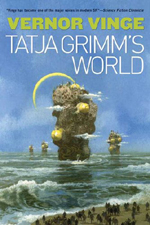
“The Barbarian Princess” – It’s also interesting to note how most of Vinge’s novels have grown out of his short fiction. “The Barbarian Princess” is part of his pastiche novel Tatja Grimm’s World, which will be dealt with at length in its own reaction.

“The Blabber” – This short story is probably most famous because it’s the genesis point of the Zone universe, which serves as the setting for Vinge’s two best-known works, A Fire Upon the Deep and A Deepness in the Sky. But “The Blabber” is a damn fine story in its own right.

The conceit of the Zones universe is a way for Vinge to cheat the exponential growth curve which ends inevitably in the Singularity. Basically, if Vinge is right about the Singularity, humans don’t get to go to space: Long before the industrial trends give us interstellar flight, the informational or biogenetic or artificial intelligence trends result in humanity becoming something transhuman.

So Vinge sidesteps the issue by, basically, waving his authorial hand and saying: “These technologies would surely be nifty… but they just don’t work. Too bad.” Vinge is hardly the only author to do this, but what makes Vinge’s experiment interesting is that he makes his authorial hand-waving explicit to the universe itself AND varies those technological limitations.

The result is a galaxy split into multiple “zones” (hence the name applied to the fictional milieu): In the Unthinking Depths at the galactic core, intelligent thought itself is impossible (or, at least, intelligent thought as we know it). If you and I were to jump on a spaceship and head down towards the galactic core, at some point our brains would simply stop functioning at anything but an animalistic level.

One step up from the Unthinking Depths is the Slow Zone. That’s where we are now: Human-level intelligence is possible, but not much more than that and the limits of physics are already pretty well known to us: FTL and gravity-control systems are impossible, for example.

The next step up is the Beyond. Here you can get some pretty sophisticated AI systems and other forms of superhuman intelligence. FTL, gravity-control, and some other amazing, physics-bending technologies are easily achievable. Basically, the Beyond is the realm of classic space opera.

And beyond the Beyond there is the Transcend: Here Vinge’s Singularity is possible. And, in fact, due to the nature of the Zones universe almost inevitable: A High Beyonder civilization has been artificially arrested on the precipice of the Singularity. Take them into a Zone where the Singularity is possible and they practically fall into Transcendance.

The net result is a universe where you, as an author, can literally scale the technology to whatever your current needs are, while also profiting immensely from unique interactions between the Zones. For example, “The Blabber” takes place near a border between the Zones, on a human colony world just far enough within the Slow Zone to be inexorably stuck, but close enough to the Beyond to know what they’re missing out on.

As a story, “The Blabber” begins to show a truly mature Vinge working his craft like a maestro. It mixes crafty and subtle storytelling; a character drama and coming of age story told with touching sincerity; marvelously intricate extrapolation and world-building; a cleverly conceived alien species; and at least a dozen nifty ideas thrown around to create sensawunda on a grand scale.

“Fast Times at Fairmont High” – As “The Blabber” was the genesis point for A Fire Upon the Deep and A Deepness in the Sky, “Fast Times at Fairmont High” is the genesis point for Vinge’s forthcoming Rainbows End. In this new cycle of stories, Vinge chooses to examine the Singularity by jumping onto the on-ramp and taking us down the gaping maw of the rapid plunge into computer-assisted super-consciousness.

What makes “Fast Times at Fairmont High” so very interesting is that Vinge’s technological predictions are not particularly outrageous. Indeed, what makes this story so utterly compelling, on a level beyond its immediate characterization and plot (which are both sterling), is Vinge’s completely believable extrapolation of the effect that technology scarcely more advanced than our own will have on the daily lives of every man, woman, and child alive.

Indeed, you can begin seeing signs of that change around us even now: The experience that I had in high school in the mid-to-late ‘90s was only tangentially different in the slightest of ways from the high school experience kids had twenty years earlier. Less than ten years later, ubiquitous proliferation of ‘net access, cell phones, wireless devices, online communities, and more have fundamentally changed the high school experience. It’s easy to say “this changes everything” – and it’s so very rarely true – but it’s actually happening right now. These new technologies are fundamentally changing the way you study; it changes the way you learn; it changes the way you socialize – it changes the way in which you live. And when you change the way people live their lives at a societal level, you change the very nature of that society. And it’s not just the change which is notable, it’s the pace of the change: Meaningful generation gaps which begin shrinking into spans of less than a decade.

What gives Vinge’s effort it’s distinction is that he doesn’t simply take a look at current trends, extend the graph lines by a few years, and then present the result. Instead he narrowly looks at the trends in the advance of computer technology and extends those graph lines a few years. Then he imagines what types of applications those technologies will make possible. Then he imagines what people will do with those types of applications. Then he imagines what a whole society of people doing those things would look like; what types of synergies would be created; what other technologies would be pursued. It’s a gestalt; it’s the traffic jam lurking behind the automobile.

OTHER SHORT STORIES

In the four years since The Collected Short Stories were published, Vernor Vinge has published two additional short stories: “Synthetic Serendipity” and “The Cookie Monster”. (These stories are both available legally online — follow the links.)

“Synthetic Serendipity” – This story takes place in the same near-future universe as “Fast Times at Fairmont High”. What I find interesting is that, despite sharing largely the same locales and a similar cast of characters, there is little thematic or content overlap between the two stories. This seems to go back to the discipline which lies behind the austerity of Vinge’s artistic output: He may go back to visit the same settings and even the same characters, but somehow he finds the ability to keep everything *completely* fresh.

I’m reminded by a story that my friend David Kloker told me the other night: The first time he went to New York City he spent the night sleeping on the floor of his friend’s dorm room at NYU and, in the morning, went to an anti-nuclear rally. The second time he went to New York he stayed at a 5-star hotel in Manhattan , supped beneath a glass chandelier, and spent the evening at the opera. The two experiences, though separated by scant miles, seemed to take place in two completely different cities. And, as my friend David says, if you stand on a busy, bustling street corner and reflect upon this, you can be humbled through the understanding that there is a reality which can only be understood through disparate views – at the interstice of diffracted experience.

Similarly, the Fairmont High we see in “Synthetic Serendipity” is the same school as the one we see in “Fast Times”… yet the experience is fundamentally different. And by refusing to hit any of the same beats a second time – by showing a completely fresh facet of his creation – Vinge adds remarkable depth to a setting which has only had a few thousand words dedicated to it.

“The Cookie Monster” – It’s difficult to do a review of this story because any substantive discussion of it would necessarily reveal the central mysteries which Vinge so very skillfully unwraps for you over the course of the story itself.

So let me speak in generalities for a moment: The escalation of the story’s central mystery and the execution of the plot are solid and well-paced. The characters not only have distinct personalities and unique roles, but genuinely make you care for them. The story, as a whole, explores a lot of different dynamics within the situation in a very efficient, entertaining, and creative fashion. There’s essentially no dead air in the story, and Vinge manages to hit a wide thematic range without beating you over the head with any particular message: Slavery. Genocide. Resistance. Freedom. Hope. Despair.

In “The Cookie Monster” I find a summary of Vinge as a whole: He excels at mixing old and new ideas alike, analyzing their implications to an unprecedented depth, twisting them in original ways, combining them in great quantities, accelerating the pace of change, and waiting to see what comes out of the mix. And then, once he’s got all that worked out, he’ll quite casually figure out where the crisis points and character dramas naturally arise and then execute the resulting story in a flawless fashion.

That’s “The Cookie Monster”. That’s Vinge. That’s genius.

GRADES:

COLLECTED STORIES OF VERNOR VINGE: A+
“Synthetic Serendipity”: A
“The Cookie Monster”: A+

Vernor Vinge
Published: 1966-2005
Publisher: Tor
Cover Price: $16.95
ISBN: 0-31-28758-43
Buy Now!

Today we have the first brand new, never-before-seen WIR reaction to appear on the website. I spent the month of March reading through essentially every word written by Vernor Vinge, and this is the first in a series of WIR reactions which will cover his entire corpus of work:

WIR 46: The Short Stories of Vernor Vinge

I’ve also recently been spending a good deal of time listening to every single note of music ever published by the Flaming Lips. It may just be a personal and idiosyncratic synchronicity, but I’ve found that their albums At War With the Mystics and (even moreso) The Soft Bulletin have proven to be the perfect musical accompaniment for Vingean exploits.

A few years ago I was asked, based on my analysis of the intrigues of the prequel trilogy, to share my thoughts on what a sequel to the original Star Wars trilogy would look like. The result was the following essay. Originally written shortly before the release of Revenge of the Sith, it has been given a minor revision to take into account the particulars of that last film.

Star Wars - Episodes VII, VIII, and IX

EPISODES VII, VIII, and IX

Everything I’ve read would seem to indicate that George Lucas originally intended for Episodes VII-IX to be the “Further Adventures of Luke Skywalker”, and that a lot of that material got rolled into Return of the Jedi. (Although, of course, the story fluctuates.)

But let’s speculate.

Each STAR WARS trilogy would seem to be formed of two components:

(1) A Star War. In the original trilogy this was the Rebellion. In the prequel trilogy this is the Clone War or the Separatist Civil War.

(2) The Skywalker Saga. To some extent this can be thought of as “the story of Anakin Skywalker” — and Lucas has certainly tried to spin it that way in pulling his dramatic commitment back to six films – but the reality is the prequel trilogy is the story of Anakin and the original trilogy is the story of Luke. Anakin’s story certainly continues into Luke’s, but claiming that the focus of the second trilogy is Anakin’s redemption would be wildly inaccurate.

So what might a sequel trilogy look like?

Well, first off we need a star war: It’s right there in the title. What would it be? The Extended Universe certainly shows us some intriguing possibilities, ranging from a resurgent Empire to intergalactic invaders. But here’s my thought: A Droid Uprising. (Obi-Wan: “If druids could think, there’d be none of us here.”) There’s a rather serious disconnect between the attitudes we see people holding towards druids in the Star Wars universe — whether it’s Obi-Wan’s off-hand comment or the casual wiping of droid memories — and the intelligent, independent, and sentient behavior we actually see droids like C3-PO and (particularly) R2-D2 engaging in.

R2-D2 as leader of a Droid Rebellion? Nah. That’s a little too weird. But what about Grievous, the Droid General? Obi-Wan may have thought he destroyed him by burning out the organic organs in his chest, but what if those remains were recovered and preserved? (The most obvious questions would be, “By who?” and “For what purpose?”) Combine these speculations with the very old rumor that a character from the prequel trilogy would be frozen in carbonite only to return in the sequel trilogy and you start getting some very interesting synergies.

Let’s turn our attention from that and take a look at the Skywalker Saga for a moment. From what we’ve seen, the Skywalkers seem irrevocably tied up with the Prophecy of the Chosen One. Now, frankly, I’m still pretty damn hazy on exactly what this Prophecy is all about. What, exactly, does it mean to “bring balance to the Force”? The obvious interpretation of the words seems rather belied by the fact that none of the Jedi say, “The Chosen One? Kill him now before he can revive the Dark Side in order to balance out our massive success as practitioners of the Light Side of the Force!”

(Tangent: One interesting theory I came up with a while back was the idea that the whole Skywalker-as-Chosen-One thing is a red herring. What if Palpatine is the Chosen One who brings balance by orchestrating the destruction of the Jedi, whose wide-spread use of the Force created unnatural imbalances? It doesn’t fully track, but it’s an interesting thought.)

In any case, there’s actually two questions here: What do the Jedi THINK the Prophecy means? And what does the Prophecy ACTUALLY mean?

I’m not sure what the Jedi think the Prophecy means, but I believe that what the Prophecy actually refers to is the finding of a third path: A balance within the individual Force-user between the Light and Dark sides of the Force. A healing of the philosophical schism which occurred when the Sith and the Jedi parted ways a millennia ago, the former succumbing to self-destructive egomania; the latter becoming the caretakers of a stagnating civilization.

In such an interpretation, the Chosen One is not, of course, Anakin: It’s Luke. And what we see in Return of the Jedi is not just the rebirth of the Republic, it’s a rebirth of the Jedi. It’s not just a return of the Jedi wiped out twenty years before: It’s a return of the True Jedi, whose path was lost in an artificial schism.

(REVISION NOTE: The Jedi’s interpretation of the Prophecy would appear to rely on the dichotomy between the Living Force (sensitivity to the moment arising from the interconnection of all things) and the Unified Force (the binding nature of the Force which results in destiny and shapes the future). Finding balance between these two sides of the Force would be seen as a positive way to escape the stagnation inherent in the Old Jedi Order’s reliance upon the Unified Force.)

Now, in the Extended Universe, we’ve seen a persistence of the old Light/Dark dichotomy. But, personally, I believe that Luke’s teachings would be influenced by that moment in Return of the Jedi where he opened his heart to the Dark Side… and DIDN’T fall. His New Jedi Order would be a rediscovery of how to walk the Path of Balance.

Where does all that take us? I’m not sure. But let’s talk about the Skywalkers some more. Looking at the Star Wars saga from a structural standpoint, we also see a generational transition between the trilogies, and I would expect to see the same thing happen again with the sequel trilogy. The Skywalker(s) at the center of the sequel trilogy would be the children of either Luke or Leia (or both).

But what’s their story? In the prequel trilogy we see the Fall of Anakin Skywalker. In the original trilogy we not only see Luke avoid that fall, we also see Anakin’s Redemption. Is there a third angle to this story? Or is the cycle complete, and all we could see is redundancy?

(Another tangent: One of the things I find brilliant about the prequels is the subtle enhancement of Luke’s character arc in the original trilogy. Having seen only part of Anakin’s fall, I find that I “worry” a lot more about Luke falling to the Dark Side. Having seen only the original trilogy, Luke is clearly the Hero of the tale; you just expect him to resist temptation. But having seen his father — and Luke is so very much like his father — you can’t help but begin to entertain the worrisome notion that Luke could be just as vulnerable to temptation. But I digress.)

The Extended Universe, in fact, offers many faceted views of this fall-and-redemption cycle. Perhaps the least satisfying of these is Dark Empire — in which (MINOR SPOILERS) Luke falls himself and then finds redemption. Although there are a lot of interesting things about Dark Empire, Luke’s fall is not only a redundant telling of his father’s story, it also directly saps the power and conviction of the conclusion of Return of the Jedi. (The Emperor’s resurrection also detracts from the conclusive nature of  Return of the Jedi, in my opinion.) Perhaps the most interesting is the Knights of the Old Republic computer roleplaying game, which I won’t spoil here for anyone who hasn’t played it. (You should.) Mara Jade is another obvious example here.

Perhaps the mirror here is one of letting Luke play his role as the Chosen One to save his children (or Leia’s children). Luke is the Redeemer. (Doc Brown: “It’s not you, Marty. It’s your kids!”) This, of course, raises the question of how Luke let things go wrong in the first place. (Maybe he wasn’t there? Maybe Luke disappeared years ago and part of the story of the new trilogy is figuring out where he went and why.)

The larger problem with such a story, though, is its inherently unfocused nature: Is it a story of the kid’s fall? Their redemption? One or the other has strength. Both in the same arc would tend to make them a pale imitation of the previous trilogies (each of which was allowed to focus on one theme over the other).

Let me make a major digression here and look at the trilogies from a Campbellian perspective: It’s interesting to note that Lucas takes a Campbellian hero cycle and, to at least some extent, extends it into a generational epic. Shmi Skywalker is the metaphorical World Goddess, her virgin womb the wellspring of the Skywalker hero-legacy. In Anakin the promise of the hero (Chosen One) is twisted as his hero-journey is warped: The corrupted nature of Anakin’s reunion with his mother lays the seed; the death of one father-figure (Qui-Gon) and the failure of another (Obi-Wan) open the door for the corrupted father-figure of Palpatine to turn Anakin’s Apotheosis into a Fall. The result is the transformation of a hero-cycle into a Greco-tragedy.

But the hero-seed of Shmi Skywalker does not end its journey in Anakin Skywalker, it jumps to Luke. In this way Lucas raises Campbell ‘s cosmogonic cycle from a single hero and extends it to the Skywalker family as a whole. Luke’s hero-cycle, unlike that of his father, cannot be corrupted.

Campbell writes: “Two degrees of initiation are to be distinguished in the mansion of the father. From the first, the son returns as emissary, but from the second, with the knowledge that ‘I and the father are one’. Heroes of this second, highest illumination, are the world redeemers, the so-called incarnations, in the highest sense. Their myths open out to cosmic proportions. Their words carry an authority beyond anything pronounced by the heroes of the scepter and the book.”

Luke is a hero of the second sort: “I am a Jedi… like my father.” And Luke is also given his father’s blessing: “Tell your sister you were right… You were right…” This indoctrinates him as the Redeemer.

(Actually, Lucas’ working of the hero-cycle at the end of Return of the Jedi is both intricate and subtle. Campbell also writes: “Stated in direct terms: the work of the hero is to slay the tenacious aspect of the father (dragon, tester, ogre king) and release from its ban the vital energies that will feed the universe.” Luke doesn’t actually slay his father, but metaphorically the content is obviously there. More subtly, however, is the fact that Anakin’s moment of redemption is ALSO a father-slaying: The warped father-figure of Palpatine.)

But there’s one major leg of the cosmogonic hero-cycle missing here: The hero’s return. The Redeemer’s revolution and transformation of society. This would seem to be Luke’s destiny, with his revolution being the New Order of True Jedi walking the Path of Balance and his new society being that of the New Republic . (This is also an interesting mirror with Anakin: In Anakin’s failed apotheosis we see the destruction of the Jedi and the fall of the Republic. In Luke’s successful apotheosis we see the founding of a new Jedi Order and the return of the Republic.)

So if the sequel trilogy is the story of Luke as Redeemer, wouldn’t that mean the sequel trilogy would focus on Luke and not the next generation of Skywalkers? Not necessarily. No moreso than the story of Anakin’s redemption was told to us with Anakin as the focus of the story. Indeed, part of the strength of the STAR WARS saga to date is the fact that the second half of Anakin’s story became merely part of Luke’s story: A large tapestry woven into an even larger saga.

So, how would we see Luke’s story as the Redeemer and World-Changer similarly reflected as being merely a part of the larger story of his children?

It would definitely be interesting to see how Lucas would answer that question.

But for our own entertainment, let’s throw a few pieces out on the table and see what happens with them:

A DROID UPRISING

This is the central crisis on which we hang our plot. It’s the focus of tension and conflict, and provides all the pretty pyrotechnics you need for a grand space opera. It grows naturally out of the themes and elements we’ve already seen in the STAR WARS saga, while also staying true to the saga’s basic palette of classic, Golden Age science fiction.

MARA JADE

Mara may belong to the Extended Universe, but her love story of redemption is so perfect in the role of Luke’s wife that if she didn’t exist we’d have to create her. (And it wouldn’t be the first time that a creation of Timothy Zahn’s Thrawn Trilogy made the jump to the big screen.) She wouldn’t necessarily be the Mara Jade of the Extended Universe, but she would be a Force-using servant of the Emperor who comes into direct conflict with Luke in the struggles which follow the destruction of the second Death Star. Although all of this would have happened off-screen, in her redemption we have the dark temptress transformed into the life-womb of the Skywalker Children. Speaking of which…

THE SKYWALKER CHILDREN

Here I see influence from the Children of the Lens (E.E. “Doc” Smith). The twin daughters of Luke and Mara; the twin sons of Han and Leia. They form the nucleus of the New Jedi Order, and their collective hero-cycle redemption is the thematic core of this third act in the Skywalker Saga. But the journey will not be smooth or predestined, for the twins are fated to be pitted one against the other.

THE NEW JEDI ORDER

In this we see Luke’s role as the Redeemer. Although twenty years have passed and the foundations of the New Order are already becoming firm, in its mere existence we can see the fruits of Luke’s apotheosis. The Order is the backbone of the New Republic, and the Skywalker Children are the nucleus of the Order: Thus we see how Luke’s role as the Redeemer is subsumed into the hero-cycle of his children.

A GRAIL QUEST

The Arthurian Grail Quest is an inversion of the hero-quest, in which the hero-quest itself becomes a tragic form. What would the grail-object be in the world of STAR WARS? I’m not sure. But in a grail-quest we would see that elusive third facet of the hero-cycle: In Anakin we see a failed hero-cycle lead to tragedy. In Luke we see a successful hero-cycle turned to apotheosis. In the Skywalker children we would see a grail-quest in which some would rise to ascension and others would be debased.

THE DISAPPEARANCE OF LUKE SKYWALKER

After the world-change, the hero must depart — it’s the final stage of his existence. In the case of Luke, his disappearance would not only play a part in triggering the crisis which initiates the hero-cycle of his children, it would also be the breadcrumbs on the path which would lead them to the grail-quest.

And how about some droid Force users? Or, rather, not Force users. Because the Force binds together *living* things. But if that’s the case, who are the Droid Knights? And how can they do the things they do?

Star Wars

EPISODE VII: THE FORGOTTEN SHADOW

The last remnants of the Empire have been swept away at the Battle of Talame. But in the aftermath of victory a dark mystery prevails: At the height of the battle, Jedi Master LUKE SKYWALKER vanished, his ship disappearing without a trace.

As the galaxy searches for the lost Jedi Master, Luke’s wife, MARA JADE, and his daughter, AMELIA, are dispatched to the Republic shipyards at Halon Prime, to investigate the facility’s sudden communications silence.

Meanwhile, on the small world of Pelori IV, an ancient menace has returned — an old threat for a New Republic …

Pan down to the ship of Mara and Amelia, running silent through intergalactic space. Cut inside to a brief conversation between Mara and her daughter. Even here, a micro-jump from Halon Prime, there’s no sign of any communications in the system. They jump. After a few seconds, they drop out of hyperspace into catastrophe: Hundreds of ruined Republican ships litter the starways, their still-burning hulls drifting listlessly through an endless field of debris…

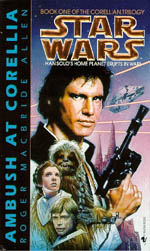
Ambush at Corellia - Roger Allen MacbrideYou would think that, after twenty years, Han Solo and Chewie could have finally gotten the kinks worked out of the Millennium Falcon. But apparently Star Wars tie-in novelists are just too damn enamored with cribbing their jokes from Empire Strikes Back. (Apparently without ever noticing that not only did the Falcon not have these problems before Empire Strikes Back, but that the ship had been fully repaired before Empire Strikes Back even came to an end.)

That is the beginning of this incredible train wreck.

Here’s the basic plot of the first novel of the trilogy, as I understand it: President Bush sets up an economic summit in Texas. When he arrives, he is completely surprised to discover that Texas has been in a depression for the past twenty years; Dallas is plagued by nightly race riots; independent militias are roaming the countryside at will; Austin, Corpus Christi, and Odessa have declared independence; and Laura has been kidnapped by an insurrectionist group. For some reason, despite the ready availability of telephones, the governor of Texas has not bothered, even once in the past twenty years, to pick up the phone, call the White House, and say: “Hey, we might have a problem down here.” The President’s response to this crisis? “Hey, I think we all need to play tourist while pretending that nothing is wrong.”

What? That plot doesn’t make the least bit of sense?

Yeah, that was kind of my impression, too.

Basically, there’s a consistent and pervasive lack of logical thought throughout the entire novel.

For example, on one page Allen will have one of his characters reflect on the fact that, if they were to jump into Corellian space outside of the regulated arrival zone, they would be instantly pounced on and possibly destroyed by the Corellian navy. Literally two pages later, Allen will have the exact same character make an uncontrolled, emergency jump into Corellian space, completely outside the regulated arrival zone and practically on top of the planet itself, and then conclude that she has certainly gone completely unnoticed.

Another example: The New Republic’s intelligence agency believes that something very bad is going on in Corellian space. They aren’t quite sure what it is, yet (because their agents keep getting killed), but they suspect it might be a threat to the New Republic itself. Leia Organa Solo, the New Republic ‘s Chief of State, is planning to go to Corellia with her family for a vacation with minimal, almost nonexistent security. Does the New Republic intelligence agency think it might be a good idea to tell Leia that going to Corellia might pose a dangerous security risk? Of course not. Instead, one lone agent alerts Han Solo that there’s serious trouble brewing. Does Han think it might be a good idea to alert Leia to the problem? Of course not.

Speaking of the keen minds of the New Republic ‘s intelligence agency, let’s talk about the latest operative they’re sending to Corellia: She knows that agents are being killed. She knows that there’s probably a security leak in her agency which is compromising the Corellian missions. Yet, despite this, after getting ambushed upon her arrival at Corellia (and I quote): “She had not spent any time at all wondering why the Corellians — or some group of Corellians — was so intent on killing NRI agents, or on how they knew her arrival plans.” I am literally left speechless at the stunning incompetence of such a statement. (But it’s actually a double-whammy, because only three pages earlier we watched her spend considerable time wondering exactly those things and heard about some of the contingency plans she’s taken based on her suspicions. So she’s not really incompetent, Allen just wants us to think so.)

The same agent is the clever girl who came up with the “warn Han Solo” plan: She wants him to poke around Corellia, causing a visible ruckus from his relatively safe position of diplomatic immunity in order to provide a distraction from her own, covert mission. Brilliant! What’s her mission? Well, apparently, to spy on the Solo family and keep them out of trouble. That’s right: She wants Han to get into trouble in order to distract people from her covert mission of keeping him out of trouble. Sigh.

And it’s not just the New Republic ‘s intelligence agency that’s suffering from mind-boggling brain damage. Han Solo is deeply concerned at the idea of safety inspectors taking a close look at the Millennium Falcon. Because the Falcon might fail to meet safety standards? No.  Because, for some reason, Han was supposed to have removed all the military-grade hardware and weaponry from the Falcon years ago, but “never got around to it” — so he’s worried that the safety inspectors might notice this stuff when they’re doing their inspection. Okay, two problems: First, Han, you may not have noticed this, but your wife is the New Republic ‘s Chief of State. Just have her sign-off on the Falcon not being modified and be done with it. Second, you remember those quad laser cannons? The big ones, with dedicated turrets on both the dorsal and ventral sides of the Falcon? Yeah. Those are still there. So anyone even casually walking past the Falcon should notice that it still seems to be overly-endowed with weaponry. (And don’t even get me started on the fact that not only does everyone apparently think Leia is departing on a long trip without any security forces, they think she’s departing on a long trip without any security forces in a completely unarmed ship. This is roughly equivalent to George W. Bush hopping into a Cessna and taking the wife and kids for a quick flight to Moscow.)

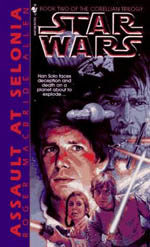
Assault at Selonia - Roger MacbrideBut, apparently, no one’s really that good at thinking things through: “Luke thought he knew Coruscant fairly well, but Lando led him through a labyrinth of passages and tunnels and lifts and moving walkways that Luke had never seen before.” City the size of a planet and Luke is surprised that there’s parts of it he’s never seen before. Right.

And here’s another blooper from Han. Remember how the NRI agent told him to stir up trouble on Corellia to provide a distraction from her own mission on Corellia? Well, when she predictably shows up on Corellia: “Somehow, Han was not at all surprised. She was just the sort of person who would pop up out of nowhere, light years from where he thought she was.” Uh… What? Light years? How big a planet do you think Corellia is, Han?

And while I don’t expect space operas with dogfighting spaceships to have the most rigid of scientific bases, I do expect a certain internal consistency and logical follow-through. For example, at one point during the story Allen unveils an interdiction field capable of covering an entire solar system. In the Star Wars universe, an interdiction field is essentially a huge, artificial gravity well designed to yank ships out of hyperspace.

I want you to stop and think (in precisely the way that Allen didn’t), about what would happen if you created a huge gravity well right in the middle of the solar system. In fact, to make things a little more interesting, imagine that you take a gravity well more massive than any planet and pop it down right inbetween the Earth and the Moon.

Other things that bug me without being completely illogical:

– Luke gives Leia a red lightsaber. I don’t even know where to start. (“Hey, sis, I’ve got a black helmet with a ventilator mask built right in! Wanna try it on? It’s very fetching!”)

– Lando the professional lothario didn’t feel right to me. (There’s a difference between being a lady’s man and hunting around for a big bank account to marry.) Luke agreeing to tag along as a chaperone was worse. The fact that their lady huntin’ took them, oh-so-coincidentally, straight to the Corellian sector just makes me roll my eyes.

– The New Republic apparently has no standing military. Given the massive, epic battles which have featured in every other Star Wars tie-in novel I’ve read, I’m at a complete loss in understanding why Allen would assert such a thing. I’m even more baffled that an editor at Bantam didn’t instantly red-line such an obvious gaffe.

– The art of carbon dating is unknown upon the world of Corellia.

– Giving Han an evil doppleganger (complete with goatee) is just… painful.

And just to make sure the pain lasts for as long as possible, the trilogy is badly padded in an obvious attempt to stretch a single novel worth of plot across three volumes. There are places where Allen literally takes a lengthy paragraph to describe something that should have only taken two sentences… and then proceeds to give you six different variants of that paragraph. The man literally takes fifteen pages to describe a crash landing, using a narrative technique lifted from Voltron and best explicated by this Sluggy Freelance comic.

In short, there are three things which happen during the crash landing: The pilot applies thrust. An object falls off the ship. The ship shakes violently. These are repeated, in nauseating detail and seemingly randomized order, until the ship finally crashes into the ocean.

And folks, here’s the scary part: That’s only the first volume.

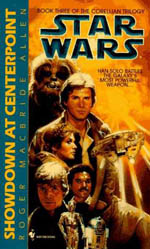
Showdown at Centerpoint - Roger MacbrideThe plot of the second novel, as far as I can tell, looks something like this: “Ms. Flowers, we understand that you once had a romantic relationship with Bill Clinton. We really, really need to use the United States Army. Could you go and ask Bill Clinton if we could use it for awhile?” For the full effect, you need to imagine that conversation taking place right now, in 2005.

Then the maddening exposition sets in again. Not only does Allen continue to inundate you with six paragraphs of repetitive exposition when a couple of sentences would do, but he begins repeating about ninety percent of the expository lumps from the first volume out of that bizarre and misguided belief that large swaths of people will be picking up a trilogy starting with book two.

So why did I keep reading? Well, partly because I’m clearly a glutton for punishment. But largely because the plot, no matter how ineptly handled, still managed to keep my curiousity piqued. In many ways the trilogy was a political thriller transplanted into the Star Wars universe, and the central mystery of the thriller was just intriguing enough to keep me turning the pages, even if I was reduced to skimming across Allen’s endless repetition.

You might find the same thing to be true: Having started, you may find yourself curious enough to endure the literary pain.

And that’s why you really shouldn’t start reading these books to begin with.

GRADE: D

AMBUSH AT CORELLIA: D-
ASSAULT AT SELONIA: D-
SHOWDOWN AT CENTERPOINT: D+

Roger Allen MacBride
Published: 1995
Publisher: Bantam Spectra
Cover Price: $6.99
ISBNs: 0-55-329803-8 / 0-55-329805-4 / 0-55-329806-2
Buy Now!

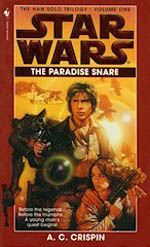
The Paradise Snare - A.C. CrispinVOLUME 1: THE PARADISE SNARE

It’s books like this which make reading tie-in fiction worthwhile. What makes this book really tick is Crispin’s ability to take the familiar character of Han Solo and vividly capture him on the page: Han Solo walks, talks, acts, and thinks like Han Solo, and Crispin uses that to tell a really solid character drama wrapped into your standard Star Wars sci-fi action fare.

Speaking of that sci-fi action fare, the other notable strength of The Paradise Snare is Crispin’s ability to craft a Star Wars story without cribbing all her material from the the films. This is actually a fairly difficult line to walk: On the one hand, you get the authors whose novels feel like modern SF novels with a thin veneer of Star Wars glossed over the top. Those just don’t have the right mixture of classic space opera and Saturday serial heroism. They don’t feel right. On the other hand, you’ve got the authors who simply take the themes and elements already present in the films, throw them into a blender, and pour out the result. Those feel right, but they don’t offer anything of particular interest.

Crispin, on the other hand, manages to craft a novel whose plot and theme are very distinct from those found in the films, but which still feels like a Star Wars story. That’s no small accomplishment and it kept my turning the pages compulsively from cover-to-cover.

I’d like to be able to say more, but that really sums it up: The Paradise Snare is a tightly written, very well-done novel that’s a lot of fun to read. Perhaps the highest praise I can pay it is that this a novel that I’m likely to come back and read again some day. As I put it aside, I was eagerly looking forward to the next two books in the trilogy…

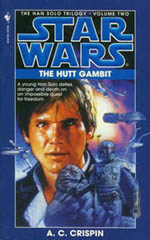
VOLUME 2: THE HUTT GAMBIT

The Hutt Gambit - A.C. CrispinUnfortunately, the promise of The Paradise Snare is not fulfilled by The Hutt Gambit.

This is a novel which doesn’t seem to have made the transition from outline to finished product. Far too many sequences are told instead of shown. For example, Han goes through several girlfriends in the course of the novel, but every single one of them follows the same course: We see Han ask them out, we get several paragraphs summarizing their months-long romance, and then we get another scene with them breaking up. The result is just words on a page — there’s no connection; no emotional resonance; no meaning.

I think Crispin is struggling with two problems here: First, the amount of time covered by the novel — at least three or four years, if not more. Such a timespan invites the author to summarize with broad strokes, and once they’re in the habit of doing that its easy for the telling-rather-than-showing to creep into the smaller sequences as well.

Second, she has a lot of previously-established continuity from the Expanded Universe to work into her stories. It’s continuity from over a dozen different stories from a half-dozen authors who were more interested in establishing their immediate dramatic needs than coming up with a coherent narrative.

As a result, there are some things which work very well. (For example, the history established between Han and Boba Fett provides some nice depth to the saga.) And there are some things that don’t. (For example, the first meeting between Han and Lando felt very flat to me.) And there are quite a few things that feel as if Crispin is going through the motions. (For example, establishing Solo’s history at Smuggler’s Run seemed very mechanical to me.)

On top of this fundamental problem, there are a lot of contributory flaws.

For example, I find the narrative itself to be poorly structured. There are numerous occasions where Crispin could have established crucial knowledge early in the book in order to lay a firm foundation for events later in the story. Instead, she opts time and time again to wait until the later events are actually playing out before dropping the crucial knowledge in as a lump of awkward, hamfisted exposition.

Crispin also gets repetitious: During one short section of the novel, for example, Han thanks another character for their help on about three or four different occasions, getting the same stock response every single time. If this happened just once, one would try to find meaning in Han’s excessive gratitude. But it happens again and again and again, until you begin to wonder whether or not Crispin even realizes that she’s already hit this narrative beat before.

The final battle sequence is solidly planned, but poorly executed. The problem is that there’s no twist or hidden back-up plan for our heroes to exploit at the last minute to snatch victory from almost certain defeat. Instead, the heroes spend more than a hundred pages minutely planning out every single detail of an ambush… and then the ambush works just the way they planned. It’s as if you were watching an episode of Mission Impossible where absolutely nothing went wrong with the plan. Or if the Rebel leaders at the end of the original Star Wars movie had spent fifteen minutes of screen time minutely planning out the final attack run exactly the way we see it happen: “Okay, and then Luke will take the lead. And he’ll turn off his targeting computers right here. And we’ll keep Han Solo in reserve just in case any TIE fighters put Luke in danger. And then Luke will take his shot and destroy the Death Star. Now, let’s go over that another half dozen times…” Oh, and Vader should be paid off AND ordered to let the Rebels win, just to remove any lingering suspense.

I also feel as if there’s some big, gaping plot holes lying around in the novel as well. Maybe I’m just missing some crucial piece of information from some other tie-in novel that would make the whole thing fit together, but the result is just deeply unsatisfying.

Perhaps the biggest problem with The Hutt Gambit, however, is that it doesn’t seem to have any coherence. It doesn’t feel like a story. It just feels like a bunch of stuff that happens, rambled off in a scrambled stream of consciousness.

In short, I found The Hutt Gambit to be a serious let-down after the extremely enjoyable Paradise Snare. Hoping for a recovery, I turned to the third volume in the trilogy, Rebel Dawn…

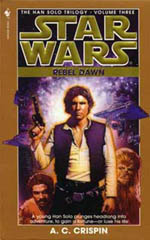
VOLUME 3: REBEL DAWN

Rebel Dawn - A.C. CrispinWhile Rebel Dawn represents an improvement over The Hutt Gambit, it still doesn’t live up to the promise of The Paradise Snare. Once again I feel as if Crispin’s hands were tied by the need to incorporate continuity from other novelists. There’s a lengthy section of Rebel Dawn which essentially consists of Crispin saying, “And then Han Solo went off to Star’s End and did a bunch of stuff which you can read about in HAN SOLO AT STAR’S END, available from Bantam Books…” Followed by, “And then Han Solo went off to some other adventures which you can read about in HAN SOLO’S REVENGE, also available from Bantam Books…”

I simply would have preferred to see a coherent narrative in THIS novel. And that could have been done without violating the continuity of the previous Han Solo novels.

And, although the book’s execution is better than The Hutt Gambit, Crispin still seems to be struggling with some of the most basic storytelling techniques. Let me give you a couple of examples of the type of stuff I’m talking about:

In desperation, Han sent the Falcon closer to the black hole clusters than any sane person would ever go. Only the ship’s breakneck speed might save them.

The Millennium Falcon skimmed so close to the black holes in the Maw that only her terrible velocity kept her from being captured and sucked in.

What’s with the repetition there? It’s like Crispin tried writing the same passage two diferent ways and then forgot to delete one of them.

Bria smiled excitedly. “Muuurgh and Mrrov!” […]

“Muuurgh!” Han shouted, so glad to see his friend that he ended up thumping the huge felinoid on the chest with his fists while his feet dangled. “How are you, buddy?”

“Han…” Muuurgh was nearly choked with emotion. “Han Solo… Muuurgh very happy see Han Solo again. Too long it has been!”

He obviously hasn’t been practicing his basic, Han thought, amused. […]

“Hey, Muuurgh! Mrrov! It’s great to see you both!”

After their greetings were over, Mrrov explained that there was a contingent of Togorians who’d had run-ins with Ylesia over the years who wanted to be part of the assault. “Six of our people were either enslaved or close to enslaved there, Han,” Mrrov said. “We wish to have a part in making sure that no other Togorians will ever again be trapped in that terrible place.”

Again you’ve got a little bit of weird repetition. (Bria and Han have already shouted out the names of Muuurgh and Mrrov. So who’s shouting out their names again in that unattributed line of dialogue? There’s nobody else in the scene.) And then you segue into one of Crispin’s puzzling tell-instead-of-show dialogues. Why slip into the distancing, amateurish technique of summarizing dialogue when you could have just as easily written:

“It is good to see you, both,” Mrrov said. “And we are not alone in wishing you well. There are six others here who were either enslaved or close to enslaved at Ylesia and who want to be part of your assault. We all wish to have a part in making sure that no other Togorians ever again be trapped in that terrible place.”

I dunno.

Of course, if this type of thing only cropped up once or twice in The Hutt Gambit and Rebel Dawn, that would be one thing. But these techniques, and other amateurish missteps like them, crop up again and again and again, constantly jerking you out the narrative.

The ending also fails to ring true for me. Not only does it seem incredibly rushed, but I also find it impossible to believe that two weeks before the beginning of Star Wars, Han Solo was actively helping the Rebellion. Nor do I find it believable that 24 hours before meeting Obi-Wan and Luke, Han Solo learns that [SPOILERS] happened to [SPOILER].

And speaking of being rushed, I’ll also say that I think a big problem with both The Hutt Gambit and Rebel Dawn is that Crispin simply tries to cram too much into each novel, and ends up shortchanging everything. For example, Crispin sets up a huge sabacc tournament at the beginning of Rebel Dawn for Han to win the Millennium Falcon at. (This also rings false to me for several reasons, but those are separate issues.) But then, after hyping it up, Crispin only spends about eight pages on it. It’s an anti-climactic waste.

When all is said and done, I give a big thumb’s up to The Paradise Snare. And, fortunately, it can stand on its own: So I recommend checking the first volume of this trilogy out and then giving the rest of it a pass.

GRADES:

THE PARADISE SNARE: B+
THE HUTT GAMBIT: C-
REBEL DAWN: C

A.C. Crispin
Published: 1997-1998
Publisher: Bantam Spectra
Cover Price: $6.99
ISBNs: 0-55-357415-9 / 0-55-357416-7 / 0-55-357417-5
Buy Now!

Archives

Recent Posts

Recent Comments

Copyright © The Alexandrian. All rights reserved.