The Alexandrian

Go to Part 1

Yesterday I talked about marks in 4th Edition, focusing particularly on how one particular mark — the war devil’s besieged foe ability — was dissociated and the problems that dissociation causes in terms of game design.

Today I’m going to talk about the dissociation of the marking mechanics in general. To understand the problem, let’s start by looking at the marked condition in 4th Edition:

MARKED: A particular creature has marked you. You can only be marked by 1 creature at a time. If another creature marks you, you lose the old mark and gain the new one. If you attack a creature other than the one marking you, you suffer a -2 penalty on your attack rolls.

The problem with this rule is that it forces an association between two mechanics where it wouldn’t otherwise exist.

Let’s look at three of the marks I listed yesterday: The warpriest’s challenge; the paladin’s divine challenge; and the fighter’s challenge.

The warpriest’s challenge allows them to take a free attack on the marked target if the marked target moves away or tries to attack somebody else. The fighter’s challenge causes the target to suffer a -2 penalty if they attack anyone other than the fighter. The paladin’s divine challenge is a magical compulsion that similarly causes the target to suffer a -2 penalty if they attack anyone other than the paladin and also deals damage if they do so.

Individually, all of these abilities can be explained: The warpriest issues a challenge and pays particular attention to one target. If the target doesn’t pay attention to the warpriest, the warpriest can take advantage of that and make a free attack.

The fighter uses his martial prowess to engage with someone, using his own attacks to distract them and interfere with their ability to attack other characters.

Paladin Motivation PosterThe paladin uses their connection with the divine to create a magical compulsion, forcing the target to either attack them or face the consequences.

The dissociation happens when these abilities start affecting each other. Take a simple sequence like this one:

  1. The fighter puts their mark on an opponent.
  2. The paladin puts their mark on the same opponent, causing the fighter’s mark to come to an end.

Imagine trying to explain what happened there to the characters involved. It’s impossible. There’s no reason why the paladin’s magical compulsion should prevent the fighter from using their martial skills to interfere with an enemy’s ability to attack their allies. It makes even less sense for the fighter’s martial skills to somehow dispel the magical compulsion. Yet this is what the marking mechanics say.

Why are the mechanics like this? Primarily game balance. Imagine two paladins coming up and both laying down a divine challenge on a single opponent. Now, no matter who this opponent attacks, they’ll be suffering at least 8 points of radiant damage each round. And if they attack anyone other than the paladins, they’ll be suffering 16 points of radiant damage each round.

Similarly, take the war devil’s besieged foe ability (granting their allies a +2 bonus to attacks against that opponent). Now, imagine an encounter with 6 war devils all dumping this mark on the same character. Suddenly all of the war devils have a +12 attack bonus against their chosen opponent.

This type of synergistic stacking is an issue and needs to be dealt with. In 3rd Edition, for example, the same ability wouldn’t stack with itself and bonuses or penalties of the same type wouldn’t stack with each other, either.

Another solution to this problem, however, would be to make it so that the ill-effects of a mark could be avoided as long as you targeted any of the characters currently marking you. Of course, this still leads to dissociation — if the paladin places a magical compulsion on me that requires me to attack the paladin, why does the fighter’s fancy footwork negate that?

Plus, the other reason the mechanics work like this is an effort to minimize complexity: There are apparently going to be lots and lots of marks in the game, and by limiting them so that only one mark can be in effect on a creature at a time you limit the amount of bookkeeping that needs to be done.

But all of this demonstrates that, at a fundamental level, 4th Edition is completely dissociated. The only way the PCs could possibly understand why their abilities interact with each other in this fashion is if they understand that they’re actually just characters in a roleplaying game suffering the consequences of the marking mechanic.

Breaking the fourth wall in Order of the Stick is pretty funny, but do we really need to turn D&D into a punchline?

Continued tomorrow…

Go to Part 1

Marking Mechanics

This is a cheap shot.

Let’s take a more complex example of the dissociated mechanics cropping up in 4th Edition: Marks.

The effect of placing a mark on another character depends on the mark you’re using, but here are a couple of examples:

Warpriest’s Challenge (16th level)
When you hit an enemy with an at-will melee attack, you can choose to mark that enemy for the rest of the encounter. The next time that enemy shifts or attacks a creature other than you, you can make an opportunity attack against that enemy. If you mark a new enemy with this feature, any previous marks you have made with this feature end.

* * *

Divine Challenge (Paladin Feature)
You boldly confront a nearby enemy, searing it with divine light if it ignores your challenge.

At-Will * Divine, Radiant
Minor Action Close burst 5
Target: One creature in burst
Effect: You mark the target. The target remains marked until you use this power against another target. If you mark other creatures using other powers, the target is still marked. A creature can be subject to only one mark at a time. A new mark supersedes a mark that was already in place. If the target makes an attack that doesn’t include you as a target, it takes a -2 penalty to attack rolls and takes 8 radiant damage. The target takes this damage only once per turn.
Special: Even though this ability is called a challenge, it doesn’t rely on the intelligence or language ability of the target. It’s a magical compulsion that affects the creature’s behavior, regardless of the creature’s nature. You can’t place a divine challenge on a creature that is already affected by your divine challenge.

* * *

Combat Challenge (Fighter Feature)
When you attack you may mark the enemy, giving a -2 to attack targets other than you.

* * *

Besieged Foe (minor; at-will)
Ranged sight; automatic hit; the target is marked, and allies of the war devil gain a +2 bonus to attack rolls made against the target until the encounter ends or the war devil marks a new target.

There are two levels on which these mechanics dissociate.

First, just like any other mechanic, the basic mark itself can be dissociated. Look at the war devil’s besieged foe ability, for example: The war devil marks the target and the war devil’s allies gain a +2 bonus to attack rolls made against the target.

Mechanically quite simple, but utterly dissociated from the game world. In point of fact, no explanation is given at all for what these mechanics represent in the game world.

Let’s return to our example of the fireball spell again: If you’re the DM and you want to describe what happens when a fireball spell goes off, you can easily give a description of what the character sees. A wizard casts the spell, a bead of fire shoots out of his fingertip, and then explodes into a ball of flame.

But if you’re talking about this besieged foe ability, what would the DM describe? What is the war devil actually doing when it marks an opponent? What happens that causes the war devil’s allies to gain the +2 bonus to attack rolls? Is it affecting the target or is it affecting the allies?

(The name of the ability, of course, gives you no guidance here at all. The use of the term “besieged” would imply that the target is being overwhelmed by multiple opponents… but there’s no such requirement in the actual ability. In fact, the war devil doesn’t have to be anywhere near the target and the bonuses apply even if there’s only one guy whacking on the target.)

EXPLAINING IT ALL AWAY

Of course the argument can be made that such explanations can be trivially made up: A ruby beam of light shoots out of the war devil’s head and strikes their target, afflicting them with a black blight. The war devil shouts horrific commands in demonic tongues to his allies, unnaturally spurring them into a frenzied bloodlust. The war devil utters a primeval curse.

These all sound pretty awesome, so what’s the problem? The problem is that every single one of these is a house rule. If it’s a ruby beam of light, can it be blocked by a pane of glass or a transparent wall of force? If it’s a shouted command, shouldn’t it be prevented by a silence spell? If it’s a curse, can it be affected by a remove curse spell?

And even if you manage to craft an explanation which doesn’t run afoul of mechanical questions like these, there are still logical questions to be answered in the game world. For example, is it an ability that the war devil can use without the target becoming aware of them? If the target does become aware of them, can they pinpoint the war devil’s location based on its use of the ability? Do the war devil’s allies need to be aware of the war devil in order to gain the bonus?

If the mechanic wasn’t fundamentally dissociated — if there was an explanation of what the mechanic was actually modeling in the game world — the answers to these questions would be immediately apparent. And if you’re slapping on fluff text in order to answer these questions, the answers will be different depending on the fluff text you apply — and that makes the fluff text a house rule.

(Why would you want to answer these types of questions? Well, some trivial possibilities would include: The war devil has used magic to disguise himself as an ally of the PCs. The war devil is invisible. The war devil is hiding in the supernatural shadows behind the Throne of Doom and doesn’t want to reveal himself… yet.)

THE PROBLEM WITH HOUSE RULES

So now we’ve established that any attempt to provide an explanation for this mechanic constitutes a house rule: Whatever explanation you come up with will have a meaningful impact on how the ability is used in the game. Why is this a problem?

First, there’s a matter of principle. Once we’ve accepted that you need to immediately house rule the war devil in order to use the war devil, we’ve accepted that the game designers gave us busted rules that need to be fixed before they can be used. The Rule 0 Fallacy (“this rule isn’t broken because I can fix it”) is a poor defense for any game.

But there’s also a practical problem: Yes, fixing the war devil’s besieged foe ability is relatively easy. But these types of dissociated abilities have been scattered liberally through the 4th Edition promo material we’ve seen. We can safely assume that they’ll be similarly found throughout the core rulebooks. This means that there will be hundreds of them. As supplements come out, there will probably be thousands of them.

And every single one of them will need to be house ruled before you can use them.

Now you’ve got hundreds (or thousands) of house rules to create, keep track of, and use consistently. Even if this is trivial for any one of them, it becomes a huge problem in bulk.

These massive house rules also create a disjunction in the game. One of the things that was identified as problematic in the waning days of AD&D was that the vast majority of people playing the game had heavily house ruled the game in various ways. That meant that when you switched from one AD&D group to a different AD&D group, you could often end up playing what was essentially a completely different game.

In the case of AD&D, this widespread house ruling was the result of disaffection with a fundamentally weak and inconsistent game system. House ruling, of course, didn’t disappear with the release of 3rd Edition — but the amount of house ruling, in general, was significantly decreased and the consistency of experience from one game table to the next was improved.

But now we have a 4th Edition which, due to its dissociated design principles, requires you to create hundreds (or thousands) of house rules. And, of course, as soon as you switch game tables all of those house rules will change.

ACCEPTING YOUR FATE

Of course, you can sidestep all these issues with house rules if you just embrace the design ethos of 4th Edition: There is no explanation for the besieged foe ability. It is a mechanical manipulation with no corresponding reality in the game world whatsoever.

At that point, however, you’re no longer playing a roleplaying game. When the characters’ relationship to the game world is stripped away, they are no longer roles to be played. They have become nothing more than mechanical artifacts that are manipulated with other mechanical artifacts.

ChessYou might have a very good improv session that is vaguely based on the dissociated mechanics that you’re using, but there has been a fundamental disconnect between the game and the world — and when that happens, it stop being a roleplaying game. You could just as easily be playing a game of Chess while improvising a vaguely related story about a royal coup starring your character named Rook.

In short, you can simply accept that 4th Edition is being designed primarily as a tactical miniatures game. And if it happens to still end up looking vaguely like a roleplaying game, that’s entirely accidental.

Continued tomorrow…

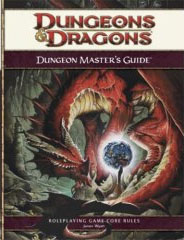
Dungeon Master's Guide - 4th EditionSo the 4th Edition of Dungeons & Dragons is coming down the pike and people have recently been asking me what I think about it.

Well, I’ve written up some of my thoughts in the past. Those thoughts are largely unchanged: The design team at Wizards of the Coast has decided to design a really amazing tactical miniatures game. (Their motivation for doing so probably has more than a little to do with the reports that the D&D Miniatures game is the most profitable part of the D&D brand.) In order to design that game, however, they have apparently decided that:

(1) They are going to fundamentally alter the gameplay of D&D. (The short version: Yes, the game has changed considerably over the years. But playing a basic fighter in 3rd Edition was still basically the same thing as playing a fighter in 2nd Edition or a fighter in 1st Edition or a fighter in BECMI. Playing a wizard in 3rd Edition was still basically the same thing as playing a wizard in previous editions. And so forth.)

(2) It’s not particularly necessary for them to actually make a roleplaying game. (Don’t believe me? Go ahead and read my previous post on this. WotC’s designers are on public record saying the only thing that matters in the game is what happens during combat.)

One of the most pernicious results of this design philosophy, in my opinion, is the prevalence of dissociated mechanics in 4th Edition.

When I talk about “dissociated mechanics”, I’m talking about mechanics which have no association with the game world. These are mechanics for which the characters have no functional explanations.

Now, of course, all game mechanics are — to varying degrees — abstracted and metagamed. For example, the destructive power of a fireball spell is defined by the number of d6’s you roll for damage; and the number of d6’s you roll is determined by the caster level of the wizard casting the spell.

If you asked a character about d6’s of damage or caster levels, they’d have no idea what you’re talking about. But they could tell you what a fireball is and they could tell you that casters of greater skill can create more intense flames during the casting of the spell.

So a fireball spell has a direct association to the game world. What does a dissociated mechanic look like?

A SIMPLE EXAMPLE

No Robin Hoods AllowedHere’s a sample power taken from one of the pregen characters used in the Keep on the Shadowfell preview adventure:

Trick Strike (Rogue Attack 1)

Through a series of feints and lures, you maneuver your foe right where you want him.

Daily – Martial, Weapon
Standard Action Melee or Ranged weapon
Target: One creature
Attack: +8 vs. AC
Hit: 3d4 + 4 damage, and you can slide the target 1 square
Effect: Until the end of the encounter, each time you hit the target you can slide it 1 square

At first glance, this looks pretty innocuous: The rogue, through martial prowess, can force others to move where he wants them to move. Imagine Robin Hood shooting an arrow and causing someone to jump backwards; or a furious swashbuckling duel with a clever swordsman shifting the ground on which they fight. It’s right there in the fluff text description: Through a series of feints and lures, you maneuver your foe right where you want him.

The problem  is that this is a Daily power — which means it can only be used once per day by the rogue.

Huh? Why is Robin Hood losing his skill with the bow after using his skill with the bow? Since when did a swashbuckler have a limited number of feints that they can perform in a day?

There’s a fundamental disconnect between what the mechanics are supposed to be modeling (the rogue’s skill with a blade or a bow) and what the mechanics are actually doing.

If you’re watching a football game, for example, and a player makes an amazing one-handed catch, you don’t think to yourself: “Wow, they won’t be able to do that again until tomorrow!”

And yet that’s exactly the type of thing these mechanics are modeling. Unlike a fireball, I can’t hold any kind of intelligible conversation with the rogue about his trick strike ability:

Me: So what is this thing you’re doing?
Rogue: I’m performing a series of feints and lures, allowing me to maneuver my foe right where I want him.
Me: Nifty. So why can you only do that once per day?
Rogue: … I have no idea.

Continued tomorrow…


Go, Speed Racer, Go!

May 14th, 2008

Speed Racer

By the time I was able to get to the theater last night and see Speed Racer last night I was already aware that the critics’ reviews were terrible and the box office had tanked.

I dunno what the hell is going on here, but Speed Racer is incredible. There was a guy behind me who literally spent the last 10 minutes of the film muttering, “This is awesome. This is just… awesome. It’s awesome…” And I didn’t mind because, frankly, I was thinking the same thing.

The guy next to me got up when the film was over and said, “That was beautiful. That was god damn beautiful.”

And he was right, too.

The film is a visual feast. The plot is clever without being convoluted. The performances are beautifully stylized, yet capture astonishing truthfulness from the characters. The film has that rare ability to be emotionally moving and completely thrilling at the same time. Humor is strewn around liberally like a party favor.

But, ultimately, if I had to choose a single word to describe the film, that word would be: Delightful.

Speed Racer is delightful.

I left the theater with a grin literally plastered across my face. The film made me happy. It filled me with joy.

And I’m not alone: Yeah, the critics ripped it apart. But audiences are loving it. Metacritic and Rottentomatoes are both showing a 45+ point skew between audience opinion and critics opinion. Moviefone is reporting 4 out of 5 stars from moviegoers. Other sites are reporting ratings of B+ or A-. There does seem to be a certain atmosphere of love-it or hate-it going on, but so far those who love it are outnumbering those who hate it.

So if you’ve been turned off by the critics — or if you’re just looking for a film made of joy and awesome — then you owe it to yourself to catch a showing of Speed Racer.

The Hollow - Agatha Christie - Starting Gate ProductionsAs I write this, I’ve just finished the opening weekend of The Hollow: Three performances down, ten to go.

For those of you unfamiliar with theater, the week before opening is typically known as tech week: This is when the technical elements of the show — the lights, the music, the sound effects, and so forth — are added. Obviously, this can also become an incredibly stressful time.

Fortunately, this was one of the good tech weeks: Everything was well-organized and ran smoothly.

Particularly fortunate, in fact, because I was rapidly falling apart at the seams.

On Tuesday I went to bed with a slight tickle at the back of my throat. When I woke up on Wednesday, this had become a painful sore throat. I immediately began treating it with cough syrup and spent the day in bed, but by the time I went in to rehearsal that night my muscles were aching and any hope that this was just going to be a 24 hour bug were rapidly fading.

By the time rehearsal ended on Wednesday, my voice was beginning to show signs of strain. This was bad news: An actor without his voice is just a mime. And nobody likes mimes.

But when Thursday dawned I was pretty hopeful: I was still sick, but I felt much better than I had the day before and my voice felt fine. Opening night was on Friday, so if I showed as much improvement over I’d be feeling close to 100%.

Thursday evening, however, became catastrophic. When I left home to go to rehearsal I was fine. By the time I got to rehearsal 20 minutes later, my voice was almost completely gone — the only thing I had left was a sickly croak.

Now people were beginning to get worried looks on their faces whenever they heard me say anything. But I was still hopeful: Even if my voice had decided to take a vacation, I was still feeling much better. I had my fingers crossed that this was just the tail end of the illness and that I would wake up on the morrow completely rejuvenated.

… no such luck. When I woke up on Friday, my voice was only slightly improved. I spent the day dousing it with every medicine and home remedy I could think of, but by the time I was called for the show things were still not looking good. I had managed to resuscitate my voice, but it was pretty clear that it could collapse at any time.

And the real problem was the huge span of time in the middle of Act 2 when I don’t leave the stage: I’m the Inspector in an Agatha Christie mystery. I’m the main character. I stay on stage and continue asking questions as other people cycle on and off the stage. All I do is talk. If my voice decides to become frog-like, not only am I screwed — the entire production is screwed.

And, being opening night, the reviewers are of course in the house. So if things go down the drain, not only have I screwed up this performance — I’ve potentially screwed us for the entire run of the show.

No pressure or anything, though!

By mid-afternoon I was hatching emergency plans: There was a drinks table onstage as part of the show. I contacted the stage manager and asked her to make sure there was extra water on the table so that I could improvise crossing to the drinks table and pouring myself a drink if I needed it.

Next up, I packed myself a voice-saving kit: I had cough drops. Bottled water. Cough syrup. Vitamin-C doses. I also pulled out a bottle of brandy and asked my girlfriend to pick me up a bottle of honey.

But I was absolutely terrified: There was simply no guarantee that any of this was going to work.

I arrived at the theater, checked in with Lydia, my wonderful stage manager. Touched base with the other actors who might be thrown or need to make minor adjustments to their own blocking to accommodate my crosses to the drinks table (although I had taken the trouble to identify specific moments when I could do this with minimal disruption). The rest of the cast — bless them — rallied around me with many good wishes (although I could still see the worry behind their eyes).

The thing that made the final difference, I think, is the warm brandy and honey. This is not healthy for your voice in the long-run, but in the short-term it will completely blast open your sinuses; warm your throat; and loosen your vocal cords. I dosed myself with a fresh shot before every entrance, and then — during my long sequence of scenes — I made two pit-stops by the drinks table to pick up a glass of water (and two more stops later in the play).

As plans go, this was not ideal. Opening night is not a good time to be losing your voice and improvising your lines while drunk.

But it worked.

There were a couple of times when I felt my voice right on the verge of breaking, but it never did. The next night I was able to pull it back to a single shot of brandy-and-honey and a single visit to the drinks table. On Sunday I brought the brandy just in case, but was able to skip it and make it through the show with just a single visit to the drinks table.

People who saw the show said they loved it, and those who didn’t know about the catastrophe that was always one strained vocal cord away from sweeping us all away were shocked to hear me croaking in the lobby after the show.

And it was only after it was all done that I realized how desperately terrified I had been.

Fridays – Saturdays at 7:30pm
Sunday Matinees at 2:00pm
Pay What You Can Night – Monday, May 19th, 2008 at 7:30pm
Audio Described Performance – Sunday, May 18th at 2:00pm

Archives

Recent Posts

Recent Comments

Copyright © The Alexandrian. All rights reserved.