
 Originally Published March 24th, 2004
REVIEWING THE NOVELS
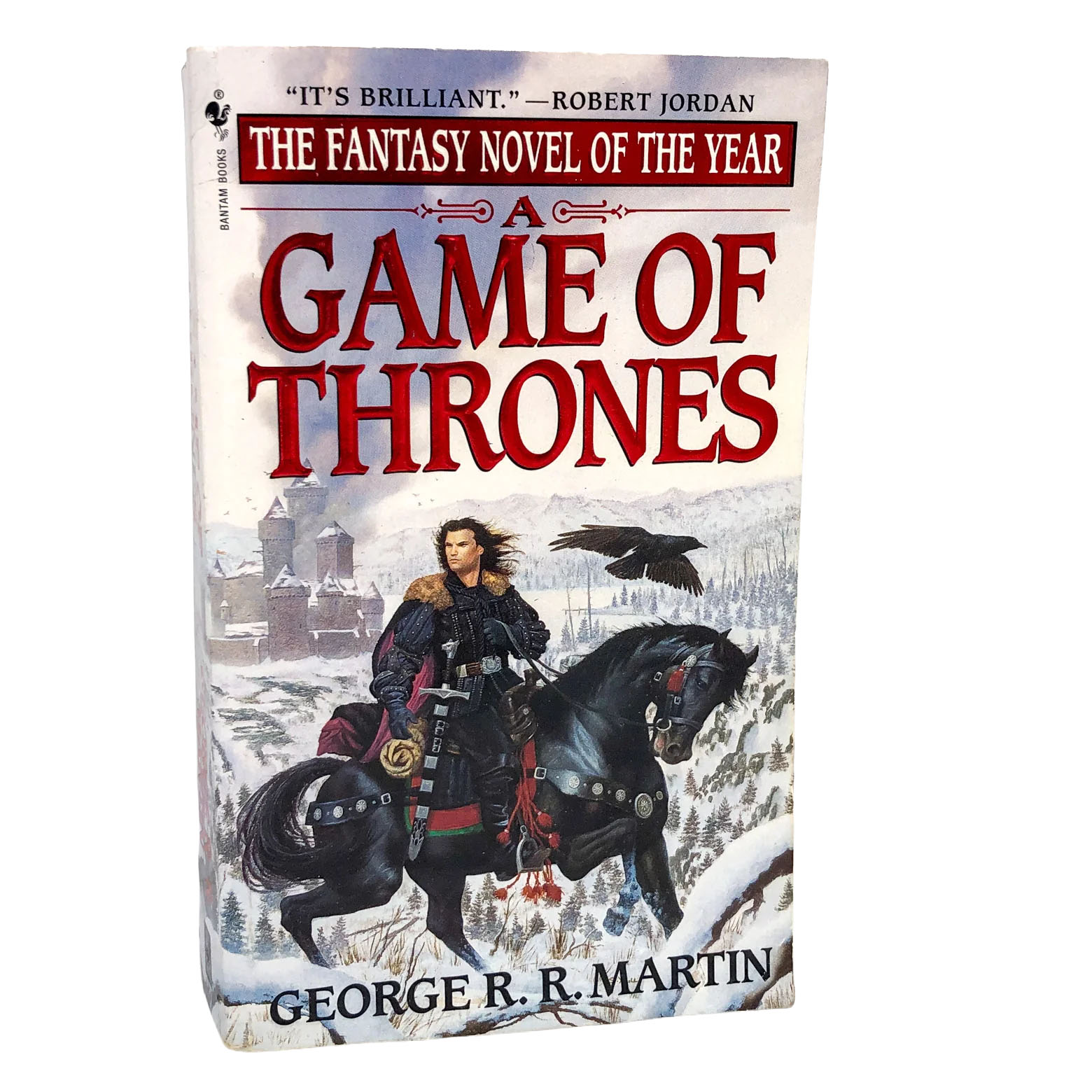
I think a very strong argument can be made that George R.R. Martin’s A Song of Ice and Fire is the finest work of epic fantasy since J.R.R. Tolkien first defined the genre with The Lord of the Rings.
And that’s pretty much the only comparison which can be made between Martin’s emerging masterpiece and Tolkien’s classic.
Where Tolkien is a romantic, Martin is a realist. Where Tolkien is evocatively poetic, Martin is powerfully blunt. Where Tolkien is mythic, Martin is historical.
This review covers the first three books in the series: A Game of Thrones, A Clash of Kings, and A Storm of Swords. The fourth book, titled A Feast of Crows, is scheduled to come out later this year. (Of course, it was also scheduled to come out last year. So don’t hold your breath.) The series is not done, and so it would be premature to judge it as a whole. But I will say this: If Martin finishes as he has begun, he will have crafted the first work to truly redefine what epic fantasy is capable of since Frodo passed out of Middle Earth.
(I’ve also heard this series described as “a fantasy version of the Wars of the Rose.” Having read the books, I feel compelled to report that this is only true in the vaguest of all possible senses. It would be roughly equivalent to saying that The Lord of the Rings is “a fantasy version of The Sting”.)
Here’s what I like:
First, the series is simply not predictable. Based on a long experience with extruded fantasy products, you may think you know where the plot is going from page one… but you don’t. (No, really. You don’t.) And the effect never ends: As you read on, you’ll be wrong in your guesses more often than not. And Martin isn’t so foolish as to have nothing turn out the way you would expect: Just enough threads carry themselves out in a traditional fashion that you cannot even rest assured in the unexpected.
Second, the depth and breadth of worldbuilding is staggering. Martin’s Westeros is no pale copy of Middle Earth with the names scratched off and written over. Nor is it a poorly disguised historical analogue. Nor a paper-thin construction whose scope is wholly spent with the first revelation. No, with Westeros Martin has made an onion: And with each chapter and volume he peels back a new layer.
Third, injuries have meaningful, long-lasting effects. Scars linger, old wounds ache, and even bruises make their presence felt. And when people die, the death is tangible and real, with the least trace of romanticism. (The only seeming exception here are missing teeth: Martin seems to have a fetish for knocking teeth out of his characters during fights, yet the lack never seems to be commented upon again. Perhaps there is a magical orthodontist running around backstage.)
Fourth, Martin does a very good job of putting you inside the heads of many different characters, each of whom has a unique outlook on the world.
Finally, these are just damn fine books. If you’ve been thinking to yourself, “I’d like to read a really good book,” then this is what you’re looking for.
There are two minor complaints I would lay against the series as a whole:
First, the timeline is a little vague and seems to be very flexible. Travel times, in particular, seem to elongate for effect when necessary, throwing off the relationship between various plot streams.
Second, Martin falls into the trap of recapping information and plot from previous volumes in each new volume. I’m not sure why authors of series like this feel a need to do this. The recaps would seem to suggest that each book could be read independently. But they can’t and they won’t, so why pretend? It’s only frustrating to those of us who start with the first book and read from there. In other words, it’s frustrating to all of us.
To elaborate on these general thoughts a little more:
The first two volumes are of a piece in my mind: The first is a crafty mystery and the second is a powerful war story, both set against a backdrop of byzantine intrigue and feudal politics. Both are excellent and nearly flawless.
The third volume, on the other hand, seems to tail off a bit. It’s not an exceptional decline by any stretch of the imagination – indeed, if this book were not preceded by the other two, it would be barely mentionable. But weaknesses do begin to appear here which were not previously present in the series: Crudity which was once an effective evocation of Martin’s world begins slipping into simple shock value and occasional titillation. The violence and pain suffered by his characters becomes arbitrary, rather than arising naturally from their circumstances. A weird running “joke” appears. A mandatory rule of “a character must piss their pants once every fifteen pages” is instituted. (I wish I was kidding.) Several characters become mired at the beginning of the book and their plot threads begin to drag. An increasing proportion of the action begins slipping into flashbacks, being told instead of shown. Chapters begin ending with false, melodramatic cliffhangers.
Just strange, little stuff. Nothing major. Nothing which cripples the work. But enough minor irritants to consistently distract (particularly during the first third of the book).
On the other hand, the third volume also takes all of the strengths of the series and deepens them: The world becomes richer. The characters become more compelling. The plot grips you even tighter than before.
And here’s the most important thing to understand:
This is a brilliant series. Brilliant and painful and beautiful and stunning. Literally stunning. There are points in reading it when I found my mouth hanging agape, in sheer shock.
If you have not yet found this series, find it now. If you have been avoiding it skeptically as yet another poorly done set of fantasy doorstops, stop cheating yourself. If it is already on your reading list, move it to the top.
In short: Read it. Read it now.
IN THE GAME
Martin’s Westeros is a richly developed world, although – at the moment – there are a lot of places where the innate mystery of the setting will require you to read between the lines to get the depth necessary for a true campaign. That being said, there are several campaigns I could easily see being played in Westeros. For example:
1. The PCs are members of the Night’s Watch. Whether they’re dealing with Wildlings, ancient ruins beyond the Wall, or the Others there are endless possibilities.
2. The PCs take the roles of noble heirs during the last civil war. Instead of Robert, Ned, Jaime, and the others of that generation, it is the PCs who must deal with the final madness of the Targaryens.
Additional resources to consider: Dragon Magazine #307 contained several articles aimed at gaming in Westeros. The Westeros website has a lot of material to chew on – including heraldry, a concordance of world information, and a variety of correspondence from Martin himself.
I also understand that Guardians of Order will be releasing A Song of Ice and Fire roleplaying game some time this year. (Although that release date has already been shoved back from last year. Looks like they’re truly following in the footsteps of the author…)
Style: 5
Subtance: 5
Grade: A+
“If Martin finishes…”
Ah. Well. There’s the rub, isn’t it?
Much has passed since I wrote this review in 2004. The Guardians of Order RPG I mentioned rose and fell, taking the company with it. Another was published by Green Ronin, only to also come to an end. There have been three television series. Spin-offs and graphic novels and even a stage play.
But, of course, the series itself remains infamously incomplete.
For myself, having started both the Wheel of Time and A Song of Ice and Fire in 1995/96, it was right around the time I wrote this review that I was resolving to never again start reading an ongoing fantasy epic that had not yet been finished. Although this resolution has been, upon occasion, broken by accident (when I started a book not realizing it was an unfinished story), it has meant, for example, dodging the heartbreak of Patrick Rothfuss. I was delighted, a decade later, to be able to come back to Wheel of Time and finish it. I sincerely hope to be able to do so some day with A Song of Ice and Fire, although, sadly, I doubt that this will happen.
Do I still rank it as the “finest work of finest work of epic fantasy since The Lord of the Rings“? Truth be told, I am not as well read in epic fantasy as I once was. I keep various rankings in my personal logs, however, and A Song of Ice and Fire still ranks quite high, although it also still bears the tag “preliminarily” that I’d first placed on it back in 2003. Either way, it may have been edged out by Steven Erikson’s Malazan Empire. Or perhaps Matt Dinniman’s Dungeon Crawler Carl, if that counts as epic fantasy.
This was my final review for RPGNet. It was, as you can see, an experiment in reviewing literature with a slant towards how it could be brought to the gaming table. For better or worse, it didn’t really work. I pitched a similar concept (adapting works from other mediums to RPGs) as a column to a few different places, but it was difficult to chart a clear path through copyright law and licensing, so I was never able to quite make it work.
For an explanation of where these reviews came from and why you can no longer find them at RPGNet, click here.











I still maintain that reading Rothfuss’s books and being sad about not having an ending is still much better than never reading them at all. When I read A Song of Ice and Fire, I was always thinking “this story is pretty great, but it’s such a shame it doesn’t get close to the level of Rothfuss.”
I’ll submit that GRRM is actually a romantic, actually, not a realist. He’s simply someone who thinks the most beautiful romantic good deed is one done in the midst of evil, winning no reward, taken by pure motives by someone who is never believed to be capable of it and will never receive any recognition for it.
(E.g. Jaime keeping his oath to Catelyn, Tyrion’s defense of King’s Landing, Theon’s mad rescue, Ned’s long lie, Balor Breakspear’s last tourney, everything to do with the Hound…)
When I first starting reading the series, the third book had just come out. By the end of that book, and my wife will say she remembers the scene exactly as I do, but I slammed the book shut and threw it across the room, against the wall, and I said I’d never read GRRM again. (And I haven’t…though I did watch the series.)
What I did not (and still do not) appreciate was something you mention about GRRM – how “he will have crafted the first work to truly redefine what epic fantasy is capable of since Frodo passed out of Middle Earth.”
And I agree with you! It seems like much of the recent (I say recent, but going back a few decades now) of fantasy likes to get all “edgy and real” like GRRM and I honestly hate it. First, sometimes it’s true (like in the Battle of Agincourt, but the death of all that nobility had more to do with Henry’s worry about a counter attack and being on foreign soil than was the typical pattern) but all that armor made nobles hard to kill, and they were worth far more alive than dead for ransom.
But, secondly, and for me (and I know many people disagree) but high fantasy is…escapism. It’s kind of the point. The good guy winning, the bad guy losing. Heroes journey and all that.
So, no if you want traditional high fantasy, look elsewhere. If you want “everyone’s a shade of gray and frankly, you don’t even know who the protagonist is from the antagonists” then you’ll find that in spaces in GRRM’s work.
One final note – by the time I slammed that book against the wall, I’d far since lost any thought of sympathizing with any character in the book, except for a few of the Stark kids. Even if you like them, you’re wondering when the author is just going to send them to the chopping block as well, so, it’s hard to gin up that feeling you’d have in other, typical, works of fantasy.
GRRM IS a fantastic writer and agree that his worldbuilding is top notch. But, I still think Wheel of Time is a far better series, with just as many side plots and twists (though it too drags a bit at times) and as much and BETTER world building than GRRM delivers. (For example, GRRMs “magic system” (scare quotes intended) doesn’t really exist. It seems to just be available when his plot needs something weird to happen.) Whereas WoT’s, for comparison, goes back thousands of years and is detailed and exciting.
Loved your review, though I disagree (and I know I am not in the majority) of whatever may be the long-term result of GRRM’s series. Of course, if he never finishes it, it may well end up in the dustbin of history.
“First, the timeline is a little vague and seems to be very flexible. Travel times, in particular, seem to elongate for effect when necessary, throwing off the relationship between various plot streams.”
I find it funny that this particular criticism is much easier to spot in the visual medium of television. Good eye for catching it in print!
@Jake
“But, secondly, and for me (and I know many people disagree) but high fantasy is…escapism. It’s kind of the point. The good guy winning, the bad guy losing. Heroes journey and all that.”
But ASoIaF is specifically not high fantasy. It’s low fantasy, which also helps to explain the randomness of the magic in the story.
I have other issues with the series but I think these critcisms are more genre mismatch than actual negatives.