The Alexandrian

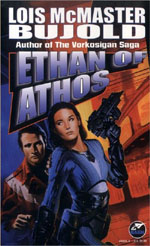
The Vor Game - Lois McMaster BujoldThe Vor Game is, almost certainly, the worst of Bujold’s Vorkosigan novels.

Last week I wrote that Memory combined all of Bujold’s strengths without any of her flaws. The Vor Game is almost an inversion of this: It combines her worst flaws as an early writer with very few of her strengths. The powerful themes of her others works are missing. The plot is driven by one implausible chance encounter and improbability after another. Even the little touches and subtle nuances seem absent once you are past the first fifty pages. The one strength which may still be cited are the characters – but even they are somewhat lamed as the absurdity of the plot grows.

In many ways, this is actually a book of two parts: The first part is an effective novella (which, unfortunately, lacks an ending). The second part is a disastrous outing compared to the standard Bujold has set for herself, primarily as a result of the SOD-breaking coincidences which drive the plot.

When you read this book, try counting the number of times the plot is advanced because Miles has a chance encounter with someone. In some cases these are merely as improbable as running into someone by chance in New York City. In other cases it’s as improbable as running into someone in Beijing who you just saw two weeks ago in Los Angeles.

If it happened once, it wouldn’t be a problem. Heck, Bujold might even be able to pull it off two or even three times if she were careful.

Instead, she does it more than a dozen times. The entire plot is driven along this single-minded authorial fiat.

Okay. So there are some significant problems here. There are also good points: If you can swallow your disbelief repeatedly, the plot is a rip-roaring ride. Watching Miles at his most hyperactively desperate is as much fun as it usually is, and the supporting cast can be truly delightful.

When all is said and done, this is still a good book. It’s a frustrating and disappointing book compared to Bujold’s other works, and its utterly baffling that such a poorly-constructed novel could win the Hugo. But that doesn’t change the fact that this is still a fun little read, as long as you don’t come to it with artificially heightened expectations.

GRADE: B-

Lois McMaster Bujold
Published: 1990
Publisher: Baen Books
Cover Price: $15.00
ISBN: 0-671-87782-8
Buy Now!

Warrior's Apprentice - Lois McMaster BujoldI made the mistake of re-reading Bujold’s Memory last week. I say “mistake” because reading Bujold is, above all, an addictive pleasure. I have thus been consuming her books at a rate of 1 or 2 per day ever since.

I’m reviewing The Warrior’s Apprentice and Cetaganda together here because, in many ways, they are very similar works. They are also, perhaps, the books I see most consistently cited as the “worst” or “weakest” examples of the Vorkosigan series. This is not a reputation they deserve. Even The Warrior’s Apprentice — which may, in fact, rank last on the list of stories starring Miles — is ill-served by a description of “weak”. It is, rather, a good novel which has the relative misfortune of being written by a woman who has gone on to write great novels.

THE WARRIOR’S APPRENTICE

This is only the second time I’ve read The Warrior’s Apprentice. It was the second Bujold book I ever read, taking up the second half of the Test of Honor omnibus (which also collected Bujold’s first novel, Shards of Honor).

In my memory, The Warrior’s Apprentice didn’t particularly distinguish itself. I was left with the vague impression of a light adventure story, without the depth of character or theme which I came to recognize in Bujold’s later work. An addictive reading experience, yes, but not a lasting one.

My memory has been playing tricks on me.

Sure, at first glance this is nothing more than a light adventure story: Boy seeks adventure among the stars. And, to be sure, Bujold embraces the plot with fast-paced prose and character, carrying you along with stylish verve on a thrilling rollercoaster ride.

But, as the novel progresses, you begin to gain the sense that there’s more at work here: Why, for example, does Bujold choose to touch so lightly on some of the adventure elements in her plot? Why do none of the characters develop the way you would expect them to in an adventure story?

Because Bujold isn’t telling a light adventure story. She’s telling a coming of age story, and the light adventure is just a trapping. What’s really clever is that it isn’t just a random trapping selected to spice things up: It’s a light adventure trapping because that’s what Miles goes looking for. (What Miles finds, of course, is something quite different.) Throughout the novel there is a running joke about the difference between the way things work in holovids and the way things work in reality. It’s charmingly witty throughout and has a wickedly amusing pay-off towards the end, but I also see it as a commentary on the novel at a much deeper level: There’s a way things work in a light adventure story, and its quite different from the way things work (and why they work) in this story.

And, like so many of Bujold’s works, the story of Miles is only the beginning of what the novel has to offer: Take a look at how his coming of age is eloquently mirrored in Elena’s. (And it is mirrored, not duplicated, you’ll note.) And once I realized that it was also a story of redemption, whole new layers of the narrative opened up for me.

Which isn’t to say that The Warrior’s Apprentice doesn’t have its problems. The construction of the plot is not as smoothly or as brilliantly handled as a later Bujold might have done. There are notable occasions of authorial fiat and startling coincidence (although they’re generally well-covered). The ending, in particular, is very weak: Its pacing is rushed and the earlier scenes which established its basis were clumsily included.

Young Miles - Lois McMaster BujoldSo I’m left looking back on my memory and trying to figure out why it betrayed me: Sleep deprivation might have something to do with it. After finishing Shards of Honor around 3 A.M. or so I just kept reading straight through The Warrior’s Apprentice, which probably degraded the reading experience (no matter how much Bujold demanded my continued attention). I think I can also blame it, in part, on the fact that – after Shards of Honor – I was expecting a sequel starring Cordelia, not one starring her son twenty years later. And the weak ending probably didn’t help to give the book a strong, lasting impression, either.

Or maybe, with more Bujold experience, I just know what to look for now. Books like Memory made it plain that Bujold offered hidden depths, and so now – coming back to The Warrior’s Apprentice – I am more apt to see that which was there all along, instead of reading it “merely” as a light adventure and overlooking the nuances of its true quality.

I also think a greater exposure to the stories of the Vorkosigan cycle as a whole help to soften the sharp edges of the novel’s flaws. For example, the redemption of the future Dendarii has a deeper resonance when you recognize their future selves. The ending, too, works better now that I have a prior understanding of, for example, the relationship between Miles and Gregor, whereas – when I first read the novel – the revelation of their prior relationship was dumped on me only at the very moment that it was required.

Another thing: I’m struck, once again, by the fact that Bujold’s books function so differently depending on the order in which you read them. There’s a lot of material in The Warrior’s Apprentice, for example, which alludes to events in Shards of Honor. When I first read it, I was intimately familiar with those events (having just finished Shards of Honor) – and the book read one way as a result of that. Coming back to The Warrior’s Apprentice, its been several years since I read Shards of Honor and The Warrior’s Apprentice reads very differently as a result.

And it works both ways. It even works (in yet a third way) if you’ve read Barrayar before reading The Warrior’s Apprentice, even though Barrayar had not yet been finished or published when The Warrior’s Apprentice first appeared. That’s an astonishing accomplishment. And is a depth which, undoubtedly, makes re-reading Bujold such a uniquely enjoyable and enriching experience.

CETAGANDA

Cetagana - Lois McMaster BujoldCetaganda suffered a horrible fate: It was a published after Mirror Dance and before Memory.

If you’ve never read the books, you’ll have no idea why that’s important. Suffice it to say, however, that Mirror Dance and Memory are one type of book… and Cetaganda is a very different kind of book. As a result of its place in publication order, however, Cetaganda is repeatedly contrasted against its two closest siblings: The result is like comparing an apple to oranges, and Cetaganda seems to lose out every time.

Like The Warrior’s Apprentice, Cetaganda is a light adventure story. Where The Warrior’s Apprentice tends towards space opera, however, Cetaganda tends towards mystery and political intrigue.

I could wax eloquent about all the amazing things that Bujold does in this book, but most of it would be merely repetitious (since it’s the same amazing things she does in all of her books). Instead, let me point out three specific things and let it rest at that.

First, the plot is a fast-paced tale of mystery and romance. Of course, Bujold being Bujold, neither plot has the good manners to play by all the rules. Have you heard the anecdote about the author who, when all else fails, would have someone come through the door with a gun? That happens on page two. (Well, not quite. Bujold doesn’t play by the rules remember.) That gets the plot running. By page twenty-five, the plot has hit Mach 2 and you’re basically stuck on the ride until it comes to an end.

This means that, above all, Cetaganda is a fun book to read.

Second, the world-building is literally breathtaking in its beauty and startling in its depth. Cetaganda is a world on the cusp of the transhuman, and Bujold conjures forth a grand image: Here, the social intricacies of a byzantine imperialism. There, the wondrous spectacles of a world where nature, technology, and art are one and the same. And then, just as you are being seduced by Cetaganda’s charms, Bujold reminds you that there is no such thing as perfection: Here, the corruption and degeneracy of caste. There, the subtle horrors which can only be created by those with a godlike power over life itself.

Third, the character arc of Miles. When read in publication order, this arc suffers from the fact that the Miles of Mirror Dance (the previous volume) has already moved beyond the personal issues he must grow through here. When read in internal chronological order, on the other hand, the arc suffers because Miles is beginning to consider issues which are not fully explored until Memory and Komarr. But if you can approach Cetaganda as a novel unto itself, I think you’ll find a lot of entertainment in watching Miles grow as a character.

In short, I find Cetaganda to be a book both fascinating and entertaining. It has withstood the test of being re-read twice, and I have no doubt that it will stand that test again.

GRADES:

WARRIOR’S APPRENTICE: A-
CETAGANDA: A

Lois McMaster Bujold
Published: 1986 / 1996
Publisher: Baen Books
Cover Price: $7.99
ISBNs: 1-886-77827-2 / 0-671-87744-5 / 0-671-87782-8 (omnibus)
Buy Now!

My Bedroom: The Swamp

August 4th, 2005

My bedroom has been turned into a swamp.

A poorly designed gutter wore away the seal along a cement drainage channel. The water, forced into the crevice behind the drainage channel, eroded the earth along the foundation of my building. Torrential downpours last week finished the damage, creating a sinkhole right next to a window well. Last night, when it rained again, the gutter essentially directed a torrent of water directly through the sinkhole, into the window well, and from the window well directly into my bedroom.

So… that’s been fun.

I haven’t had a chance to polish up the education standard I was hoping to post yesterday. Instead, I’m going to give you five more What I’m Reading reviews:

11. Warrior’s Apprentice / Cetaganda – Lois McMaster Bujold
12. The Vor Game – Lois McMaster Bujold
13. Downbelow Station – C.J. Cherryh
14. Diplomatic Immunity – Lois McMaster Bujold
15. A Song of Ice and Fire – George R.R. Martin

These would have originally been written in October and November of 2003. As you can see, I was on a bit of a Bujold kick at the time. Basically, I think her books need to be classified as an addictive substance. If I read one of them I literally can’t stop myself from reading all the rest.

Yesterday evening I was talking to my oldest friend in the entire world about the general discontent and dissatisfaction we were feeling with our lives. I sit here, at twenty-five, and I wonder where my life took a wrong turn. And, basically, I know where my life took a wrong turn: Sophomore year in high school. That’s the year where the utter mediocrity of the education system broke my soul. After an illness which took me out of school for the better part of a month, I returned to discover that I could, in fact, catch up on an entire month’s worth of school work at A+ levels in two days. Two days.

Up to that point I had always faced school as a challenge. A competition which could be won. And, as a result, I was an over-achiever. Just a year earlier I had stayed up for 48 hours straight to complete an 80-page biography of Shakespeare… for an assignment which only required a 5-page research paper.

But, ultimately, the lesson I ended up carrying away from school was this: I can put off any assignment to the last minute, crank it out in a couple of hours, and expect marvelous success. I can slack off to an astonishing degree and still succeed, because I am so gosh-darn smart and my teachers love me for it.

These are piss-poor lessons to learn, and I wish I never had. Because once I became actively conscious of the charade I had been playing, the new challenge became, “Just how far can I push before anybody holds me to account?” Well, the first and easiest answer: If I miss two months worth of school, they’ll knock down my grades from their former highs (even if I’ve completed all the work). But that was just playing games with the backwards absenteeism policies of a bureaucratic school system. So now I focused on procrastination and putting the least amount of work into assignments that I could manage while still pulling down A+ grades.

The worst part is that, actively conscious of the charade as I now was, I wasn’t actively conscious of the new games I was playing. Not for awhile, any way. And I learned a very bad life lesson.

I lack discipline.

I don’t meet the goals I set for myself. I don’t achieve the things I want to achieve. I don’t have the life I want to have.

And I’ve known that for awhile now, and I still can’t fix it.

That’s the conversation I had this evening. And then I got off the phone, logged into my e-mail account, and discovered that Kris Okins had died. She was a friend and classmate when I attended the Minnesota Arts High School. We hadn’t talked since we graduated, so I didn’t know that in the years since she’d moved to Portland, Oregon. That’s where she was hit by a truck while riding her bike.

The e-mail that delivered the news to me included a news article, which read in part: “When Melissa encouraged her to get back to her career as a graphic artist, Kristine shrugged it off. She had had a taste of sitting all day in front of a computer screen, she said. Right now, she loved her life, loved her freedom and wanted to enjoy it a little while longer. She had a whole lifetime ahead of her to spend in front of that screen.”

Thus, we have a moment of personal crisis, a moment of tragedy, and a moment of synchronicity. (One might even say serendipity, since a picture of John Cusack just popped up in the background as I type this.)

The lesson I should be learning here is simple: Life is short. Live it. Don’t Waste it.

But the thing which frightens me is that, even knowing this, I still won’t have learned it. Twenty-five will become thirty, thirty will become thirty-five… and I’ll still be sitting here. Living the hollow shell of a the life I could have had.

My dreams shall be the stuff of nightmares…

The first two goals of my campaign deal with the need to create and enforce knowledge-based standards. Education is the bedrock on which the future is built, and we need to guarantee that the foundation we provide to our children is a firm one.

But our educational system should not be a lowest common denominator; it should be about giving our children the opportunity to be the best they can be.

The great fallacy of our school system as it exists today is the demand for conformity. Instead of acknowledging that different students learn different skills at different rates, our current system demands a rote progression defined by some sort of mythical average: If a student is capable of achieving more than that average, they are held back. If a student is unable to maintain the pace demanded by that average, they are dragged along in ignorance.

There needs to be opportunity for our best students; support for our worst. We can no longer endorse a system whose first interest is making sure that no one feels bad about themselves. An educational system must encourage success, or it will breed only failure.

By the same token, we must be careful: A mistake of the past has been segregating students into “smart” groups and “dumb” groups. The educational system should not be about choosing which students are going to be given a chance to succeed and which students are not: The system should give the same opportunities to all students, and those opportunities should never be taken away. A student who needs help in third grade should be given the chance to blossom in twelfth.

Implementing opportunity means allowing students to prove they are capable of more – and that requires a standard against which they can measure themselves. Implementing support means allowing students to see where they need to be – and that, too, requires a standard against which they can measure themselves.

PRINCIPLE OF OPPORTUNITY

If a five year old is capable of doing what a high school senior can do, then the five year old should be given the same educational opportunities as that high school senior. Because otherwise we’re cheating that five year old of their potential: Instead of teaching our children what they can be, we are telling them what they can’t.

Opportunity – Extracurricular Classes: Let’s offer extra classes as an extracurricular activity. Our schools are already open to support sports, theater, debate, and other after-school activity, why not take the extra ounce of effort to give those students who want to learn more the chance to learn more?

Opportunity – Independent Study: At the high school level, the challenge of setting standards which allow students to get ahead is that students will exceed the opportunities we have defined for them. But if a student is capable of outrunning our system, then the student is capable of charting their own course. Independent study programs will allow them to define their own curriculum, and post-secondary opportunities will give them additional opportunities to get ahead in their preparation for college or the professional world.

Opportunity – Support for Gifted Students: At the elementary level, the challenge of setting standards which allow students to get ahead is supporting those students who are gifted in certain areas. In some cases, students will be best served by skipping grades. In other cases, special study groups will allow those with an aptitude for math or science or art to push themselves to whatever level of excellence is right for them.

PRINCIPLE OF SUPPORT

If a sixth grader has not yet learned the things a sixth grader needs to learn, then the sixth grader is not yet ready for the seventh grade. Indeed, promoting them to the seventh grade would be a punishment, because we would only be forcing them into failure.

Support – Kindergarten Plus: There is a great disparity between the students who enter kindergarten for the first time. If we can win this one, big battle – and even the playing field before students enter the first grade – then all our other battles become easier. Many disadvantaged students will be able to benefit for Kindergarten Plus – a summer program which would extend kindergarten education for those who need it.

Support – Summer Self Study: At higher levels, district-supported self study programs will allow students to catch up – or move ahead – through home study.

Support – After School Study: Opportunities will be made available for after school study, to give additional help to those students who need and want it.

Knowledge, not process.

Teachers, not bureaucrats.

Education, not socialization.

Archives

Recent Posts

Recent Comments

Copyright © The Alexandrian. All rights reserved.