 You would think that, after twenty years, Han Solo and Chewie could have finally gotten the kinks worked out of the Millennium Falcon. But apparently Star Wars tie-in novelists are just too damn enamored with cribbing their jokes from Empire Strikes Back. (Apparently without ever noticing that not only did the Falcon not have these problems before Empire Strikes Back, but that the ship had been fully repaired before Empire Strikes Back even came to an end.)
That is the beginning of this incredible train wreck.
Here’s the basic plot of the first novel of the trilogy, as I understand it: President Bush sets up an economic summit in Texas. When he arrives, he is completely surprised to discover that Texas has been in a depression for the past twenty years; Dallas is plagued by nightly race riots; independent militias are roaming the countryside at will; Austin, Corpus Christi, and Odessa have declared independence; and Laura has been kidnapped by an insurrectionist group. For some reason, despite the ready availability of telephones, the governor of Texas has not bothered, even once in the past twenty years, to pick up the phone, call the White House, and say: “Hey, we might have a problem down here.” The President’s response to this crisis? “Hey, I think we all need to play tourist while pretending that nothing is wrong.”
What? That plot doesn’t make the least bit of sense?
Yeah, that was kind of my impression, too.
Basically, there’s a consistent and pervasive lack of logical thought throughout the entire novel.
For example, on one page Allen will have one of his characters reflect on the fact that, if they were to jump into Corellian space outside of the regulated arrival zone, they would be instantly pounced on and possibly destroyed by the Corellian navy. Literally two pages later, Allen will have the exact same character make an uncontrolled, emergency jump into Corellian space, completely outside the regulated arrival zone and practically on top of the planet itself, and then conclude that she has certainly gone completely unnoticed.
Another example: The New Republic’s intelligence agency believes that something very bad is going on in Corellian space. They aren’t quite sure what it is, yet (because their agents keep getting killed), but they suspect it might be a threat to the New Republic itself. Leia Organa Solo, the New Republic ‘s Chief of State, is planning to go to Corellia with her family for a vacation with minimal, almost nonexistent security. Does the New Republic intelligence agency think it might be a good idea to tell Leia that going to Corellia might pose a dangerous security risk? Of course not. Instead, one lone agent alerts Han Solo that there’s serious trouble brewing. Does Han think it might be a good idea to alert Leia to the problem? Of course not.
Speaking of the keen minds of the New Republic ‘s intelligence agency, let’s talk about the latest operative they’re sending to Corellia: She knows that agents are being killed. She knows that there’s probably a security leak in her agency which is compromising the Corellian missions. Yet, despite this, after getting ambushed upon her arrival at Corellia (and I quote): “She had not spent any time at all wondering why the Corellians — or some group of Corellians — was so intent on killing NRI agents, or on how they knew her arrival plans.” I am literally left speechless at the stunning incompetence of such a statement. (But it’s actually a double-whammy, because only three pages earlier we watched her spend considerable time wondering exactly those things and heard about some of the contingency plans she’s taken based on her suspicions. So she’s not really incompetent, Allen just wants us to think so.)
The same agent is the clever girl who came up with the “warn Han Solo” plan: She wants him to poke around Corellia, causing a visible ruckus from his relatively safe position of diplomatic immunity in order to provide a distraction from her own, covert mission. Brilliant! What’s her mission? Well, apparently, to spy on the Solo family and keep them out of trouble. That’s right: She wants Han to get into trouble in order to distract people from her covert mission of keeping him out of trouble. Sigh.
And it’s not just the New Republic ‘s intelligence agency that’s suffering from mind-boggling brain damage. Han Solo is deeply concerned at the idea of safety inspectors taking a close look at the Millennium Falcon. Because the Falcon might fail to meet safety standards? No. Because, for some reason, Han was supposed to have removed all the military-grade hardware and weaponry from the Falcon years ago, but “never got around to it” — so he’s worried that the safety inspectors might notice this stuff when they’re doing their inspection. Okay, two problems: First, Han, you may not have noticed this, but your wife is the New Republic ‘s Chief of State. Just have her sign-off on the Falcon not being modified and be done with it. Second, you remember those quad laser cannons? The big ones, with dedicated turrets on both the dorsal and ventral sides of the Falcon? Yeah. Those are still there. So anyone even casually walking past the Falcon should notice that it still seems to be overly-endowed with weaponry. (And don’t even get me started on the fact that not only does everyone apparently think Leia is departing on a long trip without any security forces, they think she’s departing on a long trip without any security forces in a completely unarmed ship. This is roughly equivalent to George W. Bush hopping into a Cessna and taking the wife and kids for a quick flight to Moscow.)
 But, apparently, no one’s really that good at thinking things through: “Luke thought he knew Coruscant fairly well, but Lando led him through a labyrinth of passages and tunnels and lifts and moving walkways that Luke had never seen before.” City the size of a planet and Luke is surprised that there’s parts of it he’s never seen before. Right.
And here’s another blooper from Han. Remember how the NRI agent told him to stir up trouble on Corellia to provide a distraction from her own mission on Corellia? Well, when she predictably shows up on Corellia: “Somehow, Han was not at all surprised. She was just the sort of person who would pop up out of nowhere, light years from where he thought she was.” Uh… What? Light years? How big a planet do you think Corellia is, Han?
And while I don’t expect space operas with dogfighting spaceships to have the most rigid of scientific bases, I do expect a certain internal consistency and logical follow-through. For example, at one point during the story Allen unveils an interdiction field capable of covering an entire solar system. In the Star Wars universe, an interdiction field is essentially a huge, artificial gravity well designed to yank ships out of hyperspace.
I want you to stop and think (in precisely the way that Allen didn’t), about what would happen if you created a huge gravity well right in the middle of the solar system. In fact, to make things a little more interesting, imagine that you take a gravity well more massive than any planet and pop it down right inbetween the Earth and the Moon.
Other things that bug me without being completely illogical:
– Luke gives Leia a red lightsaber. I don’t even know where to start. (“Hey, sis, I’ve got a black helmet with a ventilator mask built right in! Wanna try it on? It’s very fetching!”)
– Lando the professional lothario didn’t feel right to me. (There’s a difference between being a lady’s man and hunting around for a big bank account to marry.) Luke agreeing to tag along as a chaperone was worse. The fact that their lady huntin’ took them, oh-so-coincidentally, straight to the Corellian sector just makes me roll my eyes.
– The New Republic apparently has no standing military. Given the massive, epic battles which have featured in every other Star Wars tie-in novel I’ve read, I’m at a complete loss in understanding why Allen would assert such a thing. I’m even more baffled that an editor at Bantam didn’t instantly red-line such an obvious gaffe.
– The art of carbon dating is unknown upon the world of Corellia.
– Giving Han an evil doppleganger (complete with goatee) is just… painful.
And just to make sure the pain lasts for as long as possible, the trilogy is badly padded in an obvious attempt to stretch a single novel worth of plot across three volumes. There are places where Allen literally takes a lengthy paragraph to describe something that should have only taken two sentences… and then proceeds to give you six different variants of that paragraph. The man literally takes fifteen pages to describe a crash landing, using a narrative technique lifted from Voltron and best explicated by this Sluggy Freelance comic.
In short, there are three things which happen during the crash landing: The pilot applies thrust. An object falls off the ship. The ship shakes violently. These are repeated, in nauseating detail and seemingly randomized order, until the ship finally crashes into the ocean.
And folks, here’s the scary part: That’s only the first volume.
 The plot of the second novel, as far as I can tell, looks something like this: “Ms. Flowers, we understand that you once had a romantic relationship with Bill Clinton. We really, really need to use the United States Army. Could you go and ask Bill Clinton if we could use it for awhile?” For the full effect, you need to imagine that conversation taking place right now, in 2005.
Then the maddening exposition sets in again. Not only does Allen continue to inundate you with six paragraphs of repetitive exposition when a couple of sentences would do, but he begins repeating about ninety percent of the expository lumps from the first volume out of that bizarre and misguided belief that large swaths of people will be picking up a trilogy starting with book two.
So why did I keep reading? Well, partly because I’m clearly a glutton for punishment. But largely because the plot, no matter how ineptly handled, still managed to keep my curiousity piqued. In many ways the trilogy was a political thriller transplanted into the Star Wars universe, and the central mystery of the thriller was just intriguing enough to keep me turning the pages, even if I was reduced to skimming across Allen’s endless repetition.
You might find the same thing to be true: Having started, you may find yourself curious enough to endure the literary pain.
And that’s why you really shouldn’t start reading these books to begin with.
GRADE: D
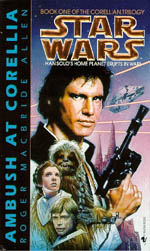
AMBUSH AT CORELLIA: D-
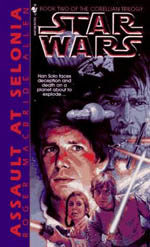
ASSAULT AT SELONIA: D-
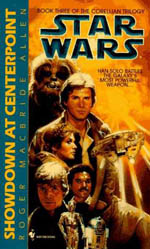
SHOWDOWN AT CENTERPOINT: D+
Roger Allen MacBride
Published: 1995
Publisher: Bantam Spectra
Cover Price: $6.99
ISBNs: 0-55-329803-8 / 0-55-329805-4 / 0-55-329806-2
Buy Now!