The Alexandrian

SEEN ON THE INTERNET: Someone plagiarized Jane Austen and then submitted the work to eighteen major publishers. This would be pretty stupid in its own right, but the bloke receives something of a reprieve because it was, in fact, a stunt. He typed out the manuscripts, using a pseudonym that cleverly alluded to Jane Austen’s early pen-name, and submitted them to see what kind of reaction he would get.

So why does this guy deserve a prominent spot on The List of Idiocy?

Because he actually thought that this would be some sort of meaningful demonstration of the difficulty of getting a novel published.

Wait. It gets better: He actually uses the boilerplate rejection letters he receives as “evidence” that the publishing industry wouldn’t publish a piece of classic literature if it arrived at their doorstep.

Think about it for a second: If you’re reading a manuscript (one of many dozens that you receive every day) and you quickly realize that what you’re reading is, in fact, the plagiarized opening chapter of a Jane Austen novel, would you bother writing out a lengthy response explaining that you would publish this novel if it were not, in fact, plagiarized? Probably not. You’re just going to grab your standard rejection letter, stuff it in this moronic plagiarist’s SASE, and stick it in your Outbox.

Or you’ll simply dump the whole package into your trash bin, which is what many of the publishers apparently did. (And, hilariously, this too is used as “evidence” that Jane Austen couldn’t get published today.)

The only thing this “experiment” manages to “prove” is that someone blatantly plagiarizing Jane Austen can’t get published today.

Now, if you want to talk about the possibility that short-sighted publishers are rejecting manuscripts which later go on to be huge successes with massive readerships… well, you don’t have to look too far. A sequel to The Hobbit was requested by the publisher, who then rejected The Lord of the Rings twelve years later (before a fortunate chain of events led to the book being published). Madeleine L’Engle’s Wrinkle in Time was rejected 26 times before it was published. More recently, J.K. Rowling’s Harry Potter and the Philosopher’s Stone was rejected by at least a dozen publishers before being purchased by Bloomsbury.

Is it possible that there are authors just as talented as Jane Austen who have never been published and whose work has been lost to the misty tides of history? Almost certainly. Has this somehow become more prevalent in recent years? Almost certainly not.

For example, let’s take Jane Austen herself: She originally sold Susan (the novel which would later become Northanger Abbey) to an extremely minor publisher in 1803, four years after it had been completed. This minor publisher never actually got around to publishing the book, however, and it was not until 1811 that Jane Austen’s first novel, Sense and Sensibility, was published… at her own expense.

That’s right, Jane Austen herself was originally published by the 19th century equivalent of a vanity press.

So even if we were to accept this idiot’s premise that submitting blatant plagiaries of Jane Austen’s work demonstrates anything at all about the likelihood of escaping the slush pile, the only thing he’s demonstrated is that absolutely nothing has changed in two hundred years. (At least, when it comes to editors being gifted with some unique insight into what will or won’t be embraced by the public.)

35W Bridge Collapse

August 2nd, 2007

As some of you may already be aware, the 35W Interstate bridge across the Mississippi in Minneapolis collapsed last night at around 6 o’clock p.m. I am posting this around 1 a.m. to let everyone know that I am safe, and — as far as I can tell — everyone I know in the area is safe. I have, however, been forced to turn off my phone, because I am exhausted and I must sleep. Thank you for your concern, however. And my own thoughts and best wishes lie with all those who are still awake tonight with doubt or fear or grief in their hearts.

The reason I’m so exhausted at the moment? We finished the tech period for John & Abigail today. With the exception of mending a few buttons on our costumes and tucking away a few other odds and ends, we are as ready as we’ll ever for our opening at 6 p.m., August 3rd at the Bryant-Lake Bowl Theater (810 West Lake Street). We’re essentially taking tomorrow off to give everyone involved a chance to recuperate and rest, so that we can explode onto the stage Friday night with the best play you’ll see at this year’s Minnesota Fringe Festival.

John and Abigail

Hustling Hustle

July 30th, 2007

I’m a bit bummed at the moment.

I recently discovered the BBC series Hustle. The show is about a group of professional con-men and every episode features a con in the style The Sting. As soon as I heard the concept, I knew this was a show I had to check out. And as soon as I saw the first episode I was completely hooked.

The show truly delivers on its promise: Every episode is a tightly-scripted and carefully-constructed piece that delivers the special magic of the long con. It really does feel as if you’re watching an episodic version of Ocean’s Eleven.

Adrian Lester, who plays the role of the mastermind and leader for the group, exudes the confidence, slickness, and sex appeal of a Brad Pitt or a Robert Redford. Robert Vaughn, who plays the wizened master, has the quiet mastery of a Paul Newman or George Clooney. The cons themselves are clever, elaborate, and masterfully executed. The entire show reeks of glamour and cleverness and sophistication.

But what really makes the show click is that the writers and directors clearly understand that, when you’re making a movie (or television series) about a long con, the first thing you must do is con the audience. The creators of Hustle are constantly trying to keep one step ahead of you, and it’s a real joy to try to keep one step ahead of them.

So why am I bummed?

I’ve just hit the fourth season of the series, and it all seems to be falling apart. Adrian Lester, for whatever reason, left the show. This has left the show without it’s strong center — it’s become Ocean’s Eleven without Danny Ocean. At the same time, the writing seems to have become sloppy, bloated, and ham-fisted. The cleverness and slickness is gone. Some of this may be intentional since, without Adrian Lester’s character, the team itself lacks that cleverness and slickness. But the result is simply not as satisfying.

And perhaps the creative team has simply used up its ideas. There are only so many ways in which the basic components of a con can be spun, after all, before you’re really just spinning your wheels. I was certainly seeing some weaknesses appearing even towards the end of the third season.

For example, one of the clever storytelling conceits the show employed in its very first episode was the freeze-frame: While the con is running, the action will suddenly enter a freeze frame — except for the grifters themselves, who will take the opportunity to turn to the camera and begin explaining the nature of the con. This was slick and clever and very well done. It has led to a general friendliness with the fourth wall in the series, in which the audience is drawn into the grifters’ inner circle through knowing looks, glances, double-takes, and the like.

But as the series has gone on, this use of the fourth wall has begun to be, in my opinion, abused. This unfortunate trend culminates late in the third season when the entire cast suddenly breaks into a full-fledged Bollywood musical number. They were, at the time, executing a con in which they attempted to convince a mark to invest in a Bollywood film (so there was some semblance of a connection). But, whatever the excuse may have been, the reality is that not only the con, but the characters and the dramatic reality of the sequence were all put on hold for a self-indulgent and utterly unnecessary extravagance.

So, in any case, I’m bummed because I have a strong feeling that this show has jumped the shark on me.

If it has, though, I’m going to keep my eye on the silver lining: I got eighteen really exceptional episodes of television in the show’s first three seasons (of six episodes each). And if that’s all I get, that’s more than most series can ever boast of.

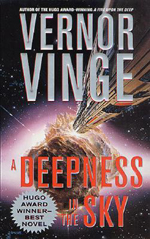
A Deepness in the Sky- Vernor VingeIn my previous reaction I described A Fire Upon the Deep as a masterpiece. This is undoubtedly true. If Vernor Vinge had never written another book, A Fire Upon the Deep would have stood as a monumental accomplishment, firmly cementing Vinge’s reputation as one of the best science fiction authors to ever practice the craft.

So it was even more impressive when A Deepness in the Sky, Vinge’s next book, was even better.

I first read A Fire Upon the Deep and A Deepness in the Sky back in 1999, shortly after A Deepness in the Sky was first published. Reading those two novels for the first time – back-to-back and in such close succession – was a one-two punch which I could only compare to reading, in my much younger days, Asimov’s I, Robot and Foundation Trilogy back-to-back. Or Clarke’s Rendezvous with Rama and Childhood’s End. It would go unmatched until several years later when I was awed by reading Bester’s The Stars My Destination and The Demolished Man for the first time.

Despite the fact that I’d read them before, I still found it hard to accept, as I finished A Fire Upon the Deep, that A Deepness in the Sky was truly as superior as I remembered it to be. But as I picked up the second book, which takes place during an earlier epoch of the Zones universe and serves as a very light prequel of sorts, I discovered to my delight that my memories were not false: Vinge actually managed to ascend even higher on the pinnacle of excellence.

On reflecting on these twin masterpieces, it’s interesting to note that both of them – and Marooned in Realtime immediately before them – feature truly original plots. Looking at Vinge’s earlier works you can find a cornucopia of originality, but the plots are structurally quite familiar: Tatja Grimm’s World is fundamentally a coming of age story. The Witling is fundamentally a great escape story serving as a vehicle for a Campbellian “let’s extrapolate a nifty idea” story. And so forth.

But while you can certainly draw parallels between other stories and various elements of A Fire Upon the Deep and A Deepness in the Sky (the former is hardly the only story to feature “rescue the kids” and “defeat the evil menace”), there are deep structural elements in both stories which are only possible because the unique elements of Vinge’s universe. In A Deepness in the Sky, for example, Pham’s lifelong dream and the faux-Singularity offered to him in the form of the Focused can be crudely compared to an Empire based on slavery, but the fundamental differences make a mockery of the premise.

(All those who find personal joy in stripping out every relevant and meaningful distinction within a story so that you can cram it into half a phrase and then claim that there are only thirty plots or seven plots or one plot in the world can calm down: I know you exist. Your obsession with dogmatizing a mildly interesting intellectual game that can occasionally serve as a useful tool is noted. I pity you in general. Let’s leave it at that.)

Moving beyond the freshness of the plot, I am also struck profoundly by the depth of the plot. Vinge creates an utterly unique setting, populates it with dozens of vividly drawn characters (both human and evocatively alien), and then paints his story on a canvas spread across half a dozen centuries – casting his net far into the past and cascading into the future. And perhaps the most remarkable achievement of it all is that Vinge manages to handle the incredibly complex edifice he has erected with such adroit skill that the reader is never left at a loss.

Once again, the familiar Vingean strengths can be found peppered throughout the story: Villains drawn with vivid and believable detail. Myriad casts of deeply drawn characters brought together through chance and fate to form a tale of epic proportions. Complete and detailed realizations of not only entire societies, but entire societies going through massive upheaval and change.

In fact, re-reading A Deepness in the Sky after reading Vinge’s other works was an interesting experience because I had seen Vinge’s earlier experiments with some of the themes and elements which can be found here: A deeper appreciation of the Singularity served to add greater resonance to the work. The society going through a technological revolution was touched on earlier in Tatja Grimm’s World, but is handled in a completely unique fashion here. And so forth.

I find this reaction has become something of a rambling discourse, and not an entirely satisfying one at that. So I will draw it to a close with these words: If you have not read A Deepness in the Sky, then you have almost certainly missed out on the finest science fiction novel of the past decade.

GRADE: A+

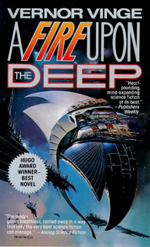
A Fire Upon the Deep - Vernor VingeThe first time I read A Fire Upon the Deep it expanded my mind: I was still a teeny-bopper and the concepts and ideas that Vinge was casually playing with were literally two or three steps beyond anything I had encountered before. For an intellectual junky like myself, the book was like a shot of adrenaline straight to the hippocampus.

In the years since then I’ve read more Vinge; I’ve read Iain Banks; I’ve dabbled with Reynolds; I’ve laid in some more background with Bester’s masterpieces and Brin’s Uplift…

So this time I was able to really savor what Vinge was offering here.

First, let me say this:

A Fire Upon the Deep is cool.

I mean, there’s just no other word for it. Even after fourteen years, with hundreds of other works drawing inspiration from it, A Fire Upon the Deep remains a truly awesome work. If your sensawunda isn’t being kicked into overdrive on nearly every other page, then I name you a jaded and tragically cynical soul.

Second, let me say this:

A Fire Upon the Deep is a testament to Vinge’s growing skill as a writer.

Let me give you an example: Early in the book, Vinge dumps a character into his story as a clueless newbie to the realities of his universe. This clueless fellow allows Vinge to seamlessly integrate the basic exposition of his setting into a series of “as you NEED to know Bob” speeches. He invests these expository lumps with higher meaning because of the immediate and touching impact their revelations have on the character’s emotions and sense of self. That’s pretty good: Smooth handling of exposition in an active and character-focused manner is one of the trickier elements of the science fiction writer’s craft. But what makes Vinge incessantly clever is that he then seamlessly transforms the character’s role within the narrative into a completely different form as soon as his original purpose has been used up.

These types of subtle, sophisticated storytelling techniques can be found throughout the entire book. A Fire Upon the Deep is a mammoth novel, but there’s not a wasted character or scene. Vinge demonstrates authoritatively that he has achieved a mastery of his craft, allowing his work to reach a whole new plateau.

Finally, let me say this:

A Fire Upon the Deep is a complex work.

Its plot stretches across multiple milieus and involves several distinct casts of characters. Its thematic mesh is expressed in varied and active ways. It’s an immensely satisfying work, while still leaving the reader yearning to see deeper into its hidden depths.

Another example: One of the most prevalent themes in Vinge’s work is the way in which technology impacts the life of the individual. He carries that theme further by looking at the way in which the changing lives of individuals reshape society, and then he loops it back around on itself to show how the reshaping of society also impacts the life of the individual.

In A Fire Upon the Deep, Vinge plays with this theme on multiple levels: He shows high technology thrust haphazardly upon a primitive society. He mirrors that theme by showing a transcendant technology thrust forcefully upon a society of high technology. Simultaneously, on the individual level, he is showing a primitive shaped by technology a thousand years ahead of our own thrust into a society of even higher technology. And then he mirrors that by showing the children of high technology thrust into the extremely primitive. Around the edges he shows societies yearning for ever greater technological glories, contrasted by entities raised to the level of godhood by their technology mucking about in the playgrounds of technological children.

And in conclusion let me say this:

It is nearly impossible to satisfactorily summarize the many and varied achievements of A Fire Upon the Deep. I have not even begun to discuss, for example, Vinge’s masterful creation of a half dozen or so alien species utterly inhuman in their countenance, utterly plausible in their nature, and utterly fascinating in their execution. And even that scarcely makes a meaningful touch on the tip of the iceberg.

Vinge’s accomplishments are so varied, in fact, that the worst criticism I have ever read of A Fire Upon the Deep is this: “I liked most of it, but there was this one part/setting/character that did nothing for me.” Vinge keeps so many balls in the air that it’s almost inevitable that some people will find a ball they didn’t like. But for the lucky multitude, the balls are all beautiful creations in their own right, and the juggling act only adds to their magnificence.

There are few artistic creations which truly earn the right to be called a masterpiece. A Fire Upon the Deep is one of them.

GRADE: A+

Archives

Recent Posts

Recent Comments

Copyright © The Alexandrian. All rights reserved.