
 Well, it took about five more hours than I really wanted it to, but I finally managed to wrestle DriveThru and Lulu into submission. It looks like they’ll behave themselves now as far as Mythos Audio Library: Call of Cthulhu is concerned. You can now purchase a version of the audio book in MP3 and listen to a sample.
Call of Cthulhu – On DriveThru and Lulu
September 8th, 2007
Mythos Audio Library: Call of Cthulhu
September 7th, 2007
After many travails, I have finally managed to get Mythos Audio Library: Call of Cthulhu published through CafePress as an audiobook on CD. I’m hoping to have MP3 files available for purchase shortly, but I’m running into delays trying to get the files uploaded to both DriveThru and Lulu. I’ll post an announcement here as soon as that happens.
The delay in getting the MP3 files up is also delaying my ability to get a direct download link to a sample of the audiobook. But if you click through to CafePress, they have several samples available for you to listen to.
THAT IS NOT DEAD WHICH CAN ETERNAL LIE,
AND WITH STRANGE AEONS EVEN DEATH MAY DIE…
On February 28th, 1925, a terrible cataclysm wracked the Pacific Ocean. On March 22nd of the same year, the world nearly came to an end.
But humanity lived through it all on a placid island of ignorance in the midst of black seas of infinity. And perhaps it was merciful that it should be so, for if those who had in their possession the disparate clues which might have pieced out the truth of it had ever had a chance to compare notes a true panic would have broken loose.
Such secrets should remain buried… and more than buried.
“In his house at R’lyeh dead Cthulhu waits dreaming.”
Buy CD – Buy MP3
72 minutes – Sample Audio
“Of such great powers or beings there may be conceivably a survival… a survival of a hugely remote period when… consciousness was manifested, perhaps, in shapes and forms long since withdrawn before the tide of advancing humanity… forms of which poetry and legend alone have caught a flying memory and called them gods, monsters, mythical beings of all sorts and kinds…”
– Algernon Blackwood
The Drugging of Our Children
August 29th, 2007
This is a documentary that you should see. That everyone should see.
I’ve been concerned for years by the apparent over-prescription of mood-altering drugs in our modern society. Watching just the first five minutes of this documentary has raised that from a mild concern to a serious concern. We are living in a society where entire families live in a drug-induced fiction; where sadness is combatted as if it were an abnormal lesion upon the brain; and children who don’t behave like miniature adults are sedated until they become good little citizens.
And why is this happening? Because we’re lazy. Because society wants us to be sheep. And because the drug companies benefit by creating life-long customers of their drugs.
It is easy to simply blame the parents here. But, increasingly, we’re seeing schools and government organizations working hand-in-hand to force unwilling parents to put their “disorderly” children onto drugs. (Is it truly coincidental that the number of children supposedly suffering from ADD/ADHD suddenly shot through the roof just as schools were given more money based on the number of ADD/ADHD students they had?)
But what is truly disturbing is that this Ritalin obsession is that it’s masking the actual source of the problem, rather than correcting it: Precocious children are bored in school; the solution is not to drug them, but to challenge them. Children are suffering from allergic reactions or lead poisoning or PCB exposure; the solution is to treat the actual medical condition, not drug them into submission. Children are over-stimulated by television or hyperactive on excess sugar. The list goes on and on.
Is there an underlying condition of ADD/ADHD that some exceptionally small percentage of our society suffers from and which can be successfully treated with Ritalin and similar drugs? Yes.
Is there an underlying condition of chemically-induced depression that some exceptionally small percentage of our society suffers from and which can be successfully treated with anti-depressants? Yes.
But 10% of boys from age 6 to 12 are now taking psychotropic medication. We, as a society, are becoming as warped as 19th-century China with its opiates. Our behavior is being shaped by drugs instead of brains. And if we allow this trend to continue, we will destroy ourselves.
What I’m Reading #51 – Rainbows End (Spoiler Commentary)
August 28th, 2007
To read a spoiler-free review of Rainbows End, click here.
For some spoiler-filled thoughts about the book, go ahead and read more…
What I’m Reading #51 – Rainbows End
August 28th, 2007
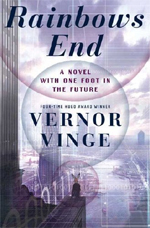 It seemed to me that Rainbows End was the perfect storm:
For starters, Vernor Vinge was an author who could truly boast that every single novel he’d ever written was better than the one he’d written before: The Witling was better than Grimm’s World; The Peace War was better than The Witling; Marooned in Realtime was better than The Peace War; A Fire Upon the Deep was better than Marooned in Realtime; and A Deepness in the Sky was better than A Fire Upon the Deep. If Rainbows End followed that pattern, it was going to be a tremendous book.
Rainbows End also saw Vinge returning to a fictional universe which had been the setting for two excellent short stories: “Fast Time at Fairmont High” and “Synthetic Serendipity”. An analogy could be drawn, I felt, between this relationship and the relationship between “The Blabber” and A Fire Upon the Deep. Both of these latter stories are set in in Vinge’s Zone of Thoughts universe, and “The Blabber” was the first peek we had into that universe. In that story, Vinge gave us a glimpse — from the edge of the Slow Zone — of what an amazing place the near-Singularity of the Beyond would be like. Frankly, when I first read “The Blabber” I didn’t think Vinge or anyone else could really deliver on that promise. But Vinge did. And A Fire Upon the Deep is one of the most amazing science fiction novels ever written.
“Fast Times at Fairmont High” excited me even more than “The Blabber”. Vinge was working his future history talents at their finest: He forwarded half a dozen different technical fields all at once and then started looking at how that would change us as a society and as individuals. His vision was compelling, startling, dynamic, and utterly believable. If those technologies become prevalent, society is going to look a lot like “Fast Times at Fairmont High” — you can already see the beginning of those trend lines forming in the high schools of today as the technology of today reshapes the contours of daily life. And those trend lines are even clearer today than they were in 2001 when he published the story.
So when I approached Rainbows End I was excited: Even if Vinge did nothing more than expand his previous treatment into a larger, more intricately woven plot it was going to be one of the most exciting science fiction novels I’ve read in the last decade. And if he followed his previous trends, I was fully prepared to be dazzled by his vision of the future
Finally, on a personal level, Rainbows End was being published just as I was tearing through Vinge’s entire corpus work of work: As you’ve seen in my recent reactions, I worked my way through his short stories and then tackled his novels one by one. It seemed as if I was working my way up a triumphant crescendo that would culminate in Vinge’s most recent and most brilliant work.
Unfortunately, I was to be disappointed in this.
To be clear, the book – considered in and of itself – is just fine. It’s a solid near-future techno-thriller. It’s very well executed, with some really interesting twists, and I give it a B+ with a solid recommendation to accompany it.
But I still can’t shake the feeling that, with Rainbows End, Vinge played chicken and he lost. He got into a staring contest… and he blinked. Rainbows End reads like a giant step backward from the vision he conjured forth in “Fast Times at Fairmont High”.
To take one example, in “Fast Times at Fairmont High”, Vinge looked at the ways in which augmented reality would fundamentally change social interaction. In Rainbows End , by contrast, there was essentially nothing that couldn’t be accomplished with a cellphone and text messaging. (The only exception I can think of is when a character virtually pops over to a beach in Indonesia … but once she’s there in virtual form, there’s nothing remarkable about the experience at all. It’s one step up from a webcam, but there’s nothing fundamentally transformative.)
There was, to put it more bluntly, more complexity of world-building in his short story than there was in his novel. And, ultimately, I consider that to be a colossal failure.
Vinge seems to have suffered a failure of imagination. And that’s not a flaw I ever thought I’d see in him.
GRADE: B+
For additional comments on Rainbows End, which include SPOILERS, click here.
Vernor Vinge
Published: 2006
Publisher: Tor
Cover Price: $7.99
ISBN: 0812536363
Buy Now!

Acting Resume
ROLEPLAYING GAMES Gamemastery 101
RPG Scenarios
RPG Cheat Sheets
RPG Miscellaneous
Dungeons & Dragons
Ptolus: Shadow of the Spire
Alexandrian Auxiliary
Check These Out
Essays
Other Games
Reviews
Shakespeare Sunday
Thoughts of the Day
Videos
Patrons
Open Game License




Archives
Recent Posts
- Prospero’s Dream: Master Rumor Table
- Updates from Patreon
- Pyramid Review – Demon City Shinjuku
- Pyramid Review – Diomin
- Chaos Lorebook – Book of the Elder Brood: Tilaxic
Recent Comments





Copyright © The Alexandrian. All rights reserved.