 If you’re unfamiliar with the concept of “decompressed storytelling” in comic books, here’s the short version: It’s a combination of reducing the number of words per panel, increasing the number of panels per moment, and (consequently) stretching a given amount of plot over a larger number of pages/issues. Its proponents describe it as “cinematic” and highlight the ability to savor particular moments and tweak comedic timing. Its detractors say that it’s just a way for writers to stretch out their plots and milk ’em for all they’re worth (to the point of not making them worth much of anything).
My personal opinion has generally been of the, “If it’s done well, it’s great. If it’s done poorly, it’s crap. Just like everything else.” school.
But what I’ve recently realized is that this trend toward decompressed storytelling at the micro-level in comic books has been accompanied by a trend towards drastic compression of storytelling at the macro-level of mainstream superhero comics.
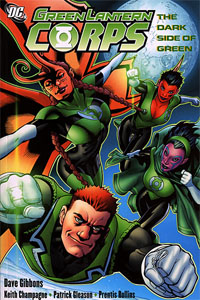
What I mean is the pace at which HUGE and DRAMATIC changes are brought down the pipeline. You can see this most dramatically in the milieu-shattering crossover events which are now essentially annual events at Marvel and DC, but you can find plenty of examples in individual titles, too. For example, when Geoff Johns rebooted the Green Lantern Corps he created a scenario which could have comfortably been used to tell dozens or hundreds of stories. Instead they told roughly 6 before launching into the next sequence of WE’RE CHANGING EVERYTHING.
The combination of (a) taking more time to tell a story while (b) having less time to tell a story is, in my opinion, increasingly disastrous.
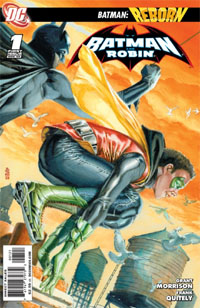 Where this is perhaps most deeply felt is the relationship between characters. Bruce Wayne starts dating Jezebel Jet and the relationship is supposed to be completely changing his life before it turns out that she’s secretly betraying him… but since she appears in maybe a hundred panels between the time she’s introduced and the time she’s revealed to be a traitor, it’s really hard to take any of it seriously. Hal Jordan is in a new relationship with a lady call-signed Cowgirl, but there’s a publishing deadline so there’s no time to actually show us that relationship. Dick Grayson and Damien are supposed to be forging a deep and meaningful bond in their new working relationship as Batman and Robin… but the status quo necessary for us to invest into that relationship never actually exists.
“Status quo.” A potentially deadly phrase. Am I saying I just want comics to enter into a form of stasis? Not at all. I want to see Bruce Wayne fall for Jezebel Jet. I want to see Hal Jordan try to rediscover what it means to be human with Jillian “Cowgirl” Pearlman. I want to watch the comradeship between Dick Grayson and Damien grow into a rich and rewarding partnership.
 But that’s not what I’m getting right now. What I’m getting right now is a sort of “highlight reel” of the actual story, followed abruptly by SOMETHING EPIC that CHANGES EVERYTHING.
The shallowness of what I’m experiencing in these (de)compressed books can be contrasted to three other recent comic-reading experiences I’ve had:
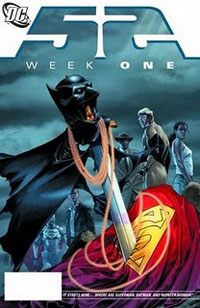
First, looking back at 52 I think one of the reasons I really enjoyed it was that the main characters seemed to get more time to just naturally reveal themselves over the course of the series than characters limited to monthly books do. Effectively, it was as if I was reading a comic from an alternate reality where the DC Universe had gone unplagued by a THIS CHANGES EVERYTHING event for more than four years. (Since the DC Universe has effectively been in a perpetual state of THIS CHANGES EVERYTHING for the better part of a decade, the contrast is huge.)
Second, I’ve been reading Walter Simonson’s mid-1980’s run on Thor. I’ve actually only gotten about six issues into it, but this is back in the “compressed” era of comic book storytelling and more shit can happen in 3 panels of this book than in entire issues of “decompressed” stories. The book is not entirely immune from character developments lacking justification (Sif falls for Beta Ray Bill without much in the way of narrative support to back it up), but I do note that the faster pace of events allows certain storytelling beats to be achieved effectively with fewer issues. (For example, Odin’s curse-gift to Beta Ray Bill comes after only knowing the character for a few issues… but you’ve spent so much narrative space with him that you’ve really come to know the character well and the curse-gift resonates beautifully as a result.)
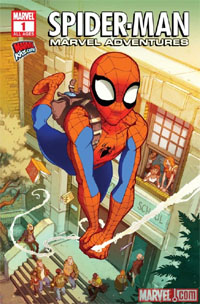 Third, Paul Tobin’s work on Spider-Man Adventures as collected in Thwip!, Peter Parker vs. the X-Men, Amazing, and Sensational. These stories conveniently exist in the “Tobin-verse” and are completely separate from mainstream Marvel continuity… which means they’re immune to the macro-compression of the mega-events. Although Tobin uses a more relaxed, decompressed pacing within each issue he’s never forced to wrap things up in time for the next corporate-enforced game-changer. The result is that characters are given the room to breathe and develop; relationships become invested with the sorts of detailed storytelling that make them come alive; and the whole series is simply a delight. They’re also the best Spider-Man stories I’ve read in years.
So what I’m saying here is not “decompression is bad”. I’m not even saying that massive continuity shifts and cross-title mega-events are bad. But I am saying that the two of them together — the (de)compressed pace of modern superhero comics — does not seem to be a healthy combination.

 In the Middle Ages, the wealthy were known to sponsor holy pilgrims. Like modern millionaires funding a NASCAR team, the sponsors would share in the reflected glory of the pilgrimage. Of course, as in all matters of salvation and piety, there were also deeper spiritual entanglements to consider in such things: Acting in their name and as their agents, the pilgrims would receive blessing not only for themselves but for the lords and ladies in whose name they journeyed.