The Alexandrian

Go to Part 1

Now that we’ve discussed incomplete game structures, let me go fully the wrong way about it and explain what I mean by a “complete game structure”.

Most importantly, what I do not mean by a complete game structure is that the players will never be able to take actions outside the structure. As I’ve been saying all along, roleplaying games are functionally open-ended: Unlike a boardgame or card game, players are always free to propose whatever course of action strikes their fancy.

Instead, what we’re talking about is a structure which can theoretically provide a complete experience. If the players choose to stick to a complete game structure, that structure will never deliver the game to a place where no structure exists.

Practical experience at the game table plays a role here, and I’m also expecting a dose of common sense: It’s possible to argue that Traveller presents a “complete game structure” as long as the PCs never leave their ships. But, of course, that’s not what actually happens at the game table, is it? What happens in actual practice is that the Traveller scenario structure delivers a ship to a starport, the PCs get off their ship, and… the scenario structure has delivered them to an unstructured place.

In practice, complete game structures require vertically integrated structures and closed resolution loops. They will also usually feature complete transitions from macro-level to micro-level game structures.

For example, consider the basic mystery scenario structure: You start in a location and you search for clues. The clues take you to another location, where you search for clues (which will, of course, take you to another location).

That’s a closed resolution loop: You can follow that structure forever.

Earlier, we talked about the smooth transition from dungeoncrawling to combat in D&D: You’re in a dungeon room, you pick an exit, and you go to another dungeon room (there’s your closed resolution loop). But in that room are a bunch of monsters, so you switch to the combat system (which is another closed resolution loop) until you defeat the monsters. Once the combat is finished, you swap back to the dungeoncrawl structure, pick an exit, and go to the next room (which might also have monsters in it, in which case you swap back into combat).

That’s a vertically integrated structure: The dungeoncrawl structure provides a specific trigger (“there are monsters here”) which transitions you into the combat structure; and the combat structure provides a specific trigger (“all the monsters are dead and the room is empty of interest”) which transitions you back into the dungeoncrawl structure.

(As a thought experiment, imagine that you were using a dungeoncrawl structure but you had no combat system. Can you see what happens when the dungeoncrawl delivers you to a room full of orcs? The structure is incomplete. Now, imagine that you’re using a dungeoncrawl structure but instead of a combat system the rules had a well-developed mechanical structure for resolving riddle contests. That’s a very different dungeon, isn’t it?)

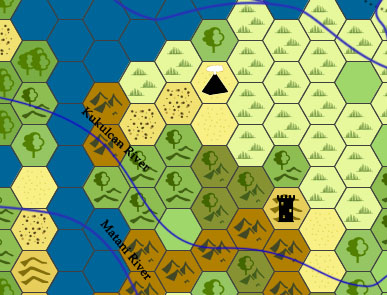
It’s also possible to extend the chain of macro-level to micro-level transitions. An easy demonstration of this is a hex keyed with a dungeon complex: The hexcrawl structure triggers the discovery of the dungeon; entering the dungeon transitions you to the dungeoncrawl structure; and meeting some monsters in the dungeon transitions you to the combat structure.

I occasionally think of this as an inverted pyramid, but it’s not necessarily a tidy one. (For example, hex keys can also easily trigger you straight into combat.)

The Inverted Pyramid of Hexcrawling

FEATURES OF A COMPLETE GAME STRUCTURE

Let’s take a moment to look at the basic features a complete game structure requires. By matter of necessity, these will be somewhat preliminary conclusions: There aren’t many complete game structures in roleplaying games, so the body of data is sparse.

First, each part of the game structure requires a clear and specific trigger. (For example, combat is triggered when someone wants to make an attack and initiative is rolled.) Vertically integrating your structure requires that the macro-structure will deliver the triggers necessary for the micro-structures. (For example, the dungeoncrawl structure delivers the trigger for combat when you enter a room filled with hostile monsters.)

Second, you need a default scenario hook. This is actually just the trigger for the macro-structure which contains the micro-structures and it doesn’t need to be terribly complex: For example, the default scenario hook for a dungeoncrawl is “the dungeon entrance is in front of you”.

Third, you need a default goal. This is what motivates the players to engage the scenario hook. For example, the PCs go into the dungeon (i.e., accept the hook presented by the dungeon entrance) because they want to find treasure.

(It should be noted that the default scenario hook and goal are often the first things to get swapped out when you’re adapting a game structure into actual play. For example, the PCs might be going into this dungeon – which is actually a fortress – because their friend has been kidnapped by the slavers inside.)

Fourth, you need a default action: Picking an exit in the dungeoncrawl; picking a direction in a hexcrawl; looking for clues in a mystery; attacking an enemy during combat; etc.

Fifth, taking the default action should return you (either directly or after a sequence of actions) to a point where you can take that default action again. This is the point where you close the resolution loop and complete the game structure.

EFFECTIVE GAME STRUCTURES

There are also a few things which aren’t necessarily required for a complete game structure, but which are probably a good idea.

First, the structure should be flexible. Flexibility for the players means the ability to make choices which are not constrained by the structure. Flexibility for the GM means the ability to include a broad and creative array of content into the “containers” of the structure.

(These constitute the “structure, not a straitjacket” and “flexibility within the form” principles we talked about before.)

Second, the default action should usually allow the players to make meaningful decisions. Roleplaying games are primarily about making choices and structures which don’t allow for those choices to be made will, in my opinion, struggle. Furthermore, a structure which doesn’t include points at which players are free to make decisions is probably going to strongly inhibit their opportunities to make choices which are not constrained by the structure (see above).

(As a counterexample, consider a hypothetical piratecrawl structure in which the players choose a direction to sail and then the GM randomly determines what type of ship they run into: This has a great deal of flexibility for the GM, since he’s basically free to include anything which fits into a ship-shaped container. But you’ll notice that the players’ decision of sailing direction is meaningless, which will result in less than satisfactory play.)

Third, assuming that we’re talking about RPGs and not STGs, the players’ decisions within the game structure should be associated and in-character.

(For pretty much all the same reasons that the mechanics of an RPG should be associated.)

Fourth, the reward structures of the game should probably be tied into the default actions and default goals of the game structure.

(The easy example here, as I’ve mentioned before, is D&D: The default dungeoncrawl / combat game structure rewards you with XP for the default action of fighting monsters and with GP (and XP) for the default goal of treasure-hunting.)

Fifth, the game structure should be fun. This, of course, can be a somewhat nebulous quality and will also vary from one group to the next. But the important point here is that a complete game structure will act as the foundation for your scenario or campaign: If that foundation is fun, then everything you and your players build on top of it will be fun. If it is simply workmanlike bookkeeping, on the other hand, you may still end up having fun if the stuff you build on top of it is awesome enough, but it’ll be less of a sure thing.

Sixth, the game structure should be easy to prep. Part of this is providing a clear structure for prep (and I think you’ll find that clearly defined game structures will simultaneously provide straight-forward guidance on what you need to prep). But it’s also about limiting the amount of prep necessary for play to begin. (If your structure requires the GM to prep 500 pages of material in order to use it, it’s not going to see a lot of use in the real world.) And all of this, of course, can be helped by giving the GM tools which assist with prep (like the old dungeon- and hex-stocking tables that used to be a mainstay of D&D).

I was also going to add “easy to run” to this list, but I suspect that this is a quality which actually arises naturally out of properly constructed game structures. But if you’re in need of a reminder, check out Part 8 of this series.

Go to Part 12: Using Scenario Structures

TravellerAs a brief tangent to our discussion of game structures, how could we go about plugging the “hole” in Traveller’s scenario structure?

Since Traveller’s starmaps are hex-based, we could start by rifling through the pockets of the hexcrawl and snagging the concept of “when the PCs enter the hex, trigger the hex’s keyed content”. But what we’ll quickly realize is that there’s a reason Traveller doesn’t do this already: Planets are really, really big.

If we think of a dungeon room or a wilderness hex as a “container” which holds keyed content, it’s pretty easy to recognize that a planet-sized container completely dwarfs the scale of any single encounter or location. Take an encounter and stick it in a dungeon room; it fills the room. Take the same encounter and put it in a wilderness hex; it gets a little bit lonely but there’s still enough to quench our thirst. Stick it on a planet, on the other hand, and the glass still looks completely empty.

And this isn’t just a matter of aesthetics. It impacts the GM’s ability to logically transition the scene: If the PCs are traveling through a wilderness, it’s relatively easy to find a transition from the macro-level of wilderness travel to the micro-level of the keyed encounter. You just say something like, “As you pass through the forest, you see a bunch of orcs.” But this method doesn’t work quite as well if the PCs are approaching a planet.

Perhaps more importantly, this also affects the ability for players to make meaningful decisions within the context of the scenario structure. If the GM of a hexcrawl says, “You see a castle perched upon a rocky crag of blackened stone.” The players can say, “Okay, that looks scary. I think we’ll just skirt it as far to the west as possible.” And they can do that. But if they were to say, in this hypothetical game structure for spacecrawling, “Okay, I don’t want to deal with this settlement of murderous cannibals. Let’s lift-off and land somewhere else on the planet.” Suddenly they’ve exited the purview of the scenario structure.

One logical leap from this conclusion is that we simply need to key more content to the planet. Maybe, for example, we could just map the entire planet and key it as a hexcrawl: Thus, just like a hexcrawl contains dungeoncrawls, our spacecrawl would contain hexcrawls.

But hexmapping and keying an entire planet in any sort of meaningful or interesting detail? That’s an absurd amount of work. It’s obviously completely impractical.

HAILING FREQUENCIES OPEN

So maybe, instead of that, we let our logic take us the other way. Maybe we accept our limitations and implement a structure where each planet is keyed with a “hail”: When an intrepid band of interstellar scouts enters orbit, they’ll receive the hail.

This basically handles the problem of scale by embracing the old pulp SF trope of “every planet is a village”. The result is less Traveller: Firefly and more Traveller: Star Trek. But as long as the players are onboard with the fact that they have to either engage with Oxymyx and Krako or bypass the planet (i.e., they can’t just decide to head over to the other side of the planet and talk to a different set of gangsters), you’ll probably be in pretty good shape.

Unfortunately, the structure starts to breakdown once you’re dealing with civilized planets (instead of exploration). But, of course, this is also true for traditional hexcrawls (which provide no guidance for PCs once they pass through the gates of Greyhawk).

ABOARD THE KING ARTHUR

Unsurprisingly, I’m not the first person to start thinking this way about Traveller. Back in 1981, FASA produced Action Aboard: Adventures on the King Richard. In addition to detailing the ISCV King Richard and providing two sample adventures, this module included a dozen or so “Outline Adventures”, all of which constitute primitive scenario structures into which any number of specific scenarios could be poured. For example, the Hijack:

Action Aboard: Adventures on the King RichardI. HIJACK

The forcible capture of the vessel and its contents may come from either inside or outside the ship.

A) Internal

A hijack from inside assumes that the hijackers and their equipment are all aboard at the beginning of the scenario.

1) Players as crew – the players may or may not be issued weapons from the ship’s locker, depending upon the level of surprise.

2) Players as passengers – The players will not be given weapons and, unless they have social standing A-F, they will be abandoned at any habitable planet (roll 1-4 on  one die) or shot, and/or dumped into a vacuum (roll 5 or 6 on one die). If they have high social ranking, they will be ransomed.

And so forth.

Primitive? Yes. Still incomplete? Sure. But you can see how this begins to provide a basic structure into which a few stats can be poured to give you something that can be used in play. In combination with the other “Outline Adventures”, Action Aboard begins to give you enough structure to run an entire campaign based around the voyages of the ISCV King Arthur.

http://en.wikipedia.org/wiki/A_Piece_of_the_Action_%28Star_Trek:_The_Original_Series%29WITHOUT

Go to Part 1

Consider, for a moment, the explicit game structure presented in the original Traveller.

(1)   Create a subsector. For this, the game gives guidelines for creating a starmap; populating that starmap with planets; determining the population, law level, and technological level of those planets; determining travel zones and trade routes; and so forth.

(2)   Own a starship. The game offers several options by which the PCs can own, lease, or otherwise operate a starship.

(3)   Interstellar movement. Providing mechanics for determining how far and how fast PCs can move between planetary systems.

(4)   Trade and revenue. Finally, explicit guidelines on how revenue can be earned by carrying cargo, passengers, and the like.

When you boil it down, this is Firefly: The Roleplaying Game.

Firefly as Marc Miller's Traveller

But what this scenario structure notably lacks is any support for play below the interplanetary level. Traveller recognizes this lack and works to patch the hole with the concept of the Patron:

The key to adventure in Traveller is the patron. When a band of adventurers meets an appropriate patron, they have a person who can give them direction in their activities, and who can reward them for success. The patron is the single most important NPC there can be. (Book 3: Worlds and Adventure)

Basically, the patron serves as a default method for delivering adventure seeds to the PCs. And Traveller integrates the patron into its larger game structure by triggering patrons through its random encounter system. (So, basically, every time the PCs fly into a starport there’s a chance they’ll be contacted by someone with a special job.)

Of course, this still leaves the vast gulf of what the game structure for the actual mission itself is. But it’s not as if Traveller is alone in having such gaps in its scenario structure. In fact, virtually all RPGs have such gaps. (And, at a micro-level, virtually all RPG mechanics constitute incomplete game structures, as our example of the Duchess of Canterlocke demonstrated.)

MECHANICS WITHOUT STRUCTURE

I’ve long maintained that RPGs naturally gravitate towards their mechanics. For example, when I added counter-intelligence mechanics to D&D, counter-intelligence suddenly became a significant part of my campaign. When I added usable encumbrance mechanics to my OD&D campaign, encumbrance-based gameplay immediately followed.

What’s even more true, however, is that RPG gameplay naturally gravitates towards structure. Because they’re open-ended, of course, RPGs are not bound to their structure (like a boardgame is) and good game structures in RPGs won’t act as straitjackets, but clear game structures nevertheless attract players and GMs alike.

Or, to put it another way: If you’re in a dungeon, at some point you’re almost certainly going to start dungeoncrawling.

An interesting corollary of this is that mechanics which aren’t (a) required by a well-defined game structure or (b) enhancing a well-defined game structure are often ignored.

As a result of this corollary, you’ll often find popular game systems ringed with a large number of rules which nobody uses. Many of these rules seem to accumulate from a vestigial urge for simulationism.

This is particularly true with specialized supplements. For example, the D20 market is crammed full with supplements that aimed to provide the “Definitive Guide to Ships”. The little simulationist urge says: “There are ships in fantasyland. So we must need rules for ships.”

But once you have them, what do you do with them?

A typical seafaring supplement, for example, usually included all kinds of rules for varying the speed at which a group traveled: The ship they’re using, wind speed, crew experience, navigation checks, weather conditions, tidal drifts, and so forth. But unless you’re using a scenario structure in which travel time matters – and in a modern era of railroaded scenarios, it generally doesn’t – all of these rules are pretty much irrelevant. Oh, having some guidelines for how long it takes to get from Point A to Point B is nice, but anything involving a lot of calculation which varies from one day to the next is basically useless chaff.

That’s how you get books full of feats that nobody takes, spells that are rarely cast, rules for ramming that nobody bothers with, and so forth. Without a supporting scenario structure, this stuff just flounders: It occasionally gets toyed with, but it rarely gets used.

But imagine for a moment that someone took the time to design a fully-integrated scenario structure for sea-based play that, for example, made playing a pirate or a privateer just as much fun as dungeoncrawling or solving mysteries. You could build entire campaigns around this structure, or just slot it in as appropriate. Maybe you could even go ahead and publish a full campaign that people can just pick up and play. Suddenly all those rules for handling crew morale and ship-to-ship combat are being used.

And if your new scenario structure were really successful, suddenly you’d have opened up a whole new market for support products.

THE VALUE OF PARTIAL STRUCTURES

The “gravitational effects” of clearly defined game structures may also help to explain why even partial scenario structures have often proved monstrously successful in the RPG industry.

For example, consider Shadowrun and Paranoia. Neither game features a comprehensive scenario structure, but they both have default methods for delivering scenario hooks which also tend to lend a common shape to their scenario concepts. And you can see evidence for the efficacy of these techniques in the number of “traitorous Mr. Johnson” stories you see from Shadowrun and the number of “briefing room horror stories” you see from Paranoia.

In fact, even partial scenario structures seem to be very effective at providing a commonality of experience which can draw a player base together into more meaningful communities. (This is particularly true for default scenario hooks.) Such communities provide a strong network effect which further strengthens the game.

This commonality of experience also makes it possible to produce supplements which target that common ground. 76 Patrons for Traveller or Mr. Johnson’s Little Black Book for Shadowrun are obvious examples given the context of our current discussion, but it’s particularly true when it comes to adventure modules: You can trivially produce an adventure module for D&D which could theoretically be plugged into 90% or more of the current campaigns being run in the system. On the other hand, it would be essentially impossible to produce a Heavy Gear module for which that would be true.

Of course, having a viable market for those kinds of adventure products makes it easier for a publisher to produce adventure products. And having adventure products available makes it easier for new GMs to start playing the game. Which further enhances the network externality of the game.

Go to Part 11: Complete Game Structures

Go to Part 1

As we wrap up our discussion of the hexcrawl game structure, I thought it might be interesting to take a few moments to revisit a few archaic game structures that have been abandoned by the hobby.

Wilderlands of High Fantasy - Necromancer GamesUntil recently, of course, the hexcrawl itself could be described as an archaic structure. By 1989 there were a few vestigial hex maps cropping up in products, but none of them were actually designed for hexcrawl play. The 2nd Edition of AD&D removed hexcrawling procedures from the rulebooks entirely. It wasn’t until Necromancer Games brought the Wilderlands back into print and Ben Robbins’ West Marches campaign went viral that people started to rediscover the lost art of the hexcrawl.

The original game structure for hexcrawls described in OD&D is actually quite distinct from the hexcrawl procedures I described earlier (which were largely innovated by Judges Guild and than adapted into AD&D). The bulk of wilderness adventures in OD&D focused on castles:

Castles: As stated, the ponds [on the Outdoor Survival gameboard] indicate Castles. The inhabitants of these strongholds are determined at random. Occupants of these castles will venture out if a party of adventurers passes nearby. If passing over the castle hex there is a 50% chance (die 1-3) that they will come out, if one hex away there is a 33-1/3% chance (die 1-2), and if two hexes away there is only a 16-2/3% chance (die 1). If the party is on the castle hex and hails the castle, the occupants will come forth if the party is not obviously very strong and warlike. Patriarchs are always Lawful, and Evil High Priests are always Chaotic. All other castle inhabitants will be either hostile to the adventurers (die 1-3) or neutral (4-6).

This is followed by a random table for determining the occupant of a castle and their guards/retainers. Then specific procedures for each type of inhabitant are provided: Fighters will “demand a jousting match with all passersby of like class”, Magic-Users will “send passerby after treasure by Geas if they are not hostile, with the Magic-User taking at least half of all treasure so gained”, Clerics will “require passersby to give a tithe (10%) of all their money and jewels” and so forth.

A vestigial remnant of this structure survived all the way into the Rule Cyclopedia (where tables were still being presented to randomly determine the attitude of castle occupants), but I’m guessing it’s been essentially nonexistent in actual play since 1980 at the latest. And, unlike JG-style hexcrawling, I doubt these “castle occupant rides forth” game structures are likely to enjoy a significant renaissance any time soon.

(Although, on the other hand, there are some potentially interesting things lurking in there: First, the implied setting – in which civilization is so sparsely populated that feudal lords will ride out to meet travelers who pass anywhere within a dozen leagues of their walls – is a fascinating one. Second, note how the structure provides default scenario hooks: Like the treasure maps seeded randomly into OD&D hordes, the quests proffered by feudal lords can spontaneously transform the aimless exploration of the hexcrawl into specific direction. But I digress.)

The other major procedure for wilderness play in OD&D was the idea of “clearing” a hex of monsters (which was a prerequisite for establishing a barony or stronghold):

The player/character moves a force to the hex, the referee rolls a die to determine if there is a monster encountered, and if there is one the player/character’s force must remove it. If no monster is encountered the hex is already cleared. Territory up to 20 miles distant from a stronghold may be kept clear of monsters once cleared – the inhabitation of the stronghold being considered as sufficient to maintain the monster-free status.

This basic structure was greatly expanded in AD&D. (For example, it added a precise system for determining when and how monsters return to an area, along with all kinds of modifiers – like placing skulls and carcasses as warning signs.) And then it, too, faded away.

Boot Hill (1st Edition) - Blume & GygaxIn fact, if you look back at the early history of gaming you’ll find these kinds of explicit game structures all over the place: The system for artifact use in Gamma World, the mercantile models of Traveller, the posse and tracking system for Boot Hill (which, in the 2nd Edition, could be tied into a larger competitive structure of lawmen vs. outlaws), the status points of En Garde, and so forth.

What you had, in short, were a bunch of wargamers who were very familiar with creating specific game structures heavily laden with the details of world simulation: After all, they’d been using precisely defined game structures to model historical battlefields for years. Roleplaying games, however, cracked open the game world, and the game designers were applying game structures to a much wider “world simulation”.

Over time, for a variety of reasons, these explicit game structures became more and more simulationist in nature. As the focus shifted from structures that were fun to play to structures that were accurate “models of the game world”, however, the structures became rather boring and (as the details of the simulation became fetishized) often too complicated to use in actual play to any great effect.

What followed next (and this all happened over the course of only a few short years) was almost inevitable: The explicit game structures became vestigial and then, with the advent of universal systems, disappeared from rulebooks entirely. (With the notable exception, of course, of highly structured combat systems.)

But — and this is important to understand! — the game structures didn’t actually disappear from gaming! They are, after all, essential for play. Instead, a handful of the most popular structures became treated as a sort of common knowledge: Everybody “knew them”, so game designers didn’t bother explaining them. (Although, in truth, very few people really thought about them at all.)

In short, the general sense that playing an RPG consisted of nothing more than “the players tell me what they want to do and then we resolve it” settled over the industry. But, as we’ve seen, this is completely false. What happened in actual practice was that GMs would use a random grab-bag of unexamined techniques that they had collected from people they played with, published adventures, and the occasional unique insight. And this, of course, resulted in a lot of frustrating play.

The lack of explicit game structures in the rulebooks – particularly explicit scenario structures – also helped to make roleplaying games a lot less accessible to people who hadn’t played them before.

Arkham Horror - Fantasy Flight GamesImagine that you took the rules for the boardgame Arkham Horror and you stripped out all the rules about explicit turn sequencing (i.e., the scenario structure of the game): Instead, you’re left with some rules about how to make skill checks; how far you can move around the board each turn; how to fight monsters; how you can move through gates and close them behind you; how you can fight Ancient Ones if they wake up; and so forth. But… what do you do with all those rules?

And that, in short, is what virtually every RPG for the past thirty years except for D&D has looked like to newcomers. (And it is somewhat worrisome to note that every iteration of Dungeons & Dragons since 1983 has reduced the amount of explicit game structure in the core rulebooks until, finally, 4th Edition eliminated dungeoncrawling procedures almost entirely.)

But as we look back at the archaic era of explicit game structures, I think there is something else of import to note that may help to explain why they went way: With the exception of the ‘crawls and a few others, almost all of these game structures were fundamentally incomplete.

Go to Part 10: Incomplete Game Structures

Tagline: Cheapass Games are cool. Bad Bond jokes are cool. This game is cool. You cool with that? Or do I have to kill you in a bizarre, drawn out fashion which will leave plenty of opportunities to escape?

Before I Kill You, Mister Bond... - Cheapass Games“Imagine, just once, luring the master spy into your evil lair and putting a bullet in his head. Imagine resisting the temptation to gloat over your prize, to tell him your secret plans, to let him escape certain death and blow up your lair in the process. Imagine winning.

Yeah, right.

Before I kill you, Mister Bond, I am going to tell you my entire life story, because I believe that you are the only man alive who would understand…”

I’ve been hearing good things about Cheapass Games for quite awhile now, but only last month did I finally find a store which sells them. Whoa boy, has it been worth the wait. Before I Kill You, Mister Bond… is one of the coolest games I’ve ever played, simply because its conceptual basis is so excellent for a game among friends.

For those who haven’t been let in on the secret yet, Cheapass Games produces games with ultra-original concepts and mechanics on very cheap materials so that they can keep the prices down. Do not confuse “cheap” with poor in quality, though. Before I Kill You, Mister Bond… comes in a handsomely designed white paper envelope which has been printed with a simple, but elegant cover. The instructions take up both sides of a single sheet of paper and there are two decks of cards – one printed on yellowish card stock, the other on greenish card stock. Everything is professionally put together and printed – it just doesn’t come in a cardboard box with laminated cards. Games, as their mission statement says, are fun because of how they’re designed – not because of the clever pieces of plastic with which they come. The pay-off to you is that Cheapass Games are just that – cheap as hell. If Before I Kill You, Mister Bond… was produced like most other games it would cost $20, not $5.

The concept of the game is simple: You take on the role of a super-villain in the classic James Bond tradition – massive secret bases, advanced technological wonders, and master plans… all ruined by our need to design Rube Goldberg machines to kill off the super-spy who comes after us. (Anyone who has seen Austin Powers knows the joke.)

The deck is made of three types of cards — lairs, spies, and doublers. The spies are a different color in order to make them easy to find… “just like in real life. ‘Hi! I’m Doctor Kelley! Any messages for me? Say, I’m a Spy!’” Each player is dealt a hand of cards and play begins in a clockwise manner.

Each turn consists of two phases. In the first phase you can play a single lair card from your own hand. Lair cards have different point values and the value of your lair is the point total of all the lair cards you have played. In the second phase you can play a spy card – either from your hand, anyone else’s hand, or from the top of the deck. You can also play a team of spies from your own hand (but not anyone else’s or the top of the deck). You play the spy cards against a particular lair – either your own, or someone else’s. Each spy has a point value (a team of spies has a point value equal to their total). If that value is larger than the lair then the spy infiltrates the lair and destroys it. If that value is smaller or equal to the value of the lair then the spy is captured.

Once a spy is captured the owner of the lair can either kill the spy or taunt the spy. If they kill the spy they score the number of points the spy is worth. The other option is to play a doubler card, which will double the value of the spy. Each doubler card is printed with a letter and has a matching doubler card with an identical letter somewhere else in the deck. If a doubler card is played it can be challenged by its matched pair. If this challenge takes place the spy escapes and the lair is destroyed.

So, overall, your goal is to build a lair with which to catch spies and score points. The first person to score 30 points wins the game.

The place where the game really shines, though, is the comedic interaction of the players. The cards are all jokes playing off the spy adventure/thriller genre (the Bond films, The Avengers, etc.). Most notable are the doubler cards – all of which are printed with cheezy super-villain taunts, such as: “I shall taunt you with this deadly weapon, blithely unaware that a child could have untied those ropes by now.” Having the players read these aloud in their best super-villain accents is truly the coolest part of the game.

There is, unfortunately, a massive problem with this game: It doesn’t work. I playtested it using a group of three and then a group of four players (it’s advertised as being for 2-6) and the dynamics and balance of the deck simply don’t work properly to let the rules fully realize themselves. Because spies can be played from essentially anywhere it is impossible to build up teams of spies, because any attempt to do so will invariably have someone else use your spies against you or for themselves. Lairs are difficult to get established (because they are easy to destroy), but once they are established they are almost impossible to destroy because you can’t build up teams of spies. Because there are an equal number of lairs, spies, and doublers in the deck, invariably by the time any sort of serious spy-catching is going on (because the lairs take so long to build up to a point where they can capture spies) everyone has built up a huge reserve of doubler cards – making it infeasible to play any of them (because someone else invariably has the matching card).

In the end these flaws meant that all the games we played (and we played nearly a dozen) went down the exact same route: Most lairs were wiped out repeatedly until one person got a lair large enough so that it couldn’t destroyed. That person then won the game. Very few doublers were ever played, because whenever they were it only resulted in the person’s lair being wiped out.

The rules themselves, IMO, work, but the deck of cards simply isn’t properly balanced. Plus more cards overall would have been nice because the phrases on these got tired pretty quick – and its the panache and cleverness of those phrases which are the primary strength of this game.

Nonetheless, this is a pretty classy game. At $5 it ain’t a bad buy, particularly since you can get quite a few laughs out of it.

Style: 5
Substance: 3

Writers: James Ernest
Publisher: Cheapass Games
Price: $4.95
Page Count: n/a
ISBN: n/a

Originally Posted: 1999/04/13

This is a game I enjoyed playing for about 3 weeks. Then I wrote a review about how much I liked it. Then I never played it again. Games that are fun only because the content on the cards is amusing simply don’t last. (See, also, Munchkin Quest.)

Also: 14 years later, the idea of needing to wait for a game until “finally finding a store that sells them” is simply adorable.

If you’re interested in checking this game out, you should be aware that Cheapass Games got hit with a cease-and-desist order in 2000. The game is now marketed as James Ernest’s Totally Renamed Spy Game.

For an explanation of where these reviews came from and why you can no longer find them at RPGNet, click here.

Archives

Recent Posts

Recent Comments

Copyright © The Alexandrian. All rights reserved.