
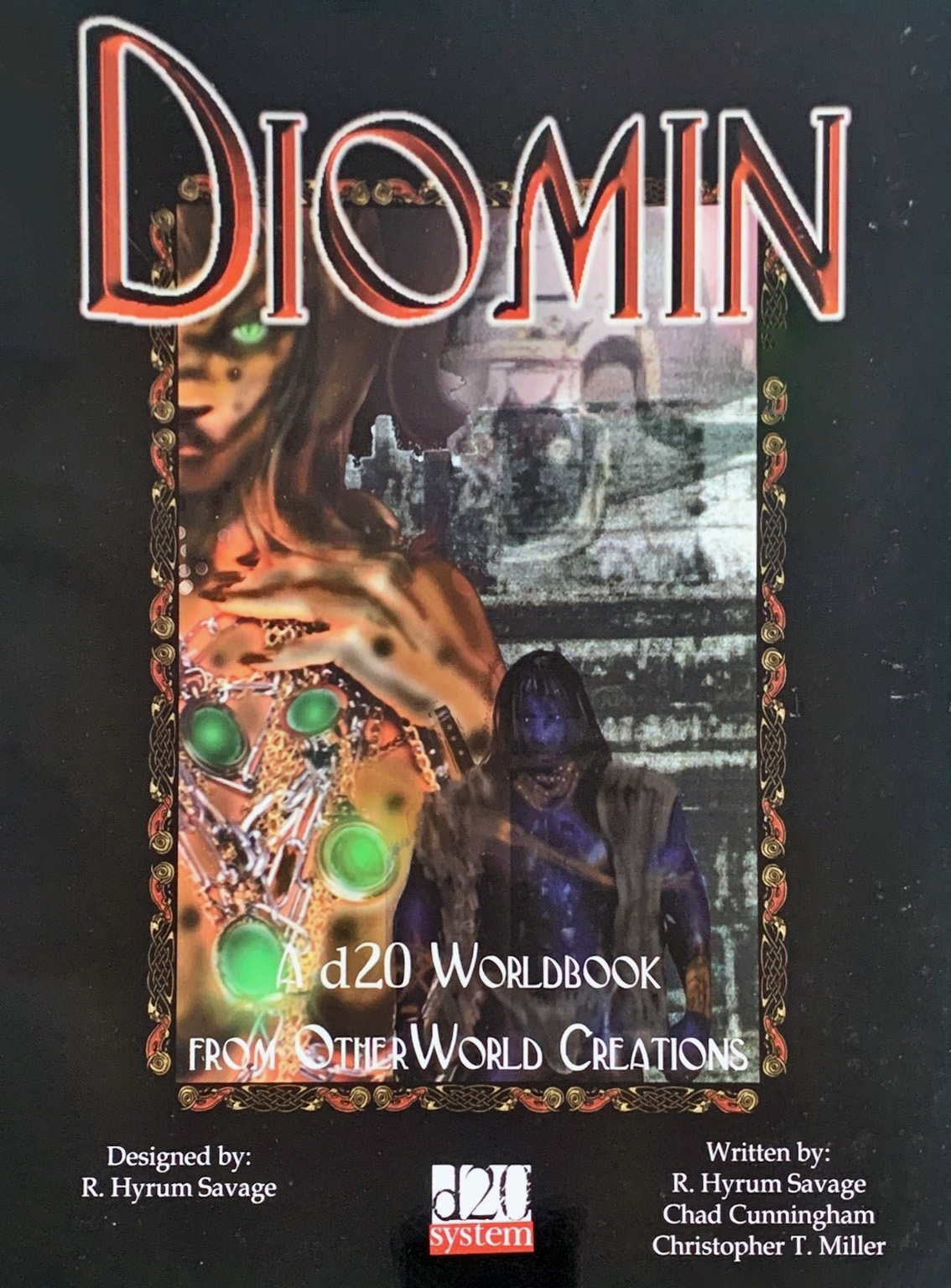
The artwork ranges from mediocre to terrible. The pages seem to overflow with wasted white space. There’s a lack of depth to the material. They neglected to put a price on the cover. The soy-based ink their printer used smears at the slightest provocation, leaving your fingers an inky mess. The prose occasionally slips from one tense to another – the bane of the amateur. The maps are of poor quality and reproduced in a manner which makes them nearly impossible to read. The tagline of the game is a needless, second rate rip-off of Talislanta.
It is a litany of faults which first assaults your senses as you take a look at Diomin – but if you let them cloud our judgment, you’ll be missing out on some of the golden material which is hiding underneath its somewhat rough exterior.
So, grit your teeth just a little bit, and come along with me into the world of Diomin…
COSMOLOGY
Diomin opens with a discussion of the cosmology and primal, mythological history of the book. At first glance you may feel your jaw starting to tighten even more, but I suggest you unclench: Although it firmly maintains the feel of a traditional fantasy pantheon, there’s some fascinating material here.
Basically, the creation mythos of Diomin works like this: The One looked out upon the Void and felt alone. And so he created the world, and peopled it with servants who would accompany him. The gods lived with the One in the Divine Realm. But, of course, not all would go well with his creations: Some of them discovered another realm, the Spirit Realm, and sought to understand its secrets. After long debate, the One finally yielded to their wishes and created a passage between the Divine and Spirit Realms: The Physical or Mortal Realm. What they discovered is that a spirit contains tremendous power – and some of them became addicted to that power, and consumed souls whole to grasp it. With inevitability, wars followed.
All of this gives rise to a really great pantheon: The Warriors of the Light serve the One. The Lords of Darkness serve Cedron, the Liberator. And the Children of the Vineyard serve none but themselves. Each god has a vibrant existence, with a fully developed role and presence within the greater cosmology.
What makes this work is the successful wedding of two worlds: Savage has taken the mythology surrounding Christianity, given it a couple of unique twists, and then jacked up the pantheist elements by several notches. The result is a tapestry providing a rich setting from which to build a world.
RACES
When the conflict between the Divine Children had come to an end, the Lords of Darkness withdrew beneath the earth with those who had followed them, while the Warriors of the Light stayed to tend their flock of mortal followers. In both cases, the care of the gods (whether nefarious or beneficent) reshaped some of the mortal stock into new forms.
The Arak were the original race of Diomin and the Mortal Realm. They are tall and blue-skinned, with red eyes and black hair. They are a proud, barbaric people (very Howard-esque) who look down upon the “Seconds.” Five of the Arak clans remain intact, the rest were changed by the gods:
The Gnolaum were taken to the lands of the East, where they learned strange mystic arts which extended the span of their lives and turned them into a fair and beautiful people. When their race became corrupted, those who remained loyal to the Warriors of the Light were forced to flee back across the sea to Diomin.
There are two human races on Diomin: The Tirasim and the Zeredites – their history is locked together.
Finally, there are the Gadianti – strange, cat-like creatures who were corrupted by the Lords of Darkness and now are the bane of all civilized existence.
In recent years another race has appeared, apparently not of Arak stock – although their true origins remain unknown: The Hearthrom are living statues.
What’s really nice about this is that Diomin manages to capture the feel of the traditional/Tolkienesque fantasy races used by D&D and its brethren (elves, dwarves, and halflings) without actually using those races (or pale rip-offs of them). This is a major strength for the product (which is, unfortunately, buried somewhat behind the lame derivative of Talislanta’s “Still no elves” in Diomin’s backcover text of “Elves? We don’t need no stinkin’ elves…” and “Who needs elves?”).
Indeed, it can be said that the races are the showcase on which the value of this product rests (with some major assists from the cosmology and a minor assist from the classes): They are presented with a wealth of detail, and are easily appreciated as fully developed cultures.
An unfortunate fault in an otherwise excellent section is the lack of the coverage of the half-Arak races (which are explicitly mentioned in the text) in the rules, and the lack of coverage for any of the other possible racial combinations.
CLASSES
Diomin performs some simple modifications on a couple of classes to give them a unique flavor and presence within the game world – and it works quite well. It also introduces a new class, the Shaman, which works with spirits – this is also well done.
A SECOND LITANY
It is rather unfortunate that a product which is labeled a Worldbook is, essentially, completely lacking in actual world information: Geography is not detailed. Nations are not detailed. Cities are not detailed. These are all left ciphers upon the nearly illegible maps located at the back of the book. In a book with a low page count, massive sidebars, and a layout which promiscuously wastes space as if it were going of fashion this is simply inexcusable.
For example, in one of the most insulting bits, the solar-based calendars which are used by most of the races on Diomin is explained in one sidebar. At the end of the explanation, we are told that the Arak use a lunar-based calendar. This lunar-based calendar is not described in the text – despite the fact that if you move your eyes from the page on which the solar-based calendar is detailed across to the facing page, you see a gaping, empty sidebar which, of course, could have been filled with just that detail.
Furthermore, the maps themselves – from what can be made out on them – are far too simplistic: Even if this world had been described, it would not be as impressive as the stuff from which it was getting made. The Arak have a nation. The two human races each have a nation. The Gnolaum have a nation. The Gadianti have a nation. And the Hearthrom have a nation. And the world itself is incredibly tiny: Although the maps lack a legend, you can extrapolate from a travel time given in the text and reach the conclusion that no point in the world is more than ten days distant from any other point.
And never, ever describe something in a fantasy world by saying “it’s just like the FBI” – especially when you’re wrong, and it’s not “just like the FBI.”
As I noted, all of this would be more forgivable except for the fact that the product also wastes space: Not just in layout, but in content decisions. How did the authors convince themselves that they didn’t need to include a single monster (once you’ve eliminated elves and dwarves, why would you bring in orcs and goblins?), but did need to include a 30+ page adventure in a 112 page book? An adventure which is nothing more than a “hired in a bar” yawner? An adventure which uses seven pages for random encounter tables? (Random encounter tables, note, which a more sensible lay-out could have gotten onto a single page.)
I just don’t get it.
IN CONCLUSION…
As I mentioned above, there are three areas where Diomin shines: The cosmology (primal myth and gods); the races; and the information regarding classes.
I suspect that, if it had been included, the bestiary would have been equally impressive. And it was possible that, despite the simplistic maps, the world itself could have had potential. Tragically, we don’t know if this is true or not.
However, I will give this cautious recommendation: The tool-set found in Diomin is extremely rich, and could easily serve as the foundation of a truly excellent, and uniquely different, fantasy world. But Diomin itself misses the target substantially, and squanders its potential.
This doesn’t mean, however, that you must squander it. Or waste it. Although the cover charge is a bit steep here, I would say that it wouldn’t necessarily be a bad idea to pick up Diomin and then using the building blocks it presents to build your own fantasy world. Or just use it to construct a “land beyond the seas” for your existing fantasy world – a region with unique flavor, utterly different than the realms with which your players are already familiar.
Give it some thought.
Writers: R. Hyrum Savage, Chad Cunningham, Christopher T. Miller
Publisher: OtherWorld Creations
Price: $19.95
Page Count: 112
ISBN: 0-9705312-0-6
Product Code: OWC1001
This review was originally written for Pyramid Magazine back in 2000, but was never published. Unlike similar reviews, however, I apparently never found a new home for this one and it has instead lurked unread and unloved on my hard drive for the past quarter century.
It’s interesting reading my critiques of the Diomin‘s shortcomings. They’re certainly true, but overall I’ve generally had a fond impression of the book whenever I’ve noticed it on my shelf. On the other hand, I’ve also never actually used it for anything. For better or worse, there’s always been a faint whiff of Fantasy Heartbreaker around Diomin for me. (But that idea of using it as a “land beyond the seas” is really intriguing.)









This review didn’t get a “Grade: “?
I’m genuinely intrigued on what it’s earned.