A classic fantasy world, Hârn continues to distinguish itself as a setting of unique detail, depth, and excellence.
Review Originally Published October 9th, 2001
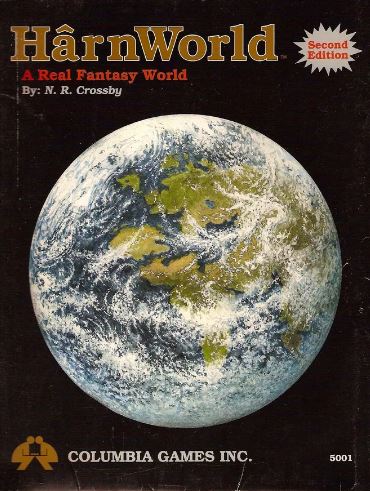
Hârn is a fantasy world created by N.R. Crossby and first published in 1983 by Columbia Games. In 1990, a second edition of HârnWorld (which is being reviewed here) was released, including:
HârnWorld: A 64-page booklet – including the articles Hârn, Kethira, and Lythia — serving as a general introduction to the campaign setting.
Harndex: The “Master Index for Hârn”, an 80-page booklet serving as the specific source material for the campaign setting. (Although referred to as an “index”, it is probably easier to describe it as an “abridged” encyclopedia. Entries are arranged alphabetically, with short articles discussing each entry.)
Map: A full-color poster map of the campaign setting.
Since then, Hârn has been supported with a variety of supplements (all of which are kept in print by Columbia) and its own rule system (HarnMaster, also currently in its second edition). In general, however, the source material is kept separate from the rules.
The Hârn product line, as a whole, is organized into a series of modular articles. For example, as mentioned above, the HârnWorld booklet which comes as part of the second addition HârnWorld product is actually comprised of three articles: Hârn (describing the island of Hârn), Kethira (the world on which Hârn is located), and Lythia (the continent which Hârn is part of).
Each of these articles has its pages numbered individually, and are specifically designed so that you can cut the book apart and separate the articles from one another and place them in a binder. As you purchase other Hârn products (which contain their own articles) you can organize the articles in any order you want (or pull specific articles to take with you to a particular game session). The concept/conceit is that each of these articles is part of an ever-expanding Encyclopedia Hârnica, with each GM assembling their own Encyclopedia as they assemble official material and create their own material over time. I don’t know that I’ll ever take advantage of this design myself, but it’s a nice option to have available.
SETTING DETAILS
Hârn approaches fantasy with a light touch. For example: Humans, elves, dwarves, and orcs are the only significant races to be found here. Other intelligent races do exist, including the Ivashu (a sterile race of diverse magical creatures who are perpetually created anew by the god Ilvir from the limited number of souls available to him) and the mere-dragons (a distant cousin of the true dragons) – but their rarity gives them a special significance. Hârn succeeds at making the magical elements of its fantasy effective and special because those elements are rare, not despite it.
Hârn itself is a large island, just northwest of the continent Lythia on the world of Kethira. As the name on the front cover would suggest, Hârn itself is the primary center of focus for HârnWorld — although Lythia also receives enough attention that you can easily use it as part of your campaign without too many problems (although I, for one, would really like to see additional support material released for the non-Hârn areas of the world). The other two continents on Kethira are briefly described in a couple of paragraphs each.
One of the first things I do when looking at a new campaign setting is to look at the map. Not only does a good map give you insight into what type of world you’re looking at, it can also serve as a sort of alternative “Table of Contents” for the setting – providing a structure by which you can understand the campaign material in context. Although this is generally a good piece of advice, I found it to be literally true in the case of HârnWorld — the various maps found in the product, essentially, serve as the Table of Contents for the various indexes via which the bulk of information is conveyed. In other words, you look at a map, see something you want to know more about, and then look it up in the appropriate index and cross-reference from there.
What immediately caught my attention about the poster map of Hârn is that, unlike the usual fantasy campaign map, this one did not feature continuous strings of nations from one end of the map to another. What I discovered was that there were only nine civilized states on the island of Hârn, with vast swaths of territory between them being settled only be eighteen barbarian “nations” (read: largely nomadic, decentralized tribes).
This does two things: First, it helps carry Hârn away from the pseudo-Renaissance period which haunts so many fantasy worlds (historically Hârn is similar to Britain somewhere between the 9th and 14th centuries – although several unique cultures also exist). Secondly, it establishes a large frontier in which adventuring can take place.
In this same vein, Harn’s history is an alternation between sumptuous detail (dating back to roughly the first appearance of humans on the island) and ancient mystery (everything before that). This not only gives you a plethora of solid roots in which to plant your stories; it also gives you a plethora of mysteries with which to spice your campaign. Best of both worlds.
The major highlights:
The Feudal Kingdoms. Most of the human kingdoms on Hârn are feudal in the most classical sense of the term. This includes Kanday and Rethem in the east; as well as Chybisa and Kaldor in the west. As noted above, these kingdoms are strongly reminiscent of 9th- to 14th-century Britain. One of Harn’s primary strengths is the realism with which these feudal societies are imbued – both in terms of their present day composition, and the history which believably leads to their composition. There is a truly organic feeling to the world, insofar as its current state of existence seems to flow naturally and believably from past events. Hârn’s history may not be the most dramatic fantasy history you will ever read; but, in my opinion, it is possessed of incredible power because it rings with such incredible truth.
Azadmere. The last dwarven kingdom. There’s really not much more which can be said here.
Evael. The last remnant of the elven kingdom which once covered all of Hârn. Finally unable to withstand the human migrations from Lythia approximately fourteen centuries ago, the elves renounced claim to Harnic sovereignty and retired to the Shavan Forest – where they have remained ever since. (Both the elves and the dwarves are, essentially, dying cultures. There is definitely a sense of influence from Tolkien’s Lord of the Rings, insofar as both of these races seem poised on the edge of being wiped from the face of history by the growing strength of humanity.)
Orbaal. Orbaal was founded by the Ivinians, more recent human invaders from Lythia. The Ivinians are essentially a Norse culture, and I see strong parallels between Orbaal and the Norse invasion of Britain.
Melderyn. Another human realm, but one with strong mystical overtones. It exists primarily in a smaller island just southeast of Hârn itself – but its influence and domain extends onto the main island as well. It is rumored that Melderyn’s civilization is a descendant of the ancient civilizations which populated the world in long-forgotten days.
STRENGTHS
Hârn’s primary claim to fame it’s meticulous detail – particularly in the area of culture, society, and history. It has a truly medieval feel which is absent from every other fantasy RPG setting I’ve seen on the market.
Indeed, Hârn’s attention to detail is scrupulous enough that HârnWorld actually ends up distinguishing itself as an excellent reference for medieval societies – regardless of whether you use Hârn as your campaign setting or not. If you’re not familiar with true feudalism, Hârn will open your eyes to a wealth of information.
WEAKNESSES
The first thing you’ll notice about Hârn is the bland production values which run through the product line. Essentially, the “look and feel” of HârnWorld and its supplements was set back in 1983 – and nothing has changed much since then. It’s clear that an emphasis is being placed on information over the presentation of that information. (The exception to this is the full-color poster map. That’s gorgeous. Easily one of the most beautiful fantasy maps ever produced.)
Note, however, that “bland production values” does not mean “poor production values”. The paper is stiff and durable. The editing is faultless. The layout is clean and easily comprehensible. This is a product designed to be used.
Another problem I had with HârnWorld was that, despite the generally exemplary organization of information, the wealth of detail combined with the disjointed nature of the articles means that – eventually – some information just plain ends up getting lost. For example, it took me quite a while to figure out where to look for the calendar/timekeeping information.
HârnWorld’s largest pitfall, however, is this: Sometimes the real world parallels become just a little too… parallel. In general, the historical parallels Hârn chooses to draw do exactly what Crossby says they should be doing: Giving the audience a point of reference so that they can draw on historical resources in expanding and detailing the campaign setting.
But occasionally the line gets crossed and Hârn ends up looking like 7th Sea: A pseudo-clone of the real world, lacking both the significance of reality and the joy of creativity. The worst of both worlds.
Fortunately, this problem seems to be contained mostly to the distant lands of Lythia (I noticed it particularly in the Ivinian culture) – while Hârn itself manages to maintain the best of both worlds (offering the familiarity of real-world analogues; while still sustaining a creative freshness).
CONCLUSION
The world of Hârn is a classic campaign setting, which has built its reputation through nearly two decades of consistency and a scrupulous commitment to quality and detail. It succeeds at giving you a depth and reality which is rarely matched.
At the same time, Hârn delivers because it succeeds at offering something different and unique from the rest of the market – while still being almost definitionally “traditional fantasy”. Here you will find your fantasy favorites (dwarven kingdoms, elven forests, ancient ruins, strange magic, kings, princesses, knights, and adventure) – but you’ll find them in a distinctly different flavor of world. Ironically, Hârn finds this “distinctly different flavor of world” by adhering closely to the real world – simply choosing to embrace the medieval roots so many fantasy settings claim (while, in actuality, treading around in a pseudo-Renaissance).
In short: Hârn is excellent.
Style: 3
Substance: 5
Author: N.R. Crossby, Tom Dalgliesh, and Edwin King
Additional Contributions: Brad Carter, Brian Clemens, Rob Duff, Mike Dwyer, John Frazer, Doug Gillanders, John Greer, Stephen Hinchcliffe, David Kowan, Sharon MacLeod, Simon Matthews, Brad Murray, Gene Siegal, and Garry Steinhilber
Publisher: Columbia Games, Inc.
Line: Hârn
Price: $29.98
Product Code: 5001
Pages: 134
ADDITIONAL HARN REVIEWS
HârnWorld: Azadmere
HârnWorld: Kiraz
For an explanation of where these reviews came from and why you can no longer find them at RPGNet, click here.









How different is 2nd edition Harnworld from the currently available 40th Anniversary edition?